

Introduction to Seal Carving (Practical)
This time, we will introduce the actual carving process using a seal knife (intō). For preparations before seal engraving, please read this article.
How to Hold the Seal Knife
Just like with a brush, there are proper ways to hold a seal knife. Let’s check them.
Tankō-hō (Single Hook Method)
Hold it with the thumb and index finger.
Sōkō-hō (Double Hook Method)
Hold it with the thumb, index finger, and middle finger.
How to Use the Seal Knife
Next is how to use the seal knife, which refers to how to move the blade. This is also called "untō" (blade movement).
Pull Cut
Carve from the back toward the front.
Push Cut
Carve from the front toward the back. Also called "thrust cut".
For beginners, we recommend using softer stones that contain clay. However, when using the pull cut, there is a risk of the blade slipping suddenly and causing injury. Therefore, it is safer to carve using the push cut along with a seal clamp.
In addition, the type of blade movement differs depending on the style of engraving, so here is an overview:
- Hakubun (Negative Engraving): Carve while placing the blade on the right side of the line.
- Shubun (Positive Engraving): Carve while placing the blade on the left side of the line.
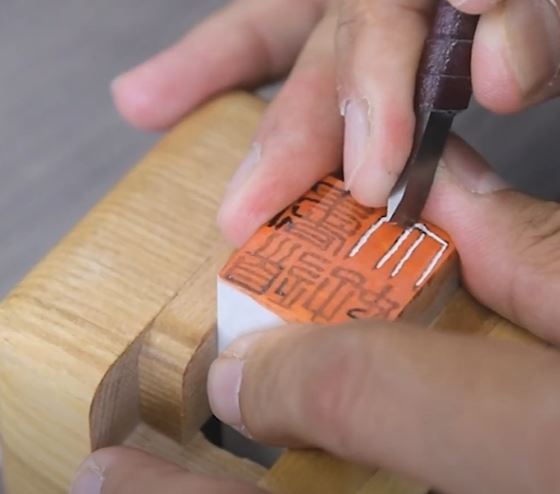
Finishing Work
Hotō (Touch-up Carving)
After carving, press the seal and check the imprint, then make corrections if necessary.
Gekihen
Intentionally carving chips to create the effect of an aged or weathered seal.
Stamping
The paper used for seal impressions (insen) is very fine-textured. By rubbing the paper surface to flatten the fibers, stamping errors can be reduced. For more information about stamping, please also refer to the link below.
How to Use the Seal Ruler (Inku)
The tools used this time are as follows:
Seal Stone: Balin Stone, 2.5cm square, height 5.0cm
Ink: Unfinished Ink, Itsutsu-Maru Bansei Ink, 1.0-chō size, Made in Japan
Cinnabar Ink: Seal Cinnabar, Red, approx. 6g, Made in Japan
Inkstone: Rammon Double-Sided Seal Engraving Inkstone
Seal Paste: Shanghai Xiling Seal Paste “Birei” 1/2 ryō pack
Seal Clamp: Wooden Karin, Screw Type [Made in Japan] *Large size used in the video (now discontinued)
Water Sandpaper: #600 (N), 1 sheet
Transfer Paper: Seal Engraving Transfer Ganpi Paper, 40 sheets
Seal Ruler (Inku): Wooden/Black, T-shape
Seal Cushion: Suminbo 10.3×13.5cm
Click here for the video introduction
Seal engraving can be enjoyed as a creative activity anywhere, so we encourage you to give it a try!