

Collection: Shakyo Paper (Paper for Sutra Copying)
SHAKYOYOSHI
Shakyo Paper for Calming the Mind Through Heart Sutra Transcription
Our shakyo (sutra copying) papers are designed for copying the entire sutra with ease and focus. Most come with ruled lines so you can write every character in order and maintain good balance.
The most commonly used transcription paper is for the Heart Sutra (Hannya Shingyo), which consists of 276 characters and is ideal for daily practice.
Types of Shakyo (Sutra Copying) Paper
Shakyo papers come in many styles: with or without ruled lines, template types, and even elegant fan-shaped designs.
For beginners or those who lack confidence, we recommend ruled shakyo paper.
Printed guide lines make it easier to keep characters straight, evenly spaced, and visually balanced.
Template types allow you to place a sample sheet underneath and trace the characters, which is especially suitable for first-time practitioners.
Once you become more comfortable, try unruled paper or fan-shaped shakyo paper for a more advanced and expressive experience.
Fan-shaped paper, with radiating lines, can be a little challenging, but it has a unique and beautiful presence when finished.
There are also special navy or indigo papers designed to be used with gold or silver ink (instead of black ink), creating a striking contrast.
Even when copying the same sutra, the finished work changes dramatically depending on the paper you choose, which is part of the joy of shakyo. A carefully written transcription becomes a truly special piece.
Once completed, consider framing your work and displaying it as a reminder of your practice.
How to Choose Shakyo (Transcription) Paper
If you wish to continue sutra copying at home after an experience at a temple, all you need is template shakyo paper and a brush pen.
It is best to choose paper that matches your writing instrument.
If you use a brush or brush pen, select Torinoko paper or Kana paper, which are resistant to bleeding and suitable for writing many small characters.
Because you will write a large number of characters in a limited space, excessive bleeding makes it difficult to keep the text legible and beautiful.
For your first attempts, ruled shakyo paper is strongly recommended.
Template types are also convenient for beginners—you can trace by placing the sample under the paper, or place it beside you as a reference while you copy.
It is said that continuing shakyo regularly is important. We offer a wide range of affordable transcription papers, so please choose the type that best suits your pace and lifestyle.
The Ultimate Shakyo: Gold-Character Transcription
While it is common to copy sutras with black ink on white paper, transcribing on navy or indigo paper with gold or silver ink is called “Gold-Character Transcription” and is regarded as the highest and most formal style.
When gold or silver characters shine against a deep, dark background, they create a gorgeous yet solemn impression. To express gold or silver vividly, pigment-based metallic inks are used. Gold-character transcription is held in special esteem because of its dignity and visual impact.
Shakyo (Transcription) Paper Column Transcription Paper Column
Shakyo has been loved since ancient times and continues to this day. It is also highly valued as an accessible way to learn calligraphy techniques while calming the mind.
Sutra copying is an act of carefully writing down the Buddha’s teachings, and various customs and practices related to shakyo have been handed down in different forms.
Below are some key points to keep in mind when practicing shakyo at home.
Which Side of the Transcription Paper Is the Front?
Transcription paper is printed in the correct orientation, and the top and bottom margins of the ruled frame are intentionally different.
Following traditional practice that shows respect for the sutra, the narrower margin represents the top (“Heaven”), and the wider margin represents the bottom (“Earth”).
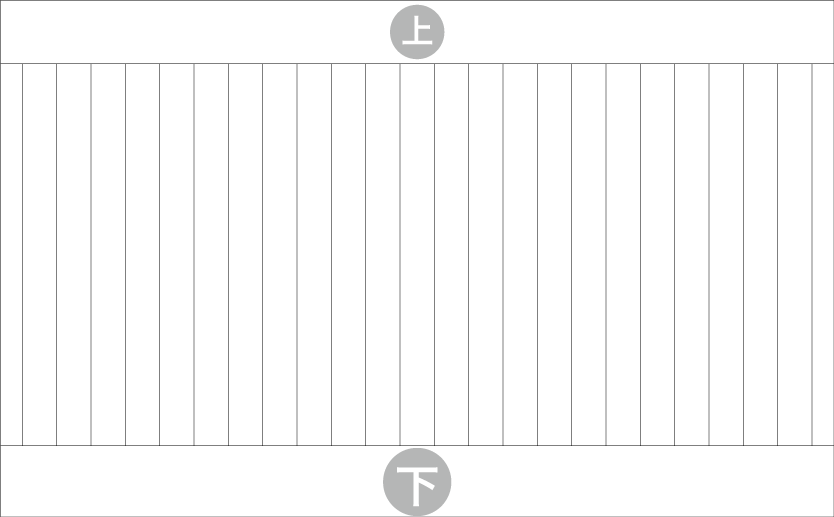
Transcription Guide
Here is one example of a basic procedure for shakyo (sutra copying).
1. Sit in a formal position, correct your posture, and regulate your breathing. (If you wish, light incense, place your palms together, and bow.)
2. Prepare a water dropper and inkstone, and quietly grind the ink on the inkstone while calming your mind.
3. Once enough ink is prepared, place the transcription paper on a mat, secure it with paperweights, and place the sample sutra on the left side. (For beginners, it is recommended to place the paper over the sample and trace the characters.)
4. After placing your palms together and bowing, recite the Heart Sutra.
5. Begin writing from the title. During transcription, focus wholeheartedly on writing, form each character carefully, and avoid unnecessary corrections or hesitation.
*About the prayer text: If your purpose is solely copying the sutra, a prayer text is not required.
Prayer text examples:
For the repose of the deceased (including posthumous Buddhist names), enlightenment, gratitude, wishes, etc.
Examples:
Eternal memorial service for the ancestors of the ○○ family, Mr./Ms. ○○
Attaining enlightenment, bringing good fortune
Family safety
Academic success
Skill improvement
Fulfillment of heartfelt wishes
World peace
Good health, etc.
6. Once you finish writing, place your palms together and chant a verse of “Universal Merit.”
What is “Universal Merit”?
It means, “May the virtue gained from this practice spread universally to all people, so that both we and all living beings may attain enlightenment together.”
It may also be chanted after offering your work at a Buddhist altar. Because “universal” implies everywhere, it can be used at any time and in any place.
7. Finally, tidy your desk and tools to complete the practice.
How to Write Your Name and Seal on Transcriptions
When transcribing sutras, do not use stage names or nicknames; write your real name and, if desired, stamp a seal with words such as “Respectfully Transcribed” or “Respectfully Written.” There are various opinions about the type of seal, and there are no strict rules. However, it is common to use a seal carved with a Buddhist name in white relief. If you prefer not to stamp a seal, it is not mandatory.
Important Points When Practicing Shakyo
A sutra transcribed with sincerity should be treated with respect, just like a Buddhist statue. While practicing, relax your body, keep a natural and comfortable posture, and avoid tensing your shoulders.
If you sit on a chair, do not sit too far forward or backward—keep your back straight without leaning heavily against the backrest.
As a guideline, it is recommended to complete one Heart Sutra within about one hour.
How to Properly Handle Completed or Incorrect Transcriptions
Over the years, you may accumulate many sutra copies. They should be treated with care and never casually discarded. Even practice sheets or those containing mistakes should not be thrown away, as each character is believed to embody the presence of the Buddha.
Store them respectfully, for example near a Buddhist altar. Once you have gathered enough, place your palms together, bow, and then burn them. After burning, bow again, sprinkle water over the ashes, and bury them in the ground. Other generally accepted methods of disposal include the following:
Method 1: Offer to Your Family Temple
Offer the sutra copies to your family temple. If mailing them, fold them neatly or place them in a tube and send them with care.
Method 2: Dedication at Sacred Sites
When visiting sacred sites such as the Shikoku 88-temple pilgrimage or Kannon pilgrimage routes, you can dedicate your copied sutras at designated locations, deepening your spiritual connection.
Method 3: Display Around You
It is said that keeping sutras nearby brings the protection of Buddhas and Bodhisattvas.
It is also wonderful to display them casually in your home or living room as a gentle reminder of your practice.
-
Shakyナ・Paper Ryナ行hi Gold Ruled (No Copybook)
Regular price ¥2,240 JPYRegular price¥3,200 JPYSale price ¥2,240 JPYSale -
Ganpi Purple-Navy Paper, Hansetsu
Regular price ¥2,940 JPYRegular price¥4,200 JPYSale price ¥2,940 JPYSale -
Shakyナ・Paper (No Copybook)
Regular price ¥960 JPYRegular price¥1,200 JPYSale price ¥960 JPYSale -
Shakyナ・Paper Set (with Copybook)
Regular price ¥960 JPYRegular price¥1,200 JPYSale price ¥960 JPYSale -
Shakyō Paper Creative Kozo Gold Ruled (No Copybook)
Regular price ¥2,240 JPYRegular price¥3,200 JPYSale price ¥2,240 JPYSale -
Shakyō Paper Creative Navy Gold Ruled, 10 Sheets
Regular price ¥2,240 JPYRegular price¥3,200 JPYSale price ¥2,240 JPYSale -
Shakyō Paper “Kotobuki Shakyō” (with Copybook), 30 Sheets
Regular price ¥1,680 JPYRegular price¥2,400 JPYSale price ¥1,680 JPYSale -
Shakyō Paper Pure Mino Ganpi “Kannon” (with Copybook), Furukawa Paper Works
Regular price ¥1,050 JPYRegular price¥1,500 JPYSale price ¥1,050 JPYSale -
Mini Shakyō Paper (with Copybook), 20 Sheets
Regular price ¥490 JPYRegular price¥700 JPYSale price ¥490 JPYSale


