

Collection: Japanese Folding Fan (Sensu)
Traditional Japanese Folding Fans Representing Japanese Culture
Add Calligraphy or Artwork to Create Your Own Original Fan
In Japan, folding fans have long been a familiar part of daily life and culture.
Even today, they are used to create a cooling breeze during hot summers.
More than a practical tool, a folding fan can become a personal artwork by adding your favorite calligraphy or illustrations.
A plain fan is beautiful on its own, but adding your own writing or drawings transforms it into a unique, original piece.
Why not enjoy creating something truly personal by expressing your favorite words or designs?
The Unique Appeal of Calligraphy on Folding Fans
When writing characters or drawing images on a folding fan, open it fully on a desk and gently hold it in place while working.
Ink may blur slightly along the folds, but this natural variation adds movement and character to the finished piece.
Once completed, your fan can be displayed as an artwork and enjoyed as part of your interior décor.
Women’s and Men’s Folding Fans
Folding fans are traditionally categorized into women’s and men’s sizes.
Women’s fans typically measure about 6 sun 5 bu (approximately 20 cm), while men’s fans measure about 7 sun 5 bu (approximately 23 cm).
Women’s fans are slightly smaller, creating a graceful impression, while men’s fans emphasize a bold, stylish appearance.
Choosing the right size enhances the overall visual balance when holding the fan.
Tea Ceremony Fans for Practice
Tea ceremony fans are essential tools for tea practice and formal training.
During greetings, placing the fan in front of oneself symbolizes respect and establishes a courteous boundary between people.
Fan ColumnHUDE Colum
Parts of a Folding Fan
Names of the Fan Parts
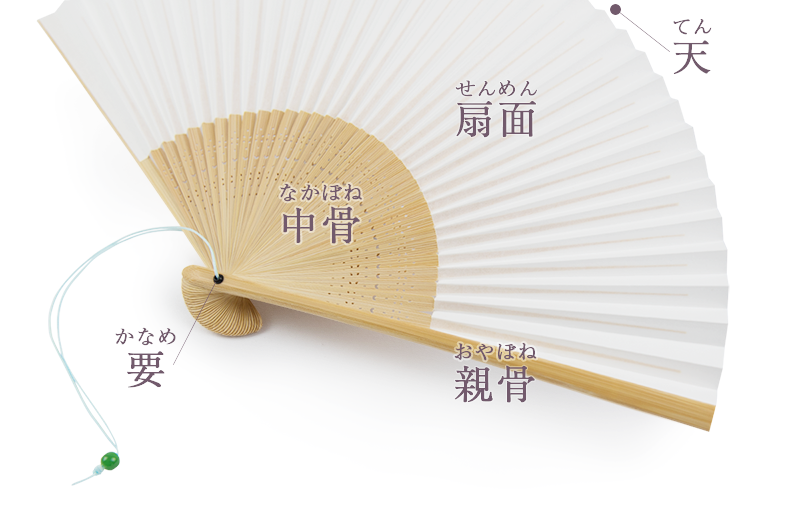
Each component of a folding fan has its own name.
Interestingly, the Japanese phrase “kanjin kaname,” meaning “the crucial point,” originates from the fan’s pivot.
・Ten (Top) — the upper edge of the fan surface.
・Senmen (Fan surface) — the paper or fabric area of the fan.
・Nakabone (Middle ribs) — the inner ribs, sometimes decorated with intricate openwork designs.
・Oyabone (Main ribs) — the thick outer ribs visible when the fan is folded.
・Kaname (Pivot) — the point that holds all ribs together and allows the fan to open and close.
The History of Folding Fans
Nara Period – The Birth of Folding Fans in Japan
A folding fan consists of multiple slender bamboo or wooden ribs fastened at one end, with paper or fabric attached to allow opening and folding.
While commonly used for cooling, folding fans are believed to have existed as early as the Nara period.
Early fans, known as hiōgi, were made from thin wooden boards and later became part of aristocratic attire during the Heian period.
Over time, fans evolved into decorative objects featuring refined colors and paintings, while remaining deeply rooted in Japanese culture.
Folding Fans as Symbols of Celebration
When opened, the fan spreads outward, symbolizing growth and good fortune.
For this reason, fans have long been associated with celebrations and auspicious occasions.
They are widely used in traditional performing arts such as Noh, Kyogen, Kabuki, Nihon Buyo, and Rakugo.
Beyond their cooling function, folding fans represent Japanese aesthetics and remain an indispensable cultural item.
-
Women窶冱 Fan Slim Ribs Brown
Regular price ¥490 JPYRegular price¥700 JPYSale price ¥490 JPYSale -
 Sale
SaleWhite Fan (Large)
Regular price ¥560 JPYRegular price¥800 JPYSale price ¥560 JPYSale -
 Sale
SaleWhite Fan (Medium)
Regular price ¥490 JPYRegular price¥700 JPYSale price ¥490 JPYSale -
Women窶冱 Fan Flat Ribs Brown with Tassel
Regular price ¥700 JPYRegular price¥1,000 JPYSale price ¥700 JPYSale -
Men窶冱 Fan Flat Ribs Brown with Tassel
Regular price ¥770 JPYRegular price¥1,100 JPYSale price ¥770 JPYSale -
Women窶冱 Fan Flat Ribs White with Tassel
Regular price ¥700 JPYRegular price¥1,000 JPYSale price ¥700 JPYSale


