

Shodo Daisuki Episode 29
Shodo Daisuki Episode 29
Definitive Guide! How to Handle Hanging Scrolls!【Calligraphy】
Shodo Daisuki – Episode 029
Are you feeling unsure about how to hang or store a hanging scroll?
This time, we’re bringing you a full, in-depth guide on how to handle hanging scrolls!
Shodo Daisuki Episode 29: Video Overview
In this video, Mr. Shimauchi explains in detail the proper way to handle hanging scrolls (kakejiku).
He emphasizes the importance of incorporating hanging scrolls into everyday life. Many people tend to be more cautious than necessary when it comes to hanging scrolls, but he explains that once you know the correct handling methods, they can be enjoyed easily.
The main purpose of the video is to spread a culture in which viewers display hanging scrolls in daily life, enriching their hearts by changing them to suit the seasons and their personal tastes.
Mr. Shimauchi suggests enjoying hanging scrolls casually—just as you would decorate with flowers.
The lecture begins with how to hang a scroll, including the importance of adjusting it to an appropriate height, differences in eye level when viewing while seated versus standing, and a demonstration of how to hang a scroll using a tool called a “yahazu.”
He also introduces how to use pins to prevent the scroll from falling due to wind or children’s movements.
Next, he provides a detailed explanation of how to roll and store a hanging scroll.
He demonstrates specific steps such as not rolling too tightly to prevent rolling creases, how to use protective paper, and the correct way to thread the hanging cord (makio).
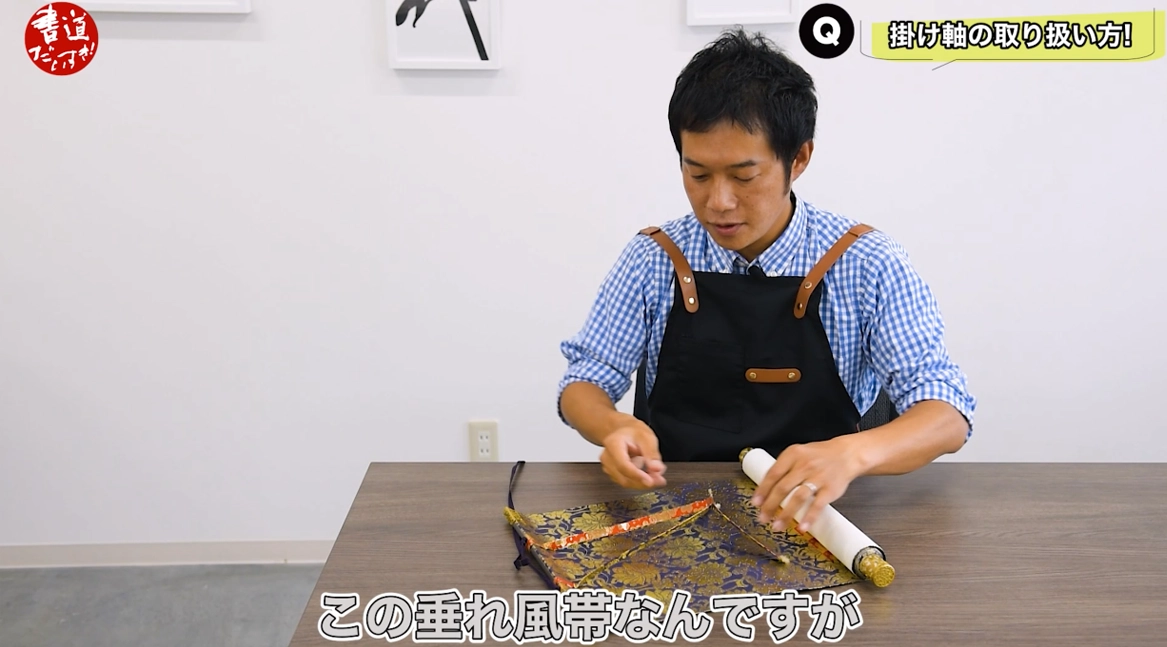
He also explains special points of caution for folding and storing scrolls that have hanging fūtai (tare-fūtai).
For storage, he covers key points for long-term preservation, such as proper use of a kiri-wood box, how to adjust the pillow blocks (makuragi), and how to choose insect repellent.
He also stresses the importance of airing the scroll (“mushiboshi”) once or twice a year—especially on clear days in spring and autumn.
Finally, he explains how to use scroll weights (fūchin) and important precautions, and also mentions that the appearance can change depending on the mounting style of the scroll.
Through this video, Mr. Shimauchi strongly encourages viewers to feel closer to hanging scrolls and incorporate them into everyday life.

YouTube Shodo Daisuki Episode 29
Shimauchi 00:00
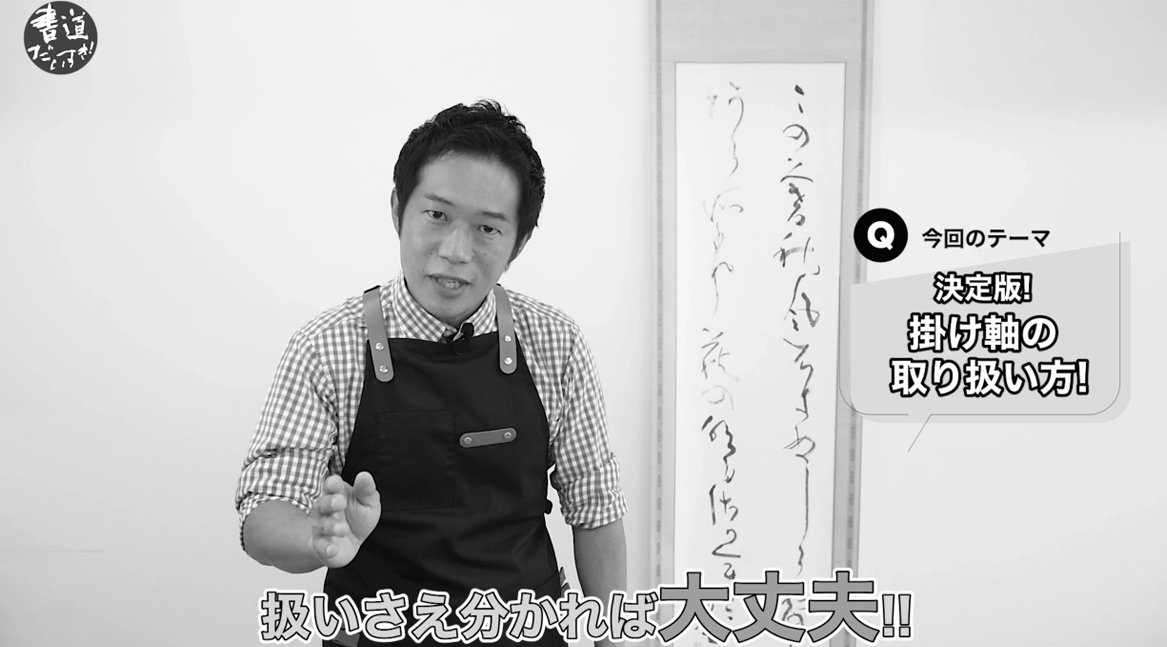
As long as you understand how to handle it, you’ll be fine. Pass this cord underneath.
Now the cord is threaded neatly. The thickness is different, you know.
Well, yes—hi, this is Shimauchi from “Shodo Daisuki.”
Today’s theme is: exactly this—how to handle a hanging scroll.
Shimauchi 00:25
This hanging scroll is actually a work Shimauchi wrote a few years ago—I’ve forgotten how old I was at the time.
When you hear “hanging scroll,” what kind of image comes to mind?
Maybe—yeah—something displayed big and bold in the tokonoma at your grandparents’ home.
Shimauchi 00:40
Or maybe as interior décor in a stylish room.
But still, it’s most commonly seen at exhibition venues, right?
Hanging scrolls are mainly viewed at exhibitions. But when everyone prepares them at the venue, you know—
Shimauchi 00:55
people get quite cautious when touching a hanging scroll.
“No, no—hanging scrolls are scary, scary, scary—what if something happens?”—that’s how it feels.
But actually, you don’t need to be that cautious. As long as you know how to handle it, you’ll be fine.
Shimauchi 01:10
What I want to share is this: you all decorate your room with flowers as part of daily life, right?
Beautiful flowers—and you change them and enjoy them, don’t you?
I want you to bring hanging scrolls into everyday life in the same way—hang them, and enjoy changing them—
Shimauchi 01:28
I think that can enrich your heart.
So, I’d like to share this video in hopes it helps you do that. Please stay with me until the end.
On this channel, I’ll keep introducing more and more things related to writing—not limited to calligraphy—so please subscribe and give a high rating.
Shimauchi 01:42
Thank you very much in advance.
Alright—let’s begin with how to hang a scroll.
First, about the height at which to hang it—this is important.
At an exhibition venue, the wall is equipped for it, so—
Shimauchi 01:59
you can adjust freely using wires. It’s truly convenient.
But if you’re displaying it at home, adjusting the height becomes crucial.
Once you decide where to hang it, using a pin—or something like this, called a “jizai,”
Shimauchi 02:14
which lets you adjust the height—can be very handy.
Originally, hanging scrolls are meant to be viewed while seated, so generally they’re displayed slightly above seated eye level.
But depending on where you display it, it may not be a place you view while seated—so in that case, of course, matching it to standing eye level becomes important.
Shimauchi 02:48
Alright—before hanging it, you need to unroll the scroll.
If the scroll has been rolled properly, you can simply pull the rolled part and the scroll should unroll neatly.
Here we go—pull the roll. There we go.
Shimauchi 03:07
Then, like this—okay. Now you can open it up.
Next, adjust the height and decide the hook position.
But when that hook is high up, a tool comes in handy—this is called a “yahazu.”
It’s hard to express in kanji, but you use this yahazu to hang the scroll.
Shimauchi 03:24
The tip of the yahazu is cleverly made.
There’s a notch here, so you set this part—right here—into the notch like this.
Shimauchi 03:40
Set it firmly, firmly on top.
Now it’s locked in tightly, so it won’t move.
Then you lift it like this—about this position—and it can reach quite a high place.
Shimauchi 03:55
And then you hang it—that’s the first step.
At that point, keep your hand supporting it. Don’t let it slide down all at once.
The key is to hang it securely first. It doesn’t happen often, but—
Shimauchi 04:10
hanging scrolls are meant to be appreciated in a calm, quiet setting, but at exhibition venues, wind can sometimes affect them.
And besides wind, if small children run by, the scroll can really sway.
Shimauchi 04:26
And in that moment, it can even fall.
In fact, Shimauchi’s work earlier fell perfectly when a child ran past, and it ended up with a crease.
So yes, that can happen—
Shimauchi 04:39
so at exhibitions, using pins like this to secure it keeps the scroll stable and fixed. Please remember that.
Next, how to carefully store a scroll after displaying it.
Now, I removed the scroll from the hook using the yahazu again.
Shimauchi 05:00
Since I’m alone, my hands are full, so I can’t roll it up like this, right?
So first, lower the scroll. Please be careful here.
Lower it slowly and carefully. Okay, now it’s down in this position.
Then set the yahazu aside—
Shimauchi 05:20
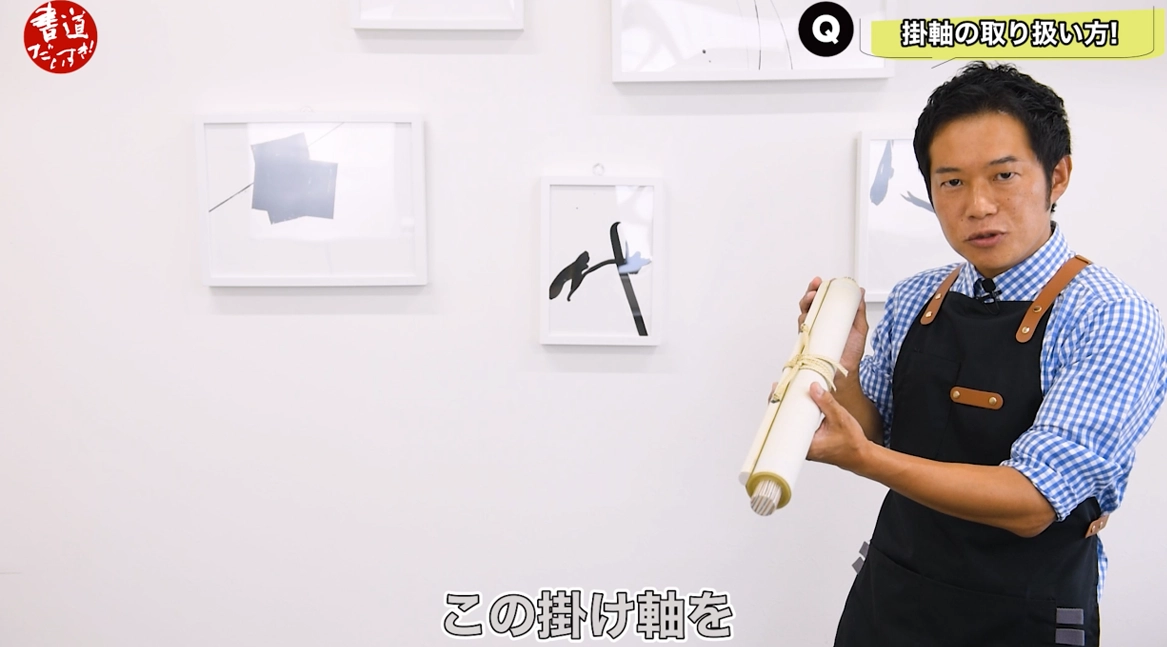
hold the scroll ends, and roll it up like this.
First, how much force should you use when rolling? If you roll lightly like this, it becomes like this—right?
That’s too loose, so—
Shimauchi 05:37
you need to redo it.
Now, roll lightly—everyone, lightly, lightly—okay, and do the same.
It won’t slip—this is just about right. If you roll it very tightly—“squeeze, squeeze”—then in the rolled state,
Shimauchi 05:56
you’ll create rolling creases on the scroll.
And once those creases form, when you open and hang it next time, the left and right sides will tend to curl like this—tight and rounded.
Shimauchi 06:10
To prevent that, don’t roll it tightly with too much force.
That’s important—please remember it. Now, since we’ve rolled it with an appropriate amount of tension, next take this protective washi paper and pass it underneath the scroll like this.
Shimauchi 06:32
Like this.
Then roll it around—roll, roll—and wrap the protective paper one full turn.
Okay—wrap it one full turn. This lightly secures it.
And why do we use this protective paper? Because when you roll the scroll, it also protects the scroll from “roll marks” (makio-ato). So we place this paper.
Shimauchi 06:55
Now let’s roll the hanging scroll up properly.
First, set the cord at the center.
Shimauchi 07:12
Then make the first full turn.
For the second turn, roll toward the right side. Overlap here, overlap on the back, and for the third turn, roll around the left side of the center.
Okay—and lastly, one more time, roll to the far left outer side. Then thread the hanging cord underneath the scroll here.
Shimauchi 07:46
Secure it here, and then adjust the cord—tighten it a bit. About this much—okay. And finally, pass it once more underneath this right side of the scroll. Just like this—here we go—pass it through.
Shimauchi 08:09
And pull it through as-is. Then—
like this—the center is here, and from there, two cords on each side are threaded neatly.
That completes it! And as a supplement—this is not an oshifūtai, but a scroll with hanging fūtai (tare-fūtai). I’ll explain how to store it.
Shimauchi 08:40
With tare-fūtai, there are pieces on both left and right, so first fold the left tare-fūtai.
Fold it like this, then place the right tare-fūtai on top, overlapping upward.
Like this. Then slowly, slowly—
Shimauchi 09:02
slowly—same as before.
The key is not to roll too tightly. Check that it’s overlapping properly, and then tighten the cord a bit.
After that, it’s the same. Sometimes, someone might be tempted to roll it up without folding the tare-fūtai at all—just “wrap it up as-is”—but that is absolutely NG.
Please don’t do that. Fold it properly and store it! Now then, this finished rolled scroll—
Shimauchi 09:35
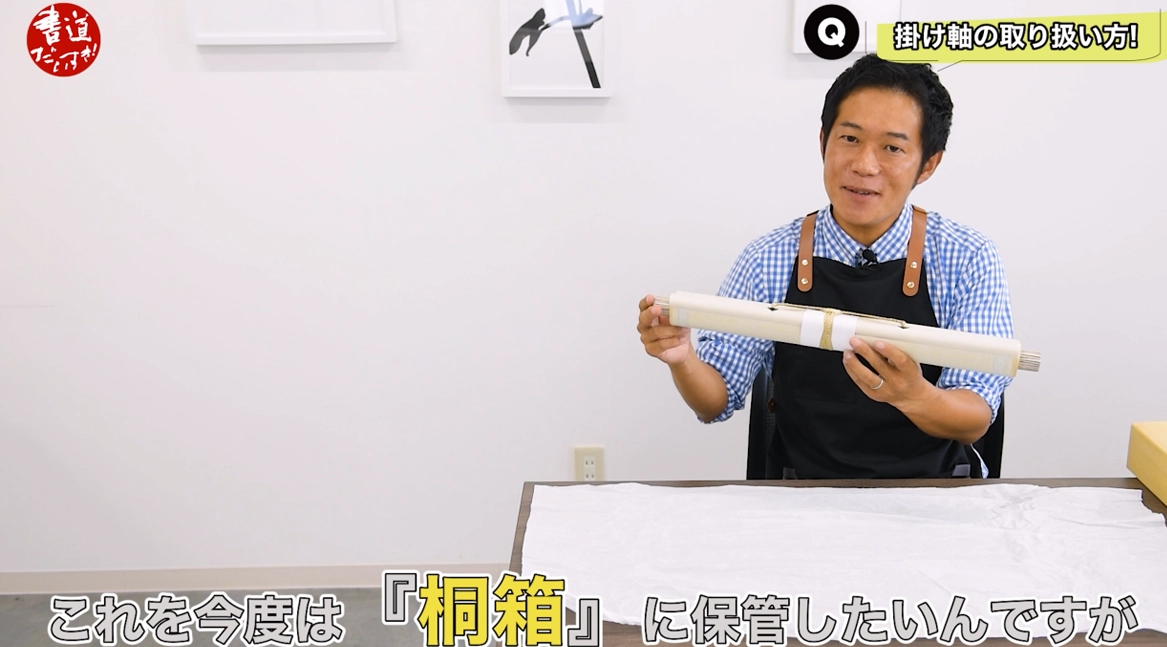
I want to store it in a kiri-wood box. You can store it as-is in the box, but since we’re here, let’s wrap it once in thin washi paper like this.
Roll it up like this—wrap, wrap. And set it aside for a moment.
Shimauchi 09:53
Next, about the kiri-wood box: these boxes are made to be sealed very precisely, so what you need to be careful about when opening the top lid is this—once you open it like this,
Shimauchi 10:12
it’s important to place it down in the same orientation as you opened it.
If, for example, you mistakenly flip it and try to close it, it will still close, but it feels tighter—and you can get gaps like this.
That defeats the purpose of the kiri-wood box.
So don’t mix up the lid orientation. The safest thing is: once you open it, place it down without changing the direction.
That’s important.
Shimauchi 10:45
Now, why store it in a kiri-wood box? Because kiri-wood boxes regulate humidity. Hanging scrolls don’t like moisture, so storing them in a kiri box is better.
Now, we’ll place the scroll inside, but actually—
Shimauchi 11:04
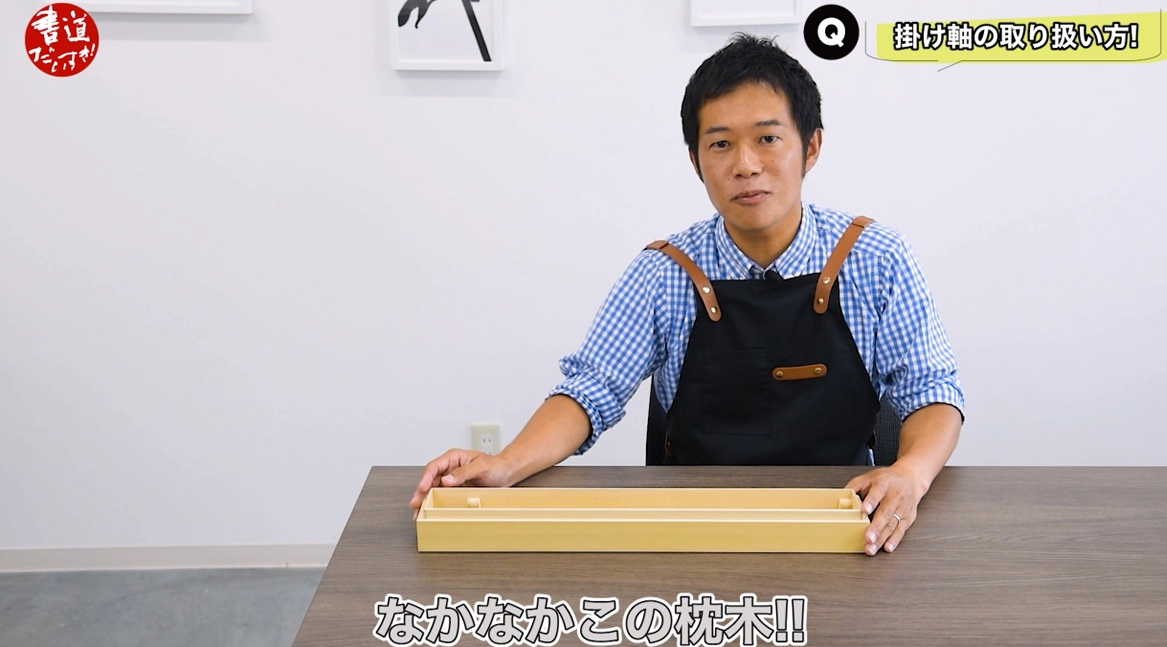
many people may not have noticed this—this is called the pillow block (makuragi), and the thickness here is different.
That’s hard to notice. So, the thicker side of the pillow block should be where you place the top of the scroll—this part attached to the upper side is called the hassō.
So the correct placement is like this—okay, like this.
Shimauchi 11:41
The hassō is on this side. Then it fits neatly. Close the lid and it seals tightly—snap, snap—amazing, isn’t it?
Now, these kiri boxes are sold in sizes, so please measure your scroll carefully—from one rod end to the other—and be sure to choose a kiri box that matches the exact measured length.
That’s truly important.
Generally, for a hankiri-sized work, it fits in a kiri box around 1 shaku 7 sun to 1 shaku 7 sun 5 bu.
Shimauchi 12:21
And then, your hanging scroll is finished.
“Oh, I have a kiri box at home. I’ll use that.”
But then you realize, “Oh, the box is larger than expected. I guess I need to buy a new one.” Some of you may think that—
Shimauchi 12:37
but don’t worry. The pillow blocks in a wooden box actually move. See? They move like this—like this.
You can adjust them.
So if the box is larger, it’s fine—you can just adjust the pillow blocks. Very convenient.
And these pillow blocks are actually very capable: when you place the scroll inside, the scroll doesn’t touch the bottom of the box—it’s “floating.”
So it can help prevent moisture even more.
Shimauchi 12:57
These pillow blocks may be small, but they do great work.
And finally, this kiri box also has an outer cloth wrap, so you store it inside that wrap.
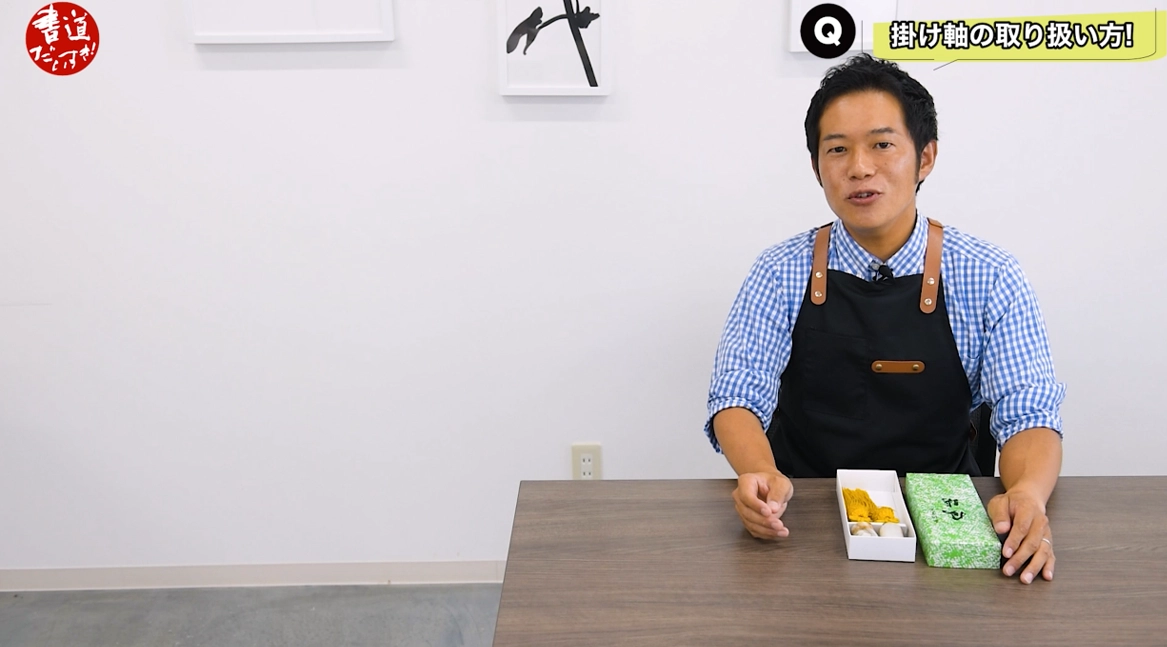
But even so, something is still missing—so what should you add? To prevent insect damage, you want to put in an insect repellent.
Camphor or other repellents may be used, but be sure to use insect repellent specifically made for mounting (hyōgu).
Shimauchi 13:34
With other types, you might end up damaging the scroll, so please be careful about that.
The more careful you are, the better. So add it in.
Let’s put it in.
Insects are living creatures, so the better the fabric, the more they want to eat it—amazing, isn’t it?
Do they have a sense of smell? Maybe.
So the nicer and cleaner the fabric—like high-grade silk—the more easily insects may damage it. So with valuable scrolls made with good fabric, please don’t forget to add insect repellent.
Now, about where to store it—
Shimauchi 14:21
since we’ve gone this far and stored it carefully, avoid high heat and humidity, and store it in a dark place.
But storing it away doesn’t mean you can relax completely.
To prevent insects properly, you should do “mushiboshi” (airing) once or twice a year.
Spring and autumn are good. On a crisp, perfectly sunny day in spring or autumn, take the scroll out of the kiri box and let it breathe fresh outside air.
That helps prevent insect damage.
And something people often forget—especially calligraphy practitioners—after submitting many works to exhibitions, you get many “makuri works” (unmounted/rolled works) back, right?
If you’ve kept those stored in the same place for a long time, you might later discover stains—or insect damage—without realizing it.
For makuri works as well, I think it’s good to air them in the same way. Since they’re rolled, you don’t have to open them—just letting air pass through while rolled is fine. Please remember that too.
Shimauchi 16:14
Now, we’ve seen various tools, and this is the last optional tool: when you make a hanging scroll, you can attach weights to the rod ends—these are called fūchin. They come as a set of two tied together with a cord like this.
By hanging the fūchin on the rod ends, the scroll becomes weighted, and it stays taut—nice and tight. It may also help prevent it from fluttering in the wind.
However, fūchin are fairly heavy, so leaving them on the scroll all the time puts a burden on it. Ideally, fūchin should be used only at the beginning when you hang the scroll. Please remember that.
Even if you like how they look, it’s better to avoid leaving them on continuously.
Now, everyone—you’ve learned how to hang a scroll properly, store it, and preserve it.
So there’s no need to think “hanging scrolls are difficult” or “scary,” right?
I know I’m repeating myself, but I really want you to display hanging scrolls in your everyday life. That’s the core theme of today’s video.
So please—actually hang scrolls and enjoy them.
Also, as mentioned briefly in the opening, there are many different mounting styles for hanging scrolls, and the way a work looks can change depending on the style. I’d like to introduce scroll styles in another video someday—so please look forward to it.
Alright then, today’s “Shodo Daisuki”—another new discovery absorbed! And Friday comes quickly, doesn’t it?
See you again next Friday, everyone.
Shimauchi 18:13
Thank you very much.
Related Products
Introducing products featured in this video.
