

How to Wash and Sharpen an Inkstone
Inkstones were devised as tools for grinding ink; their prototype is said to date back to China’s Yin (Shang) dynasty, and they were introduced to Japan during the Asuka period.
In antiquity, inkstones were made from stone, clay, tiles, jade, and ceramics. With the discovery of prized stone materials (for so-called “famous inkstones”) and the work of master carvers, they evolved over time for both practical use and aesthetic appreciation.
As the saying goes, calligraphy begins with grinding ink. Because ink grinding is so important, it’s best to calm the mind by grinding ink on a well-maintained, clean inkstone.
If an inkstone is not kept clean, ink residue stuck to the surface can adversely affect ink color and even cause unpleasant odors.
In addition, deteriorated residue can lead to problems later during mounting and framing.
Keep your inkstone clean by washing it carefully every time you use it, so you can treasure it for years to come.
Below, we introduce care methods to help you look after your inkstone—an object that can become a beloved companion.
How to Wash an Inkstone
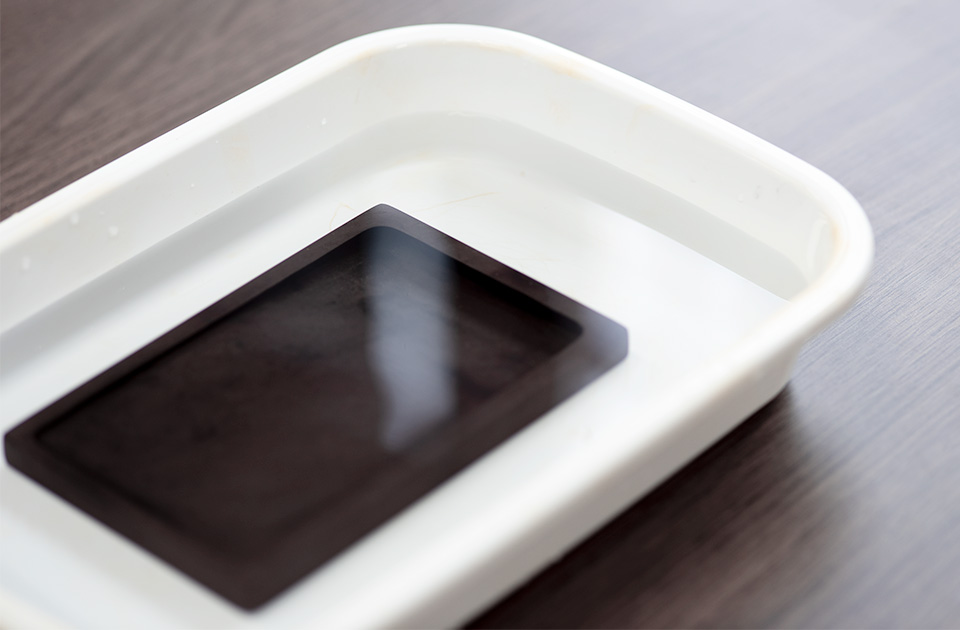
1. Soak the inkstone in hot water for about 20–30 minutes
The animal glue (nikawa), a base ingredient of ink, can be dissolved in hot water; the optimal temperature is said to be around 70 °C.
Soaking in water at about 70 °C helps loosen soot and glue residue stuck to the inkstone and also helps clear clogged pores.
2. Wash the inkstone with soft materials
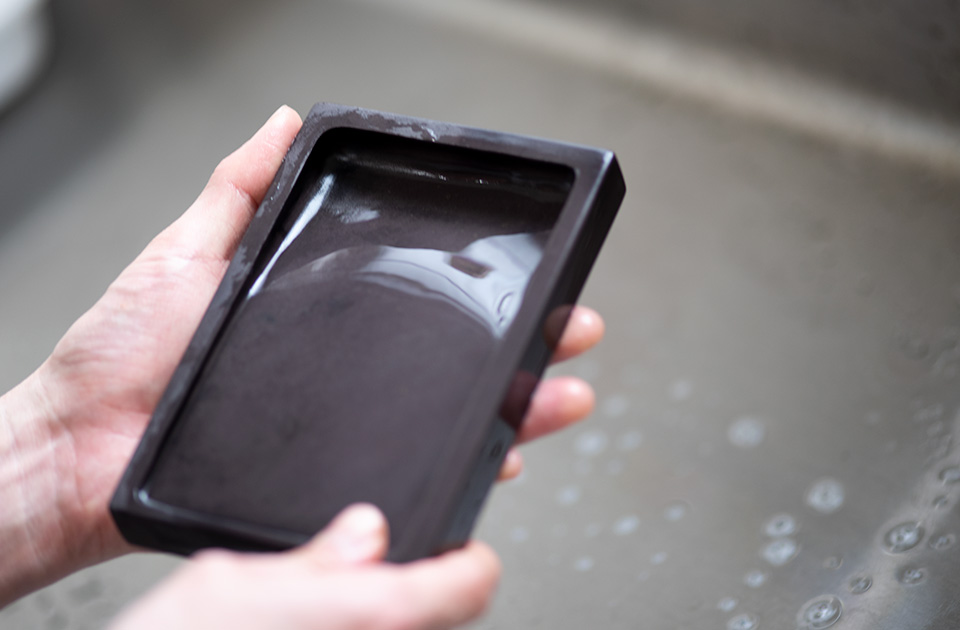
To avoid scratching the inkstone, gently rinse it with a soft sponge or a soft-bristled toothbrush.
Carefully clean hard-to-reach areas as well, such as the rim and corners.

3. Wipe off moisture and let it dry
After washing, wipe off any moisture with a cloth, then avoid rapid drying and allow the inkstone to air-dry naturally.
When ink hardens and becomes difficult to remove
If you want to remove stubbornly hardened ink, you can use the same care methods described in steps 1, 2, and 3 above.
If the ink stains still do not come off, extend the soaking time in hot water and patiently repeat the steps several times until the ink is removed.
When it feels difficult to grind ink
Some may have experienced situations where, even when grinding ink, it doesn’t seem to grind properly or feels ineffective.
Ink grinds on an inkstone because of the fine irregularities on the surface called “hōbō” (锋鋩), which function like sandpaper.
While it is sometimes said that grinding becomes difficult when the hōbō wear down, in reality, they do not wear down so easily.
If you feel that grinding has become difficult, please try the following methods.
1. Wash the inkstone again
Even if the surface of the inkstone looks clean, soot or glue may be clogging the tiny irregularities of the hōbō, preventing effective grinding.
In such cases, soak the inkstone in hot water at about 70 °C—the temperature at which glue is said to dissolve most effectively—for 20 to 30 minutes, then wash gently with a soft sponge.
If you have never tried this method before, it may be effective to repeat the process several times.
2. Check the type of ink
It is rare for Japanese-made ink (wamoku) to fail to grind, but Chinese-made ink (tōboku) tends to grind less easily (producing less blackness) compared to wamoku. If you are using tōboku, switching to wamoku may help.
3. Recutting the inkstone surface (“Medate”)
If washing thoroughly and changing the type of ink still does not resolve the problem, the last resort is to perform “medate,” the recutting of the inkstone’s surface.
Medate involves sharpening the irregularities of the hōbō again, restoring the grinding quality that may have diminished due to long-term use.
Please note that medate should only be a last resort and should never be undertaken lightly. Proceed with extreme caution.
Detailed methods are explained below.
Methods of Inkstone “Medate” (Surface Recutting)
There are three methods of performing medate:
1. Using a cream-type abrasive
2. Using a cream-type abrasive + waterproof sandpaper
3. Using a sharpening stone made specifically for inkstones
Before explaining each method, here is some background knowledge:
High-quality inkstones rarely suffer wear of the hōbō from normal ink grinding.
Therefore, in most cases, medate is unnecessary for good-quality inkstones.
However, as shown in the image below, performing medate will shave the surface of the inkstone, changing its color, and in the worst case, may damage a valuable inkstone.
For those who regularly maintain their inkstones properly, medate is almost never required. Treat medate strictly as a last resort, and undertake it only at your own risk, being prepared for the worst.
1. Using a cream-type abrasive
As a cream abrasive, we recommend the household product “Jif” (a cream cleanser many are familiar with).
Jif is an alkaline cream cleanser that combines surfactants to lift stains with abrasives to scrub them away.
The abrasive used in Jif is calcite, a natural mineral softer than glass or stainless steel, so it can clean the inkstone without scratching it.
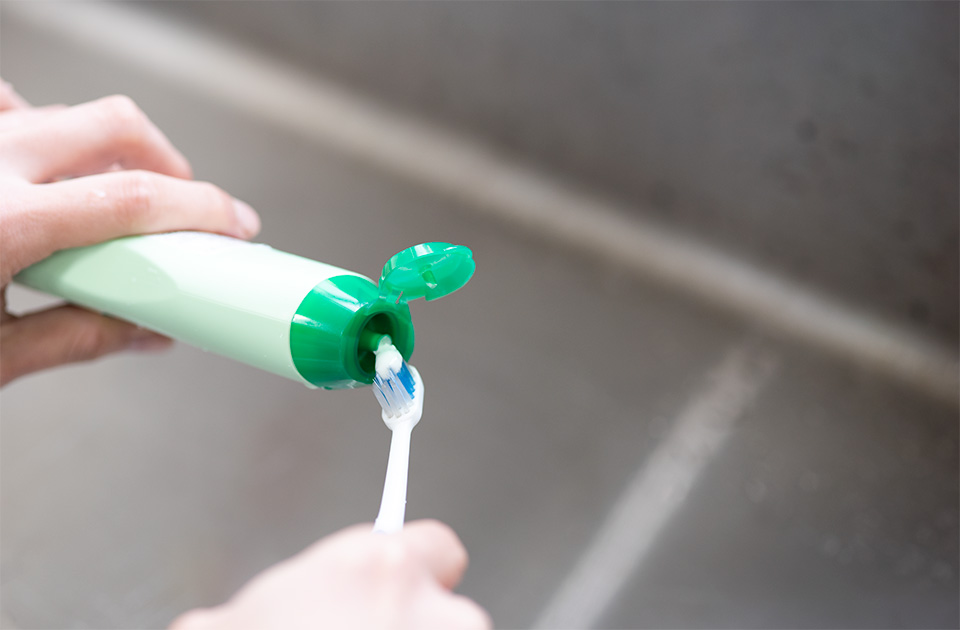
How to use it is simple.
Soak the inkstone in hot water at about 70℃, the optimal temperature for dissolving glue, for about 20–30 minutes.
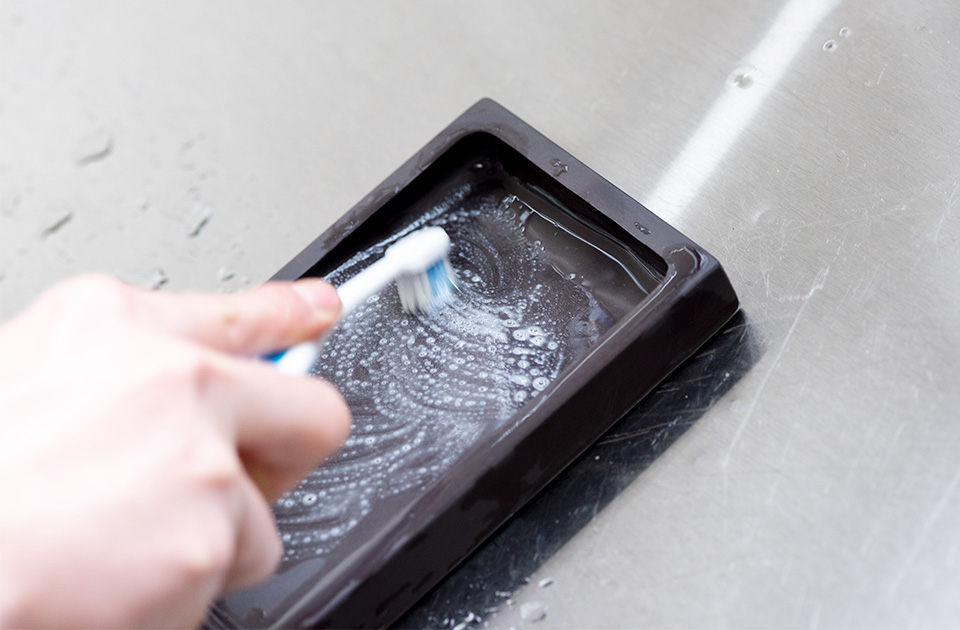
The glue stuck to the inkstone will dissolve with the power of the hot water. After removing the inkstone, apply Jif to a toothbrush and gently rub in circular motions as if grinding ink.
(Be careful not to scrub harshly.)
Not only the ink-grinding surface (kyūdō/oka), but also the corners and edges where ink tends to build up should be scrubbed thoroughly.
By patiently and evenly repeating this process many times, the coarse abrasive particles in Jif will break down into finer grains, leaving the surface clean.
Once it is clean, rinse the inkstone in hot water at about 40℃ and wipe off excess moisture.
Since Jif polishing shaves the surface, the inkstone will temporarily appear lighter in color, but as you continue to use and wash it, it will gradually return to its natural tone, so there is no need to worry.
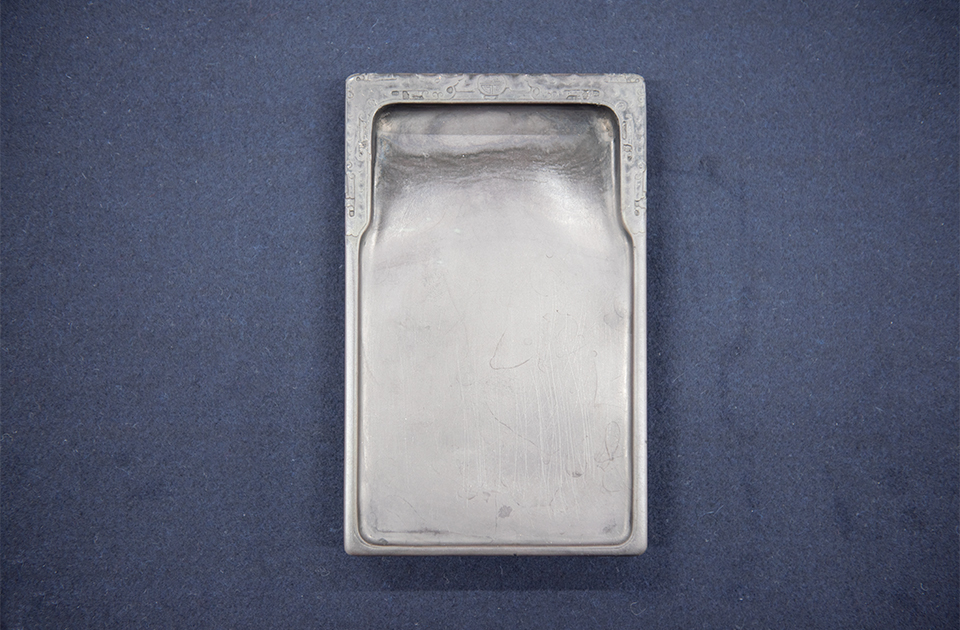
Condition after polishing with Jif.
*Please note: polishing inevitably changes the color of the inkstone, as seen in the image after polishing.
If you dislike changes in the inkstone’s color, please avoid performing medate (recutting).
2. Method using cream abrasive + waterproof sandpaper
After performing medate with Jif, the hōbō (fine irregularities) may feel overly sharp.
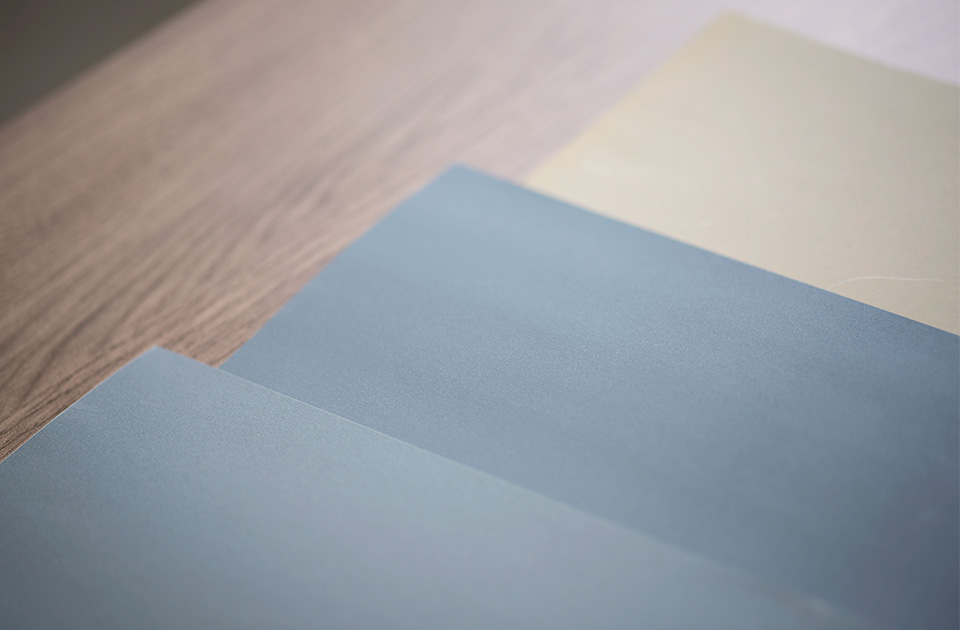
In such cases, use waterproof sandpaper (see *Note 1 for grit reference).
Wet the inkstone thoroughly with water and polish the entire ink-grinding surface (kyūdō/oka) with sandpaper.
This polishing leaves the hōbō intact while smoothing excessive protrusions, improving the grinding feel.
Tear the sandpaper into small pieces, fold it, and place it against your fingertip. Rub in gentle circular motions across the entire surface as if grinding ink.
Do not press the sandpaper down forcefully; instead, lightly polish the whole surface evenly.
Since sandpaper clogs quickly, replace it several times to maintain consistent performance as you polish the entire grinding surface.
(The higher the grit number, the finer the sandpaper, and the faster it clogs.)
This smooths out overly sharp edges left from Jif polishing.
Once the surface is evenly polished, rinse the inkstone in hot water at about 40℃ and wipe away excess moisture.
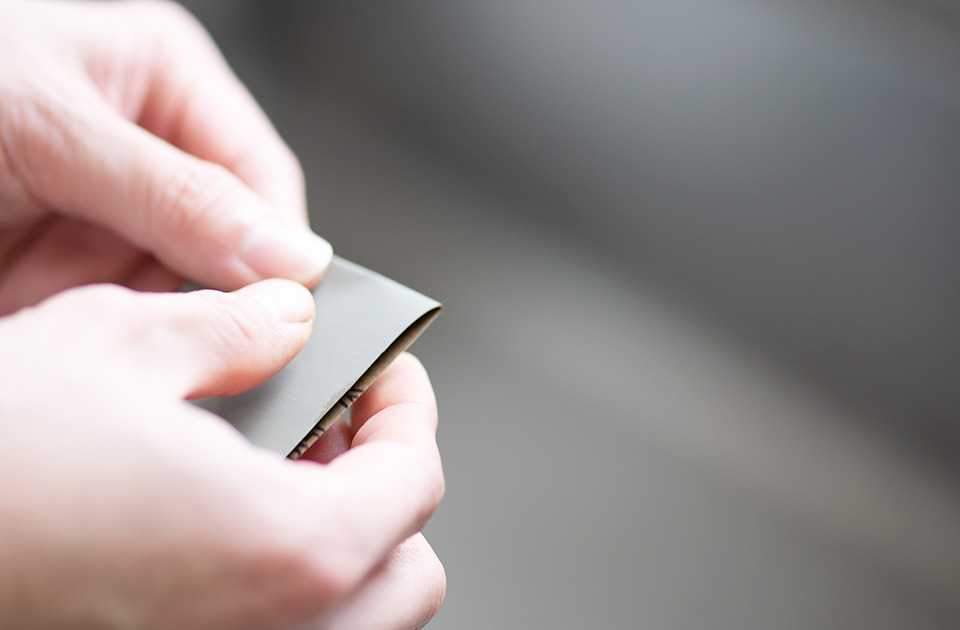
[*Note 1] The grit of waterproof sandpaper should be adjusted depending on the type of inkstone.
As a general guide, please refer to the following:
・Duan inkstone: #2000–#3000
・She inkstone: #800–#1000
・Luo inkstone: #600–#700
・Student Luo inkstone: #400–#500
*The higher the grit number, the finer the finish.
If you prefer a smoother grinding feel, use #3000–#4000 sandpaper.
*As repeatedly emphasized, medate is rarely needed for inkstones that are properly and regularly maintained.
Please treat medate strictly as a last resort and proceed entirely at your own risk, being prepared for the worst.
*Please note: polishing inevitably changes the color of the inkstone, as seen in the image after polishing.
If you dislike changes in the inkstone’s color, please avoid performing medate.
3. Method using inkstone whetstone
Another well-known method of medate is using a dedicated inkstone whetstone.
Typical inkstone whetstones are made by cutting layers of solidified clay.
Because natural clay whetstones may contain ultrafine impurities (such as metals, gravel, or glass), using them can sometimes scratch the inkstone.
As these whetstones are natural products, please use them with full understanding of the risks.
To apply the whetstone, first soak the surface of the inkstone in water, then rub with the whetstone as if grinding ink.
For corners or hard-to-clean areas, break the whetstone into smaller pieces and use the fragments.
This process is for raising the surface texture (medate), not flattening the surface.
Therefore, do not press hard, but rub gently without applying force, just as when grinding ink.
After whetstone application, wash the inkstone thoroughly and wipe off excess moisture.
Inkstones suitable or unsuitable for whetstone polishing
Because natural clay whetstones may contain ultrafine grit that could scratch the inkstone, the honest answer to “Which inkstones are suitable for whetstone polishing?” is: “In principle, it is wiser to avoid using clay whetstones on any inkstone.”
If you absolutely must use one, do so only on an inkstone where you can accept potential scratches as unavoidable.
When a newly purchased inkstone does not grind ink
This is often seen with Chinese inkstones: to enhance their appearance, some are coated with a cosmetic layer at the surface.
On such treated inkstones, grinding ink immediately after purchase may feel like the ink is sliding across the surface without grinding properly, or the water may repel as if it were waterproof.
In such cases, follow the “How to Wash an Inkstone” method: soak the inkstone in about 70℃ hot water for 20–30 minutes, wash gently with a soft material, and repeat several times until the coating is removed.
(Since wax is often used for such coatings, and wax dissolves at roughly the same temperature as glue, soaking at about 70℃ is logical.)
If discomfort still remains even after several washes, normal use—“grind ink, then wash; grind ink, then wash”—will eventually wear away the coating and restore the original grinding feel of the inkstone.