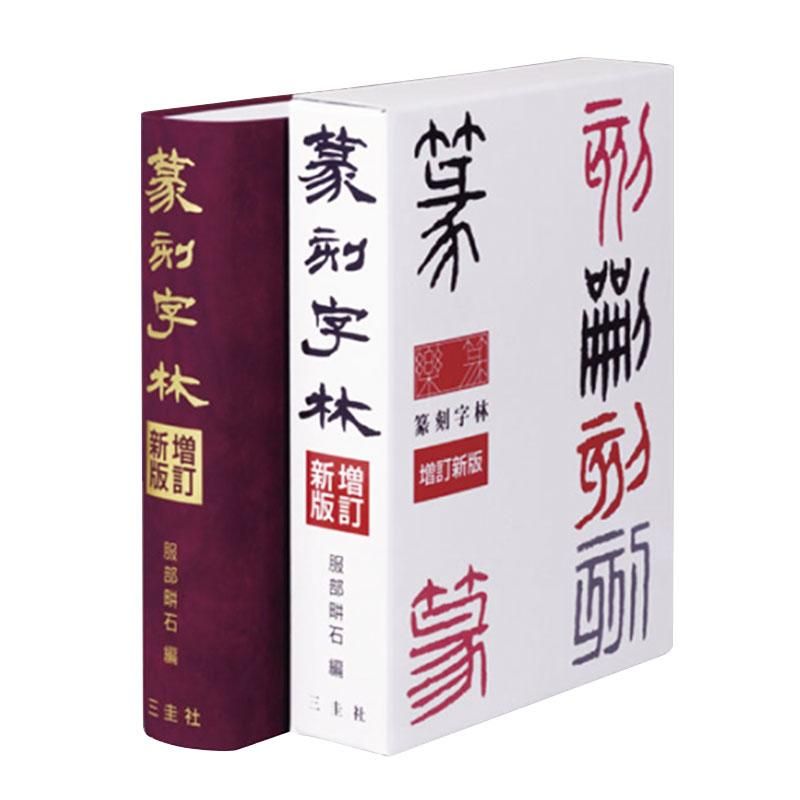
Tenkoku Jirin (Seal Script Dictionary)
Tenkoku Jirin (Seal Script Dictionary)
Product ID:9751
#Books/#Dictionaries/#Jirin/#Sankeisha/#Kanji/#Seal Script/#Seal Carving
Features of the New and Expanded Edition of "Tenkoku Jirin"1. In conjunction with the digital book "Liuxu Tongzheng" [※2], the Seal Carving Jirin features a total of 78,616 seal script characters [※1].
2. Includes a comprehensive collection of 8,600 heading characters and 34,071 seal script characters.
3. Compatible with the "New List of Commonly Used Kanji" and "New Kanji for Names."
4. A pioneering era-based character classification system that is friendly to beginners and makes seal script easy to use.
5. Used as the basis for the compilation of Chinese seal carving dictionaries. Highly utilized in the compilation of dictionaries in China, the home of seal carving.
6. Selected as a book for the "Proficiency Certification Examination." Reliability recognized by national certification.
7. Recommended by over 20 introductory seal carving books. Recommendations from others are the ultimate sign of trust.
8. In pursuit of perfection, revisions, additions, and rejuvenation are made with each new edition.
Purchase the expanded new edition of "Tenkoku Jirin" and you'll be able to browse and search the digital book "Lux Script Tsūshō" [※2]!
The large-scale seal carving and seal script dictionary "Lux Script Tsūshō" (over 2,840 pages), compiled by Hattori Hasegawa over his lifetime, is now available as a digital book! It contains a total of 44,545 seal script characters.
By combining it with the expanded new edition of "Tenkoku Jirin," the total number of seal script characters included has increased to an astounding 78,616 [※1]!
[※1] The total number of seal script characters included in the new and expanded edition of "Tenkoku Jirin" and the digital book of the Daitenkoku Jirin "Liuxu Tsūshō."
[※2] Freely viewable on the Sankeisha website.
Features of the Daitenkoku Jirin "Liuxu Tsūshō" (Digital Book)
By linking with the new and expanded edition of "Tenkoku Jirin," utilization rates reach 120%!
1. The book (over 2,840 pages), which took Hattori Seiseki's life to compile, is finally available as a digital book [※2].
2. Easily view anywhere on your computer, tablet, or smartphone.
3. The total number of seal script characters is an astounding 44,545. Boasting an overwhelming amount of character information.
4. The headings of the characters are indicated by "Shuowen Jiezi," which explains the original meaning of the characters.
5. A wide range of materials are included, from oracle bones and bones to guanli (classical Japanese characters), stone drums, and Ming and Qing dynasty seals.
6. Each seal inscription is accompanied by a reference to its source, clearly supporting its validity.
7. Inconvenient character search is instantly resolved through integration with the revised and updated edition of "Seal Carvings."
● Editor's Biography
Hattori Koseki (Hattori Koseki)
His real name was Jizaemon. His pen name was initially Koseki, later Koseki, and his pen name was Koshu. He loved sweets and was also known as Ankoro Sensei.
He was born on November 17, 1875, at 3062 Kotoda, Onmei Village, Kaijo District, Chiba Prefecture (now Asahi City), as the eldest son of Hattori Kouu (the eighth generation Jizaemon). The Hattori family was the headman of Kotoda Village for generations during the Edo period. His childhood name was Hikotaro. In 1886 (at the age of 12), he retired from Kouu and inherited the name of the 9th Jizaemon.
After graduating from Kaisei Junior High School, he studied at Tokyo Senmon Gakko (now Waseda University). Around 1892 (at the age of 18), he became a disciple of Takada Ryokuun and studied seal carving.
Around 1908 (at the age of 34), he founded the haiku magazine "Takoucho" with Makino Boto and others. Around 1911 (at the age of 37), he succeeded Tsunoda Chikurei as a judge for the Nihon Shimbun Haiku Club. He later took over the sole responsibility of editing and publishing "Takoucho."
He won a silver medal in the seal carving category at the 1920 Peace Exposition. From the early Showa period, he served as a judge for the Japan Art Association, the Japan Calligraphy Sakushinkai, the Taito Shodoin, and the Toho Shodo Association.
His works on seal carving include "Tenkoku Jirin" (Seal Carvings) and "Rokusho Tsusho" (Rokusho Tsūshō), and his works on haiku include "Celebration and Condolence Haiku Collection," "Basho Ku Shinkou," "Haiku Grammar," and the haiku collection "Ohobako."
He died at 19 Shin-Ogawacho 3-Chome, Ushigome Ward, Tokyo (now Shinjuku Ward). He was 65 years old. His posthumous Buddhist name was Kuntokuin Ekankiei Keiseki Koji.
Regular price
¥6,990 JPY
Regular price
¥6,990 JPY
Sale price
¥6,990 JPY
Shipping calculated at checkout.
9988 in stock
Quantity
International Shipping is available via Buyee. Please click "Add to Cart" to proceed with your overseas order.
Important Notice:Please ensure the currency is set to Japanese Yen (JPY) before adding items to your cart. Other currencies may cause an error during the checkout process.[View Shopping Guide (Step-by-Step)]
Couldn't load pickup availability