Shodo Daisuki Episode 19
Shodo Daisuki Episode 19
Recommendation of Seal Engraving vol.1 (About Tools)【Calligraphy】
Shodo Daisuki – Episode 019
A man who loves calligraphy, “Shimauchi,” provides a thorough explanation of seal engraving over three episodes!
Shodo Daisuki Episode 19 – Video Overview
This is the content of a lecture video by Mr. Shimauchi, a calligrapher, about seal engraving.
He plans to release several videos on seal engraving, and this first episode provides a detailed explanation of the tools used in seal engraving.
He talks about how he first encountered seal engraving, sharing experiences from high school classes as well as stories of mistakes he made in university.
He explains that he rediscovered his interest in seal engraving after seeing a piece titled “Isshou Isshou (One Smile in a Lifetime)” at an exhibition years ago, which deeply moved him.
The main topic of the lecture is an introduction to the tools needed for seal engraving.
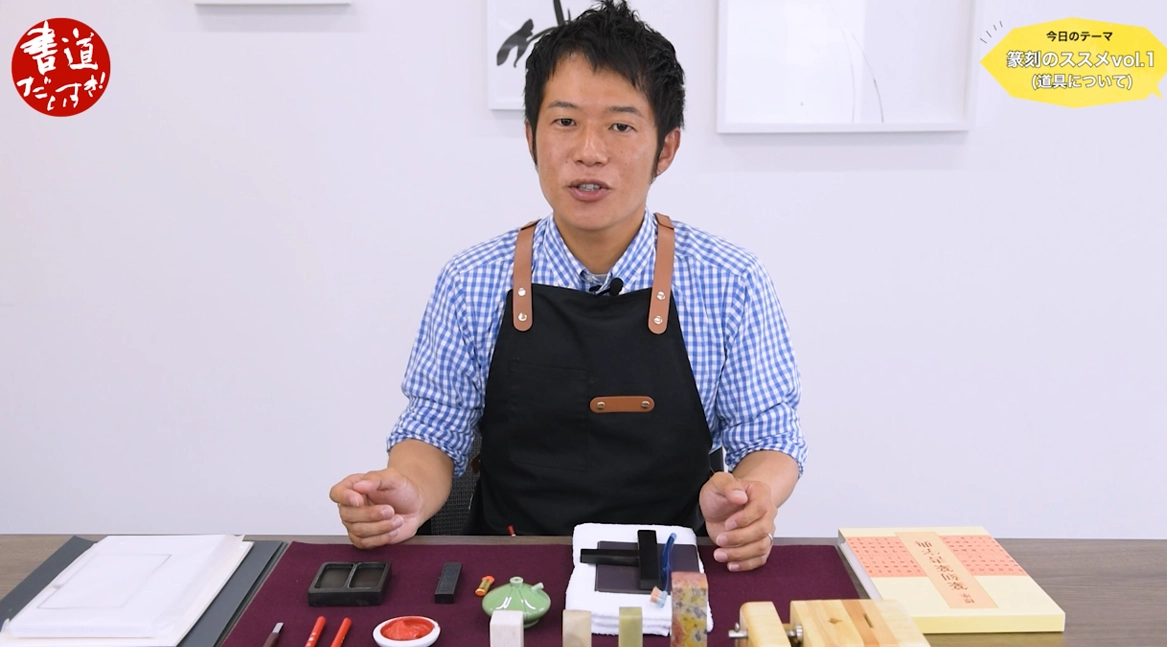
He provides detailed explanations of essential tools such as seal stones, carving knives, ink, brushes, inkstones, cinnabar ink paste, and seal stands, as well as supplementary tools such as waterproof sandpaper, transfer sheets, and dictionaries.
Mr. Shimauchi emphasizes that once purchased, these tools can be used for a long time, making them cost-effective.
He concludes the video by announcing that the next episode will be a practical tutorial and encourages viewers to subscribe to the channel.
Youtube Shodo Daisuki Episode 19
Shimauchi 00:00
Hello, this is Shimauchi who loves calligraphy.
This time, I would like to send several videos about seal engraving (tenkoku).
Do you have any experience with seal engraving? If you chose calligraphy in your high school art class, I think seal engraving was compulsory, so you probably did it then.
Shimauchi 00:21
Nowadays, eraser stamps are quite popular, so some of you may have tried making those.
But when people hear “seal engraving,” they often think it's difficult and involves carving on stone…
Shimauchi 00:34
Some may think “Impossible, impossible!” or feel they need a proper seal because they want one for documents.
Well, unfortunately, even I didn’t have a very good image of seal engraving either.
Shimauchi 00:48
In high school, I did it in class, but I hardly remember anything. The stone the teacher gave me was called “Seidai-shi,” but when I looked at it, it was green.
Shimauchi 01:06
I still remember thinking it looked like a traffic light color pattern. Later at university, I also remember something clearly.
There was something called the “Easy Magic Transfer Method.”
Shimauchi 01:24
The teacher said, “You can transfer any character easily and make any work.”
I took that literally and boldly submitted a seal carving of a certain 21st-century cat-type robot.
As you can imagine… yes, my grade was terrible.
Shimauchi 01:39
But a few years ago, I had a new encounter.
At an exhibition, a seal engraving caught my eye—a beautiful oval-shaped design with the phrase “Laugh for a lifetime.”
Shimauchi 01:55
Below it, there was a handwritten note saying “Cherish your smile.”
There was also a stylish red seal mark. It really moved my heart after a long time, and I thought, “I want this.”
I immediately bought it.
Shimauchi 02:12
I placed it in a noticeable spot at home.
Then, gradually, I started wanting to carve again.
Strange, isn’t it? I began wondering if I still had my tools somewhere at home.
Shimauchi 02:25
So I searched hard for the tools.
And when I found them, I thought, “If I have the tools, I can carve again!”
From that point, the feeling of wanting to carve came rushing back.
Shimauchi 02:42
That’s how I restarted seal engraving.
Just like calligraphy, if you always keep things ready so you can practice anytime, you can create works whenever inspiration comes.
Shimauchi 02:58
You can always do it.
So for seal engraving as well, if you have the tools ready, you can start anytime.
This time, I’d like to explain the tools needed.
Please enjoy!
Shimauchi 03:14
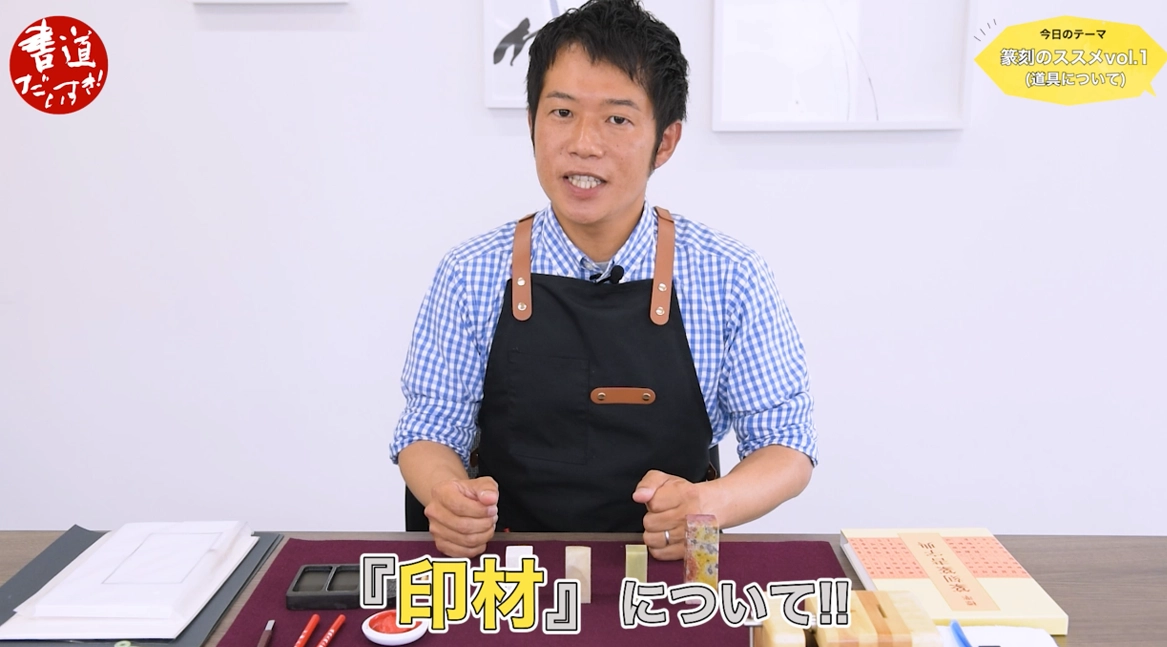
First, the seal materials. These include stone, wood, bamboo root, ivory, crystal, etc.
The easiest to carve is stone, of course. I didn’t realize so many other materials were also used.
Shimauchi 03:33
So they must be very hard, and carving them clearly requires special tools.
In Japan, good stone materials are scarce, so most are imported from China.
The types of seal stones are:
Shimauchi 03:50
Mainly four types: “Shuzan,” “Seida,” “Shoka,” and “Barin.”
These are called the Four Major Seal Stones.
For practice, what size is good?
About 2.4 cm—the so-called “8-bu size”—is ideal.
Shimauchi 04:10
Or about 3 cm—called “1 sun.” Something around this size is good.
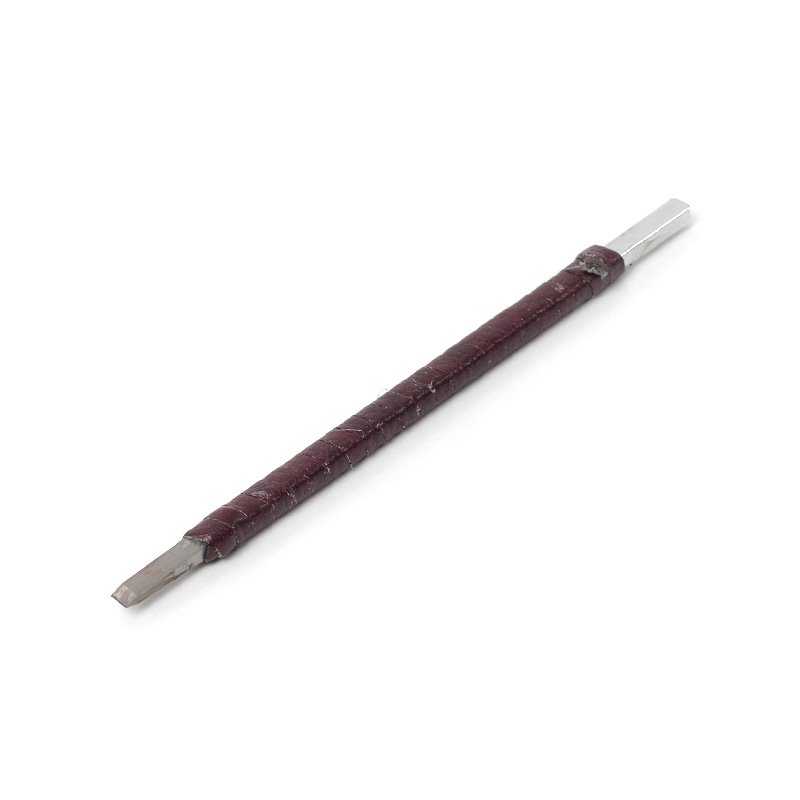
Next is the most important: the carving knife (intō).
Shimauchi 04:30
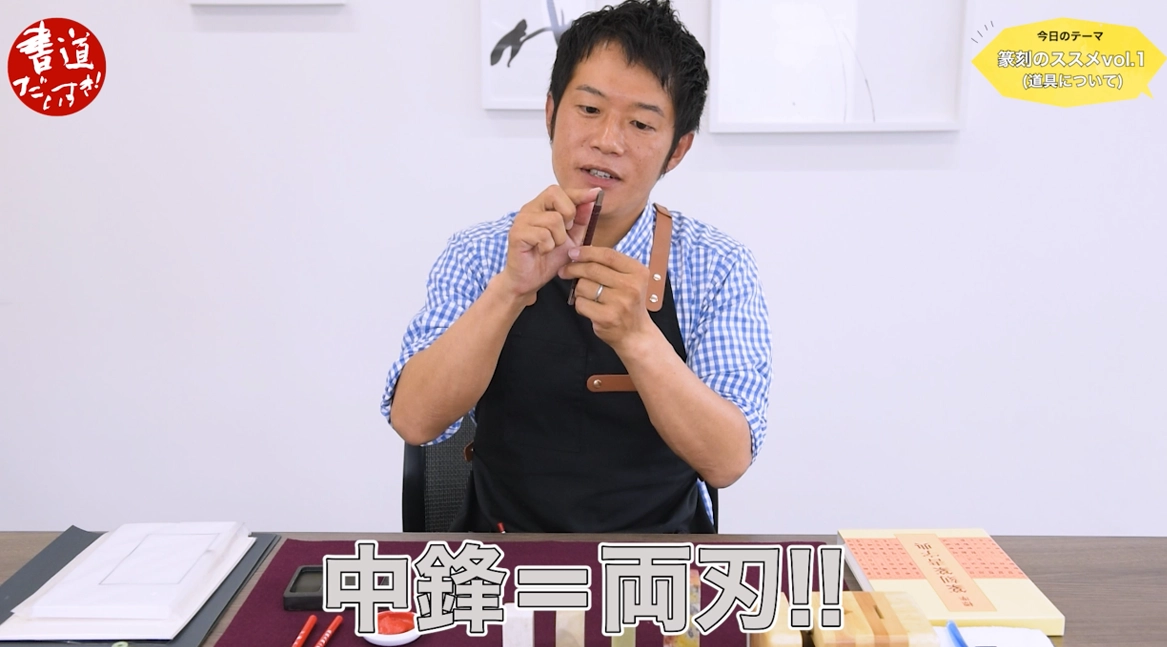
There are double-edged knives (chūhō) and single-edged knives (katahō).
For stone, chūhō is mainly used.
This carving knife—
Shimauchi 04:47
Many people have strong preferences.
There are many types, and finding one that fits your hand is part of the fun.
It’s also called “teppitsu,” meaning “iron brush.”
Shimauchi 04:59
It sounds cool, doesn’t it? “Iron brush spirit”—you carve boldly into the stone.
Next is vermilion ink (shuboku). You need it to create drafts and for the seal surface.
Shimauchi 05:18
The ink must spread evenly on the seal surface.
So don't use liquid ink—use high-quality solid ink. I’ve explained before that solid ink is the strongest.
Shimauchi 05:35
Please grind solid ink well before use.
And choose a high-quality inkstone (sumi). Heavier ones are generally better.
Next, brushes.
Shimauchi 05:51
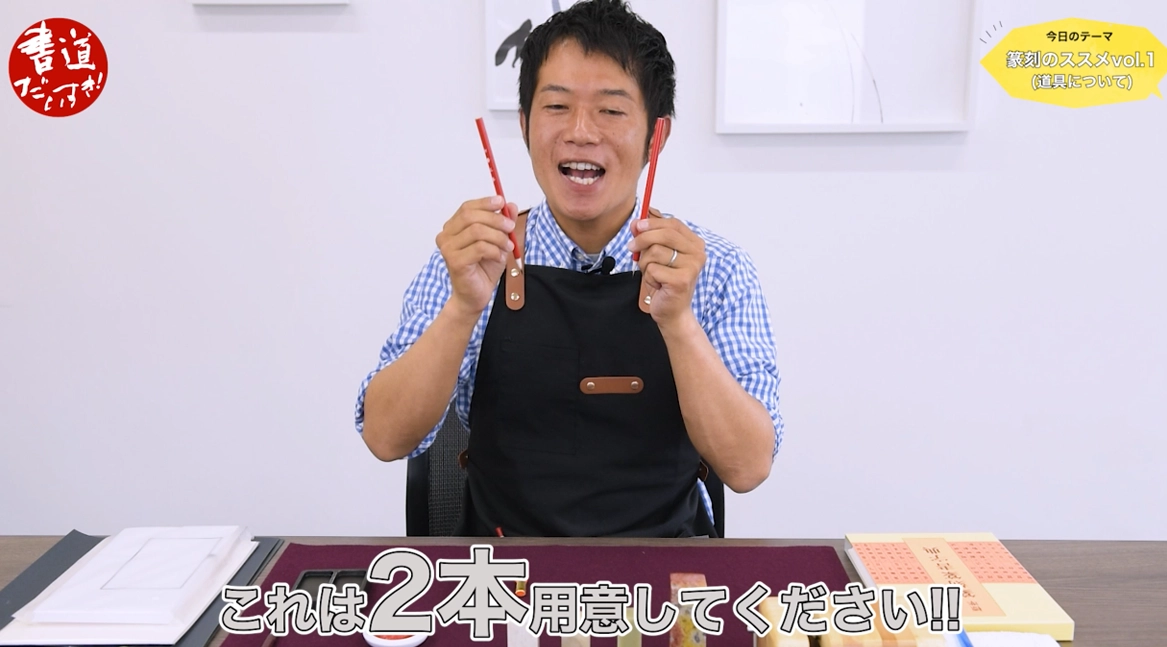
Prepare two small brushes.
Any brand is fine, but choose brushes with sharp, responsive tips.
Since the seal surface is small, you must write fine characters precisely.
Shimauchi 06:07
So choose a small brush that suits you.
Next is the inkstone. Normally you need two inkstones, one for black ink and one for red ink.
Shimauchi 06:24
But nowadays, it’s convenient—there are compact 2-sided inkstones like this.
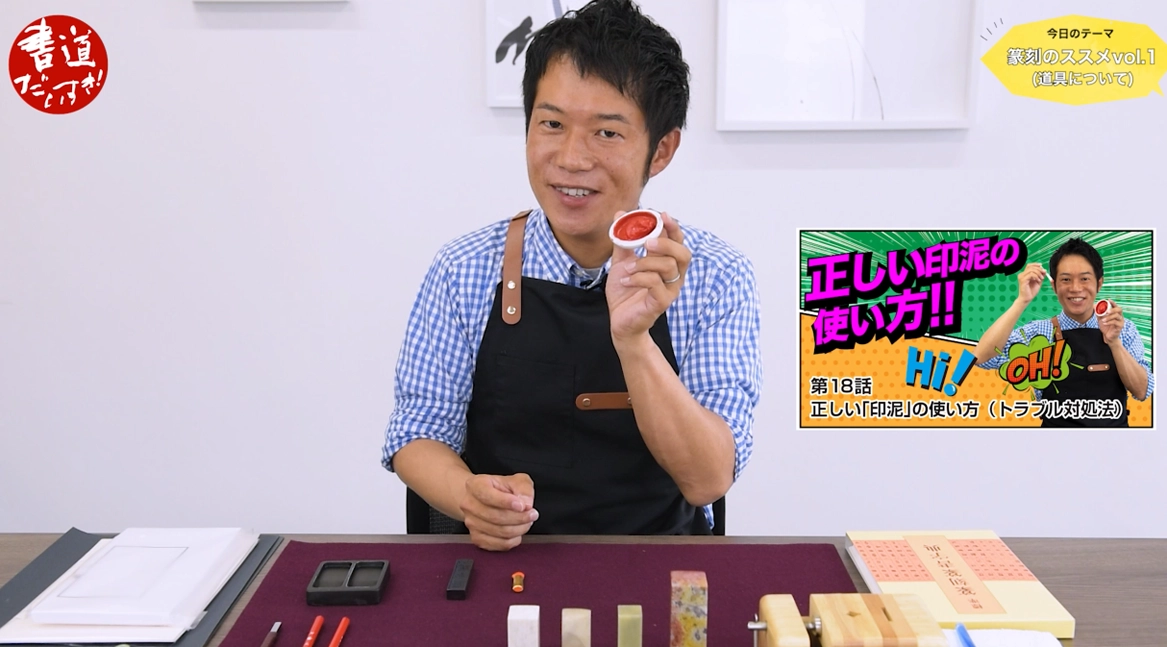
Next is the seal paste (indei), which we studied last time.
Shimauchi 06:43
Without this, you can’t stamp the seal.
There are many colors and sizes—choosing one is enjoyable too.
Next is the seal stand (inchō), a base that holds the stone securely.
Shimauchi 07:02
It’s made of a relatively hard material.
You *can* hold the stone by hand, but it’s dangerous if it slips.
Using the stand to secure the stone is much safer.
Shimauchi 07:17
It’s useful both for holding and carving.
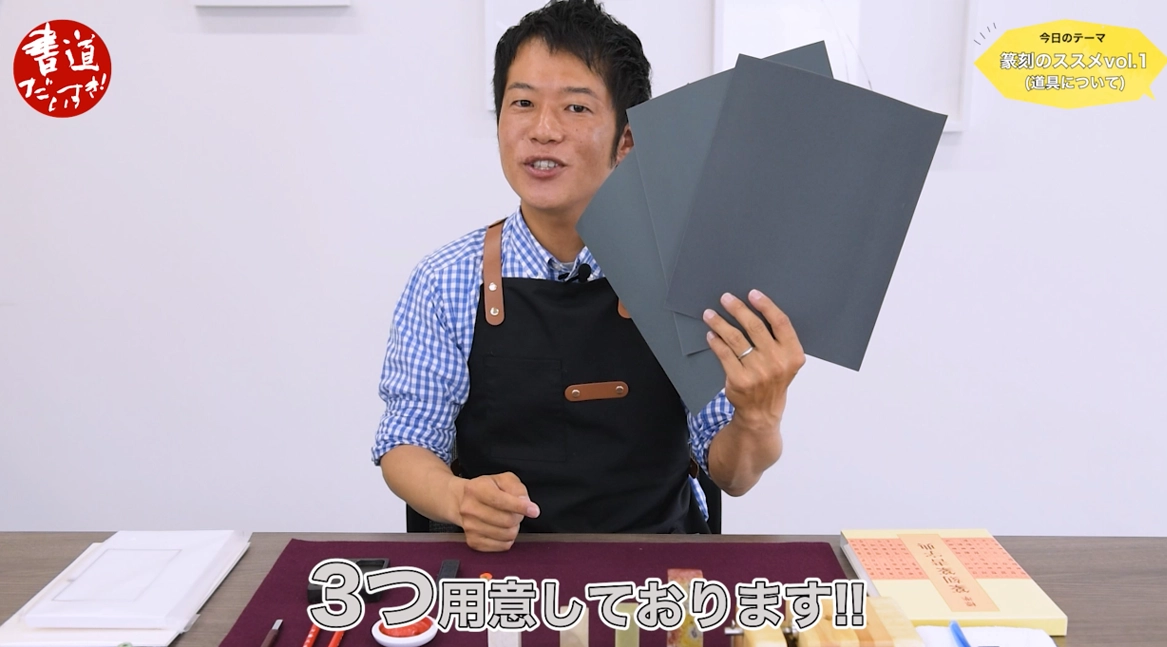
Next, water-resistant sandpaper. Prepare coarse, medium, and very fine types.
Shimauchi 07:34
Why? Because seal stones often have scratches.
The surface is rarely perfectly flat.
Shimauchi 07:48
If the surface isn't even, the seal won’t stamp cleanly.
So smoothing the seal face is an essential first step.
Sandpaper is very important.
Shimauchi 08:09
Next is the transfer sheet. It's thin but sturdy paper.
We will use it in the demonstration later, but simply put:
You draw your draft on it in ink, then attach it to the seal surface with water.
Shimauchi 08:30
Water causes the ink to transfer onto the stone.
This paper is for that purpose.
Lastly, the dictionary—used to look up ancient seal script characters.
Shimauchi 08:51
And some small additional tools:
A water dropper for grinding ink,
A ruler for stamping evenly,
A backing board for stamping,
And a brush (this one is a toothbrush) to remove stone dust.
Shimauchi 09:25
Finally, a cloth. It’s useful for wiping off dirt or seal paste.
Tissues can work too, but having a cloth is best.
Shimauchi 09:40
I introduced many tools quickly, but during the actual practice I’ll explain each one in detail.
Shimauchi 09:54
How was it?
I introduced many tools today, but once you buy them, they last a long time.
Very cost-effective, I think.
Shimauchi 10:13
If you want to try seal engraving but feel hesitant because of all the tools—
I hope this video pushes you forward just a bit.
The next video will be the practical part.
Shimauchi 10:29
This is a series, so please subscribe and watch the continuation.
Thank you very much!
This was Shimauchi, who loves calligraphy. Please subscribe! See you again!
About Related Products
Here are the products featured in this video.