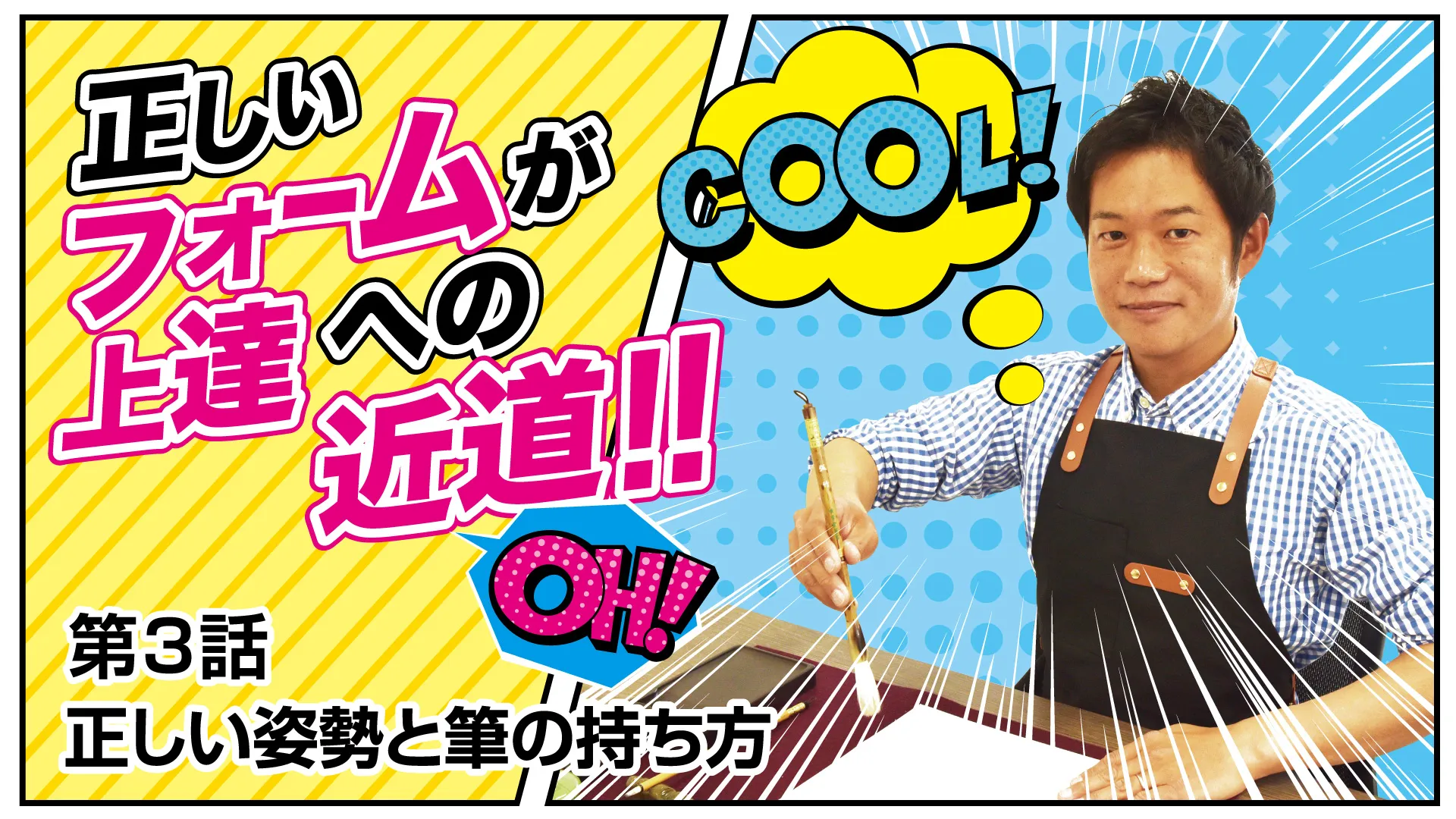
Shodo Daisuki Episode 3
Find the method that suits you! “Shimauchi” from Shodo Daisuki explains correct posture and how to hold a brush.
Shodo Daisuki Episode 3 – Video Overview
This lesson by calligraphy lover Shimauchi covers posture and how to hold the brush.
Drawing on experience from his calligraphy class, he explains why proper posture matters, showing how to sit in a chair, the right distance from the desk, and examples of poor posture.
Next, he explains how to hold the brush, introducing two basic grips: the “double-hook” (sōkō-hō) and the “single-hook” (tankō-hō).
Though he has used the double-hook grip since childhood, he notes that because the index finger is the most dexterous, the single-hook grip can also be effective.
He then introduces arm positions such as kenwan-hō (hanging arm), teiwan-hō (rested wrist/hand), and makurawan-hō (pillow arm). For beginners, he suggests teiwan-hō for stability.
Finally, he touches on a special grip called kaiwan-hō (rotational arm method). He closes by aiming to share the fun of calligraphy and invites viewers to subscribe and like the video.
YouTube – Shodo Daisuki Episode 3
Shimauchi 00:00
Hi, it’s Shimauchi, a big fan of calligraphy. Are you enjoying calligraphy today?
Today I worked on the Kyūseikyū Reisenmei. It’s tough, but it’s fun — the fun wins out!
Shimauchi 00:21
So today, let’s study posture and how to hold the brush together.
We all know posture is important, but still…
When I was little, I attended a very strict calligraphy class, so I have many memories.
Shimauchi 00:36
The teacher would suddenly start chanting shigin (poetry recitation).
That instantly made all of us kids sit up straight — it gave us goosebumps.
No wonder our posture improved!
Shimauchi 00:57
Anyway, that drove home how important posture is.
As for grips, there are many kinds — some people hold low on the brush, others high up.
Shimauchi 01:11
There’s even something like this… yes, really.
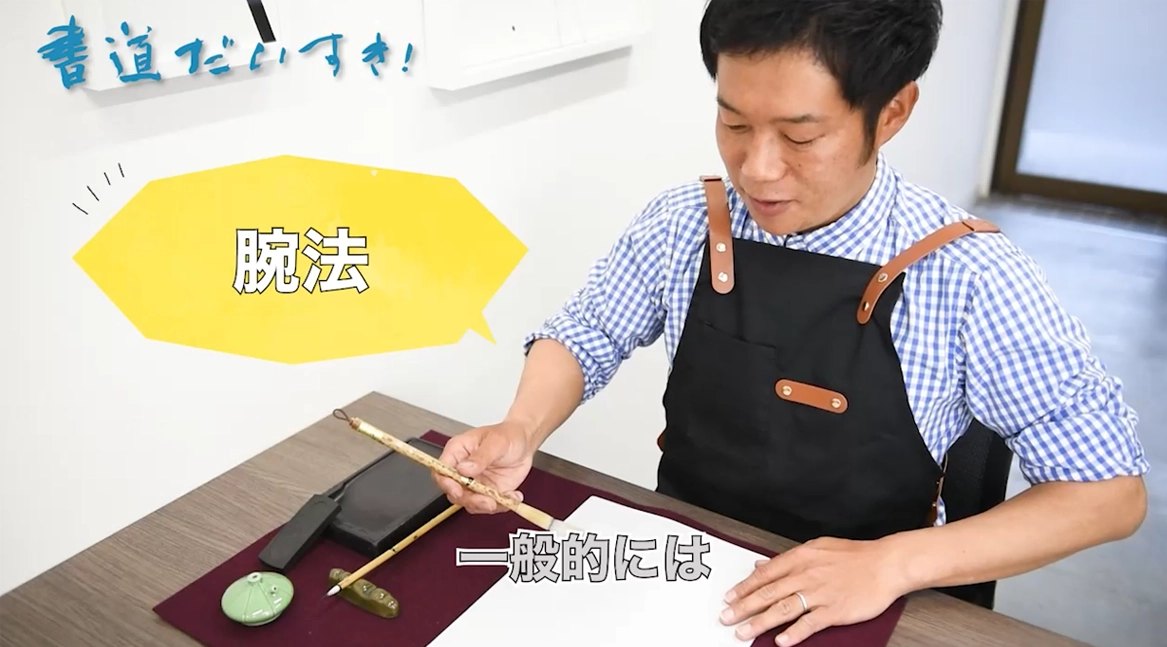
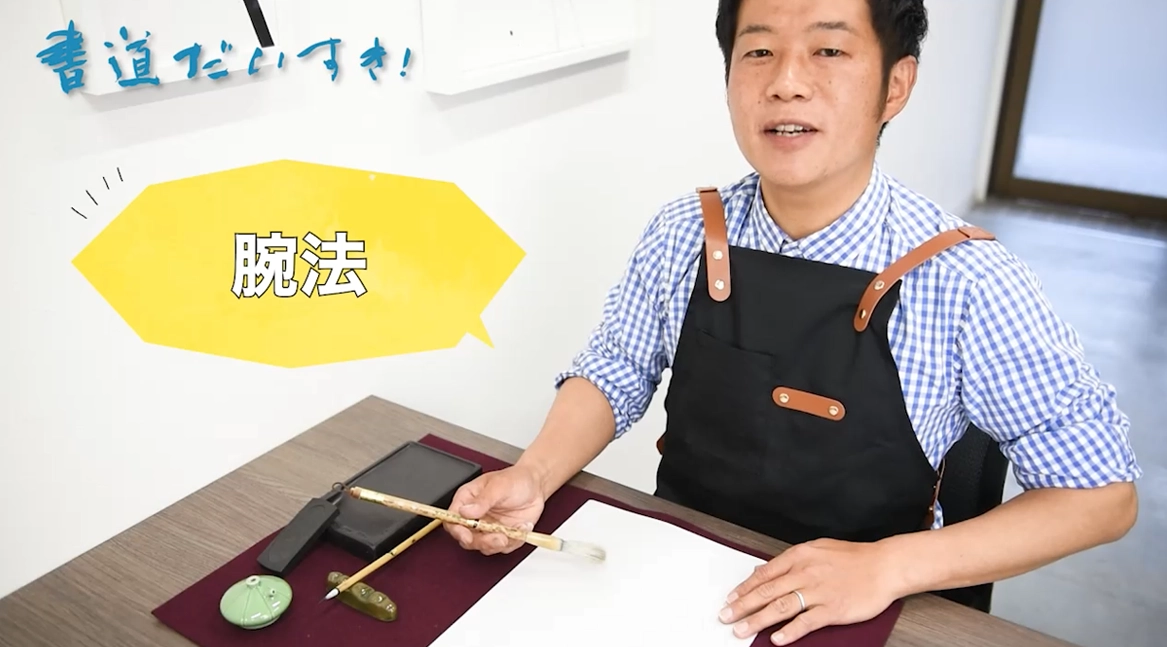
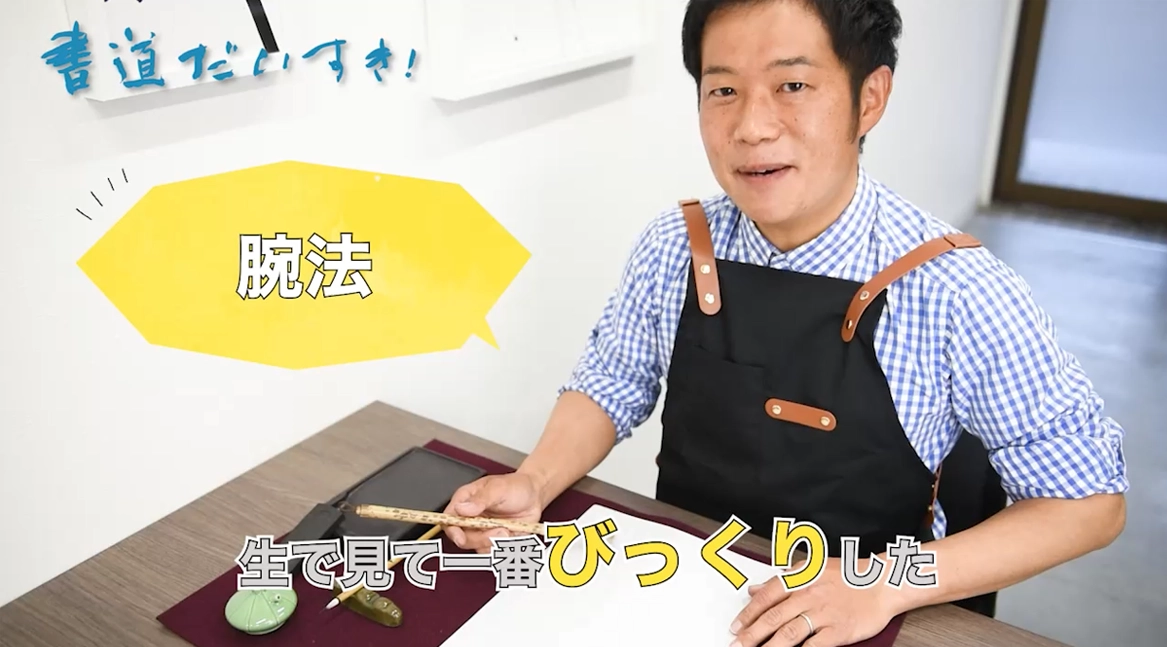
This is called kaiwan-hō (rotational arm method). We’ll enjoy learning about these together today. Let’s begin.
Shimauchi 01:27
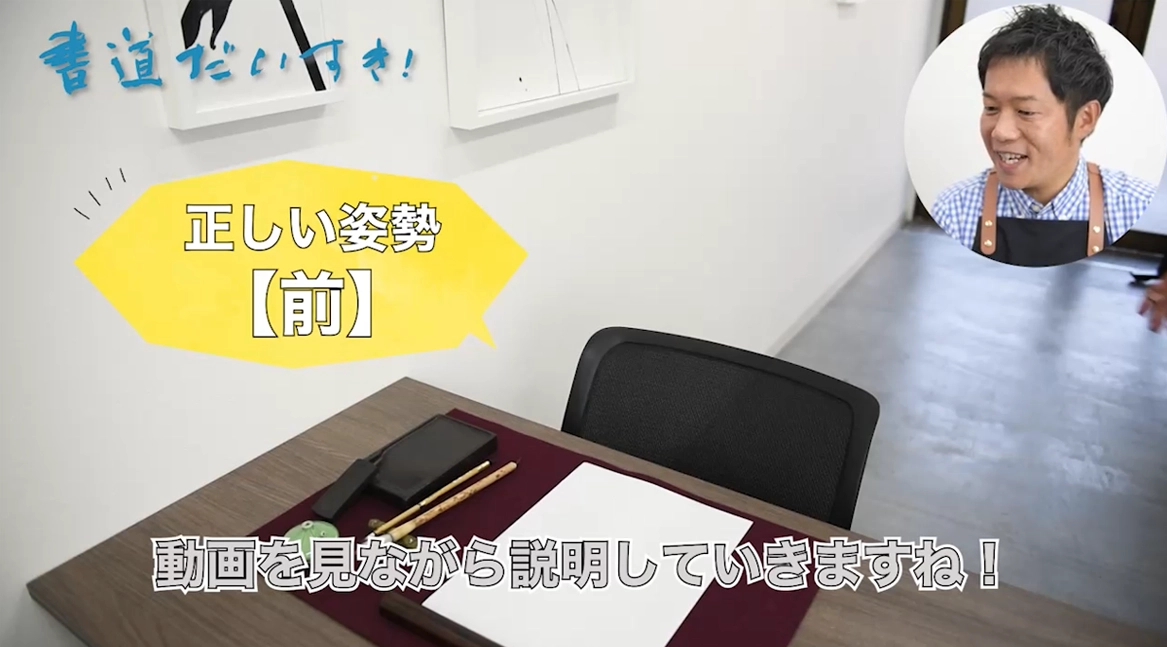
Now I’ll explain while we watch the video.
First, pull out the chair and sit facing straight ahead.
(It’s not shown here, but) make sure both feet are firmly on the floor.
Next, keep about a fist’s distance from the desk so your body can move freely.
Shimauchi 01:44
Here’s a side view.
Keep your back straight — posture matters most when writing.
Now let’s look at bad examples.
Shimauchi 02:04
Hunching forward? No good. Leaning on your left elbow? Also no.
Reclining back? Do people really do that? Maybe! Still a no.
Propping up a leg? Definitely not.
Getting too close? Also no. At that point, it’s hard to know what you’re trying to do.
Shimauchi 02:24
So — absolutely not!
Here’s my recommendation: if you’re not used to a desk and chair, or the desk is too high, kneel in seiza to secure your field of view.
Shimauchi 02:45
It’s surprisingly easy to write that way. I think it’s good. Please give it a try.
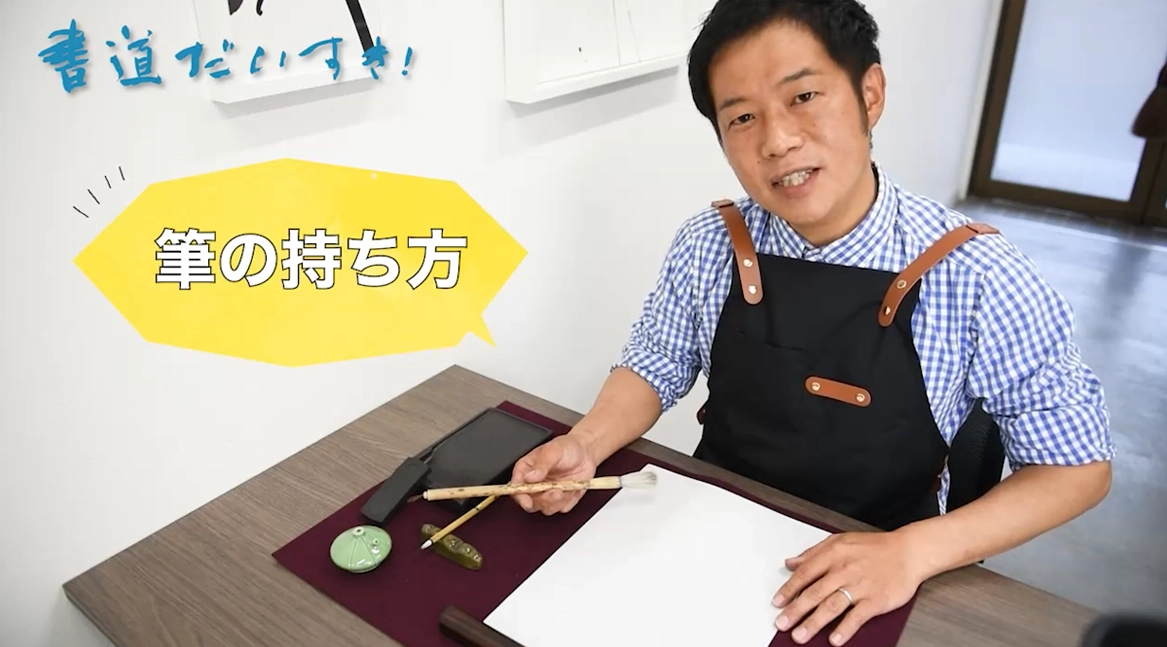
Now, how to hold the brush. There are many ways, but I’ll show textbook-standard grips.
Shimauchi 03:02
I use what’s called the double-hook (sōkō-hō).
It looks like this, with the index and middle fingers hooking the brush.
Shimauchi 03:22
This is called sōkō-hō.
Another common grip — similar to holding a pencil — hooks with only the index finger. That’s the single-hook (tankō-hō).
So, there are at least two textbook grips.
Shimauchi 03:39
I’ve held the brush like this since I was small, so I tend to drive the brush with the middle finger in the double-hook.
Shimauchi 03:56
However, I once heard that the index finger is the most dexterous of our fingers.
In that sense, the single-hook, which lets the index finger work, might be “best” for some people.
Preferences vary, of course, and perhaps that’s why many people use the single-hook.
Shimauchi 04:28
Next, arm positions (arm methods).
In kenwan-hō, you don’t clamp the elbow; you raise it and write broadly.
Shimauchi 04:48
Don’t clamp the sides tight; raise the elbow and move the brush with big motions.
The next one is probably the most common:
Shimauchi 05:09
Teiwan-hō (rested hand/arm): you place this part of the hand/arm on the desk for stability.
This is great for writing with a small brush, since it adds stability and makes writing easier.
Shimauchi 05:28
Still on teiwan-hō: if you lock this area rigidly, the lower you write, the more cramped it becomes.
So keep the arm relaxed and let it glide from above; that makes it much easier.
Shimauchi 05:43
If you want a little more angle, support with the left hand underneath and rest the right hand on top.
Shimauchi 06:01
That’s makurawan-hō (pillow arm).
This adds height, increases the brush’s range of movement, and makes writing easier — often used for kana.
Shimauchi 06:17
Personally, with makurawan-hō the brush tends to “float,” and since my technique isn’t there yet, I find it easier to write with teiwan-hō, fixing around here.
Shimauchi 06:28
Once your skills grow, either is fine, but just the difference between makurawan-hō and teiwan-hō changes how easy writing feels.
You might think, “I didn’t know that” — try it out. Makurawan-hō even looks elegant; it could be interesting to write that way.
Shimauchi 07:00
Lastly, there’s one arm method I once saw in person that shocked me:
kaiwan-hō.
Shimauchi 07:14
I’m not sure I can recreate it perfectly from memory, so please forgive me if it’s off,
but you fix the arm like this and write from here.
Shimauchi 07:32
Apparently, it was used by great calligraphers who laid the foundations of Japanese calligraphy, and some teachers continue passing it down today.
If you’re thinking, “What’s kaiwan-hō? I want to know,” a quick search should bring it up.
Shimauchi 07:49
That’s it for today.
If this video makes even one more person think calligraphy is fun, I’ll be delighted.
Shimauchi 08:09
If you found it helpful, please like the video and subscribe to the channel.
This was Shimauchi from Shodo Daisuki. See you!
Shimauchi 08:31
Bye-bye.
About Related Products
Here are items featured in this video.