

Shodo Daisuki Episode 31
```html
Shodo Daisuki Episode 31
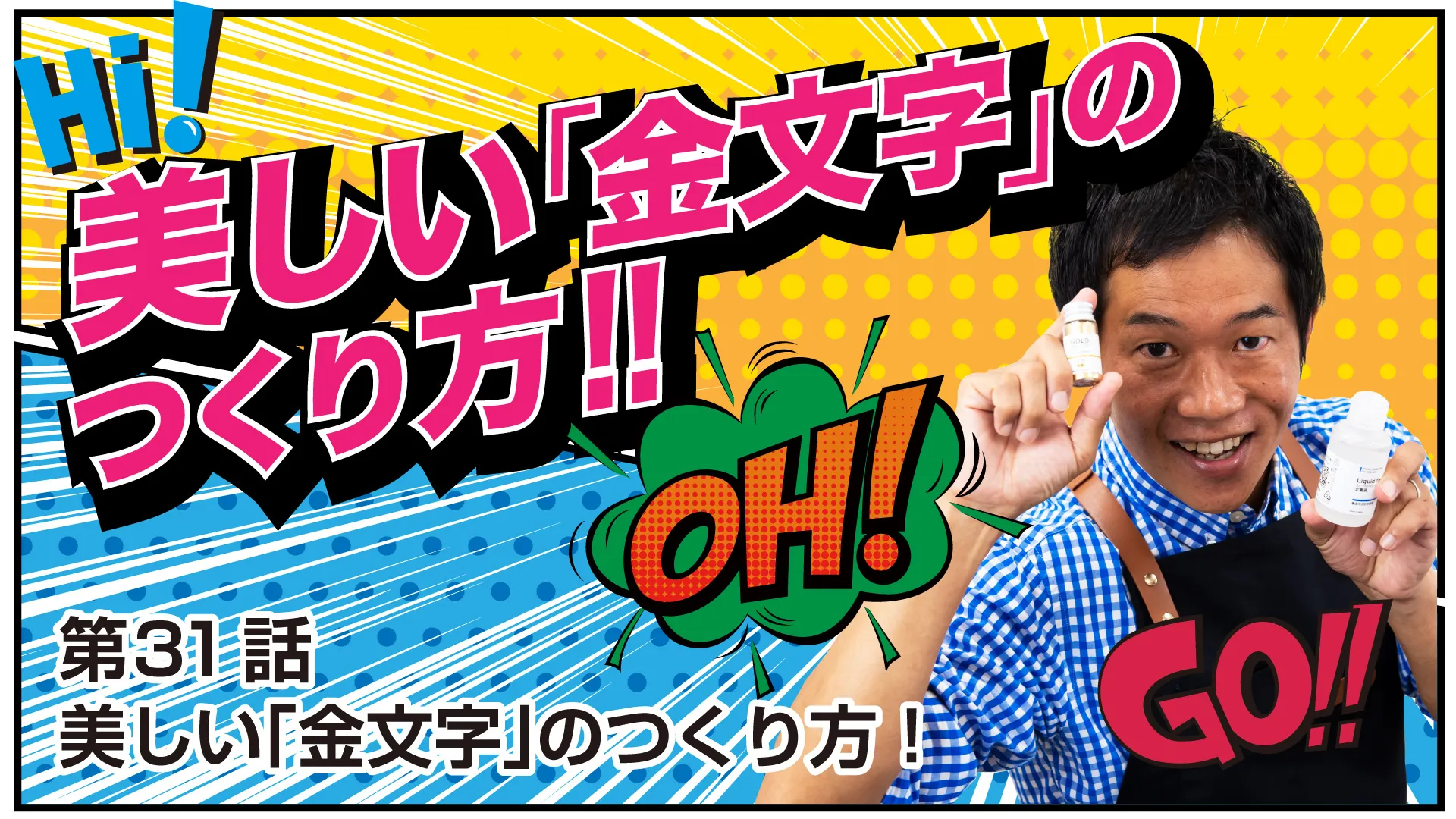
How to Create Beautiful Gold Lettering!! [Calligraphy]
Shodo Daisuki – Episode31
Want to write shimmering gold characters, but the color never turns out the way you imagined...?
Watch this and everything will be solved!! You’ll definitely be able to write beautiful gold lettering!!
Shodo Daisuki Episode 31: Video Overview
This is a calligraphy instruction video by Mr. Shimauchi on the theme of “How to Create Beautiful Gold Color.”
Mr. Shimauchi introduces how to write gold characters using gold pigment (kindei) for viewers.
As an alternative to traditional tools used to express gold (gold brush pens, gold ink, and gold in gansai watercolor), he provides a detailed explanation of how to make kindei by using gold powder and a fixing solution, and how to use it.
Mr. Shimauchi shares his own “golden ratio” using gold powder (two types: blue-gold and red-gold) and a fixing solution (mud-powder fixing solution).
Specifically, the formula is 33 ml of fixing solution for every 0.5 g of gold powder. He explains that kindei made with this ratio has a beautiful luster and a clearly superior shine compared to solid gold ink sticks.
For mixing kindei, he recommends putting the gold powder into a plastic mixing dish, adding the fixing solution on top, and thoroughly mixing it with your finger.
He explains that using your finger allows you to feel any clumps of powder and stir carefully.
For actual writing, he uses a sutra-copying brush called a “Suzume-gashira-fude” (Sparrow-Head Brush). While the tip is fine, the belly is swollen so it can hold plenty of ink, making it suitable for continuously writing small characters.
He emphasizes that when using kindei, it is important to load the brush generously without holding back.
As benefits of kindei, he highlights that it can be rinsed off easily with water, it can withstand mounting (hyogu), and it pairs well with black ink.
Mr. Shimauchi encourages viewers to use this method to write gorgeous gold characters.
YouTube Shodo Daisuki Episode 31
Shimauchi 00:00
I’d like to propose one thing to all of you, and also share a gold (kindei) recipe.
When you mix it thoroughly with your finger, the way the kindei shines is completely different, isn’t it?
Hi, this is Shimauchi from “Shodo Daisuki.”
Today’s theme: how to create a beautiful gold color.
Shimauchi 00:25
I’m sure many of you have thought at least once that you’d like to try writing shimmering gold characters.
But when you actually try, it doesn’t turn into the gold you imagined. “I’m stuck—what should I do? I don’t know.”
The tools people have used up to now include:
Shimauchi 00:41
gold brush pens, gold ink, and gold gansai watercolor. You may also have tried solid gold ink sticks in various ways.
But today I want to offer you one proposal: let’s make kindei and write gold characters with it.
I’ll also share the kindei recipe Shimauchi arrived at through repeated experiments, so
Shimauchi 01:09
please don’t miss this video.
On this channel, I’ll keep introducing more and more things related to writing—not limited to calligraphy—so please subscribe and give it a high rating. I’m also looking forward to your comments.
Shimauchi 01:25
Thank you in advance. All right then, let’s begin. First, I’ll explain the tools used this time.
The tools used are only two: gold powder (kindei powder) and a mud-powder fixing solution (also called a mixed fixing liquid).
Shimauchi 01:45
As for kindei powder, the two representative shades are blue-gold and red-gold.
Blue-gold has a brighter, more glamorous feel. Red-gold is closer to a calm, chic impression, I’d say.
Shimauchi 02:02
Now, let’s start making it. By the way, did you know about kindei powder?
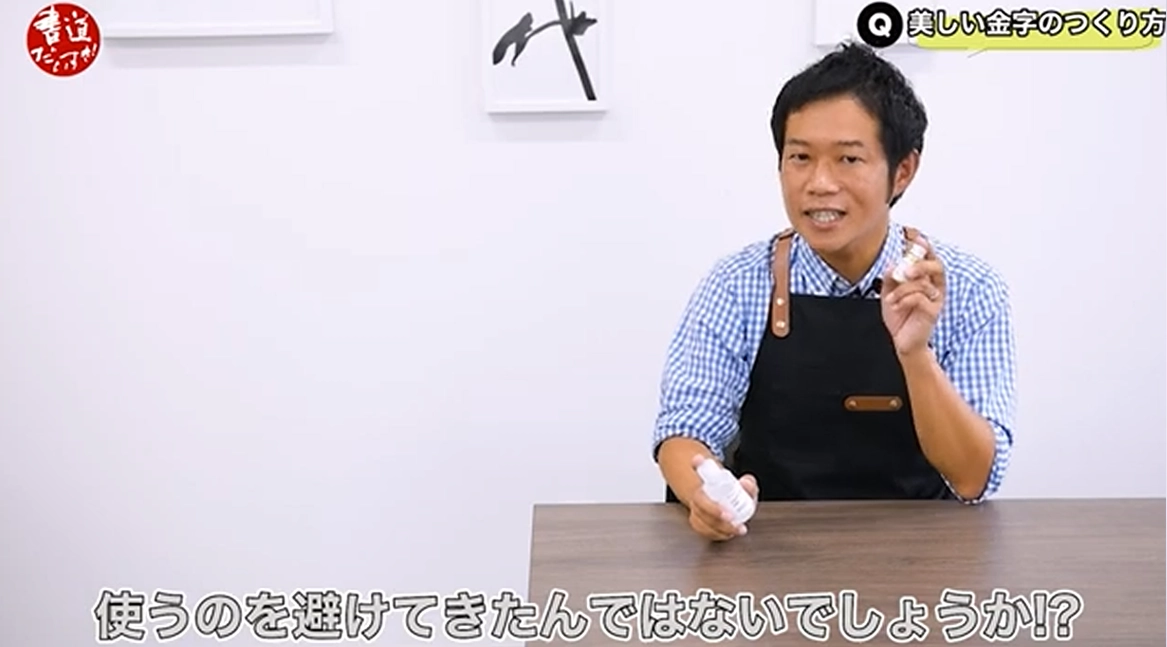
I briefly showed it in a previous, more casual video, but many people avoid using kindei and this fixing solution because they’re not sure how to use them.
Shimauchi 02:22
So this time, so you can use it with confidence, I’d like to share the kindei recipe I developed through repeated experiments.
The ratio is: 0.5 g of kindei powder to 33 ml of this fixing solution.
Shimauchi 02:46
Yes, it’s a pretty specific number.
If you’re thinking, “That’s a bit of a hassle,” that’s okay—you can use 3 g too.
But please remember this ratio. Make your kindei with this.
This time, I used
Shimauchi 03:05
a plastic mixing dish like this.
In this dish, I weighed out 0.5 g of kindei powder.
Next, I poured in 33 ml of the mud-powder fixing solution on top of the powder.
At this point, the powder and fixing solution are separated.
Shimauchi 03:28
You need to mix them thoroughly and stir the kindei powder properly.
Of course you could use various tools, but Shimauchi mixed it with a finger.
Why? Because your fingers have excellent sensitivity, so when you mix like this,
Shimauchi 03:48
you can really tell how well it’s blending. Since kindei powder is made of extremely fine particles, the fixing solution sits on top of the powder clumps—in other words, they’re coated at first.
So there can still be clumps of powder inside.
As you mix, it gets stirred in, and when you mix thoroughly with your finger, you can sometimes feel, “Ah, there’s still a lump here,” very clearly.
Shimauchi 04:04
So I mixed it well with my finger.
This is truly important, so take your time. It doesn’t take that long, so mix slowly and carefully, stirring until you feel the powder clumps are gone—and then you’re done.
Shimauchi 04:37
And here is the finished kindei.
It’s a bit hard to tilt it at an angle, but it moves like this.
There are almost no visible grains of kindei powder.
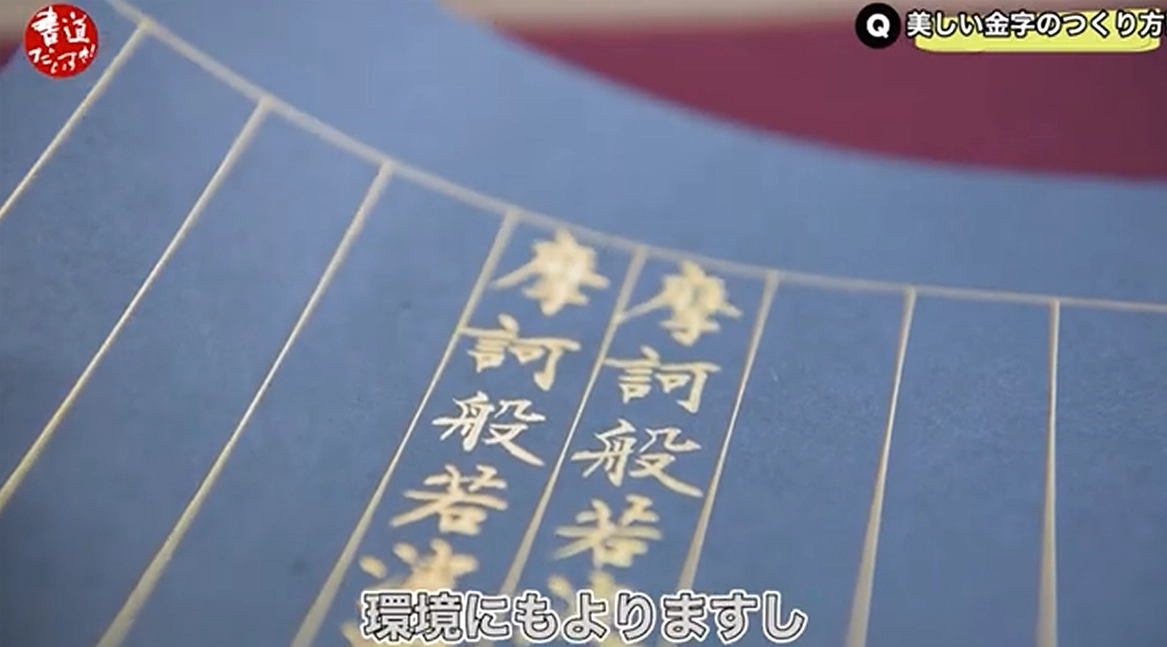
Now, we’re going to actually write with it, and I thought, when it comes to gold lettering, sutra copying would be a good match—so
Shimauchi 04:58
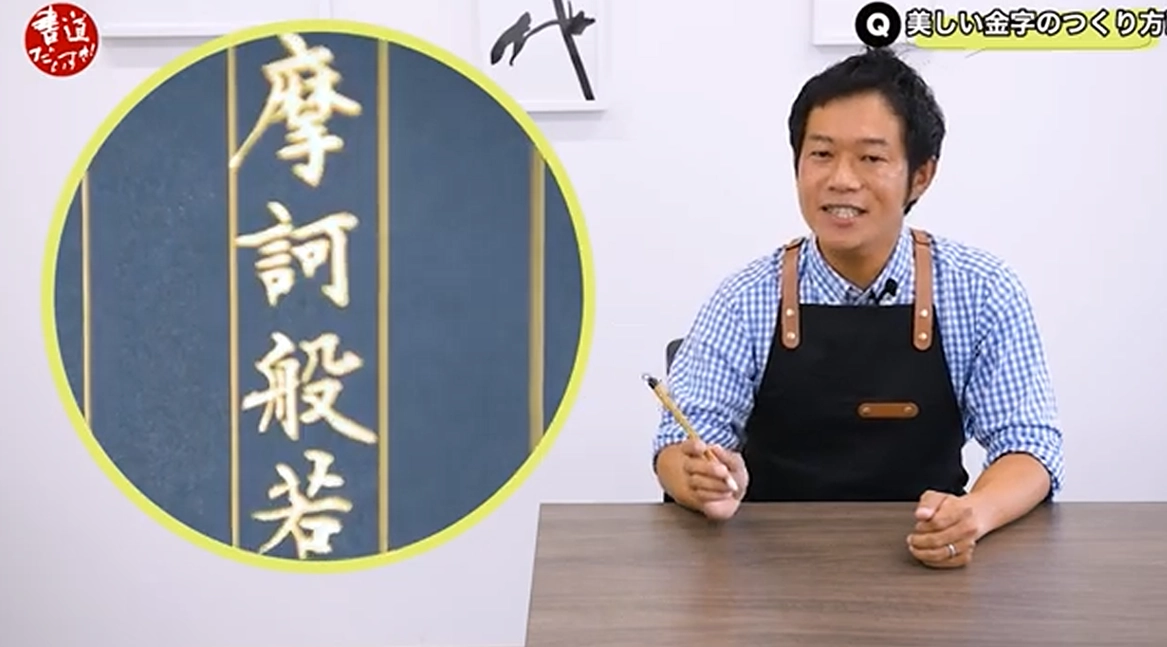
I tried copying sutra text in gold on hanshi paper.
There are various sutra-copying brushes, but I used one called a “Suzume-gashira-fude” (Sparrow-Head Brush).
“Suzume-gashira-fude” is a term you might not hear often.
As the name suggests, it comes from its shape resembling a sparrow’s head—
the tip is fine, but the belly of the brush is fuller, so it holds ink well and acts like a tank.
Shimauchi 05:15
Even for sutra copying with many characters, you can keep writing smoothly while the brush holds plenty of ink, which is one of its features.
And the tip responds very well, so it’s an excellent brush.
Please remember the “Suzume-gashira-fude.”
Now, how should you load kindei onto the brush tip?
When writing tiny characters like sutra copying, you tend to worry about making lines too thick, so you try to keep the amount down, right?
So when applying kindei, you might hesitate and apply only a little to the tip.
But then the color doesn’t come out well and it starts to skip, making it hard to write cleanly—
you’ll understand this once you try it.
So, take advantage of the Sparrow-Head Brush: even if you load it well, it acts like an ink tank.
You might think, “Is it really okay to load that much?” but because the tip is still fine, if you use the tip properly, you can write perfectly well.
So first, boldly load kindei into the brush. This is important.
If the amount is too small, the kindei color may not develop well, so I think it’s important to load it decisively.
Shimauchi 07:11
So I tried writing right away, and my first impression was, “Wow, it shines in gold more strongly than I expected.”
And yes—like I said earlier—deep down, I was a bit nervous, thinking, “Maybe I loaded too much,” but in practice, the Sparrow-Head Brush was wonderful.
The tip worked beautifully, and it wrote smoothly.
Normally, I could have kept writing more and more, but this time I thought it might be better to write a bit slowly, so I dipped more often.
Still, honestly, I could have kept going at a steady pace and it would have been fine—that’s my impression.
Shimauchi 07:49
And this time, to compare with kindei, I also used a solid gold ink stick close to the color of the kindei powder and wrote with it as a comparison.
As you can see, this gold ink—ground-ink liquid—compared to it, the shine of the kindei we just used is totally different, right?
The difference is obvious at a glance. Honestly, it was more different than I imagined, and it made me really want you all to use it.
I couldn’t help getting excited—that’s how big the difference is.
Shimauchi 08:33
And there’s another difference between kindei and solid ink.
When I mixed the kindei earlier, I used my finger, and you might have thought, “Like ink, if it gets on your finger, it won’t come off easily, right?”
But actually, kindei rinses off quickly with water.
It’s the same for the brush. Even after loading that much, when you wash it, it comes off so cleanly you’ll think, “Wait, you were using gold just now?”
So it’s very gentle on brushes.
On the other hand, solid gold ink has higher viscosity, so when you wash the brush, the gold tends to be hard to remove.
So please remember this as well: once you use a brush with solid gold ink, it can end up becoming a brush you only use for that purpose.
Shimauchi 09:24
So, everyone—what did you think?
I shared Shimauchi’s “golden ratio” for making kindei, but this is only a reference. It depends on your environment and on the paper you’re writing on, so please treat it as a guideline.
Still, for your first try, I’d really like you to start with this ratio and give it a go.
Shimauchi 09:59
Kindei can withstand mounting (hyogu), so please don’t worry.
If you’re still a bit concerned during mounting, I think it’s fine as long as you tell your mounter to apply a strong sizing/sealant to prevent bleeding.
Of course, I’ve tested it—backing (urauchi) can be done properly.
And if you want to write larger gold characters beautifully, just increase the quantity using the same golden ratio, and you can make beautiful kindei—so rest assured.
Gold lettering is gorgeous, isn’t it? You can use it for celebrations, too.
And above all, it pairs well with black ink.
So everyone, please try writing lots of shimmering gold characters.
All right—this was “Shodo Daisuki.”
Shimauchi 10:52
Gold, kindei, golden Friday—wow, nothing but good things. Feels like something good might happen today.
See you again! Goodbye.
Related Products
Here are the products featured in this video.


