

Shodo Daisuki Episode 32
Shodo Daisuki Episode 32
“Shimauchi’s One-Question-One-Answer!! [Calligraphy]”
Shodo Daisuki – Episode 032
This is a new series where “Shimauchi” answers your straightforward questions!
Shimauchi, a man who truly loves calligraphy, explains everything in depth!
Shodo Daisuki Episode 32 – Video Overview
Mr. Shimauchi is sharing a video on his YouTube channel where he answers viewers’ questions under the theme “Shimauchi’s One-Question-One-Answer.”
He happily reports that the channel has surpassed 900 subscribers and is now approaching 1,000.
In this video, he provides detailed answers to a wide range of questions about calligraphy.
First, Shimauchi talks about the significance of answering questions from viewers and explains that on this channel he will introduce not only calligraphy itself but also many calligraphy-related topics in a broad sense.
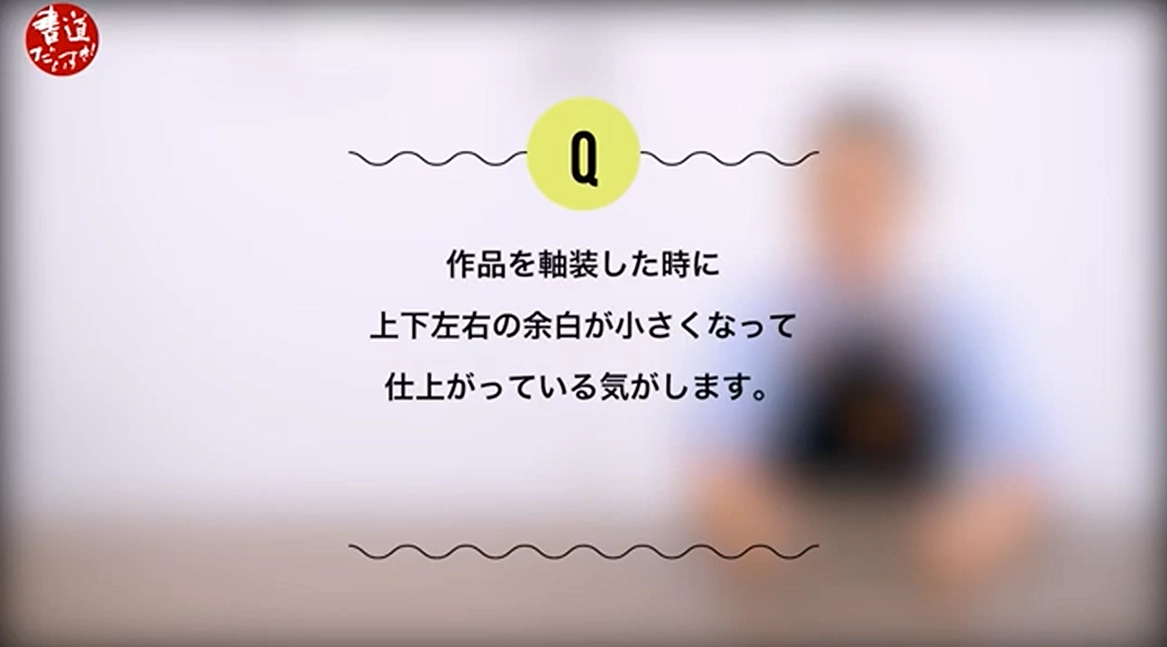
In his answers, he carefully explains, with expert knowledge, topics such as the difference between a suiteki (water dropper) and a water pitcher and how to use them correctly, why the margins become smaller when a work is mounted as a hanging scroll, the standards for solid ink sizes (classified by weight), how to improve the viscosity of bottled ink (by adding glass marbles), and why names of hanshi paper products differ depending on the region.
At the end, Shimauchi thanks viewers for their questions and concludes by promising to continue sharing useful information as he aims for 1,000 channel subscribers.
YouTube Shodo Daisuki Episode 32
Shimauchi 00:00
I, Shimauchi, would like to answer your questions.
It’s just that the way you’re using it is incorrect, so it’s not a defective product. Please don’t worry.
That’s how it feels, right? “What should I do?” This kind of situation happens quite often.
Hello, this is Shimauchi, who loves calligraphy. Today’s theme is “Shimauchi’s One-Question-One-Answer.”
Shimauchi 00:25
Oh—so as of today,
thanks to all of you, we have passed 900 channel subscribers, and now 1,000 is finally coming into sight.
I’m truly grateful, and now we’ve begun to receive many questions from everyone as well.
Shimauchi 00:44
When that happens, I feel it would be a waste to keep these questions only to myself, Shimauchi.
So this time, I decided to share them with all of you and,
with your permission, I, Shimauchi, will humbly do my best to answer them.
Shimauchi 01:03
That’s why I decided to make this into a video.
On this channel, I’m going to introduce not only calligraphy itself, but also many topics related to calligraphy, so please subscribe and give the videos a high rating.
Now, let me start answering these wonderful questions.
Shimauchi 01:20
Let’s move on to the first question.
Normally, I just keep talking straight to the camera, but this time, so I don’t misread the questions, I’ve placed a cue card in front of me. So I’ll be glancing down at that from time to time—
Shimauchi 01:40
please forgive me for that. All right, first question: I bought a suiteki (water dropper),
but I can’t pour the water properly.
Is it defective? That word “defective” really makes us on the seller’s side jump, but actually this is a very good question.
Shimauchi 02:01
Everyone, did you know the difference between a suiteki and a water pitcher?
This is what we call a suiteki, and as you can see, it has a hole in the center.
If you try to pour water just like this, it will drip and splatter everywhere and
Shimauchi 02:21
you won’t be able to pour water properly.
So how do you actually use a suiteki? First, when you pour water into it—some of you may have experienced this—because the opening is small,
you carefully adjust the faucet so the water goes in without spilling.
Shimauchi 02:39
Many of you have probably struggled, thinking, “Ah, is it going in?” But actually, there’s another way to fill it: you submerge the suiteki into the water itself
to let the water in.
And to use the suiteki, you block the center hole with your finger,
Shimauchi 06:02
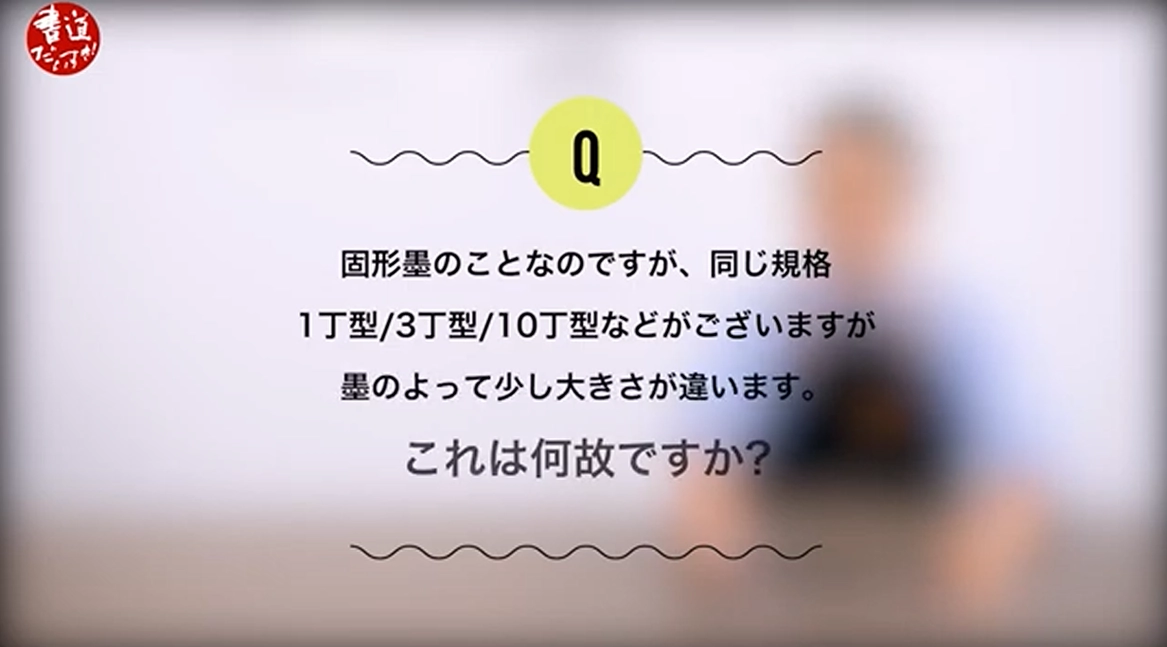
So how is the size of ink determined?
What kind of standard is used to decide how big an ink stick is?
In fact, it’s the weight.
So for example, a 1-chogata ink stick is about 15 grams; a 3-chogata stick is 45 grams;
Shimauchi 06:22
a 5-chogata stick is 75 grams; and a 10-chogata stick is 150 grams.
Of course, there are rough standards for length as well, but
because the thickness of the ink stick can vary, the actual length changes, too.
Shimauchi 06:39
So please remember that the real standard is weight.
Now, about Chinese ink sticks, called “Tou-boku,” which can look a bit mysterious.
You’ll often see markings like 1/2, 1/4, or 1/8 on them, right?
Shimauchi 06:57
Chinese ink sticks are based on a standard of 500 grams.
They show the size by how much of that 500 grams the stick weighs. So 1/2 is 250 grams, 1/4 is 125 grams, and 1/8 is
Shimauchi 07:14
about 63 grams.
It’s quite fascinating, isn’t it?
An interesting difference between Japanese and Chinese ink standards.
We still have more questions, which is wonderful.
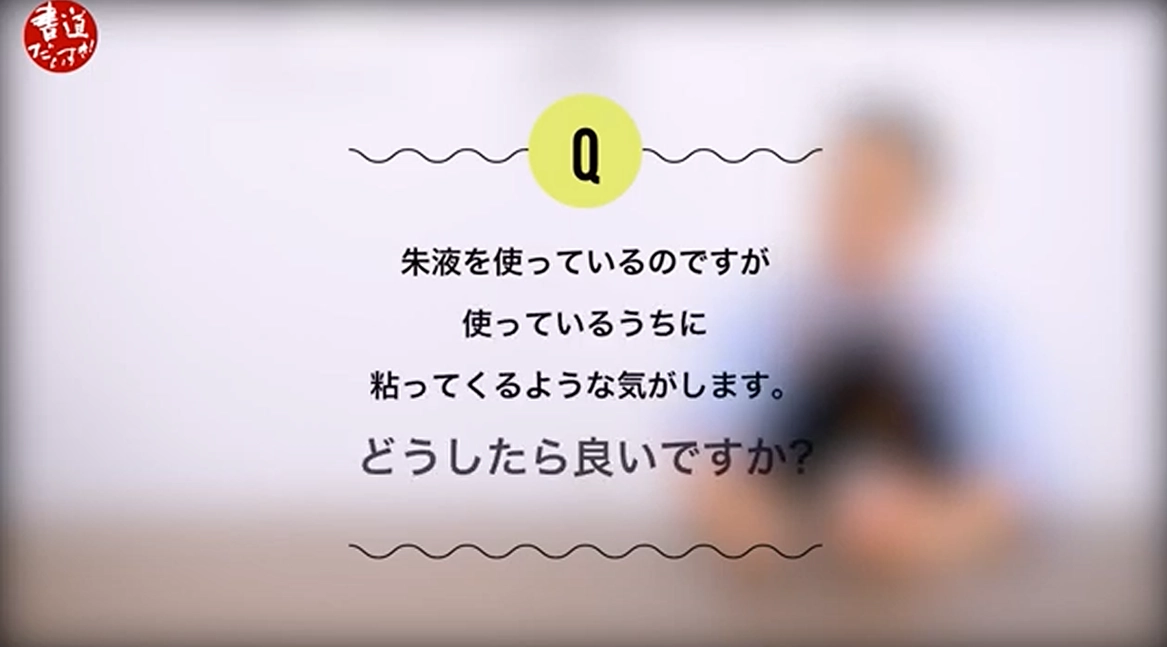
Next question: I use bottled ink, but it feels like it gets thicker and thicker as I use it.
Shimauchi 07:37
What should I do?
Yes, I can definitely understand that feeling.
In previous videos, I mentioned that you should shake ink well so that the particles move actively (Brownian motion) and the ink stays well mixed.
Shimauchi 07:53
But bottled ink, especially certain types of special ink,
tends to be heavier than regular bottled ink.
So at first it feels smooth and nice, but as time passes, because of that heavy specific gravity,
Shimauchi 08:10
it gradually settles at the bottom.
So the more you use it, the thicker and more sludgy it becomes. You might think, “Well, I’ll just shake it harder,” but I realized something.
Previously, when I shook a certain type of gold ink, I heard a sound inside the bottle.
Shimauchi 08:25
I wondered why it made that sound,
and it turned out there was a glass marble inside the bottle.
That marble helps mix the ink more effectively.
Shimauchi 08:43
So if you put a glass marble into this bottled ink as well, when you shake it,
the marble will help stir it more thoroughly and keep it well mixed.
Shimauchi 09:00
Nowadays, many children probably have glass marbles at home, and
if you look around just a bit, I’m sure you’ll find one somewhere.
If adding just a single marble makes it easier to mix the ink and reduces sedimentation, I think it’s definitely worth trying—so please give it a go.
Shimauchi 09:16
Now we’ve come to the final question.
Let me introduce it.
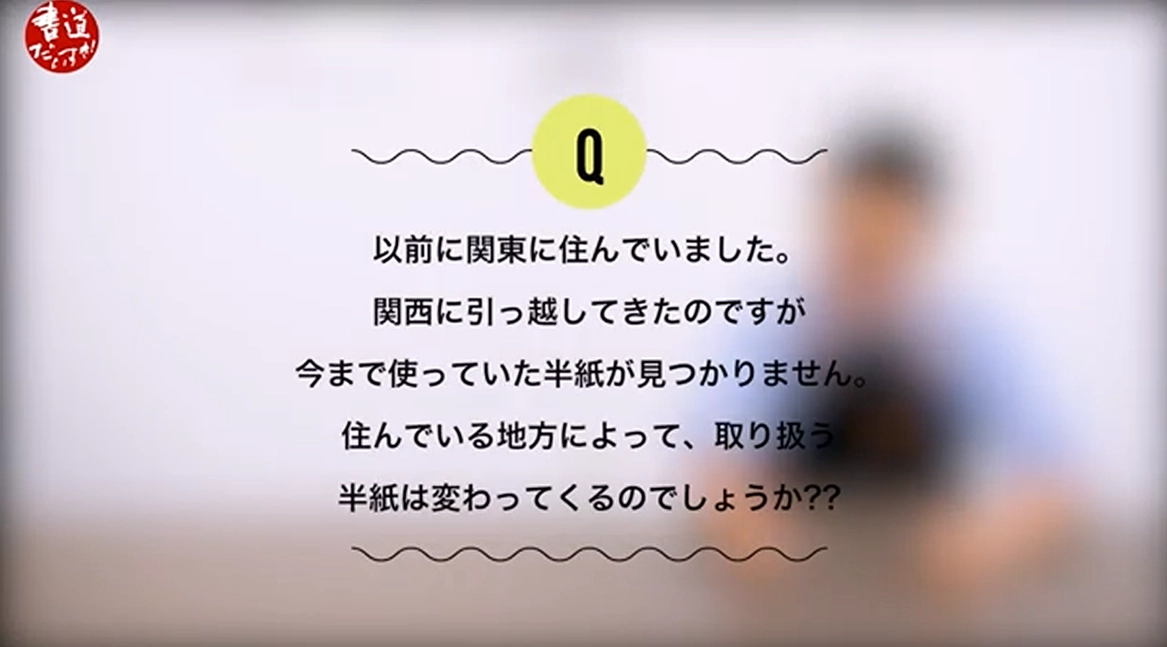
“I used to live in the Kanto region, but I moved to Kansai.
Shimauchi 09:33
However, I can’t find the same hanshi paper I used before.
Does the hanshi paper available differ depending on where you live?” This is a very deep question.
To be honest, in the past I myself used to think there was only one type of hanshi paper.
Shimauchi 09:54
I believed that the paper I was using was everything there was.
Up until around high school, I thought that way.
Naturally, that paper had a product name, and I remembered it by that product name.
When I wanted to use it again, I thought I just needed to look for that name.
Shimauchi 10:16
But just like this person experienced, sometimes you find that
the paper with that product name simply isn’t sold where you move to.
That does happen quite often.
Some product names are indeed the same as the names used by the manufacturer.
Shimauchi 10:37
However, in most cases, each calligraphy supply shop gives the paper its own name.
This doesn’t apply only to paper; it can be true for brushes as well.
If the manufacturer’s brand name is very famous, that name may appear directly on the product, of course,
Shimauchi 10:54
especially for well-known brands in the trade.
But when you’re in trouble like this, instead of searching by product name,
Shimauchi 11:11
bring the actual paper you’ve been using to the calligraphy supply shop and say, “Could you find something similar to this paper?”
If you do that, the shop will almost always be able to find a paper that’s quite close to what you’re used to, and just that
Shimauchi 11:27
will bring a great sense of relief.
So it’s important not to fixate on the product name itself.
Please just remember that point.
Now then, how was it?
Shimauchi 11:43
No, no, I don’t mean “How did I look in glasses?”
I’m not asking about that—I mean, how were the questions and my answers today?
Ah, yes, that’s the feeling I wanted to convey.
Thanks to all of you, we are now receiving many questions like this.
Shimauchi 11:59
It truly is all thanks to you.
If more questions continue to come in, we’ll be able to create even more opportunities
to introduce them in future videos.
So please don’t hesitate—whether in the comments or, as in this case,
Shimauchi 12:16
by email—any format is fine.
Feel free to send in your questions.
Now that we can finally see the goal of 1,000 subscribers,
my own excitement is really starting to build.
Shimauchi 12:31
At this point, all we can do is keep pushing forward.
To achieve that, I want to continue sharing information that will be truly useful to all of you.
So I, Shimauchi, will keep doing my very best with all my heart and energy,
Shimauchi 12:45
and I hope you will continue to support me.
This has been Shimauchi, who loves calligraphy. I’ll keep working hard to reach 1,000 subscribers. Let’s do it! Well then, goodbye!
Related Products
Here are the products that appear in this video.


