

Shodo Daisuki Episode 33
Shodo Daisuki Episode 33
About Hanging Scroll Mounting Styles! (Bunjin Style Edition) [Calligraphy]
Shodo Daisuki – Episode 033
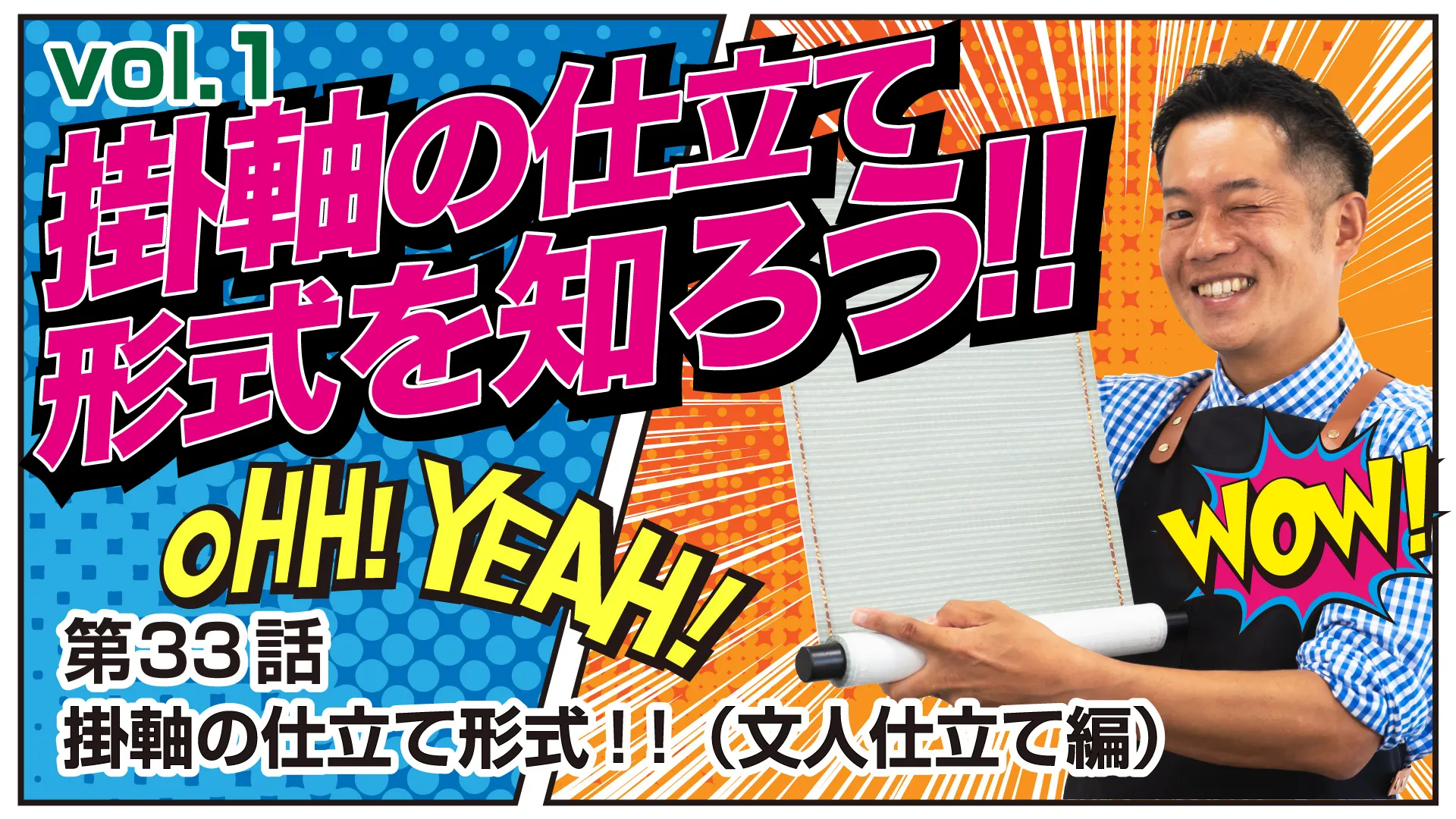
Hanging scrolls add color and character to any space, so why not fully express your own tastes and style through them?
Shimauchi, a man who truly loves calligraphy, explains everything in depth!!
Shodo Daisuki Episode 33 – Video Overview
This video features Mr. Shimauchi explaining the different mounting styles for hanging scrolls.
If you don’t know about hanging scroll mounting styles, you may leave everything to the framer when turning your calligraphy into a scroll, and your own intentions might not be reflected in the final piece.
In this video, he gives a detailed explanation of one of the major mounting styles: the “Bunjin Shitate” (literati style).
Bunjin Shitate is a type of hanging scroll that uses a single kind of mounting fabric and is a style that came to Japan from China.
It is also called “Bunjin Hyoso” and is considered a versatile style that harmonizes well with many different scripts and works.
Within Bunjin Shitate itself, there are several variations, each with its own characteristics, which are explained in the video.
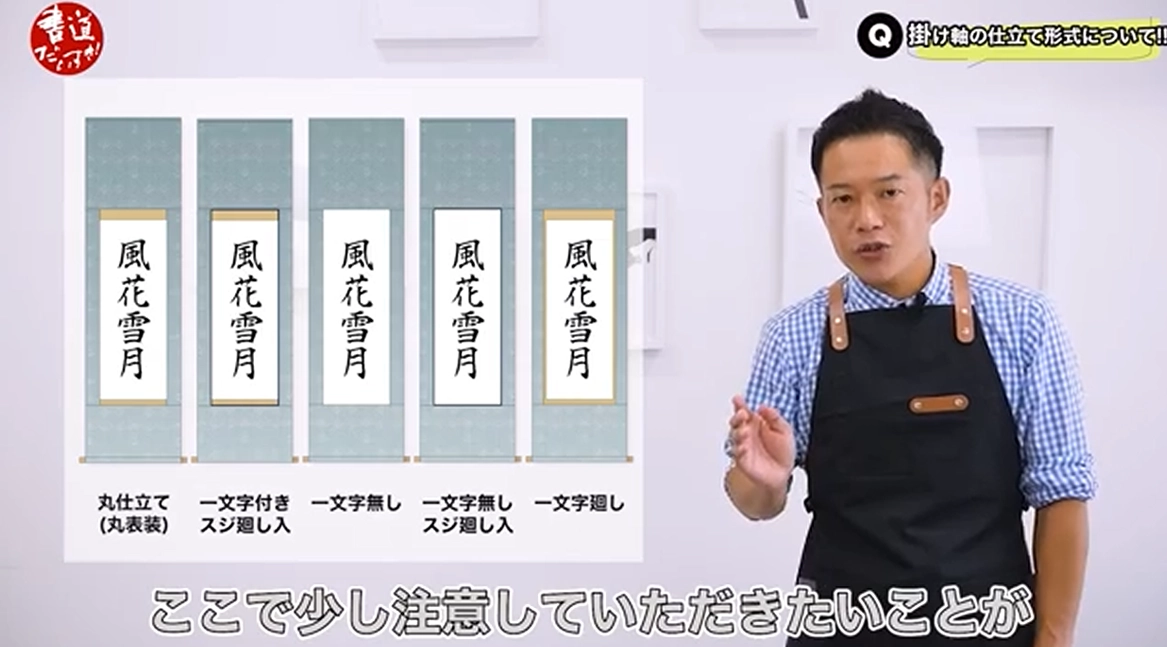
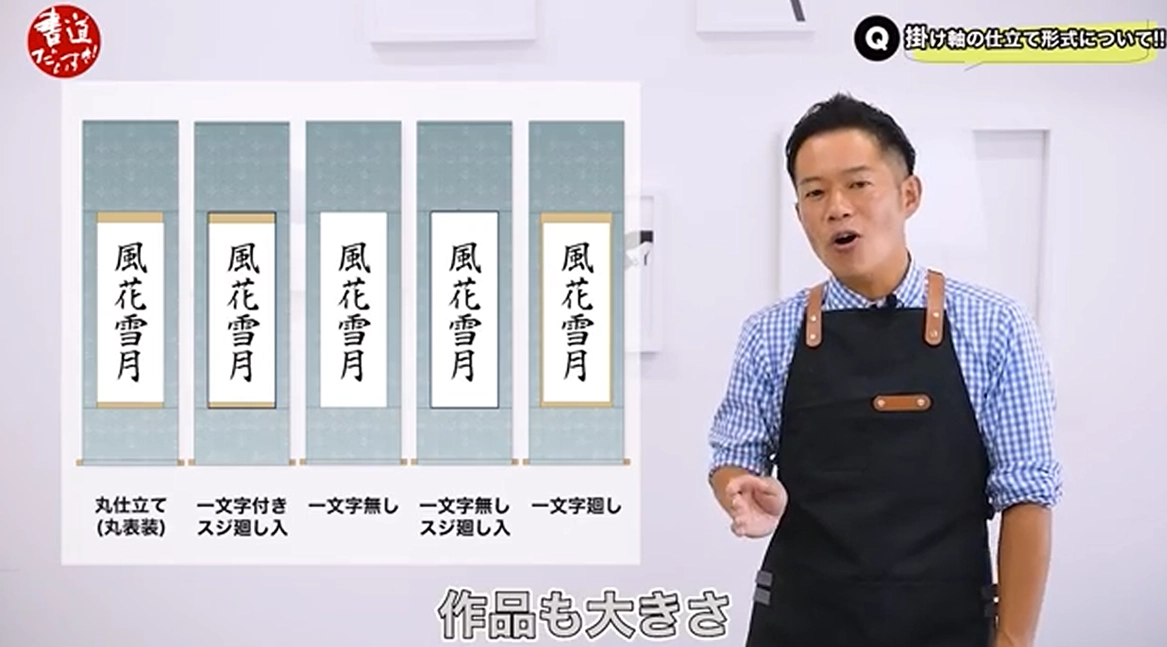
Among the main styles, “Maru Shitate (Maru Hyoso)” is the most popular form, where a strip of fabric called “ichimonji” is attached above and below the artwork; it is often seen at exhibitions, and the choice of fabric allows you to add individuality.
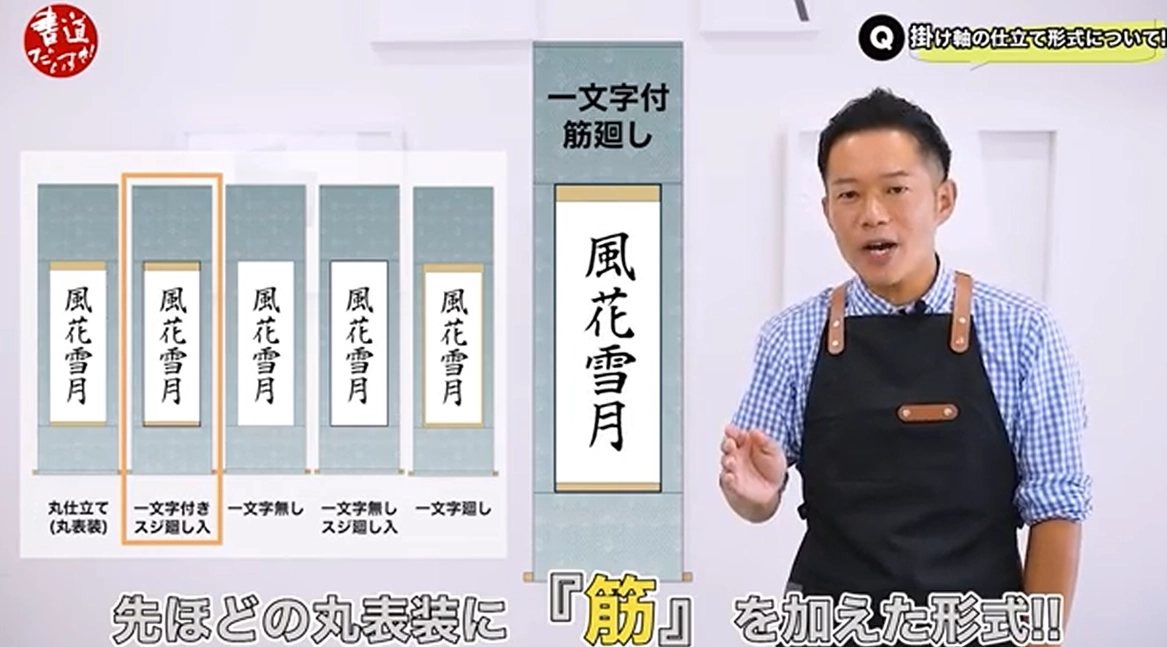
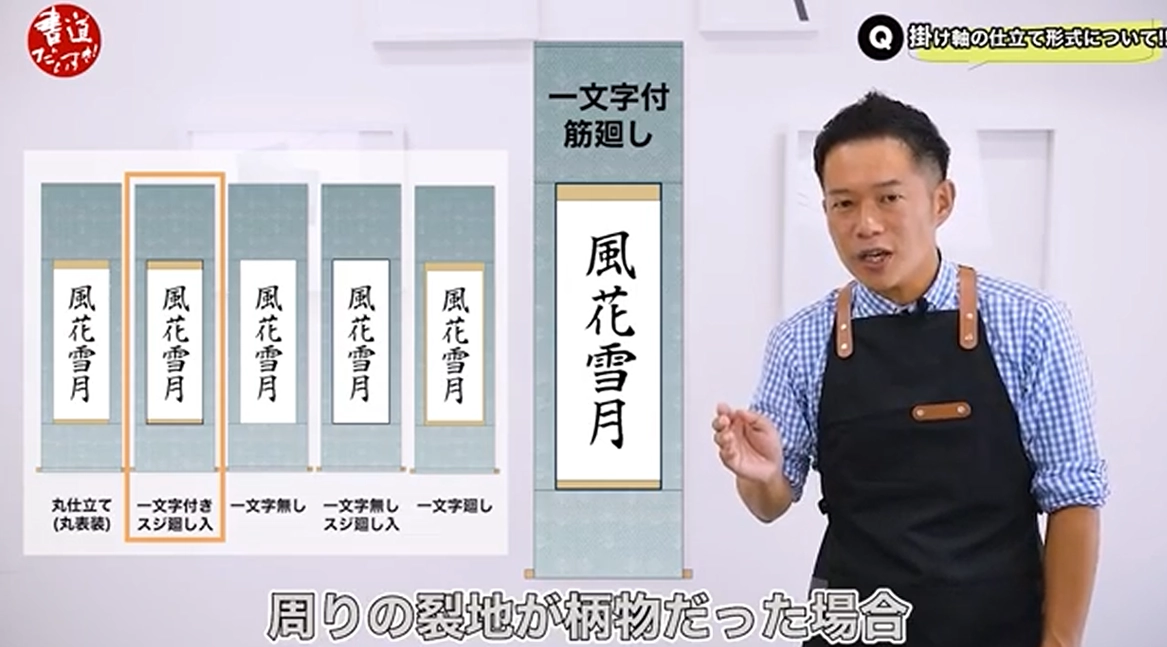
“Ichimonji-tsuki Sujimawashi Shitate” adds decorative lines (sujimawashi) to Maru Hyoso and is also known as “Honbukuro Hyogu”; the added lines tighten and accentuate the work.
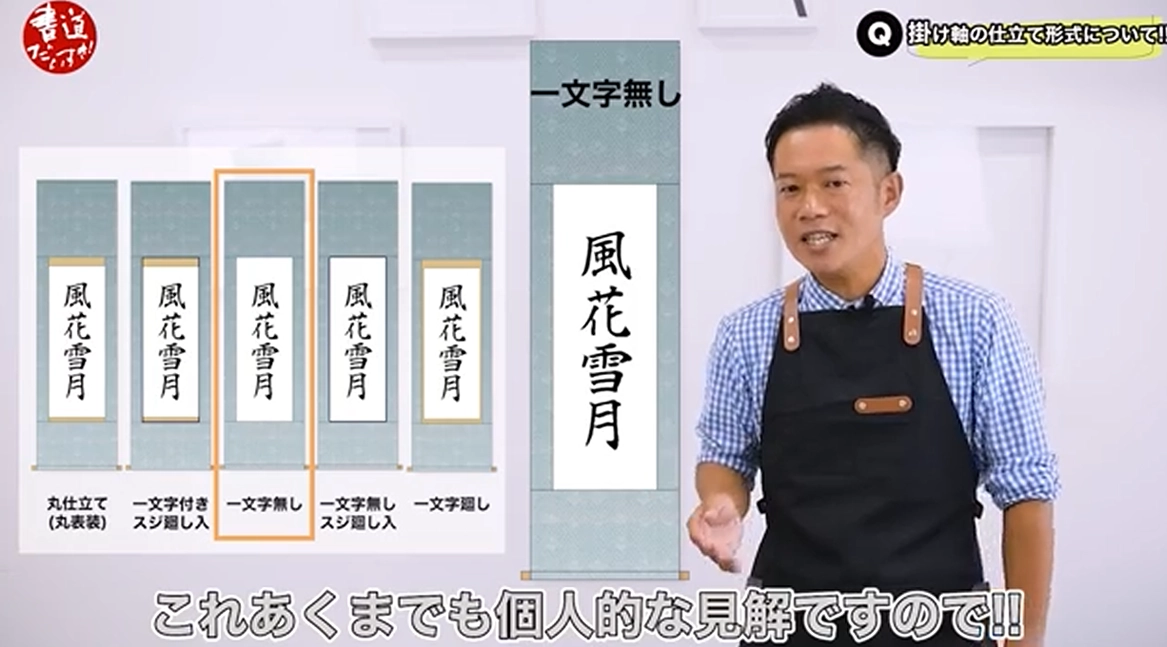
“Ichimonji-nashi Shitate” is a simple style that omits the ichimonji from the maru style and is also called “Fukuro Hyogu.”
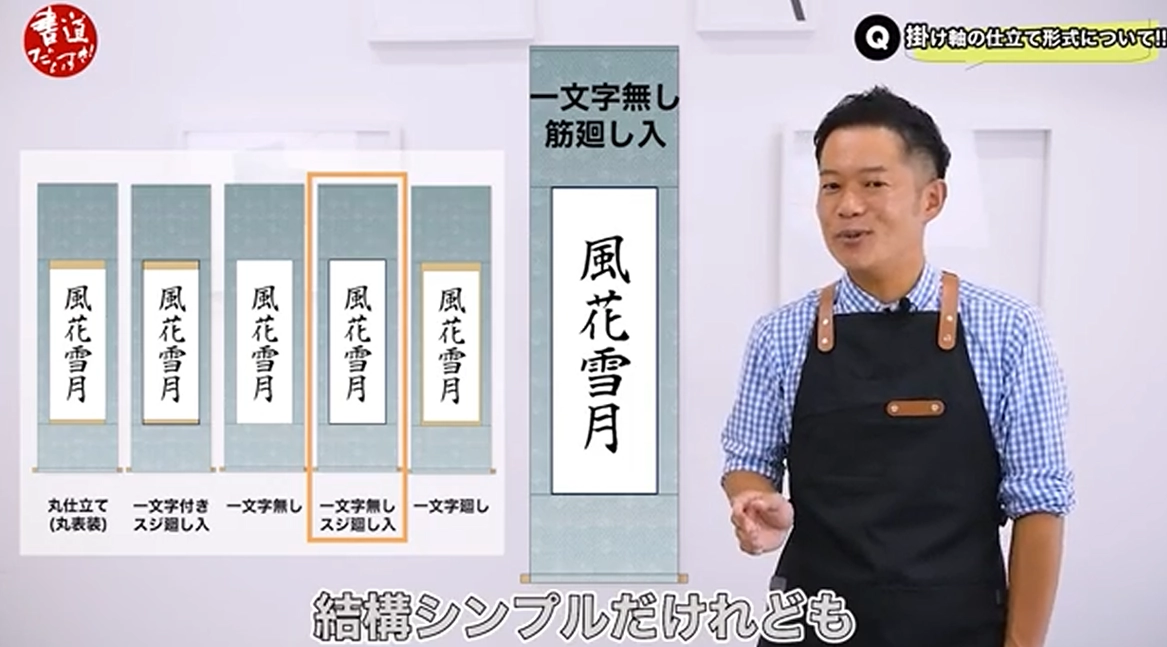
“Sujimawashi Shitate” is a style that adds lines to an ichimonji-nashi mounting, while “Ichimonji Mawashi Shitate” uses the ichimonji fabric itself to fulfill the role of the sujimawashi.
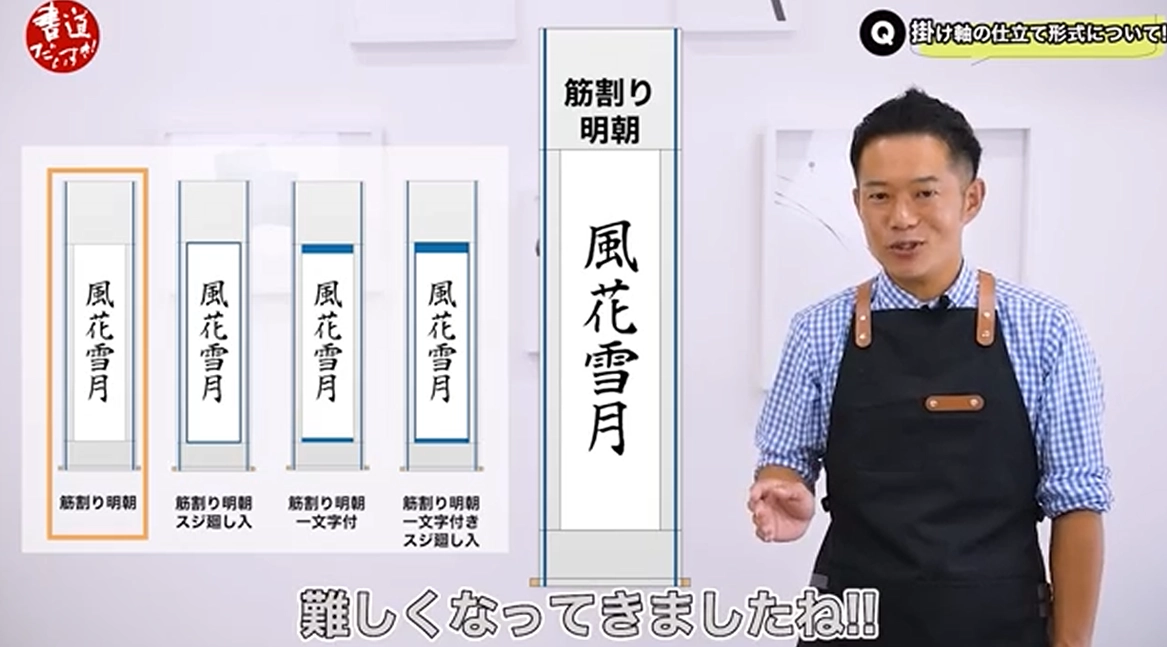
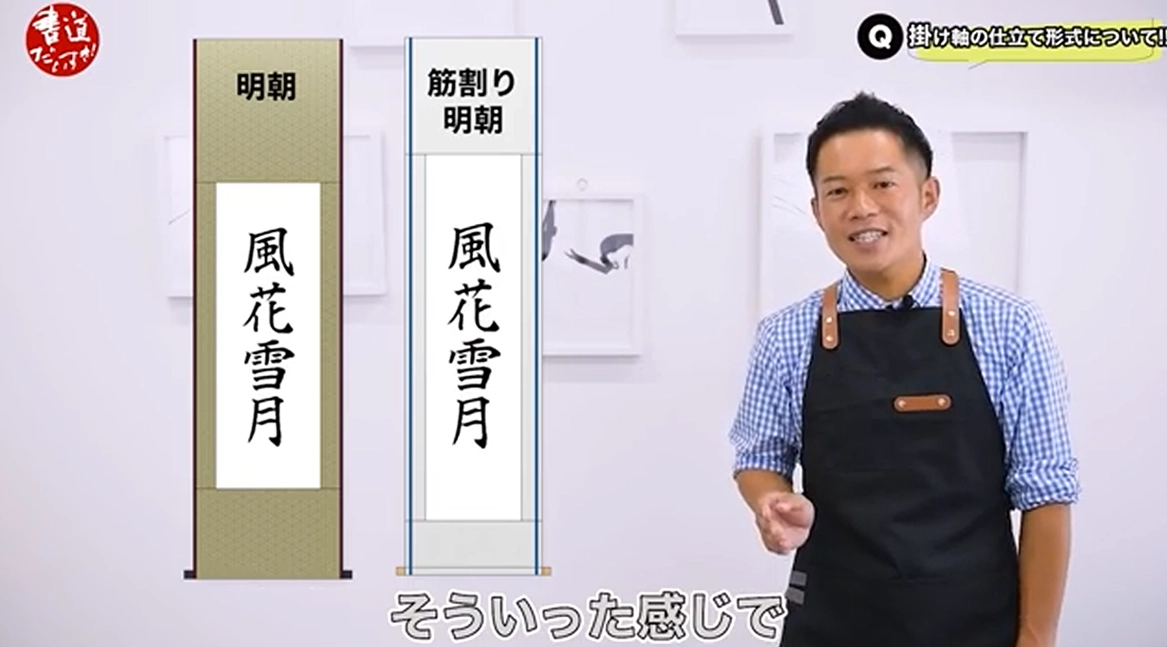
Furthermore, “Mincho Shitate” is a style that was popular in China during the Ming dynasty; it adds vertical borders along both sides of the scroll, emphasizing the vertical flow of the piece.
“Sujiwari Mincho Shitate” adds vertical lines inside the main pillars, creating a clean and stylish impression.
“Futo Mincho Shitate” replaces the pillars with wide side borders, making it an effective choice when you want the work to appear larger.
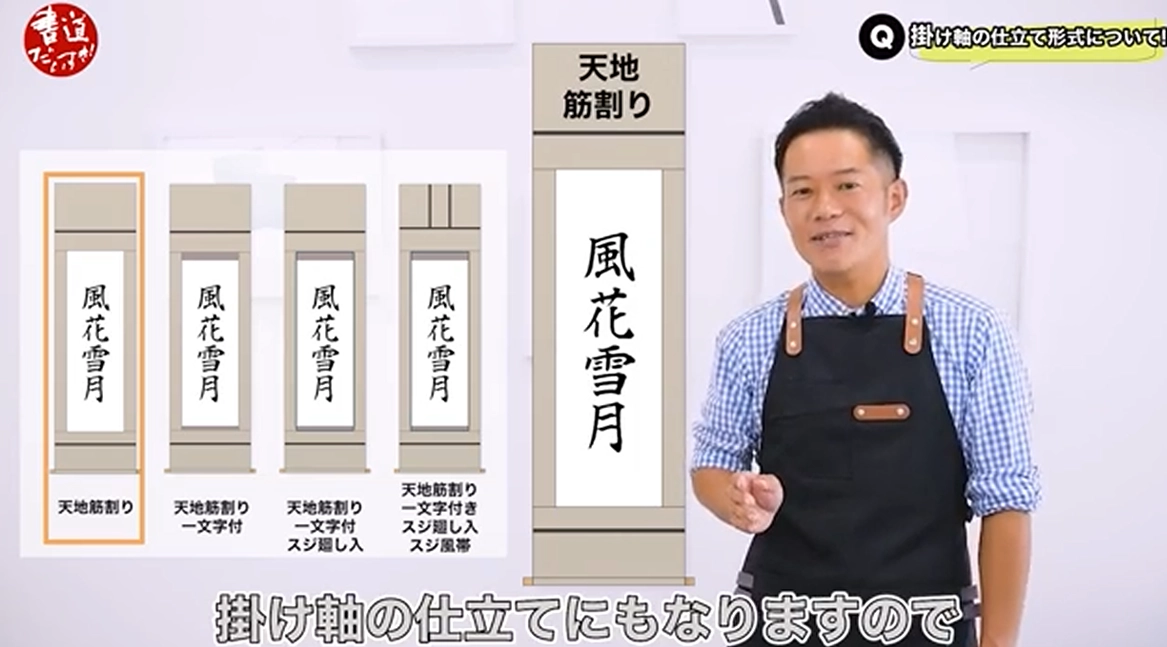
As a special variation, “Tenchi Sujiwari Shitate” is also introduced, in which the top and bottom (heaven and earth) portions are divided horizontally by lines while still using a single type of fabric.
This style is suitable for smaller works and helps them appear longer in height.
Mr. Shimauchi emphasizes that by knowing these different styles, you can choose the mounting that best suits your own work.
He also mentions that the next video will focus on the “Pure Japanese Style” mounting.
YouTube Shodo Daisuki Episode 33
Shimauchi 00:00
My hope is that your hanging scroll will be finished in a way that reflects your own intentions. I imagine there are many cases where that doesn’t happen, and the vertical flow of the piece isn’t emphasized the way you wanted.
Hello, this is Shimauchi, who loves calligraphy. Today’s theme is hanging scroll mounting styles.
Shimauchi 00:22
“All right, I’ve written a really good piece! Time to have it mounted as a hanging scroll.”
Full of enthusiasm, you go to a calligraphy supply store to make a request.
“Excuse me, I’d like to have this work mounted as a hanging scroll. Could you do that for me?” “Of course.”
Shimauchi 00:38
“Now then, what kind of mounting style would you like for this piece?”
“Mounting style…?” You might think, “Wow, they’re explaining everything so politely and in so much detail, but I have no idea what to choose.”
The clerk might say, “I can see this is a lot to think about and quite confusing.”
Shimauchi 00:56
“In that case, how about we choose the most suitable style for this work and you just leave it up to us?”
“You can do that? Then please, I’ll leave it up to you.”
Has anyone ever experienced a situation like this?
Shimauchi 01:14
Let’s reframe it a little.
Imagine you’re moving into a new home.
Would you say, “Just choose whatever you like” when it comes to the curtains or the wallpaper?
The color and pattern of curtains and wallpaper are very important, right?
Shimauchi 01:30
Of course, the patterns and the fabric matter a lot too, so leaving everything up to someone else is a bit risky.
What I want to say is this: your work should be mounted as a scroll in a way that reflects your own intentions.
Shimauchi 01:46
That’s the key point.
So to make sure you don’t end up in the kind of “I don’t know what to choose” situation we just saw,
I’d like you to at least know the standard hanging scroll formats. That’s the purpose of this video.
Shimauchi 02:02
Hanging scroll mounting styles can broadly be divided into two big categories:
Bunjin Shitate and Pure Japanese Shitate.
In this video, I’ll be focusing on Bunjin Shitate, explaining and describing it in detail, so I hope you’ll stay with me until the end.
Shimauchi 02:25
On this channel, I introduce not only calligraphy itself, but also many topics related to it, so please subscribe and give the videos a thumbs-up.
All right, let’s jump into the main part!
So then, what exactly is Bunjin Shitate?
Shimauchi 02:51
Bunjin Shitate is a hanging scroll made using a single type of fabric, and it’s a mounting style that originally came from China.
It is also known as Bunjin Hyoso. Because the mounting fabric is not made of paper, it harmonizes well with many different kinds of writing—
Shimauchi 03:13
for example, Chinese poems, classical Chinese texts, or pieces like these here.
It’s said to be a style that suits a wide variety of works.
Within Bunjin Shitate, there are actually several distinct mounting styles, so
Shimauchi 03:33
I’ll go through them one by one.
First is Maru Shitate. You might know it better under the name Maru Hyoso—that may sound more familiar.
In this style, a strip of fabric called ichimonji is attached above and below the work.
Shimauchi 03:53
You probably see this style quite often at exhibitions.
You could call it the most popular, standard format.
With Maru Shitate, the choice of fabric really takes center stage.
Shimauchi 03:53
So depending on how you select the fabric, you can express a lot of individuality.
You can go with plain cloth, patterned cloth, or even something very bold and unusual.
You can coordinate it in many ways to suit your work—simple in appearance, but very deep once you start exploring it.
That’s Maru Shitate.
Shimauchi 04:12
Next is Ichimonji-tsuki Sujimawashi Shitate.
This is basically Maru Hyoso with the addition of lines (sujimawashi). It is also known as Honbukuro Hyogu.
That name may not be very familiar and is a bit technical, but please tuck it away in a corner of your mind.
Shimauchi 04:28
Even just having the ichimonji already provides an accent, but by adding lines around the work,
the piece becomes more tightly framed and focused.
That’s the effect of this style.
Shimauchi 04:46
However, it’s not simply a matter of “just add lines and it’ll look good.”
You have to consider how the lines will relate to the surrounding fabric.
If you add them haphazardly and they clash with the surrounding cloth, you might end up thinking, “Ah, that was a mistake.”
Shimauchi 05:05
A safe approach would be to match the color of the lines to the surrounding fabric, such as using the same color family.
If the surrounding fabric has a pattern, you can pick one of the colors used in the pattern and use that color for the lines.
That’s another good way to make things look cohesive.
Shimauchi 05:26
Next is Ichimonji-nashi Shitate.
This style is essentially the maru style with the ichimonji removed.
It is also called Fukuro Hyogu.
Again, it may sound unfamiliar, but please just store that name away for reference.
Shimauchi 05:44
This style is extremely simple, right?
It’s pure simplicity—almost like saying, “Just look at the work itself.”
Because it’s so simple, if you want to add a bit of flair,
Shimauchi 05:59
you can work not only with the surrounding fabric, but also with the jikusaki (scroll ends).
Choosing stylish jikusaki is a fun way to add a nice touch.
There are ceramic ones, wooden ones, lacquered ones—
Shimauchi 06:16
as well as those with unusual shapes.
In this way, you can enjoy adding accents through the jikusaki—that’s one of the charms of this style.
Many of you probably write mixed kanji–kana pieces, right?
Shimauchi 06:16
Works such as so-called “chowa-tai” or modern poetry pieces.
Personally, I think these pieces match very well with the ichimonji-nashi style.
Shimauchi 06:34
Of course, that’s just my own opinion,
so please don’t take it as a strict rule you must follow.
Next is Sujimawashi Shitate.
This is essentially the Ichimonji-nashi Shitate with lines added.
Shimauchi 06:52
This is useful when adding an ichimonji feels a bit too busy,
but leaving it as ichimonji-nashi seems too plain.
By adding the lines, you can make the piece really stand out—that’s the effect of this style.
Personally, I like this one quite a lot.
Shimauchi 07:10
It’s simple overall, but the lines add just the right amount of variation.
So yes, it’s one of my favorite formats.
Next comes Ichimonji Mawashi Shitate.
Shimauchi 07:27
In this style, the ichimonji fabric itself also serves as the sujimawashi around the work.
It may not be very familiar, but you might think of it as similar to the glittering mounting used for Buddhist works.
This is a simplified version of that style.
Shimauchi 07:46
In the fully formal version, there would also be hanging decorative strips called tare-futai,
but in this arrangement these are removed.
Because the ichimonji fabric is often quite brilliant and decorative,
Shimauchi 08:02
you can take advantage of that brilliance to raise the dignity and presence of the work.
So you can think of it as a style that can be used more broadly—
not just for Buddhist works, but also by omitting the futai and using Ichimonji Mawashi as a flexible format.
Shimauchi 08:20
Now, there is something I’d like you to be careful about.
The five styles I’ve introduced so far all have one thing in common:
they all use just a single type of fabric for the scroll.
Shimauchi 08:35
So if you take the size of the work as a rough reference—say pieces smaller than half of a hansetsu sheet—and choose one of these five mounting styles,
you must remember that the smaller the work, the smaller the hanging scroll will be overall.
Shimauchi 08:54
So if you plan to hang the scroll in a particular space,
you might find that the space is grand, but the scroll turns out rather tiny for that area.
To avoid that, it’s important to keep in mind the size of the place where you’ll hang the scroll
Shimauchi 09:11
and choose the dimensions of the work accordingly.
Because these formats are simple, that size relationship is something you really need to pay attention to.
Next we have Mincho Shitate. The name suddenly sounds very cool, doesn’t it?
Shimauchi 09:30
As the word suggests, this is a hanging scroll style that became popular during China’s Ming dynasty.
It adds vertical borders—about 0.6 to 1.5 centimeters wide—along the left and right edges of the scroll, emphasizing the vertical flow of the piece.
Shimauchi 09:53
The border fabric differs from the cloth used in the rest of the scroll; different fabric is used for these side edges.
This allows you to tighten the overall look of the scroll or add a sense of luxury or elegance.
Sometimes people refer to just these borders as “Mincho.”
Shimauchi 10:14
That’s how important a role these side borders play in this format.
When I see a really powerful work, I often think, “Ah, I want to mount this in Mincho style.”
Shimauchi 10:27
For instance, with a dynamic running or cursive script piece where the connected strokes continue strongly down the page,
you really want to emphasize that vertical flow as much as possible
because you know it will look incredibly cool.
Shimauchi 10:42
That’s when I really feel drawn to Mincho Shitate.
If you can remember that a particular mounting style can bring a work to life in this way,
I think it will be very helpful when you’re planning your own scrolls.
Shimauchi 10:57
Of course, even with Mincho Shitate you can combine it
with elements such as ichimonji or sujimawashi, just like the styles I described earlier.
So please don’t worry—you have a lot of flexibility.
Next up is Sujiwari Mincho Shitate.
Shimauchi 11:17
The names are getting longer and more complicated, aren’t they?
In this style, you place a vertical line from top to bottom on the inside of each pillar.
In other words, you “divide” the pillars with these lines—that’s why it’s called Sujiwari Mincho Shitate.
Shimauchi 11:38
The fabric used for the lines is different from the fabric used for the rest of the scroll mounting, of course.
And you can freely decide the thickness of the lines as well.
Shimauchi 11:55
So you can make them thin, or slightly thicker, and since you get to choose fabric, you can use something a bit stylish to make it look even cooler.
Shimauchi 12:14
How is it different from the earlier Mincho style?
If you look at the diagrams, you can see that the impression changes a lot.
With the lines inside the pillars, it looks more streamlined
Shimauchi 12:30
and gives off a somewhat chic, sophisticated feel.
Personally, when I get a large kana piece,
I often think, “I want to emphasize the vertical flow, but also make it feel a bit stylish,”
so I end up choosing this chic Sujiwari Mincho Shitate.
Shimauchi 12:52
I think that’s one good way to use and differentiate these formats.
Next is Futo Mincho Shitate.
If you look at the diagram, you might be surprised.
Instead of normal pillars, you have quite wide side borders coming in close to the work.
Shimauchi 13:13
It’s not a style you see very often.
But when might it be useful?
It’s effective when you want to make the work appear as large as possible,
while still emphasizing its vertical flow.
Shimauchi 13:33
Now, as a kind of extra variation, there is a style that’s somewhat Bunjin-like but doesn’t fully belong to Bunjin Shitate:
Tenchi Sujiwari Shitate.
What kind of format is this?
Shimauchi 13:51
You use a single type of fabric for the scroll,
but you divide the top (ten) and bottom (chi) sections horizontally with lines.
So what type of work does this suit?
One example would be smaller pieces, such as works that are less than half of a hansetsu sheet.
Shimauchi 14:13
Earlier I mentioned that small works can sometimes feel dwarfed by the space where they’re displayed,
but with Tenchi Sujiwari Shitate, even works smaller than half a sheet
can be mounted in a way that elongates the overall look of the scroll.
Shimauchi 14:32
So for shorter works—like kana pieces, ink paintings, or cute little illustration-style works—
this Tenchi Sujiwari style can be a very good match.
Of course, just as before, you can add ichimonji or sujimawashi if you like.
Shimauchi 14:50
And because you’re already dividing the top and bottom with horizontal lines,
you can also add cross-shaped decorative bands, like T-shaped “suji-futai,” at those points.
That gives you a scroll with lots of lines—
Shimauchi 15:05
almost line-on-line-on-line—but still quite stylish.
So please remember this as another possible format.
Now then, we’ve covered a lot in one go—how did you like this overview of Bunjin Shitate?
These are all mounting styles you often see at exhibitions,
Shimauchi 15:28
and they are all made using just a single type of fabric,
which generally keeps the overall cost somewhat lower.
That’s another appealing point of these formats, so I hope you’ll remember that as well.
Shimauchi 15:49
Next time, I’ll be talking about Pure Japanese Shitate.
It’s a very deep and fascinating topic, but the more you learn, the more you’ll feel,
“Wow, hanging scrolls are really interesting!”
So please look forward to the next video on Pure Japanese Shitate.
Shimauchi 16:08
Just as you might change your curtains, I hope you’ll also try different mounting styles for your hanging scrolls.
Don’t forget—and thank you for watching. Have a great weekend. Goodbye!
Related Products
Here are the products that appear in this video.
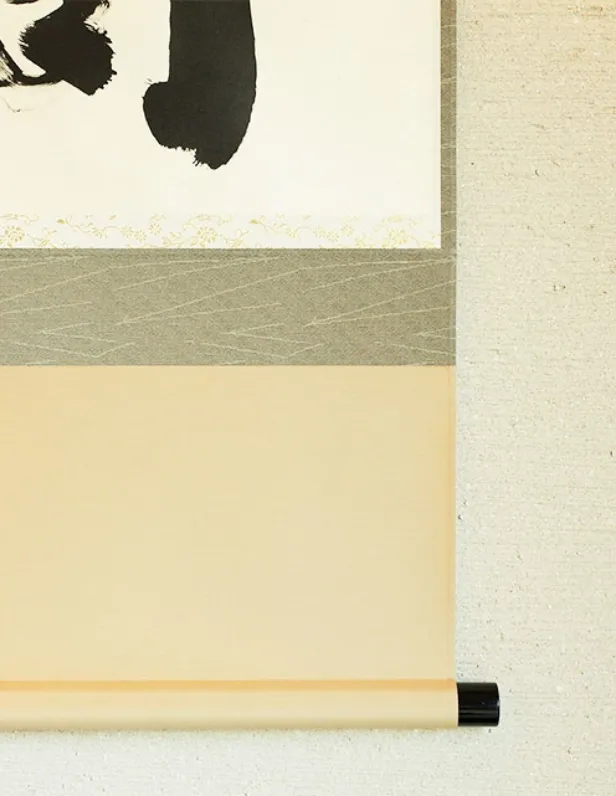
Mounting Online Service / hyousou online
For customers who are too busy to visit the store, feel uncertain about how the finished piece will look, or prefer to avoid going out, this service allows you to request mounting work from home while checking a preview of the final image.