

Shodo Daisuki Episode 39
Shodo Daisuki – Episode 39
Experiment! Does Water Change the Ink Color!? [Shodo]
Shodo Daisuki – Episode 039
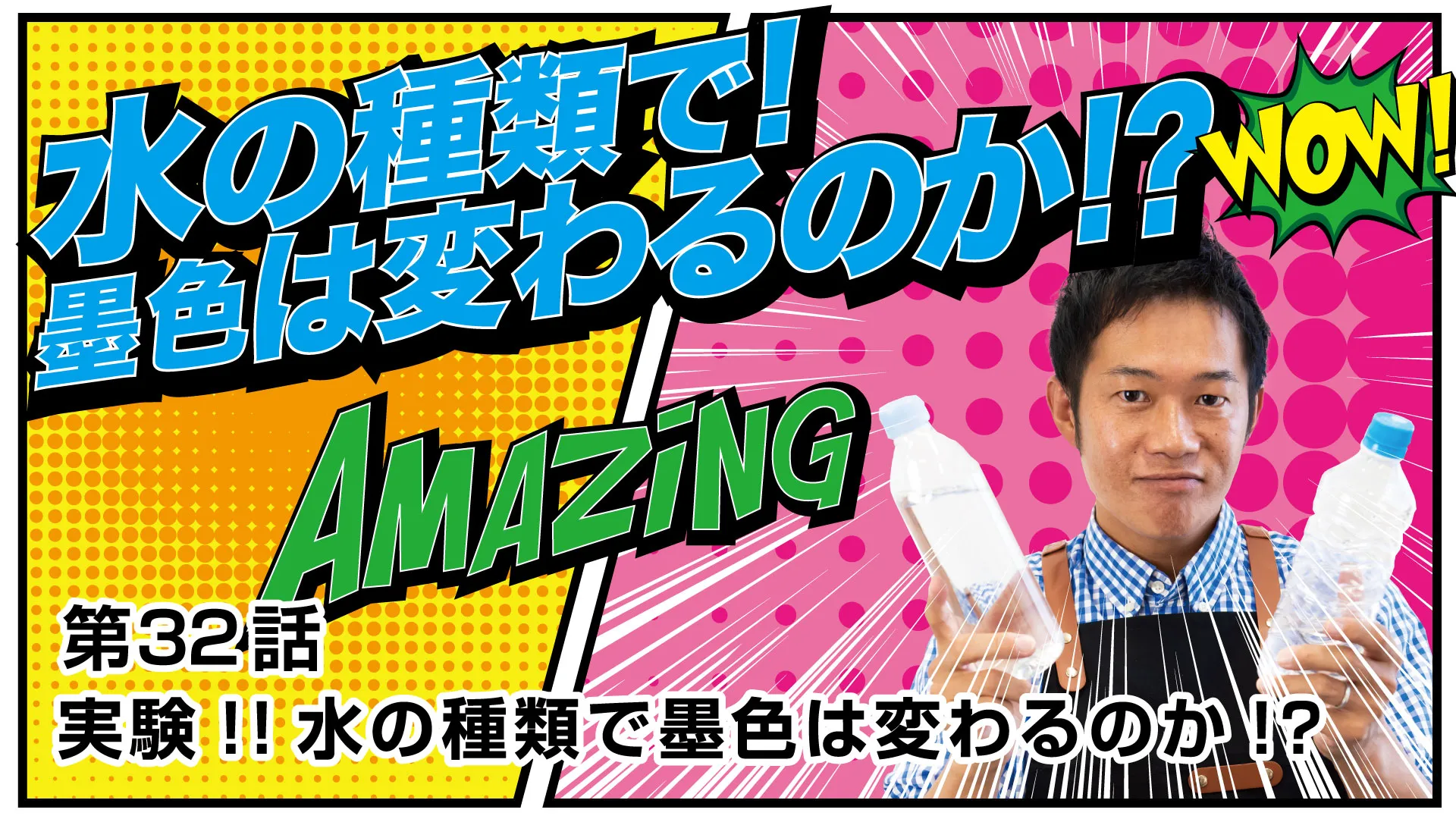
This time, we will use three types of “water” to grind ink and observe how the ink color changes!
Shimauchi, a man who loves calligraphy, gives a thorough explanation!!
Shodo Daisuki – Episode 39: Video Overview
Shimauchi conducted an experiment on the “Shodo Daisuki” channel to examine how different types of water affect the color and texture of ink.
Three types of water—hard mineral water, soft mineral water, and tap water—were used, and both Chinese ink (karasumi) and Japanese ink (wasumi) were tested for comparison.
He prepared each water type with the following characteristics: hard water (300mg of minerals per liter), soft water (88mg of minerals per liter), and tap water (about 50mg of minerals per liter). All water was used at room temperature.
For the experiment, he used 1cc of each water type to grind the ink 600 times. Then he added 10cc of water to create regular-density ink, followed by 30cc of water to make light ink (tanboku).
In the Chinese ink experiment, hard water produced the darkest color. Around 400 strokes, a characteristic aroma appeared, and by 600 strokes the ink became very thick and jelly-like.
Tap water produced more viscosity than soft water, and in terms of bleeding: tap water had the strongest bleeding, followed by soft water, and lastly hard water.
In the Japanese ink experiment, soft water produced ink the fastest, generating aroma around 200 strokes and developing viscosity quickly.
Soft water resulted in the deepest color, while tap water had the strongest bleeding, followed by soft water, then hard water.
Through the experiment, Shimauchi confirmed that the type of water creates noticeable differences in ink texture and color. He particularly recommends soft mineral water when grinding Japanese ink.
He also encourages viewers who usually only use tap water to try mineral water, as it may lead to new discoveries.
YouTube Shodo Daisuki – Episode 39
Shimauchi 00:00
Hello, this is Shimauchi, who loves calligraphy.
Recently, I’ve heard that many people are particular about the water they drink – whether for health, beauty, cooking, or pairing with alcoholic drinks.
Those of you watching this channel might be wondering:
Shimauchi 00:19
“Does the type of water change the color of the ink?”
…Or maybe you’re not that interested? (laughs)
Actually, this is a topic I’ve wanted to tackle for a long time.
This time I prepared three types of water and tried grinding both Japanese and Chinese ink with each one.
So this video is a企画検証–style experimental video.
Shimauchi 00:44
It’s the kind of experiment I absolutely love.
And it turned out to have some pretty intriguing results.
Whether that counts as a “success” or a “failure,” you’ll understand by the end of the video,
so I hope you’ll watch to the end without missing anything.
Shimauchi 01:02
If you find this video or channel interesting, I’d really appreciate it if you’d subscribe and give it a like.
Now, let’s move on to the main part.
First, I’ll explain the experimental conditions.
Shimauchi 01:26
This time I prepared three types of water.
You may have heard this before:
“When you use Chinese ink sticks, you should grind them with Chinese water.”
China is said to have harder water than Japan, with a higher mineral content, so I prepared one
hard mineral water containing 300mg of minerals per liter.
Shimauchi 01:49
The second is a soft mineral water, with a hardness of 88mg per liter.
And the last one is the water we always use: tap water.
Our precious tap water.
Of course, this varies by area,
Shimauchi 02:05
but in this region it’s soft water with about 50mg of minerals per liter.
These are the three types of water I used for the comparison.
And the hardness of the water can vary quite a lot depending on where you live,
Shimauchi 02:24
so please just take these values as rough reference.
Water temperature is also said to have a big effect on ink,
so in a strict scientific experiment you’d want to measure and control that exactly.
But since we’re filming this in autumn,
Shimauchi 02:44
I simply used all three waters at room temperature – in other words, at the current seasonal temperature.
I wanted to mention that as a supplemental note.
So we’ll be using these three kinds of water to compare how Japanese and Chinese ink grind and write.
Shimauchi 03:04
For paper, I used our usual choice for experiments: Hongxing brand four-foot cotton xuan paper.
This video isn’t based on strict scientific evidence, but rather on my own actual experience –
so you can think of it as a kind of review-style video.
Shimauchi 03:24
I’d be happy if you could just watch it casually and enjoy it in a relaxed way.
So please take it in that “soft and fluffy” spirit and have fun.
Shimauchi 03:37
All right everyone, this time too, I ground the ink thoroughly.
I really ground a lot of it! First, I started with Chinese ink.
For the Chinese ink I used the famous Tessai ink stick.
The condition was: 1cc of water for grinding.
And I counted 600 strokes.
Shimauchi 04:03
To make regular-density ink, I then added another 10cc of water and mixed it thoroughly –
that stirred mixture is what I treated as the “standard” ink.
Now, about the grinding feel – here’s the thing.
Even just in the grinding process, you can already feel differences between the water types.
The most surprising one was the hard water.
Shimauchi 04:30
With hard water, as I started grinding,
around the 400th stroke that distinctive water smell suddenly hit me all at once.
It really came on abruptly. And by the time I reached 600 strokes,
the ink had gone beyond just being sticky –
Shimauchi 04:52
it was basically jelly-like.
This was honestly astonishing.
And when I added 10cc of water to that and tried to stir it, it was really hard to mix.
It felt like a truly first-time experience for me.
Very strange indeed.
Shimauchi 05:07
Next, with soft water, around the 400th stroke, just like with hard water,
a distinct smell hit me.
But the big difference was that as I continued grinding,
the smell grew stronger and stronger.
Shimauchi 05:29
This was another first for me, and very mysterious.
Maybe that’s just what happens because it’s soft water?
Anyway, the smell really clung to my nose!
Lastly, with tap water – compared to soft water, the ink became more viscous.
That actually surprised me.
Shimauchi 05:46
It became quite sticky.
But in terms of smell, there was basically nothing noticeable at all.
Maybe that has something to do with the tap water itself.
That was also rather mysterious.
So just from the grinding process alone, we already saw clear differences.
Shimauchi 06:01
That was a new discovery for me.
Next, about the color on paper.
As you can probably see from the writing samples,
the darkest black came from the hard water.
Next darkest was tap water, and the lightest was soft water.
Shimauchi 06:20
As for bleeding, tap water produced the strongest bleeding,
followed by soft water, with hard water showing the least.
That’s an interesting pattern, isn’t it? You might even say the results
line up nicely with the old saying that “Chinese ink should be ground with Chinese water.”
Shimauchi 06:38
Some might say I’m just forcing the conclusion in that direction, but
I did feel that this gave a bit of weight to that traditional idea.
Next, I took the ink liquids I had just made and loaded the brush fully with ink,
then dipped the brush into 30cc of water to dilute it and make light ink (tanboku).
Shimauchi 06:58
Looking at the resulting light ink tones,
the most pronounced color once again came from hard water,
followed by tap water,
and soft water came in third.
Shimauchi 07:20
As for bleeding with the light ink,
strangely enough, there wasn’t much noticeable difference between the three waters.
One interesting feature of the light ink was the way the base lines appeared –
that is, the structure of the strokes.
Shimauchi 07:41
It seemed to follow the same order as the darkness of the regular-density Chinese ink we tested earlier.
If I had to rank them, I’d again put hard water first, then tap water.
I really did hesitate over which of those two should come first,
but in the end I leaned toward hard water.
Shimauchi 07:59
That said, the overlapping strokes with tap water had some very interesting bleeding patterns as well,
so I’d say it’s hard to declare a clear winner.
Tap water was definitely not bad at all.
Next, I moved on to Japanese ink – the same ink I’ve used many times on this channel.
Shimauchi 08:17
I ground the Japanese ink under the same conditions as the Chinese ink.
So first, let’s talk about the grinding feel.
With hard water, surprisingly, I didn’t feel any particular characteristics like I did with Chinese ink.
It actually felt rather light and straightforward.
Shimauchi 08:38
That’s my honest impression.
Soft water, on the other hand, really surprised me – after only about 200 strokes,
the familiar aroma began to drift up,
and the ink started to thicken.
Shimauchi 08:53
It grew more and more viscous.
In other words, a rich, dense ink formed much more quickly than usual.
That made me pretty happy, actually.
“If I can make good ink faster, grinding will be easier!” – that’s what I thought.
Finally, we have our old friend, tap water.
Shimauchi 09:14
Since I’ve been grinding with tap water for so long,
my impression was simply, “Ah, yes, this is what I’m used to.”
But when you compare it to hard and soft water,
I did notice that the ink gloss seemed to come out more quickly than with tap water alone.
Shimauchi 09:31
I think that’s one clear characteristic you could point to.
As for the color once written, the results matched the grinding impressions.
Soft water produced a clearly stronger, deeper black than the others.
There wasn’t much difference between hard water and tap water.
Shimauchi 09:52
That was a bit unexpected.
Regarding bleeding, somewhat surprisingly, the strongest bleeding came from tap water,
followed by soft water, with hard water having the least.
So, if we look at things overall and ask, “Which water should we use for Japanese ink?”
Shimauchi 10:11
my new discovery this time is that soft water is definitely the best.
With soft water, you can quickly make a dense, rich ink.
So I’d really recommend soft water.
Finally, just like with Chinese ink, I also made light ink with Japanese ink.
Shimauchi 10:35
In terms of color, the clearest and most expressive light ink came from soft water,
followed by tap water,
and last came hard water.
Bleeding followed the same order as the light ink color:
Shimauchi 10:57
soft water, tap water, and then hard water.
As for the characteristics of the light ink, once again, things like the appearance of the base lines
and how they then bled outward
seemed to follow the same pattern as the black ink.
Shimauchi 11:14
So my conclusion is that the same ranking applies to the light ink as to the regular-density ink:
for Japanese ink, I recommend soft water.
Using soft mineral water really felt like a good choice to me.
Shimauchi 11:29
Of course, tap water is fine too,
but if you’re already buying mineral water to drink anyway,
why not try using it for grinding ink as well?
I think that alone could bring a new dimension to your work.
So, how did you find this comparison video?
Shimauchi 11:45
On video, I’m not entirely sure how well the differences come across,
and that does worry me a bit,
but from my own experience doing these tests, I can say there were definitely big differences.
So I’m glad I carried out the experiment.
Shimauchi 12:01
That said, there are also points I need to reflect on.
To be honest, I still don’t fully understand the deeper differences
between Japanese and Chinese ink,
or why hard and soft water create such different results.
Shimauchi 12:18
I’ll be studying more from here on out,
and if any of you watching are knowledgeable about this topic,
I’d be very happy if you could share your insights in the comments.
I’m still very much a student myself,
Shimauchi 12:31
so once I’ve learned more about the differences between Japanese and Chinese ink,
I hope to share those findings with all of you as well.
Lastly, there’s one thing I’d like to say to those of you who are particular about ink color in your works.
Shimauchi 12:47
Of course, ink color can depend on your skill and brush control,
and also on the compatibility between the ink and the paper.
But if you’ve only ever used tap water until now,
trying mineral water or hard water
Shimauchi 13:02
may bring about completely new changes.
So for those who’ve only known tap water up to now,
I wanted to share this idea that changing the water can bring new discoveries.
That’s the message I’d like to end on.
Shimauchi 13:21
This has been Shimauchi, who loves calligraphy.
I can tell the difference between soft and hard mineral water just by taste.
So I’ll keep working to become a man who can also tell the subtle differences in calligraphy materials.
Shimauchi 13:39
I hope you all have a wonderful weekend. Goodbye!
About Related Products
Here are the products that appear in this video.
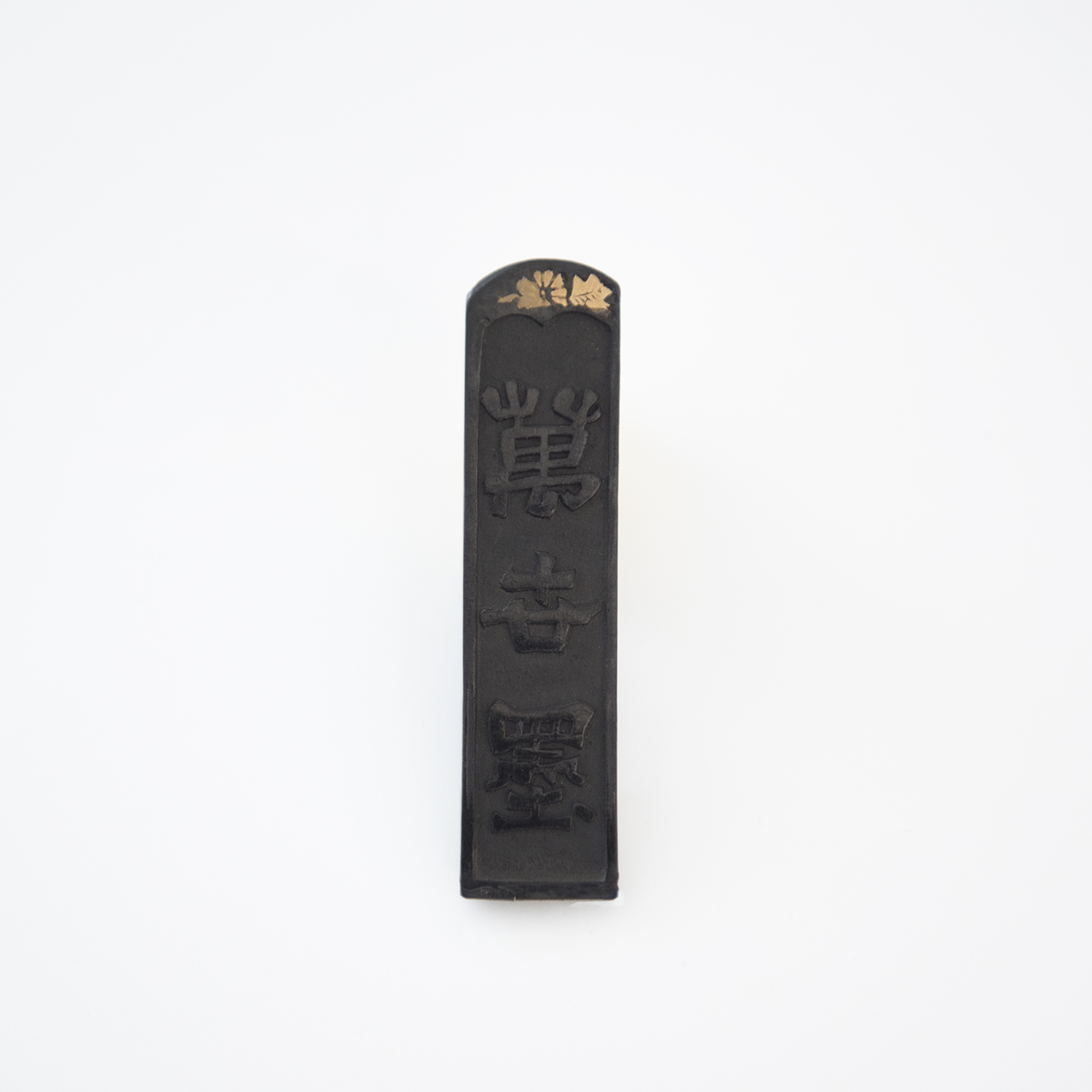
Sumi Ink / sumi
Sumi ink is said to have originated during China’s Yin (Shang) dynasty, around 1500 BCE or earlier.
Its main ingredients are soot, animal glue, and fragrance, and the types of these ingredients determine the key characteristics of each ink.
Because of these differences, you can enjoy variations in color depth, gloss, and bleeding. Solid ink sticks offer a unique expressive charm that bottled liquid ink cannot provide.


