

Shodo Daisuki Episode 38
Shodo Daisuki – Episode 38
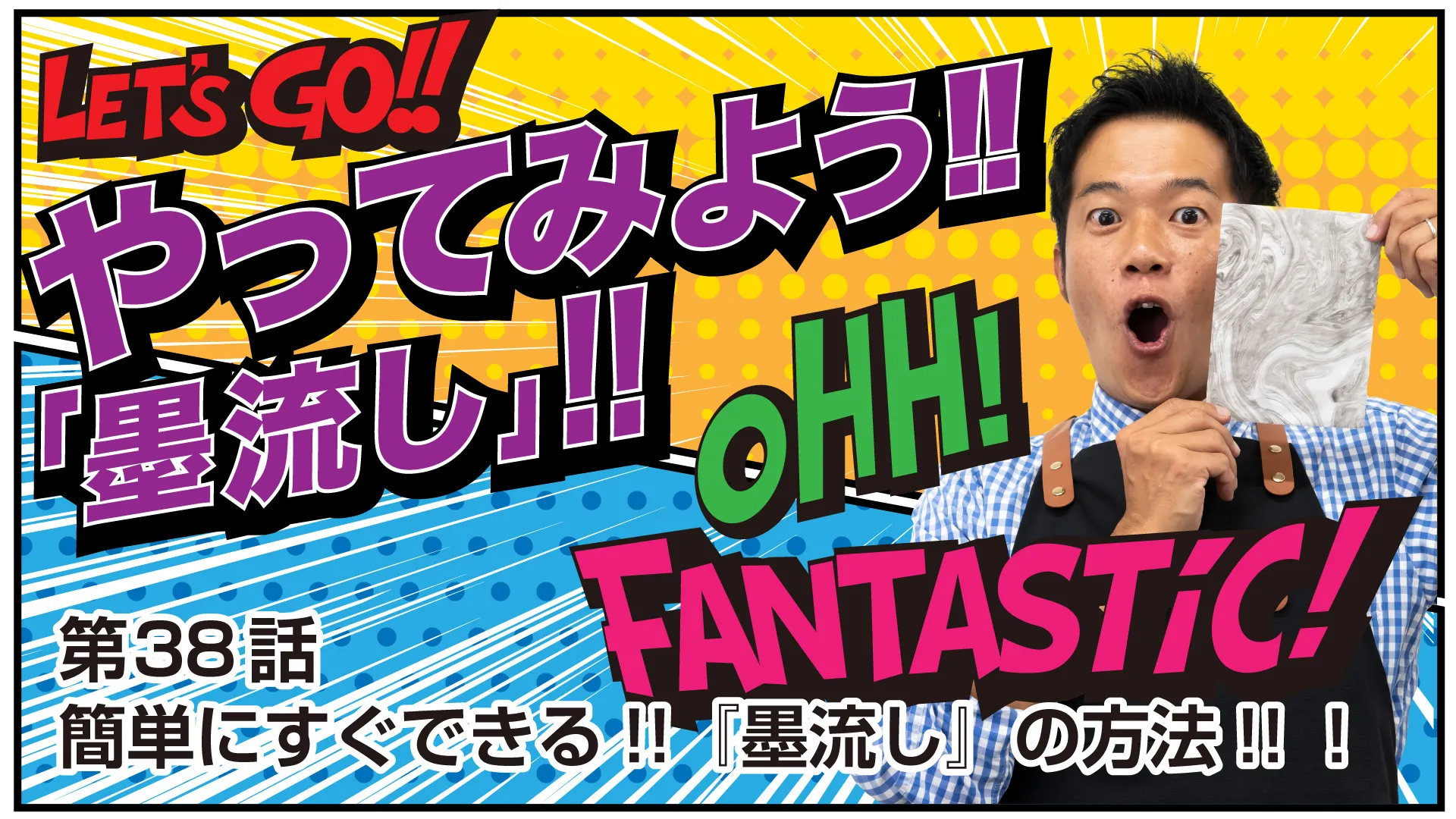
Easy for Everyone! How to Do “Suminagashi” Ink Marbling!! [Shodo]
Shodo Daisuki – Episode 038
Suminagashi is so fascinating that once you start, you’ll forget the time!
Shimauchi, a man who loves calligraphy, gives a thorough explanation!!
Shodo Daisuki – Episode 38: Video Overview
This video introduces suminagashi (ink marbling) by Shimauchi, who is crazy about calligraphy.
After a series of rather serious episodes on classical copybook practice (koten rinsho), Shimauchi makes a fresh start by focusing on suminagashi.
Suminagashi is a technique that allows you to create patterns surprisingly easily, and even though it was Shimauchi’s very first time trying it, he says he was still able to create beautiful patterns.
He explains that the history of suminagashi dates back to the Heian period in the 9th century.
Its origin lies in a court pastime where aristocrats would drop ink into a river and enjoy the patterns created by the flow of the water. Later, court ladies began filling a basin with water, dripping ink onto the surface, and transferring the patterns onto decorative paper or tanzaku strips, on which they would then write poems.
In modern times, suminagashi is used not only with ink on paper but also for dyeing fabric and in various art scenes. Shimauchi emphasizes that although it looks simple, both its history and its techniques are profound, and that it has been passed down through the highly specialized skills of a limited number of artisans.
In the demonstration part, he introduces the tools needed: a white tray (or any container where the patterns are easy to see), bottled ink (Mikawa-type liquid ink), a brush, bamboo skewers, a straw, cotton swabs, hanshi paper, and postcards.
He fills the tray with about 3 cm of water and explains that there is no need to make it very deep. When he drops a single drop of liquid ink, beautiful patterns spread out across the surface thanks to surface tension and the ink’s ability to disperse. He also demonstrates how dipping a cotton swab in oil and touching it to the water surface causes the ink to repel and form ring-shaped patterns.
Using bamboo skewers and a straw, he creates patterns on the water and then shows how to transfer them onto hanshi and postcards.
He also demonstrates how mixing sizing solution (dosa-eki, which reduces ink bleeding) into the water produces different effects.
In addition, he tries using aozumi (bluish ink) instead of ordinary bottled ink to create patterns with a different tone and feel.
Finally, he explains how to deal with paper that warps after the pattern has been transferred: after removing excess moisture, you can either place a weight on top of the paper, or place an interleaving sheet on it and gently iron it at a low temperature.
He cites the charm of suminagashi as lying in the irreproducible, once-in-a-lifetime patterns, the sense of playfulness, and the opportunity to rediscover your own sensibility and taste. He encourages viewers to give suminagashi a try.
YouTube Shodo Daisuki – Episode 38
Shimauchi 00:00
Hello, this is Shimauchi, who loves calligraphy.
Since we’ve had a series of rather serious themes like classical copybook practice, I’d like to make a fresh start this time and introduce suminagashi.
This time, with this suminagashi, it was actually my very first time experiencing it myself, but I was amazed at how easily beautiful patterns appeared.
Shimauchi 00:22
But just transferring it onto paper and calling it finished would feel a bit unsatisfying, so this time I’d like to transfer the suminagashi patterns onto postcards and then actually use those postcards for something.
For those of you who have never tried suminagashi even once, I really hope you’ll try it at home with your family, or
Shimauchi 00:43
have fun doing it together with everyone at your calligraphy classes! That would make me, Shimauchi, very happy.
On this channel, I plan to introduce not only shodo, but anything related to “writing” in a broad sense, so please subscribe to the channel.
Shimauchi 01:00
I’d really appreciate it. Now then, let’s jump right into the main part.
Ready, go! As for the origins of suminagashi, you can trace it back all the way to the 9th century, the Heian period.
Back then, court nobles would actually drop ink into real rivers and enjoy the patterns created by the flow of the water as a kind of courtly pastime.
Shimauchi 01:25
Try to picture it, everyone.
I think those rivers must have been completely different from what we imagine rivers to be like today.
They were probably incredibly pure, calm, and beautiful streams of water.
But, everyone, you mustn’t do that now.
Shimauchi 01:38
If you were to drop ink into a river nowadays, that would absolutely not be acceptable.
So please don’t do that.
Then people in the palace, especially the women, must have thought, “We’d like to do this inside the palace too.”
No matter the era, ideas from the ladies are often truly wonderful, aren’t they?
Shimauchi 01:55
So what did they do? They filled a basin with water and dripped ink into it to enjoy suminagashi there instead.
They probably thought, “These patterns are too beautiful to waste, aren’t they?”
And so they began transferring them onto decorative sheets and tanzaku strips.
Shimauchi 02:11
In other words, they were making prints of the patterns.
Then they would write poems on the finished decorative paper and tanzaku.
This is said to be the origin of suminagashi.
And this art of suminagashi has been continuously passed down right up to the present day.
Shimauchi 02:30
These days, it’s used not only on paper, but also for dyeing fabric and in all sorts of art scenes.
Earlier, I said that “it’s amazingly easy,” but in reality this art of suminagashi has a very deep history and very deep techniques.
Shimauchi 02:50
And in fact, it has been passed down and preserved through the skills of a very small number of artisans.
No matter the era, the skills and techniques of such craftspeople really do command our respect, don’t they?
That said,
Shimauchi 03:06
this “suminagashi that anyone can do easily” is something I’d like to enjoy together with all of you from here on, so I’ll begin by introducing the tools.
All right, before we start the actual suminagashi demonstration, let me explain the tools.
Shimauchi 03:24
First, this container – it’s just an ordinary tray you can buy anywhere.
I chose a white one, since I thought the patterns would be easier to see that way.
Of course, a transparent container or anything that makes it easy to see the colors and patterns is perfectly fine.
Shimauchi 03:42
Next, the most important thing for suminagashi is ink.
Without ink, suminagashi can’t even begin.
For the ink, I’ll be using bottled ink, a type of liquid ink, specifically a Mikawa-type liquid ink.
And I’ll use this brush to drip the ink onto the water surface.
Shimauchi 04:03
Any kind of brush is fine.
Then we have bamboo skewers and a straw, which I’ll use later when I want to add patterns and movement to the water.
And this mysterious cotton swab here probably has you wondering what it’s for.
Shimauchi 04:19
You’ll see what it’s used for when we get to that part, so please look forward to it.
For transferring the finished suminagashi patterns, I’ve prepared some cut pieces of hanshi paper
and some postcards. For today, I chose hanshi and postcards made from tough machine-made paper that doesn’t tear easily.
Shimauchi 04:38
All right then, let’s get started with the suminagashi demonstration. First, the very first thing we do is fill this container
– this tray we just looked at – with water.
There’s no need to fill it to the brim.
Shimauchi 04:58
You only need a certain amount of water.
We’ll be dipping paper into it at the end, but there’s no need to pour in a huge amount.
A shallow level of water is perfectly fine.
In this case, I’d say it’s only about 3 centimeters deep.
Shimauchi 05:15
That’s roughly the level we’re working with.
All right, here we go.
First, I’ll load my brush with this Mikawa-type liquid ink and drop a single drop onto the water surface.
Ohhh—can you see that? Amazing, isn’t it?
Shimauchi 05:38
This is surface tension at work on the water, combined with the spreading power of the ink.
And now I’m going to show you something else interesting.
This is where the cotton swab comes in.
Excuse me for a moment, everyone—just a little something I need to do.
Shimauchi 06:03
Thanks for waiting, everyone.
Okay, watch closely now.
Here we go.
Look at that! What you’re seeing here is the molecular structure of oil at work.
Thanks to that, these ring-like shapes are forming.
Shimauchi 06:28
In a sense, suminagashi is really part of the world of science – it’s quite surprising.
The thin film of ink on the surface is repelled by the oil and pushed away.
That’s why we get this kind of phenomenon.
Earlier when I said “Excuse me a moment,”
Shimauchi 06:45
what I actually did was gently rub the cotton swab on my own forehead to pick up some oil.
I tried all kinds of oils, you know.
Plant-based oils, and even, well, various other kinds of oils… I really tried many things.
Shimauchi 07:02
But in the end, nothing could beat the natural oil from the forehead.
So, I’ll be borrowing its power today.
Now then, let’s keep going. I’ll drop some more ink.
Here we go again—there! This is really fun, everyone.
Shimauchi 07:31
It’s honestly so much fun.
If I keep doing this, I’ll never stop, so I’ll pause here for now.
From this point on, your sense of design really starts to matter.
Please don’t expect too much from my sense, okay?
Shimauchi 07:45
I’ll start adding some patterns.
I’ll use the bamboo skewer. All right, how’s that? Yes, yes, like that. These patterns really are something you can only create at that particular moment in time.
And since we’ve gone this far, let’s use the straw
Shimauchi 08:08
to blow and create some water flow. Here we go.
Now, let’s try transferring this onto paper. Let’s start with hanshi, shall we?
Here we go.
All right, I’ll lift it up now.
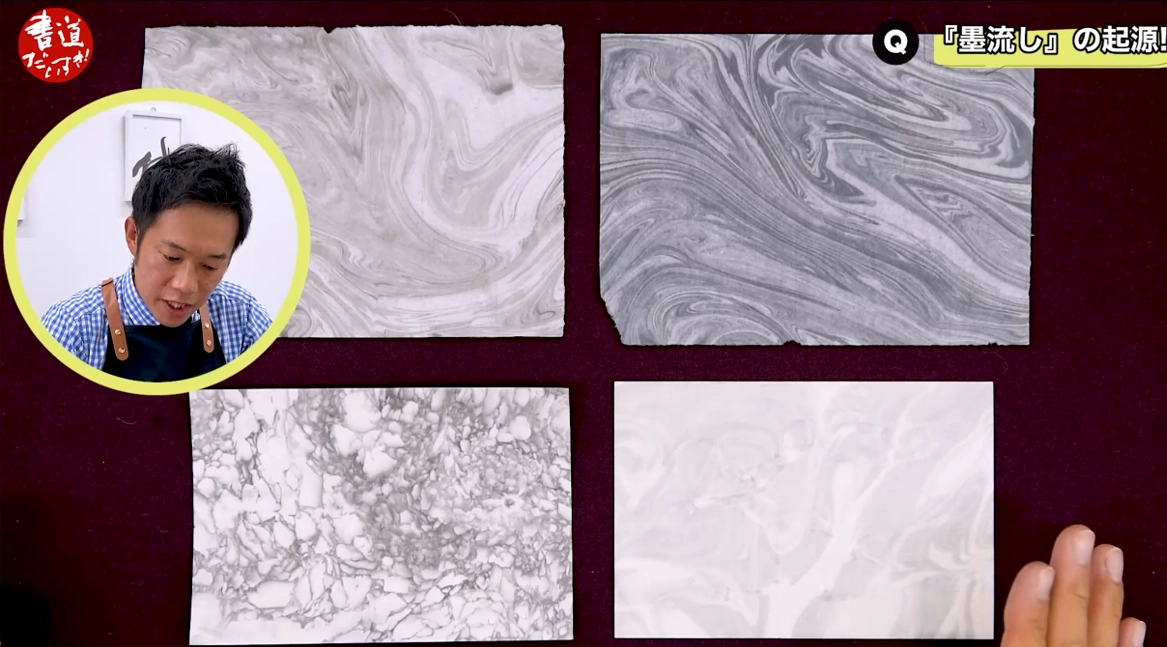
And… ta-da! This is the suminagashi pattern we just transferred.
Shimauchi 08:49
It turned out like this. I think the inked areas may be a bit dominant in this one.
But that’s something you can adjust as you like by how you handle the white spaces, so you can experiment as much as you want.
For now, I just wanted to show you how beautifully it can turn out.
Shimauchi 09:07
Now, next I’d like to do something a bit more advanced and try a slightly more elaborate suminagashi.
This time, I’ve set my sights on something called dosa-eki, a solution used to reduce ink bleeding.
I’ll mix some of this dosa-eki into the water.
Shimauchi 09:28
I’ll pour it in and then stir it.
Stir, stir. Next, I’ll drop the same Mikawa-type liquid ink into this water containing dosa-eki.
Everyone, please watch the surface of the water closely.
Here we go! There—can you see that?
Shimauchi 10:06
It looks like a bird, doesn’t it? A bird.
Let’s do that again.
Last time, the ink spread out with a big “whoosh,” but this time… look at this, everyone.
Fascinating, isn’t it? This must be the power of the dosa.
What an indescribable pattern this is, isn’t it?
Shimauchi 10:38
Now I’ll stir it. This time I’ll stir it in a swirling motion.
And now I’ll blow on it.
There we go. What is this, really?
It’s such an indescribable, mysterious pattern.
It looks like stone, or maybe marble.
Shimauchi 11:06
If someone told you to “draw this pattern” or “paint this design,” you’d never be able to do it by hand.
I just can’t hold back any longer.
I’m going to transfer it now.
This time, I’ll transfer it onto a postcard.
All right, here we go, everyone.
Shimauchi 11:31
There. It turned out like this.
It looks like stone, doesn’t it? Almost like marble, with a wonderfully mysterious pattern.
Finally, instead of liquid ink, I’ll grind some solid ink – and not just any ink, but aozumi –
Shimauchi 11:57
and use that for our next experiment.
Ohhh, can you see this? I wonder how well the camera is capturing it.
You really get that distinctive “aozumi” feel from it, don’t you?
Can you feel it, everyone?
Even just this alone
Shimauchi 12:27
already gives a strong sense of aozumi character.
All right, I’ll stir it a bit now.
There we go, swirl, swirl, swirl… all right! Oh, we’re getting some really interesting patterns now.
Next, I’ll dip the hanshi into it.
Here we go—there we are.
Shimauchi 13:02
It tore a little bit, but I feel like the unique flavor of aozumi really comes through here.
We’ve soaked it up with hanshi, but there’s still some ink left in the water,
so I’ll go ahead and transfer this onto a postcard as well.
Here we go.
Shimauchi 13:23
All right. It turned out like this. Near the end, when I was lifting the paper, the water may have run a bit,
so we got this streak here, but it has a completely different “aozumi” feel compared to the previous one.
Now, just as an extra tip,
Shimauchi 13:43
when you transfer a suminagashi pattern like this, on postcards especially, the paper tends to warp
because it absorbs moisture, so you’ll see some waviness like this.
If you remove the moisture properly and then place a weight on top,
Shimauchi 14:00
it should dry nice and flat.
And even then, if you still find waviness like this bothersome,
you can place some interleaving paper over it
and gently iron the whole area at a relatively low temperature.
Shimauchi 14:12
Be sure not to iron just one small area at a time, but the entire surface evenly.
That should help smooth it out even more.
As for the paper, once it has dried to a certain degree, you can simply leave it to rest, and it will naturally become nice and flat like this.
Shimauchi 14:32
If there are still areas where the amount of ink makes the waviness bothersome, you can do the same as before:
lightly place an interleaving sheet over it and perhaps give it a gentle iron.
Please adjust your approach flexibly depending on the situation at the time.
Shimauchi 14:48
So, what did you think, everyone? As long as the surface is an absorbent paper material, suminagashi will work on most things.
You can easily transfer patterns onto shikishi boards, tanzaku strips, and even coasters,
so I hope you’ll give it a try.
Shimauchi 15:07
One of the most captivating things about suminagashi is that you can never produce exactly the same pattern twice.
That sense of fleeting coincidence and playfulness, and the rediscovery of your own sensibility and taste –
don’t you feel that this kind of experience can lead to new insights?
Shimauchi 15:29
By trying it out, you may discover things like, “Oh, so this is the kind of feel it creates,”
or “I didn’t know I had this kind of sense of style.”
Those discoveries can then feed back into your future works,
so I really hope you’ll challenge yourself with suminagashi.
Shimauchi 15:46
As the season of the arts deepens,
I hope you’ll enjoy suminagashi as a way to add a touch of color to your own “autumn of the arts.”
This has been Shimauchi, who loves calligraphy. I wonder what tonight’s moon looks like. Is it out, I wonder?
Shimauchi 16:04
Well then, until we meet again.
Goodbye! …Ah, that’s strange, I think I’ll just make one more print.
If I don’t get a good one next time, that won’t do at all.
This has been Shimauchi, who loves calligraphy.
About Related Products
Here are the products that appear in this video.
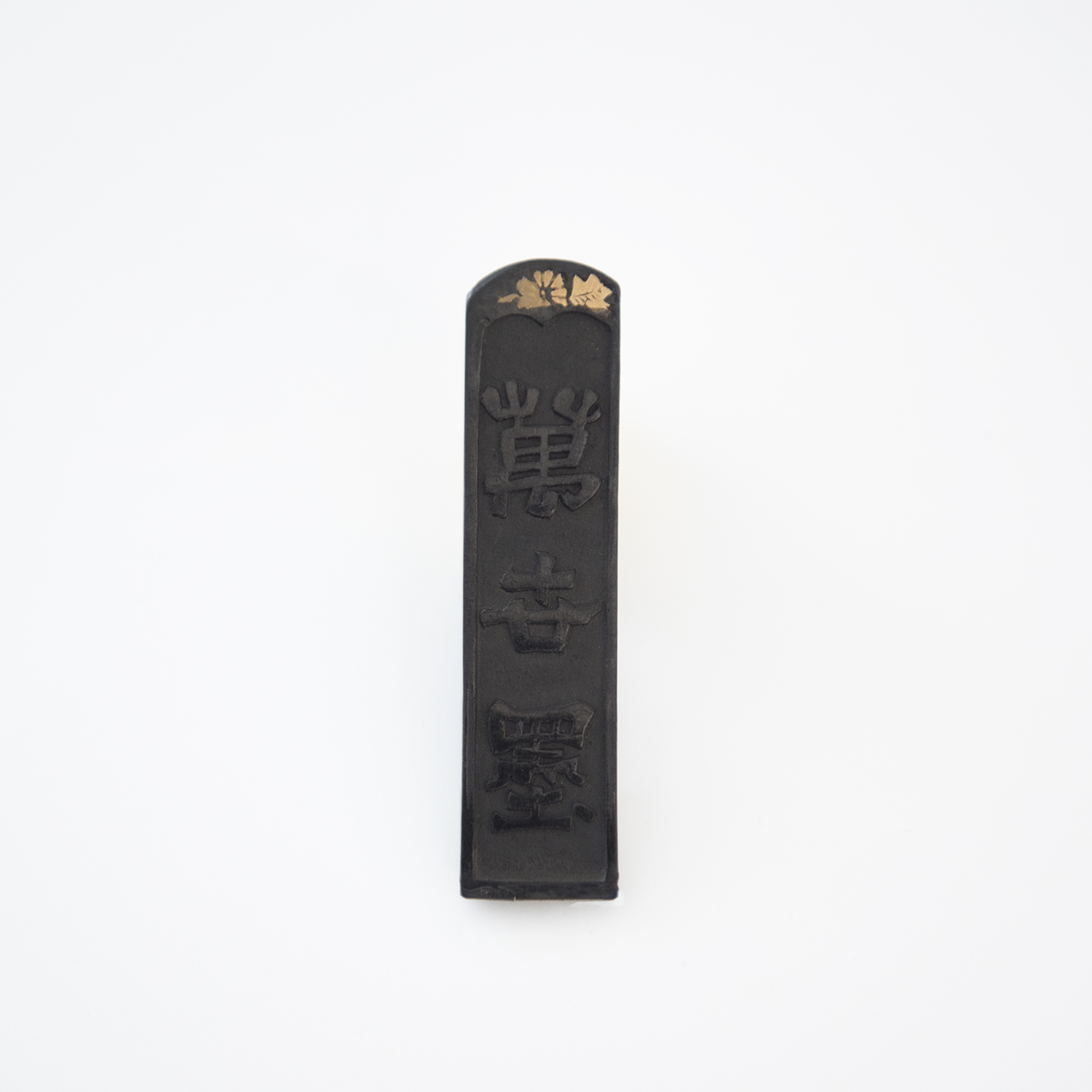
Sumi Ink / sumi
Sumi ink is said to have originated in China during the Yin (Shang) dynasty, around 1500 BCE or earlier.
Its main ingredients are soot, animal glue, and fragrance, and the specific types of these ingredients determine the essential characteristics of the ink.
Depending on these differences, you can enjoy variations in color depth, gloss, and bleeding. Solid ink sticks offer a unique charm and expressive range that bottled liquid ink cannot provide.


