

Shodo Daisuki Episode 37
Shodo Daisuki Episode 37
Controversial!? Shimauchi’s “Interpretive Rinshi” and “Back Rinshi”!! [Classical Copying][Calligraphy]
Shodo Daisuki – Episode 037
★☆★☆ Celebrating 1,000 Subscribers!! ★☆★☆
“Interpretive Rinshi” and “Back Rinshi” — topics that surprisingly don’t get discussed very often!!
This episode is once again passionate and easy to understand!!
Shodo Daisuki Episode 37 – Video Summary
Shimauchi gives a lecture on calligraphy, focusing especially on the concepts and methods of “rinsho” (copying classical works).
The lecture highlights two major rinsho techniques: “Keirin” (literal copying) and “Nyūrin” (interpretive copying), explaining their characteristics and how they are practiced.
At the beginning, Shimauchi expresses gratitude to viewers for surpassing 1,000 channel subscribers.
He then reviews the “Keirin” method introduced in the previous video—copying a model exactly—and moves on to explain the main theme of this episode: “Nyūrin.”
“Nyūrin” is described as a rinsho method in which you learn about the creator of the work and its historical context, allowing you to approach the classic with deeper understanding.
Using Wang Xizhi’s “Lantingxu” as an example, Shimauchi emphasizes how knowing its background enriches the quality of rinsho.
He explains that he once misunderstood “Lantingxu” as merely a record of a banquet, but later learned that it documents a sacred ritual — a realization that added depth to his rinsho practice.
Shimauchi also mentions the calligraphy of Kūkai and Saichō, noting that understanding how deeply they studied Wang Xizhi's works leads to deeper interpretation and expression.
He refers to “Nyūrin” as “expressive rinsho,” proposing his unique interpretation that even attempting to write without looking at the model can be a form of Nyūrin.
He shares his own attempts at both “Keirin” and “Nyūrin,” explaining the differences and new discoveries he encountered.
In conclusion, he emphasizes that the ultimate purpose of classical rinsho is “to express characters that only you can write,” and encourages viewers to continue rinsho to develop technique, sensitivity, and imagination.

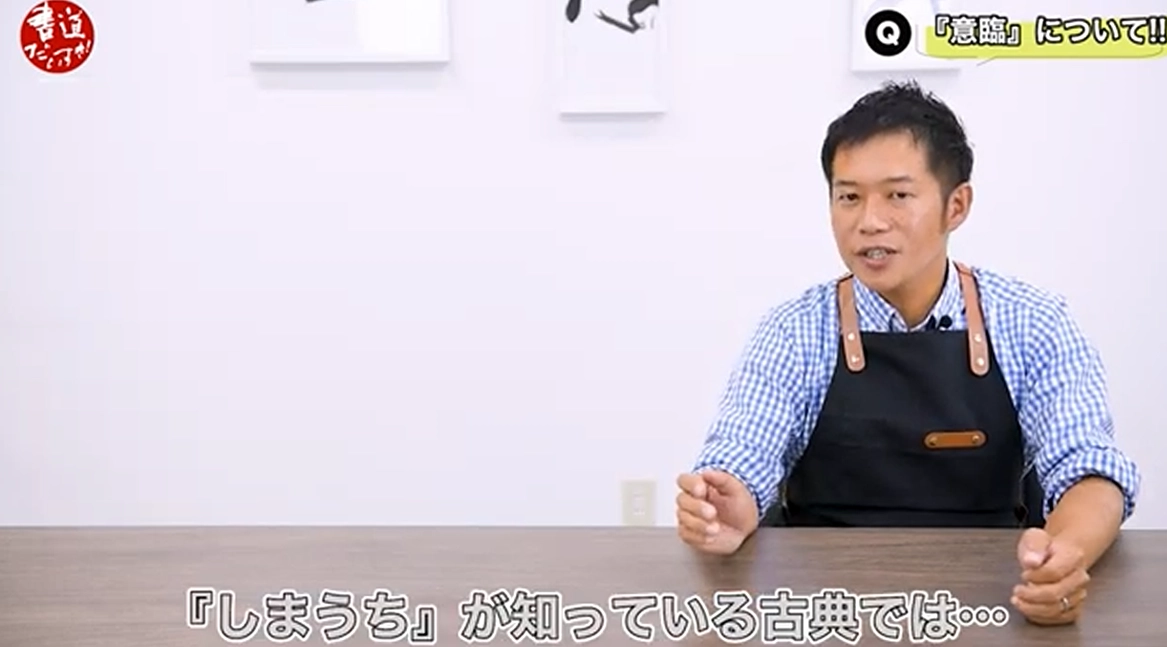
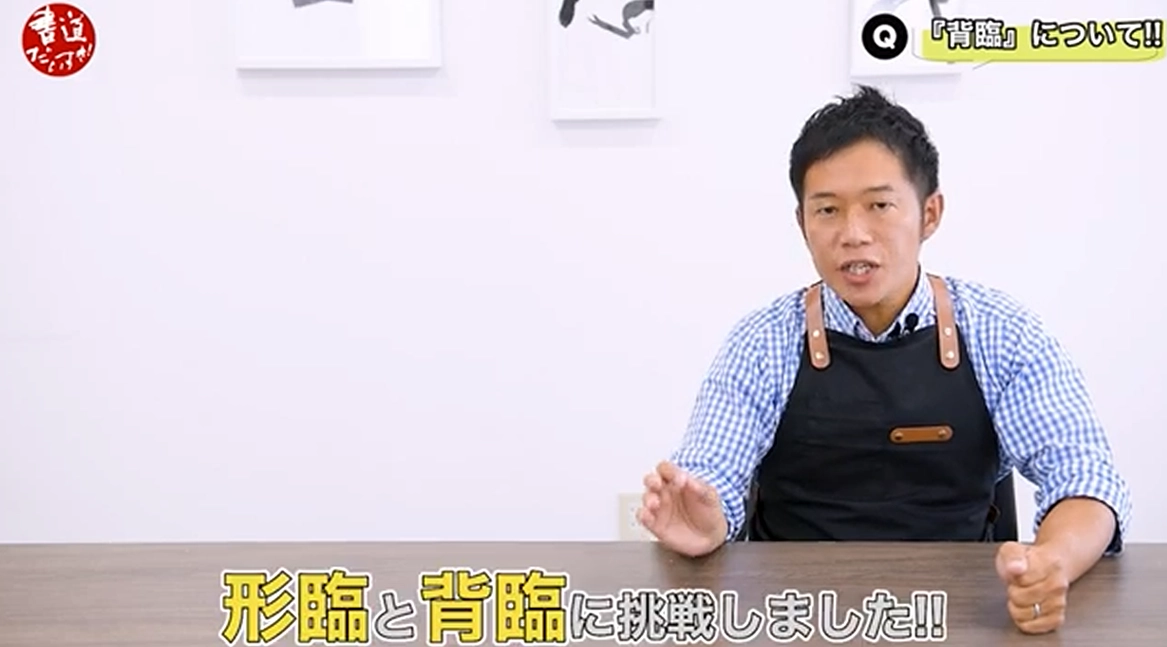
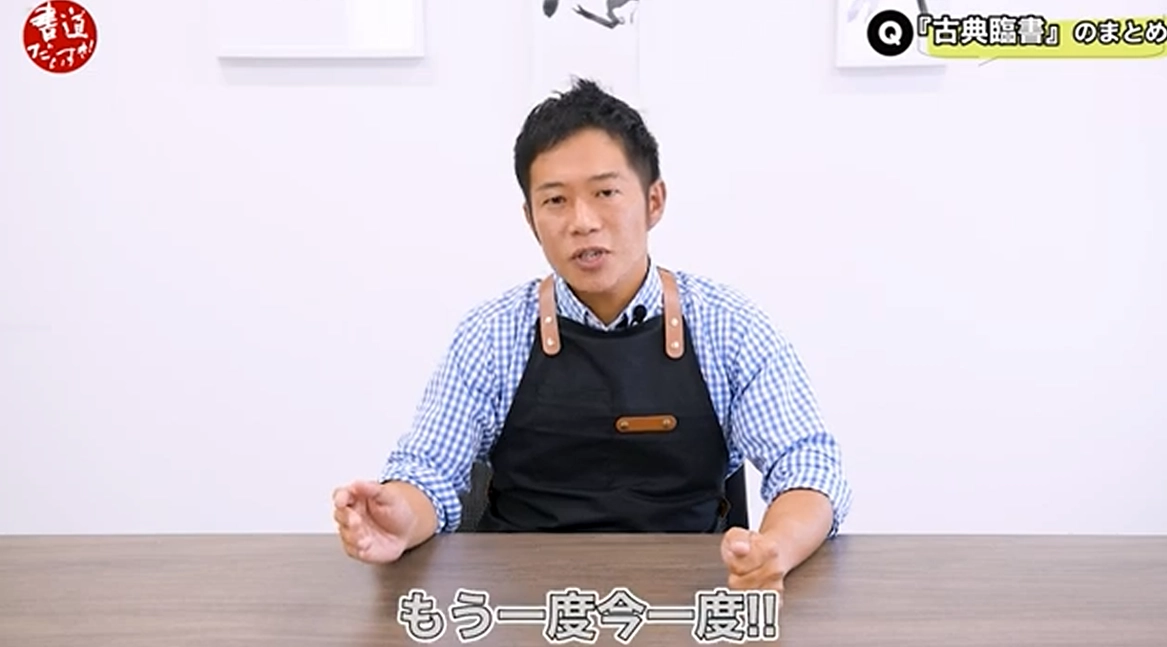
YouTube Shodo Daisuki Episode 37
Shimauchi 00:00
A wild, rowdy party? Not at all.
I think this is something incredible.
Rinsho becomes more interesting than it is now.
Even just making that a habit—doing it so you can express characters that only you can write.
Hi—this is Shimauchi from “Shodo Daisuki.”
Shimauchi 00:20
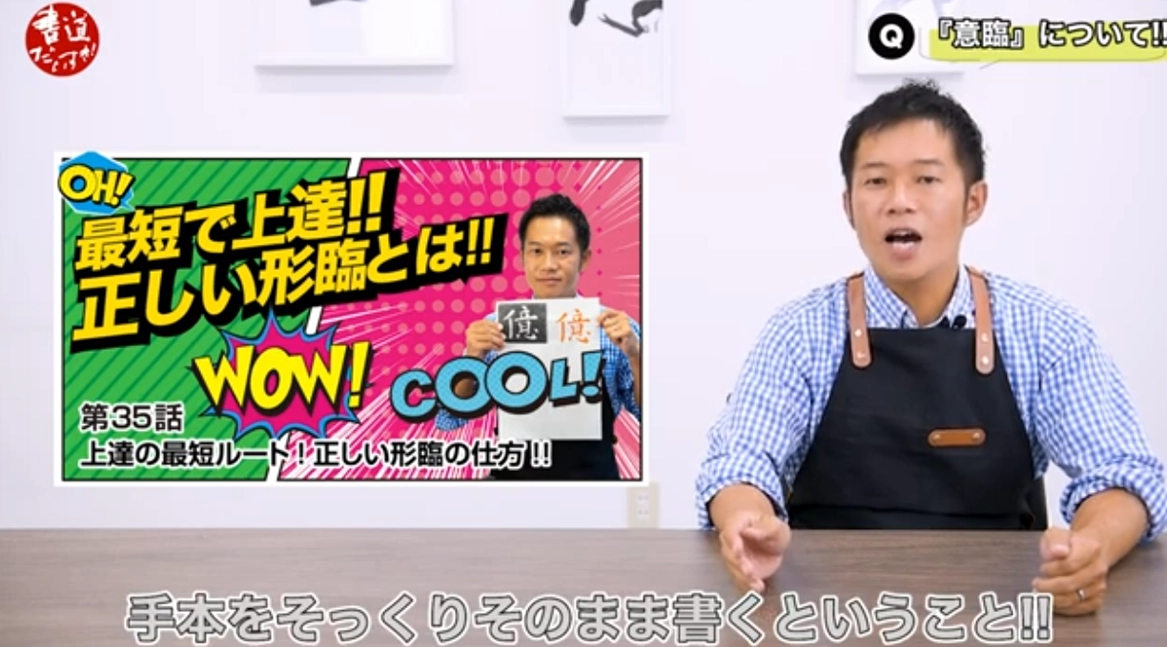
Last time, I introduced kata-rin (form-copying).
This time, as the next step up, I’d like to share Shimauchi’s own interpretation of i-rin and hai-rin.
“i-rin, i-rin”—but wait, you haven’t even mastered kata-rin yet… well,
Shimauchi 00:36
Instead of saying, “No way, no way—I’m going to chicken out,”
I believe that by learning this interpretation (Shimauchi-style), rinsho becomes incredibly fun—so I hope you’ll watch this video with the mindset of “I’m going to challenge myself and give it a try.”
Shimauchi 00:55
On this channel, I’ll keep introducing more and more things related to writing—not limited to calligraphy—so please subscribe and give it a high rating.
And everyone, I’m sorry it took so long to say this, but at last, “Shodo Daisuki” has surpassed 1,000 subscribers!
Shimauchi 01:13
Wow—thank you so much! It’s all thanks to you—truly, thank you.
I’m sure my partner is happy too, even through the camera—no, they’re grinning right now. Thank you, seriously.
Shimauchi 01:24
I’ll keep doing my best, so please continue to support me.
Now then, let’s get into the main part: i-rin.
All right—about i-rin. But before that, as I explained in detail in the previous video, kata-rin—kata-rin is,
Shimauchi 01:42
writing the model exactly as it is, right?
By doing that, you improve your technical skill, and above all, your eye for appreciation becomes sharper—this is the most important point I shared, right?
Kata-rin can also be called realistic rinsho.
Shimauchi 02:02
I-rin places emphasis on imagining the author’s intent and adding your own expression to it.
You could also call it impression-based rinsho.
I’d like to give an analogy—using music as an example.
Shimauchi 02:22
You might ask, “Shimauchi, are you knowledgeable about music?”
Honestly, not at a level I’d call “knowledgeable,” but with Japanese music—what we call hōgaku—the lyrics are in Japanese, so we can understand them, right?
And we can also grasp the background meanings behind the lyrics, too.
Shimauchi 02:39
So of course, it’s easy to picture the lyrics, right?
Then, when it’s your turn to sing, it’s easier to get emotionally involved.
In other words, it’s easier to express.
On the other hand, so-called yōgaku—
Shimauchi 02:55
foreign music—the melody is like, “That’s cool,” and even Shimauchi can feel that, but the words are hard to understand, right?
So because you don’t understand the words, it becomes harder to tell what they want to express.
In other words, you don’t know the background.
Shimauchi 03:08
And when that happens—Japanese music vs. foreign music—if someone says, “Okay, sing it,” whether your feelings really go into it or not…
it’s kind of questionable. Not just “kind of,” actually.
A big difference appears, right?
So, to put it differently, i-rin is about learning more and more information—about the author of the work, the era it was born in, the background, and so on.
Shimauchi 03:22
By doing that, your knowledge of the classics deepens.
In other words, you move closer to them.
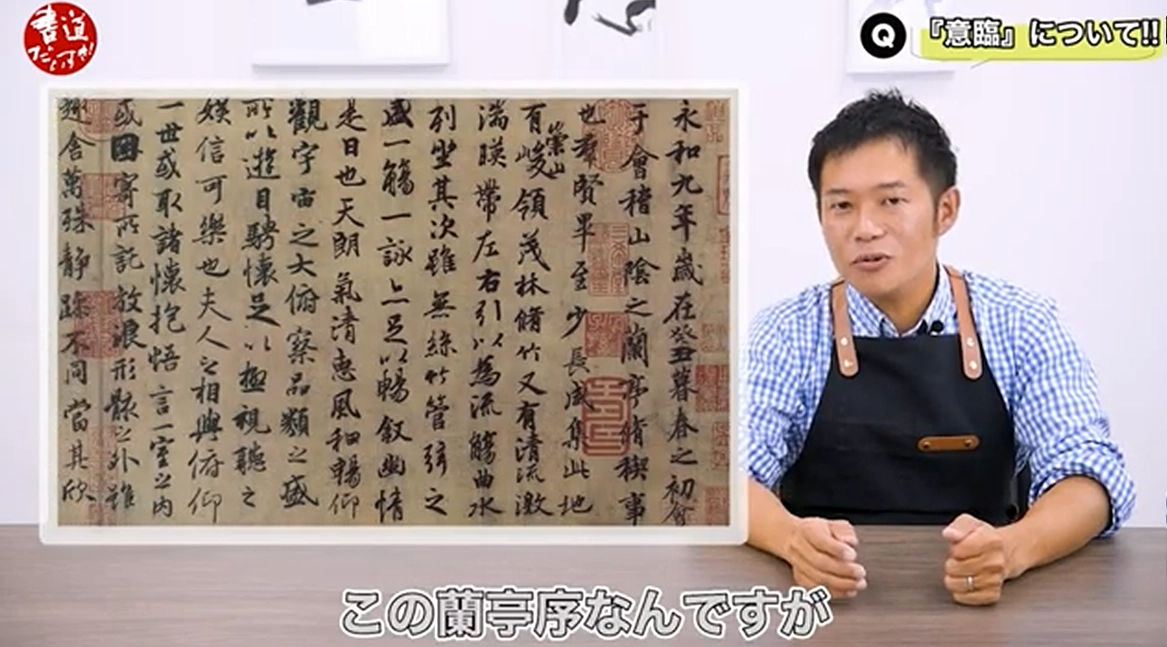
That’s why this becomes so important. For example, as a piece of classical information Shimauchi knows, let’s bring up the “Lanting Preface.”
Shimauchi 03:39
About the “Lanting Preface,” I had a somewhat self-made interpretation for a while—like, “It was a banquet,” and they floated cups down the stream, drank, recited poems, had a big noisy celebration, and then in the moment Wang Xizhi—no, the party—
Shimauchi 03:57
kind of felt fun and interesting and quickly wrote down the scene—so I ended up compressing it into that image in my mind. I thought Lanting was something like that, but then,
Shimauchi 04:16
when I properly researched the characters of Lanting this time—no, no—this is not a wild party at all. It’s about a ritual of purification—properly purifying the body and making various prayers to the gods.
Shimauchi 04:28
There were, what, forty-something wise people—sages—there.
Before the cup reached them, each person thought of one poem and recited it.
It’s such a solemn—and refined—kind of poetry.
And then, those wonderful poems were compiled into a book, right?
Shimauchi 04:43
The preface to that poetry collection is what Wang Xizhi is said to have written—that’s the “Lanting Preface.” From here on, this is Shimauchi’s expanded interpretation, okay?
I bet Wang Xizhi wrote it with a sense of excitement—thinking, “That gathering was so enjoyable.”
Shimauchi 05:03
So when you do rinsho of the “Lanting Preface,” instead of writing with a grim face thinking, “This is hard,” you return to Wang Xizhi’s feeling of “This is so fun I can’t help myself,”
re-experience that, and then write.
By doing that, I think you can get even a little closer to Wang Xizhi.
And I feel that trying to get even a little closer to Wang Xizhi as you practice—that’s Shimauchi’s i-rin.
Shimauchi 05:22
Next, as another classic Shimauchi knows: Kūkais “Fushinjō,” and Saichō’s “Kyūkakujō,” right?
Could you take a look at these?
They’re exchanges of letters between Saichō and Kūkai, but even though they’re “letters,”
Shimauchi 05:38
you can tell they studied Wang Xizhi’s classics thoroughly, right? Each of them firmly learned the classics and established it as their own writing—
in other words, they fully digested it. I think that’s incredible.
And how does this connect to i-rin? Well, if you’re studying “Fushinjō” right now, I want you to turn your eyes to Wang Xizhi’s writing for a moment.
Shimauchi 05:58
Kūkai studied Wang Xizhi seriously from a young age.
He even went to China and studied Wang Xizhi’s writing there.
Earlier, I said, “Do i-rin by putting yourself in Wang Xizhi’s feelings,” right?
This time, by knowing the historical fact that Kūkai thoroughly learned from Wang Xizhi, you can do an i-rin grounded in facts.
By repeating these kinds of shifts,
Shimauchi 06:19
you can have all sorts of “re-experiences.”
And through that, the range of your rinsho and creative work expands, and rinsho becomes even more interesting—that’s what Shimauchi thinks.
Next is hai-rin—often called the ultimate form of rinsho, and something you may want to tackle after kata-rin and i-rin.
Shimauchi 06:35
I think hai-rin can also be called expressive rinsho. But everyone, i-rin feels like a very high bar.
Some teachers might even say, “i-rin? You’re a hundred years too early.” But Shimauchi wants to remove all the “it’s difficult” thinking. This is truly an expanded interpretation, but—everyone, I think you’re all practicing classical rinsho earnestly in your daily life.
And I think you’re working with awareness on kata-rin and i-rin.
So at the very end—after you finish writing—just one sheet:
Shimauchi 06:55
place the model beside you and write without looking at it. I think that’s good.
Then after actually writing, you sincerely learn your own current ability—compare it with the model and say, “Wow, it’s this different.”
Even just thinking that—wouldn’t that already be a perfectly solid i-rin?
Shimauchi 07:15
Shimauchi actually tried kata-rin and i-rin.
For kata-rin, I looked carefully at the model.
So I think last week I was able to unify things to a certain degree.
I also watched the negative space, so I think I was able to keep that awareness properly.
Shimauchi 07:36
Even so, when I compare it with the model, there are still differences—of course.
Next is i-rin. After doing kata-rin, I tried writing without looking at the model.
Then, for Shimauchi, the desire to write the “Jiucheng Liquan Inscription” as cool as possible came out too strongly—
so the characters became a bit larger.
And the starting strokes became stronger, and the negative space felt a bit narrower.
But—you know—that strong desire to write it cool, I think, showed up as momentum in the lines.
Shimauchi 07:57
And depending on the character, I also felt I could write it in a form close to what I did in kata-rin.
So in that sense, as an i-rin of the “Jiucheng Liquan Inscription,” I think this is fine.
Everyone, even just by Shimauchi doing this, I was able to verify things and make various discoveries—so when you practice classical rinsho, I hope you’ll try ending by writing once without looking at the model.
Just making that into a habit can change things completely, so please do give it a try.
Now then, this rinsho series—delivered over three episodes—how was it?
When I used music as an analogy earlier, it was about this: even with just one set of lyrics, the way high-school Shimauchi felt about them and the way current Shimauchi—now over forty—feels about them is completely different, right?
Back then, you didn’t understand anything—but now it sinks into your heart. I think that happens.
I think many of you have experiences like that.
I think the same can be said when you apply it to classical rinsho.
The way you understood rinsho when you were young and the way you understand it now—your sensibility changes completely.
So instead of saying, “I already practiced this classic long ago, so I’m done,” I believe that now—because you’ve built experience—there will definitely be rediscoveries when you return to classics.
That’s a point I really want you to look at again.
The ultimate purpose of practicing classical rinsho is to express the characters you want to write—characters that only you can write. Please never forget that.
Through experiencing and accumulating practice, you will absolutely gain something from classical rinsho.
To improve your technical ability, your eye for appreciation, and your imagination—let’s all keep doing rinsho together.
Let’s keep working hard together with Shimauchi, shall we?
All right—this was “Shodo Daisuki.”
Shimauchi will keep up with rinsho so I don’t lose to you all.
See you again. Excuse me.
About Related Products
Here are the products that appear in this video.
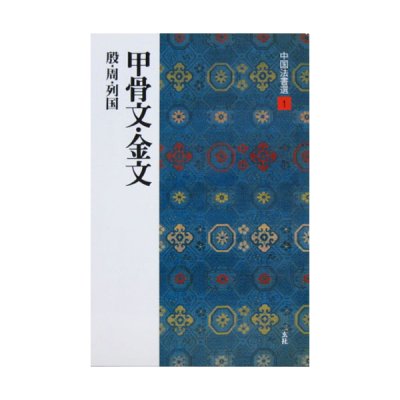
Books / Book & Publication
From complete beginners who are just starting calligraphy to intermediate and advanced learners, the knowledge you can gain from books is invaluable.
In addition to your teacher’s model pieces, books let you study on your own and are perfect for home practice and self-study.
Deepening your knowledge of calligraphy through books will also broaden your perspective and understanding of the art.
