

Shodo Daisuki Episode 40
Shodo Daisuki – Episode 40
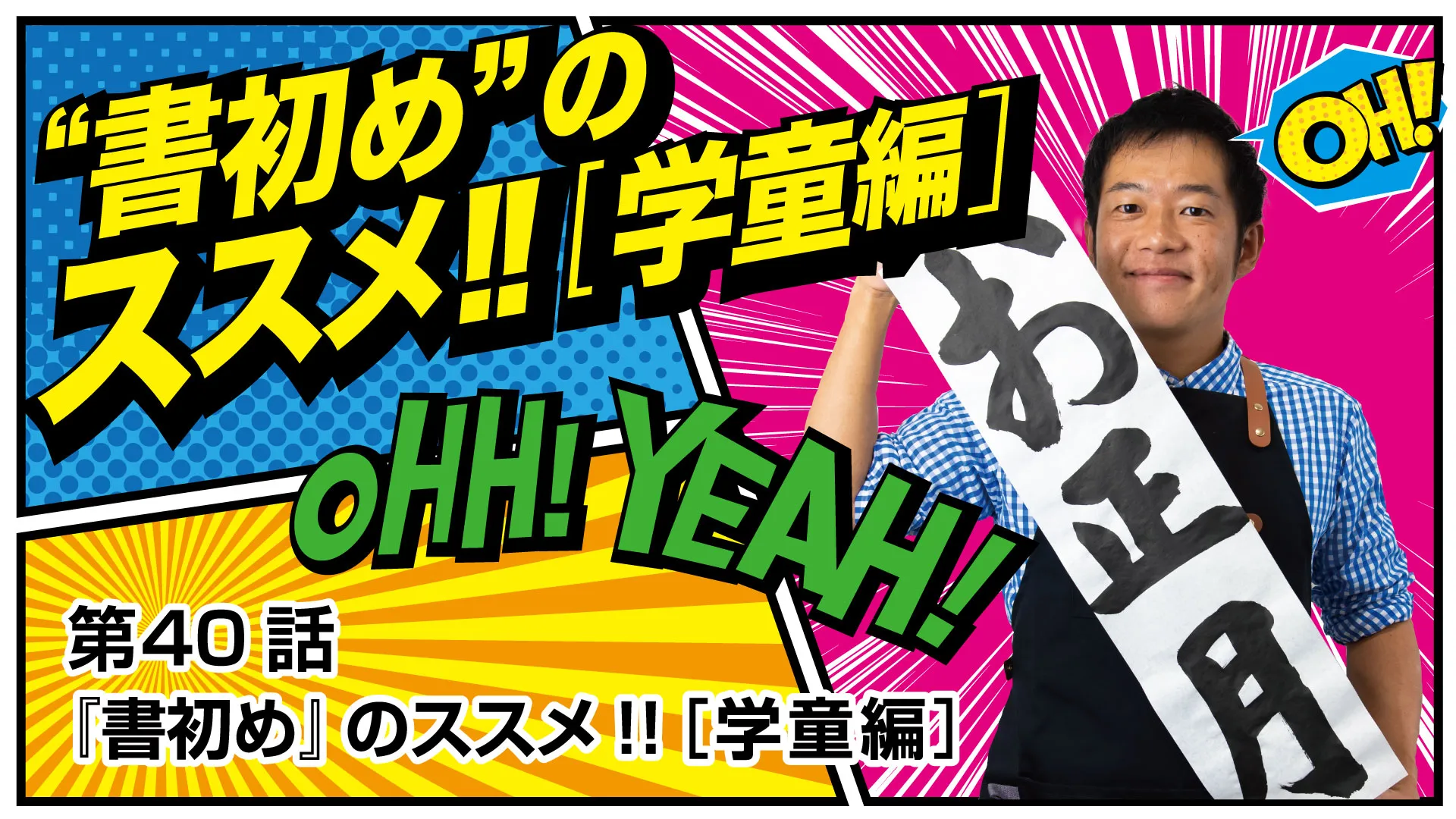
A Must-See for Parents!! “Kakizome Tips!!” (For Schoolchildren) [Shodo]
Shodo Daisuki – Episode 040
This time, we introduce the ideal tools, posture, and more for “kakizome” (New Year’s first calligraphy).
If you watch this, you’ll be perfectly prepared!!
Shimauchi, a man who loves calligraphy, explains everything cheerfully and in an easy-to-understand way!!
Shodo Daisuki – Episode 40: Video Overview
This is a summary of a video in which Shimauchi, who loves calligraphy, explains “kakizome,” the New Year’s first writing.
After a long summer, autumn feels short, and as winter approaches, the kakizome season begins in the calligraphy world.
Schools often assign kakizome as winter vacation homework, and calligraphy classes start intensive practice sessions.
Because children usually practice on hanshi-size sheets, writing kakizome on large paper can feel difficult. However, Shimauchi encourages them to write big, boldly, and energetically, just as children should. This video introduces the tools and methods for kakizome. While the main focus is on children, it also contains useful information for parents and instructors.
He encourages viewers to subscribe to the channel and give a high rating, and mentions that videos are updated every Friday night.
For kakizome paper, the most common choice is “yatsugiri” size—one eighth of a full sheet—but he explains that some regions and calligraphy organizations use their own original sizes.
Regarding paper quality, he recommends machine-made paper with little bleeding so that children can write large characters energetically.
Handmade paper tends to be thinner, and if a lot of ink is used, it tears more easily, so extra care is needed.
For the underlay, he notes that it’s hard to find a dedicated yatsugiri-sized mat, so he introduces a method of stacking three sheets of newspaper as a substitute.
As for brushes, it is possible to write with the hanshi brush they usually use, but it may not hold enough ink and can be difficult to write with.
A kakizome brush holds more ink and allows easy writing without applying much pressure, but because the grip feels different from their usual brush, children may be confused at first.
Regarding posture and writing style, he recommends spreading the paper on the floor whenever space allows.
On a desk, you must move the paper as you write, which makes it hard to see the whole layout and maintain balance.
It’s important to encourage children to write big and boldly, but also to teach them to leave space for their grade level and name.
Finally, he introduces the historical background of kakizome: on the morning of New Year’s Day, people would grind ink with sacred water, face the lucky direction of the year, and write celebratory words or poems.
He explains that writing characters with a brush is like engraving your thoughts into your heart, and talks about the significance of putting your New Year’s wishes into your kakizome.
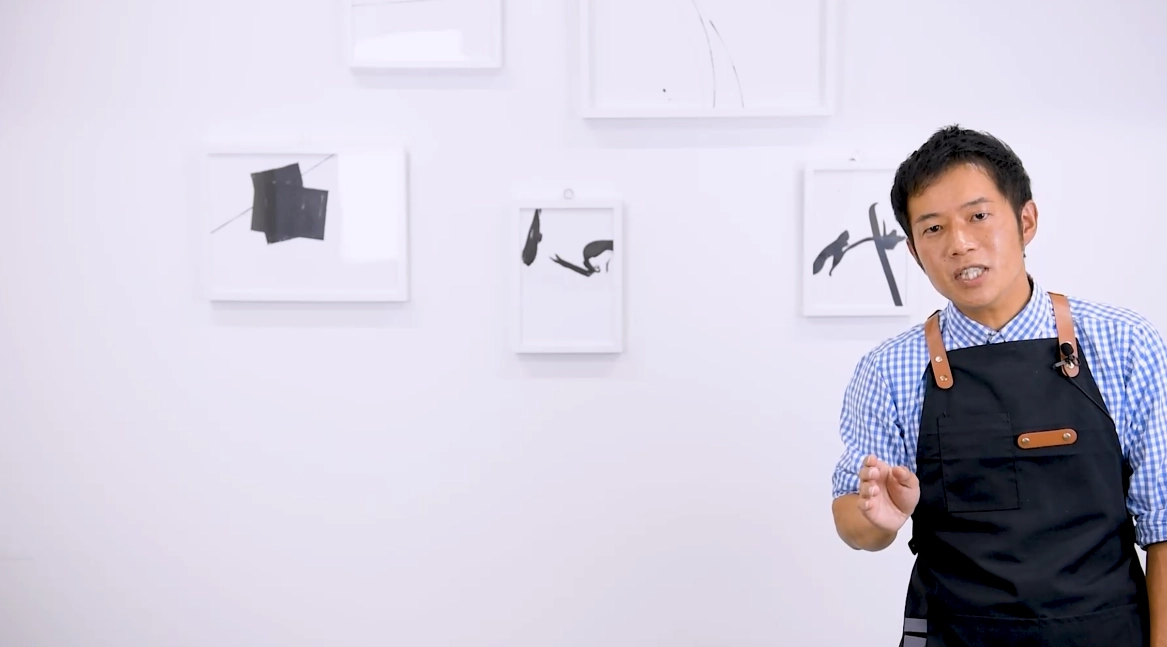
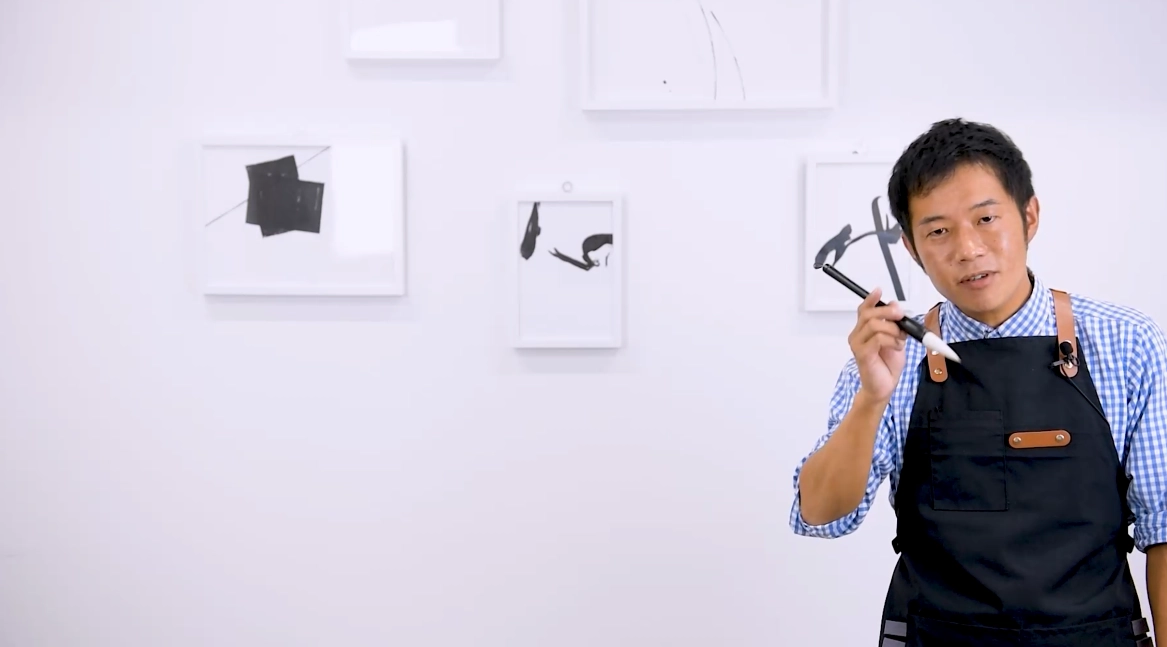
YouTube Shodo Daisuki – Episode 40
Shimauchi 00:00
Hello, this is Shimauchi, who loves calligraphy.
Since summer was so long this year, autumn felt really short, didn’t it?
And it feels like that autumn is rushing past us at high speed.
As the cold draws near, the next big event in the calligraphy world is kakizome—the New Year’s first writing.
Shimauchi 00:18
Yes, the kakizome season is coming.
At school, kakizome will soon start appearing as winter vacation homework.
And at calligraphy classes, special kakizome training may be about to begin.
For children,
Shimauchi 00:32
most of the time they practice on hanshi-size paper.
Kakizome is one of the few chances they have to write on large paper.
But because they’ve been writing on small hanshi, they might think, “Wow, this looks difficult…” or
Shimauchi 00:46
“I wonder if I can really write this?”
In times like that, I’d actually like them to flip that feeling around.
I want children to write brightly, boldly, and as big as they can, full of energy.
So this time, I’d like to talk about kakizome—covering tools, posture,
Shimauchi 01:03
and how to write, and so on.
While this video is aimed at children, I hope that parents and teachers who guide them will also watch through to the end and get ready for next year’s kakizome season together!
Shimauchi 01:20
If you find this channel useful, we upload new videos every Friday night, so please consider subscribing and giving us a like.
All right, let’s get into the main part.
Shimauchi 01:36
First, let’s talk about paper size. In Episode 17, we introduced yatsugiri—the size made by cutting a full sheet into eighths.
That yatsugiri size is the standard kakizome paper.
However, depending on the region where you live,
Shimauchi 01:54
there may be a local, special kakizome size.
Some calligraphy organizations also use their own, organization-specific kakizome paper sizes.
Please keep that in mind as well.
And when you go to a venue filled with excitement and write kakizome on the spot,
Shimauchi 02:12
there are also contests that use hansetsu-size sheets.
If you’d like to participate in those kinds of competitions, it’s important to know the required paper size ahead of time.
For today’s video, we’ll focus on the general yatsugiri size.
Shimauchi 02:32
Now, regarding the paper quality for kakizome: if we want children to write big characters with all their energy, they’ll naturally use a lot of ink.
So I recommend machine-made paper with minimal bleeding.
Shimauchi 02:50
Some of you might be thinking, “No, no, I want my child to use good paper—handmade paper.”
But handmade paper is often not that thick, and if a lot of ink is used,
Shimauchi 03:04
it can tear easily, so please be careful about that.
For this reason, I think the yatsugiri paper sold at most calligraphy supply stores is usually machine-made paper.
For adults who want to write a crisp kakizome on yatsugiri paper,
Shimauchi 03:22
one option is to take your favorite hansetsu-size paper and cut it into quarters vertically to make yatsugiri.
That way, you can create expressive works with the bleeding and character you’re used to in your regular practice paper.
Shimauchi 03:40
Next is the underlay.
Children usually use a small underlay for hanshi sheets.
Unlike paper, yatsugiri-sized underlays are not easy to find.
They’re simply not sold everywhere—you usually have to go to a calligraphy supply shop to get one.
Shimauchi 03:57
In such cases, newspaper is incredibly useful.
Try stacking three sheets of newspaper as a substitute underlay.
The underlay’s job is to absorb just the right amount of ink.
So even if you write with plenty of ink on the paper,
Shimauchi 04:14
you’ll feel, “Oh, this is nice and easy to write.”
But if you use only one sheet instead of three, the bleeding becomes intense right away.
It will feel like the ink soaks through too strongly.
The front bleeds, and the back bleeds as well—
Shimauchi 04:30
it ends up being a disappointing result.
If you try it yourself, you’ll see the difference at a glance.
It’s something you can probably see clearly here in the video too.
So whenever you use newspaper as an underlay,
Shimauchi 04:45
please remember to stack three sheets before writing.
As for the bottled ink you use, your usual ink is perfectly fine.
However, I’d also suggest trying a denser ink (nōboku) at least once.
When using an ordinary hanshi brush on yatsugiri paper,
Shimauchi 05:06
regular ink actually felt easier to use.
With dense ink, more ink is drawn into the paper, and because the hanshi brush doesn’t hold as much ink,
it tended to run dry and scratchy toward the end.
On the other hand,
Shimauchi 05:24
when using a kakizome brush, if you write with regular-density ink, the large amount of ink it holds can cause more bleeding.
But with dense ink,
the brush tightens up nicely, and the writing feel on the paper also becomes more controlled.
Most of all, the ink color becomes stronger and more powerful.
Shimauchi 05:45
That’s a real advantage, so I wanted to share it with you all.
Now, about posture and writing: if you have space, I’d very much like you to spread the paper out on the floor and write there.
Shimauchi 06:03
That way, you can see the entire work while you write.
This is the biggest benefit.
When writing on a desk, as you know,
the width of the desk is fixed.
Shimauchi 06:18
Whether you’re sitting or standing, to write a long sheet, you have to move the paper along.
Then the characters you wrote earlier naturally drop out of your field of view.
So it becomes difficult to maintain balance across the whole work.
Shimauchi 06:35
That’s a bit of a waste and can affect the final result,
so I truly believe writing on the floor with the paper fully spread out is best.
Now, about things to keep in mind while writing: when children suddenly move from small hanshi to much larger yatsugiri paper,
Shimauchi 06:53
it’s only natural that some will feel overwhelmed by the size.
So at first, some kids will start off writing the first character in a nice big size, but then their characters gradually shrink toward the bottom.
Others may think from the start, “Big is too hard,”
Shimauchi 07:09
and end up writing small from the beginning.
In such cases, I would like you to gently encourage them:
“Let’s write big, with energy and brightness, and enjoy the characters!”
Give them that kind of positive push on the back.
Shimauchi 07:24
However, for contests and kakizome events, you will always need to write your grade and name on the sheet as well.
So please also teach them that they need to leave room to write those parts.
Shimauchi 07:44
Fitting everything neatly inside the paper is not the only thing that matters.
I think it’s also wonderful for children to let their energy overflow and write so boldly that the characters almost jump off the paper.
Shimauchi 07:56
Please give the kind of guidance that gives children courage and builds their confidence.
Next, about brushes: those who attend calligraphy classes may already know this, but
Shimauchi 08:12
there are special kakizome brushes.
When writing on yatsugiri paper,
we often get questions like, “Isn’t a hanshi brush enough?” or
“There are so many sizes of kakizome brushes—what size should we get?”
Shimauchi 08:29
These are extremely common questions.
I thought it would be easiest to show you by actually comparing hanshi and kakizome brushes on video,
so that’s what I did.
The hanshi brush I used this time is relatively large for a hanshi brush.
Shimauchi 08:46
It’s a size that’s suitable for writing two characters on hanshi.
Can you write on yatsugiri with it?
Yes, you can write well enough.
If the goal is to write neatly and carefully,
Shimauchi 09:05
it’s large enough to manage that.
However, you will need to reload the brush with ink more often.
So when you try to write with childlike energy and vigor, the brush can feel a bit too small,
Shimauchi 09:22
and it becomes difficult to express that boldness.
When hiragana are included,
there are many rounded strokes.
Often you have to write from the starting stroke all the way to the ending stroke in one continuous motion.
Shimauchi 09:42
In that situation, with a hanshi brush, there may be enough ink at the start, but by the time you reach the end of the stroke, you may run out of ink and it becomes faint and scratchy.
That’s something I felt could happen in this comparison.
Shimauchi 09:56
Next, kakizome brushes come in many sizes (“gō”). It can be hard to know which size to choose.
In this video, I wrote three characters on yatsugiri paper,
so I chose a kakizome brush size appropriate for that.
Shimauchi 10:14
Naturally, it’s larger than the hanshi brush from before, so it holds more than enough ink.
When it comes to kakizome, a large brush can handle everything a smaller one can do and more.
You may not be able to draw very fine lines, but you can create big strokes with ease, which is perfect for writing boldly and large.
Shimauchi 10:35
So it made it easy to write large characters with plenty of strength.
Another advantage is that when the brush is loaded with ink, its weight alone helps it glide across the paper.
With the hanshi brush, I had to press down more strongly,
Shimauchi 10:52
but with the kakizome brush, I didn’t need to apply much pressure for it to write well.
One thing to watch out for, though, is the “daruma” style handle; its shape is different from that of a typical hanshi brush.
So the feeling in the hand is also different from usual.
Some children may be thrown off by this new grip.
Shimauchi 11:10
That’s a significant difference.
So I think it’s best if children can actually hold the kakizome brush themselves
and check whether it feels comfortable to write with.
Also, even among kakizome brushes,
Shimauchi 11:28
the hair type affects the hardness and springiness of the brush.
So if you get a chance to actually handle the brushes at a calligraphy supply store,
rather than judging by appearance alone, please think about your child and test things like how springy it is,
Shimauchi 11:45
whether it seems easy to write with,
and how heavy it feels.
Choosing a brush based on that real experience is best.
Now, what did you think of all this?
Originally, kakizome was done by grinding ink with sacred water on the morning of New Year’s Day.
Shimauchi 12:01
Then you would face the year’s lucky direction, toward the toshigami (New Year deity), and write celebratory words or poems.
That is said to be how kakizome began.
For people in the past, writing with a brush held a much deeper meaning than it does for most of us today.
Shimauchi 12:21
They probably wanted to become better at brush writing and write beautifully from the bottom of their hearts.
I have no intention of imposing anything so serious on you,
but I do believe that on New Year’s, everyone has hopes and wishes in their hearts.
Shimauchi 13:01
Writing those hopes and wishes as characters is the same as engraving them into your own heart.
By doing so, that intention remains vividly in your mind.
I think that is really important.
Shimauchi 13:20
It may be a little early in the season, but as I showed in this video,
please prepare an environment that makes it easy to write,
and then, with your New Year’s resolutions and wishes in mind, gather around and enjoy
Shimauchi 13:37
saying, “Let’s do a big kakizome to make these wishes come true!”
If you can have fun writing boldly like that, I’ll be very happy.
This has been Shimauchi, who loves calligraphy.
I’ve already decided what I’ll write for my kakizome.
I plan to write it together with my daughter
Shimauchi 13:57
and my son.
Should I tell you what it is here?
No, I’ll keep it engraved in my heart for now.
Please have a wonderful weekend. Goodbye.
About Related Products
Here are the products that appear in this video.
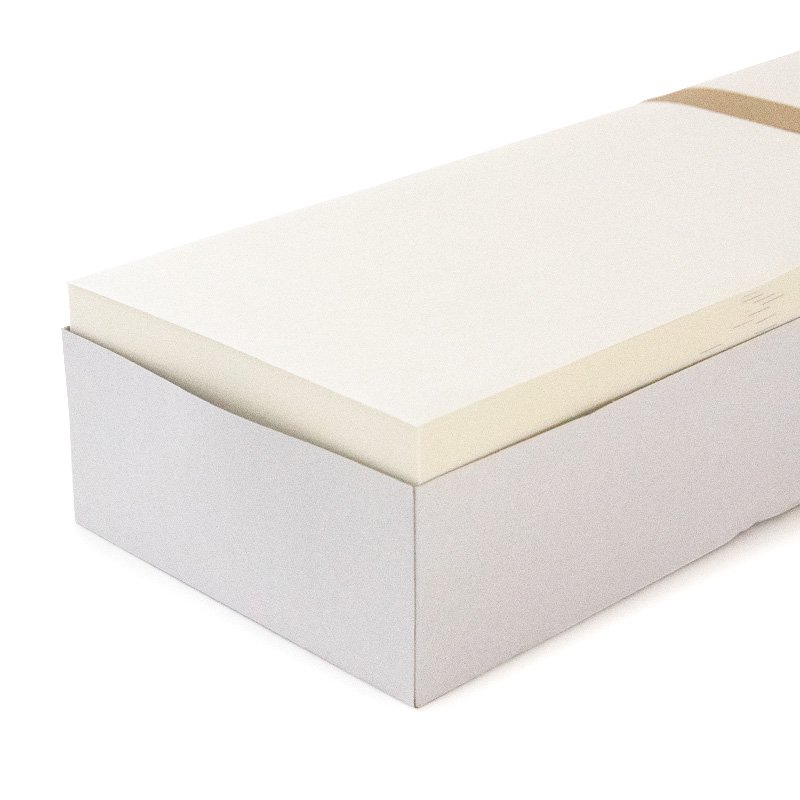
Kakizome Paper / kakizomeyoushi
When it comes to kakizome paper, this is the standard size.
Yatsugiri, kakizome paper, quarter-hansetsu… it goes by many names.
It is mainly used as practice paper for schoolchildren.
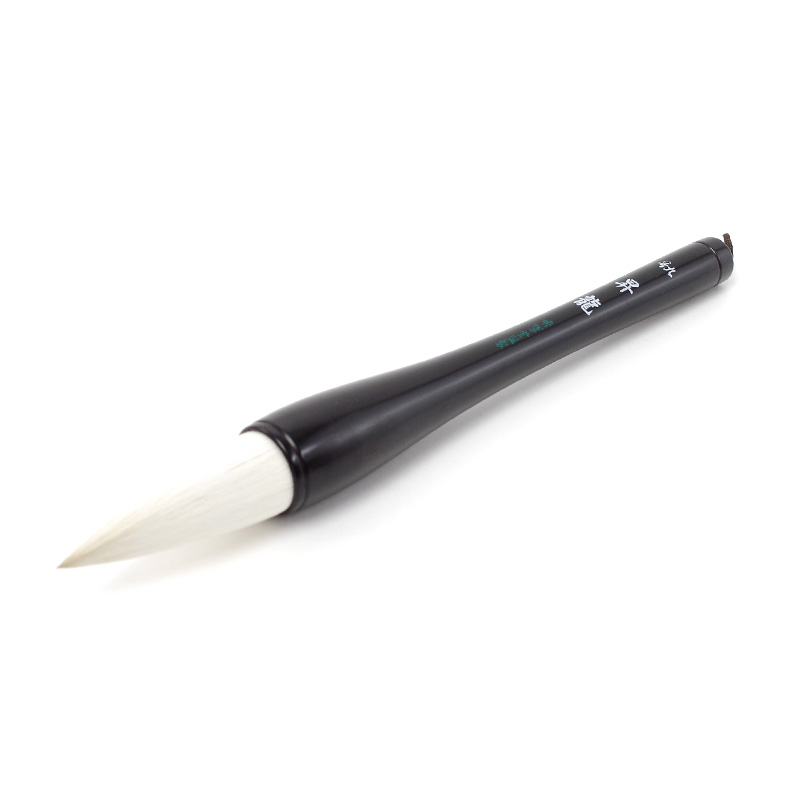
Kanji Kakizome Brush / kakizomeyoufude
These are the kakizome brushes recommended by Shoyu.
Choose one of these brushes for writing energetically on yatsugiri or hansetsu paper.
For those with strong brush pressure, choose a slightly smaller size. For those with lighter pressure, go for a slightly larger brush.
Loading the brush with plenty of ink and writing large characters in one bold sweep feels wonderfully refreshing.


