

Shodo Daisuki Episode 41
Shodo Daisuki – Episode 41
Let’s Make “Dyed Paper” Using Everyday Items!!
Shodo Daisuki – Episode 41
In this video, Shimauchi from “Shodo Daisuki” talks about how to dye washi paper!
Shodo Daisuki – Episode 41: Video Overview
This video explains in detail how to dye washi paper using coffee, black tea, and green tea. Shimauchi explains that although white washi is commonly used in calligraphy, using colored washi can change the mood and add new charm to your artwork.
In his experiment, he created very strong concentrations of each beverage and used both handmade washi and machine-made washi. The papers were soaked for either 1 minute or 30 minutes to compare the differences in coloration.
The results showed that the 30-minute soak produced deeper and richer colors. Machine-made washi is sturdier and suitable for beginners, but handmade washi produced more nuanced and expressive dye results. Another interesting finding was that dyed washi reduced ink bleeding, making it easier to write on.
As an additional experiment, Shimauchi used *dōsa-eki* (sizing solution) to write characters first, then dyed the sheets. The coffee test failed, but with black tea and green tea, the characters written with dōsa-eki appeared darker than the surrounding dyed areas. However, soaking for too long caused those areas to fade.
He concludes by describing the fun and pride of using paper you dyed yourself—being able to say “I dyed this paper myself” at an exhibition adds personality and expands the expressive possibilities of your work.
Youtube Shodo Daisuki – Episode 41
Shimauchi 00:00
Isn’t this a bit strong? It turned into a deep, rich color, didn’t it? Since it’s paper I dyed myself, the ink bleed is actually a bit controlled—very mysterious and hard to explain. Hello, this is Shimauchi, and I love calligraphy.
Shimauchi 00:19
So, everyone, let me ask you suddenly: have you ever written on colored paper before? Those eye-catching colorful sheets are fun to look at all by themselves. Most people probably write on white gasenshi (calligraphy paper), but when you write on colored gasen, don’t you sometimes feel like, “Oh, today my mood is different,” or “I think I wrote better than usual”?
Shimauchi 00:36
It’s a bit like the feeling when you write with a brush for the first time and suddenly feel like you wrote just like your teacher’s model. That’s the kind of thing I mean. In this video, I wanted to see if we can easily make a slightly retro, off-white style paper using items close at hand. So I decided to dye paper with coffee and black tea. And since we already have coffee and black tea,
Shimauchi 00:50
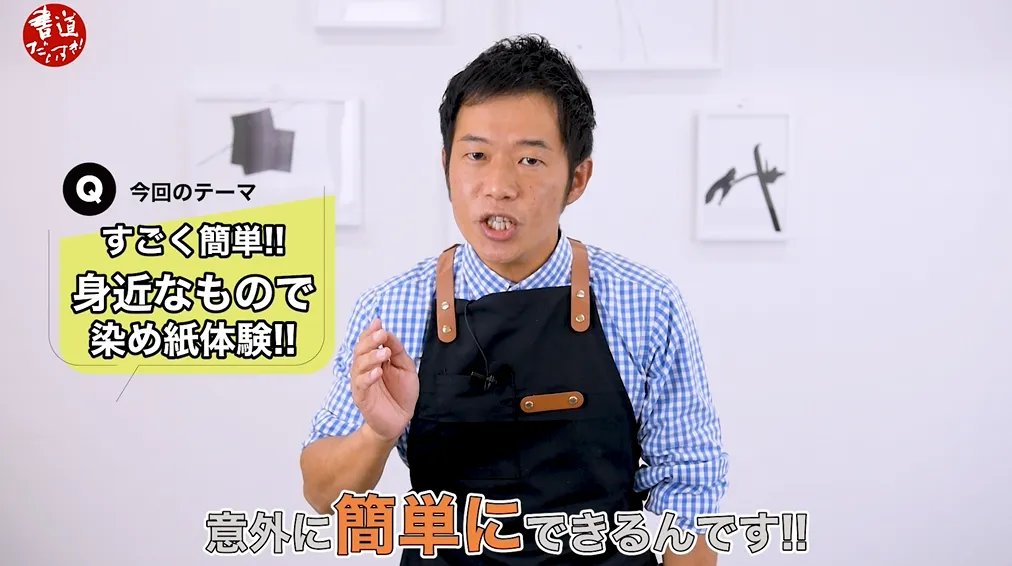
I thought, “Let’s invite green tea to join the party as well,” and decided to dye paper with green tea, too. Many people might think that dyeing gasen paper sounds like a lot of work and a hassle, but it’s actually surprisingly easy. This time,
Shimauchi 01:09
I’d be very happy if, after watching this paper-dyeing demo, you feel like, “I want to try it myself!” If you find this channel and video helpful, please consider subscribing and giving it a thumbs-up.
Shimauchi 01:23
I’d really appreciate your support. Now, let’s start the main segment. Here we go! For this paper-dyeing project, I used just one main item: a tray. Something to hold the liquid—this is the same tray I used for the suminagashi video. As I mentioned earlier,
Shimauchi 01:36
the liquids used in the experiment were instant black coffee, straight black tea, and plain green tea. These coffee, tea, and green tea solutions were all made so strong that you’d think, “Isn’t this way too concentrated?”
Shimauchi 01:52
I figured the stronger the solution, the better the dye would take. Into these liquids I put Kōsei-hai cotton-content tansen (handmade washi), and for comparison I also added machine-made gasenshi.
Shimauchi 02:08
As for soak time, I used two conditions: 1 minute and 30 minutes. These two were used as the comparison points for the experiment.
Shimauchi 02:27
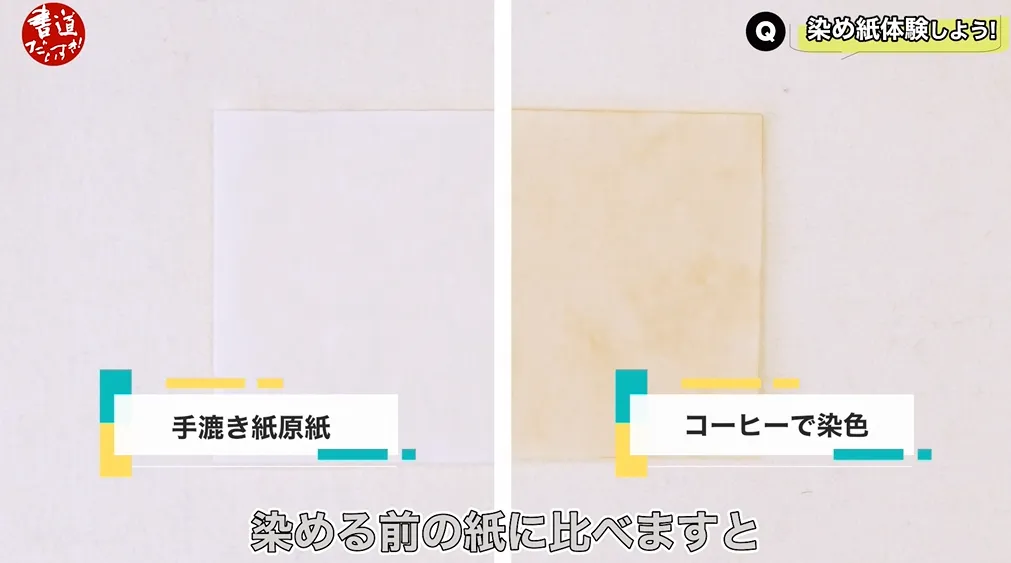
So, what happened to the sheets dyed for 1 minute? Compared to the undyed paper, they took on a very light, subtle tone, but they were definitely dyed.
Shimauchi 02:44
And the sheets that I patiently left in for 30 minutes—compared to the undyed paper, they turned into a deep, rich tone, didn’t they? In terms of toughness, machine-made paper is overwhelmingly stronger.
Shimauchi 03:01
So, if you’re worried about the paper tearing, I recommend starting with machine-made sheets for your first attempts. That said, because they were soaked for a full 30 minutes, the paper became quite fragile when lifting it out of the tray,
Shimauchi 03:17
so please be extra careful not to tear it at that stage. Setting durability aside, in terms of how beautifully the paper takes on color, handmade Kōsei-hai cotton-content tansen gives a much richer, more flavorful result than machine-made sheets. I wanted to make sure to mention that as well.
Shimauchi 03:32
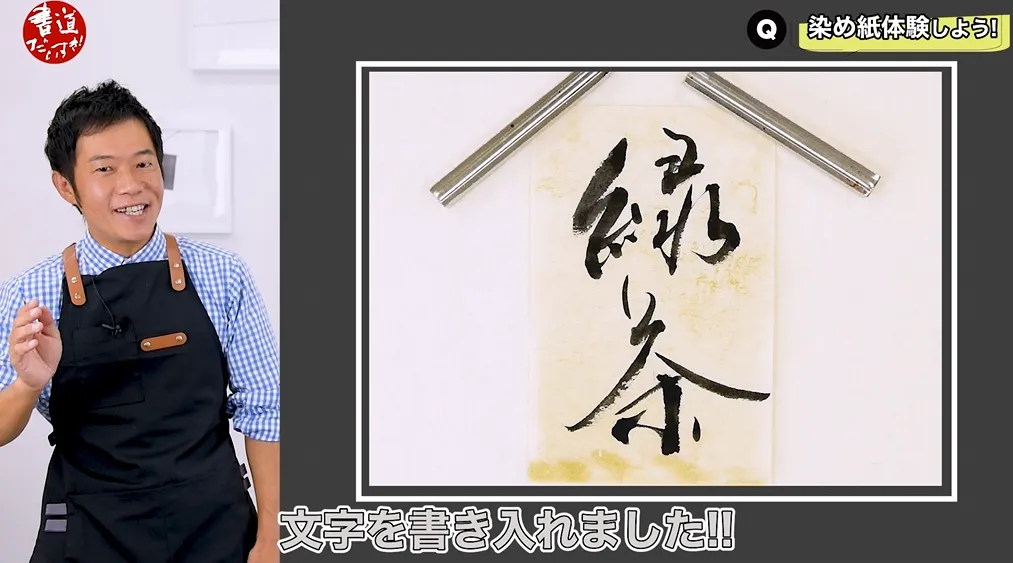
Since this is paper you dyed yourself and feel attached to, of course you’ll want to write on it—so I wrote some characters. Writing on dyed paper, compared with white paper, made me feel like, “Oh, this looks a bit more stylish!”
Shimauchi 03:45
And another curious thing: once dyed, the paper seems to slightly stop the ink from bleeding. In other words, it actually becomes easier to write on. So you get both a nice atmosphere and better writing feel—
Shimauchi 04:01
that’s pretty much a win-win, isn’t it? Now, this paper-dyeing experience alone is already rewarding enough, but I actually did one more experiment. Previously, in the suminagashi video, dōsa-eki (sizing solution) played a very interesting role, so
Shimauchi 04:15
I became very interested in it. I wondered, “What would happen if I write with dōsa first and then dye the paper?” That curiosity drove me to try it. I wanted to see what would happen to the characters written with dōsa after dyeing the sheet.
Shimauchi 04:31
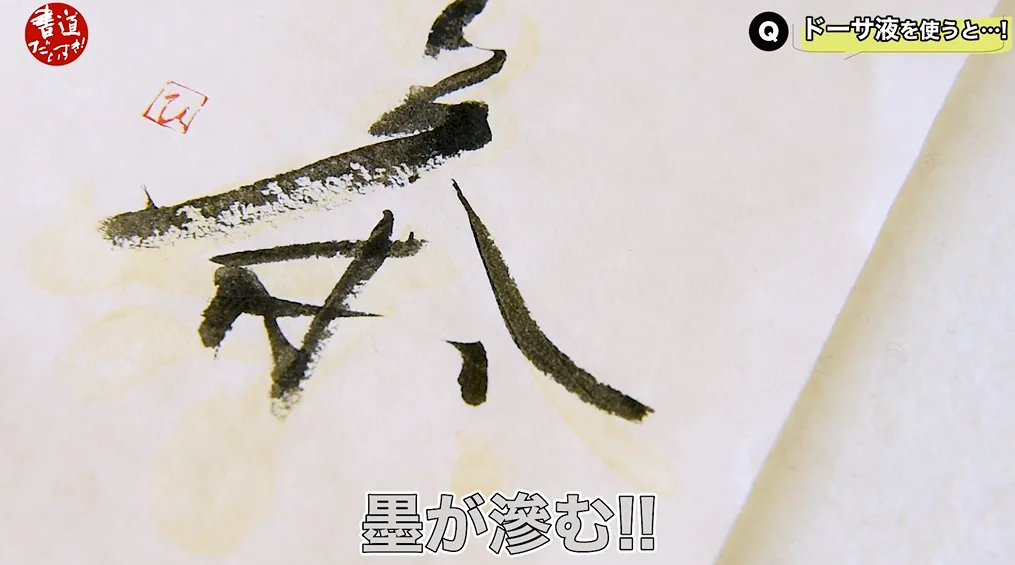
I hope you’ll check out that result as well. So, what happened in this experiment? To jump straight to the conclusion: the coffee test was something of a failure. However, with black tea and green tea, we got a very interesting result. The areas written with dōsa solution actually appeared darker
Shimauchi 04:49
than the surrounding dyed color. It was strange and fascinating at the same time. But if you leave the sheet in the dye too long, the color where the dōsa was applied disappears. Why does that happen?
Shimauchi 05:03
I honestly don’t know—it’s really mysterious. So, one thing to note is: don’t overdo the soak time. Now, you might think that, after writing with dōsa, ink would be repelled on top of those areas. Surprisingly, it isn’t repelled;
Shimauchi 05:20
you can write normally. But in another twist, ink actually bleeds more over the parts where dōsa was applied. Again, strange and hard to explain,
Shimauchi 05:39
but it made for some very interesting results. Since dōsa is transparent and hard to see, one idea is to first write characters with dōsa, then, after dyeing, write the same characters again over the top. Wouldn’t that look pretty cool? I think it’s worth trying.
Shimauchi 05:54
How was it? Of course, using ready-made products is fine, but sometimes it’s fun to make things yourself and dye the paper exactly how you like it. For example, imagine this: at an exhibition, a friend looks at your work and asks, “This paper is nice—where did you get it?” And you can answer,
Shimauchi 06:10
“I’m glad you noticed—actually, I dyed this paper myself.” Wouldn’t that feel like a fun little brag and make you happy?
Shimauchi 06:26
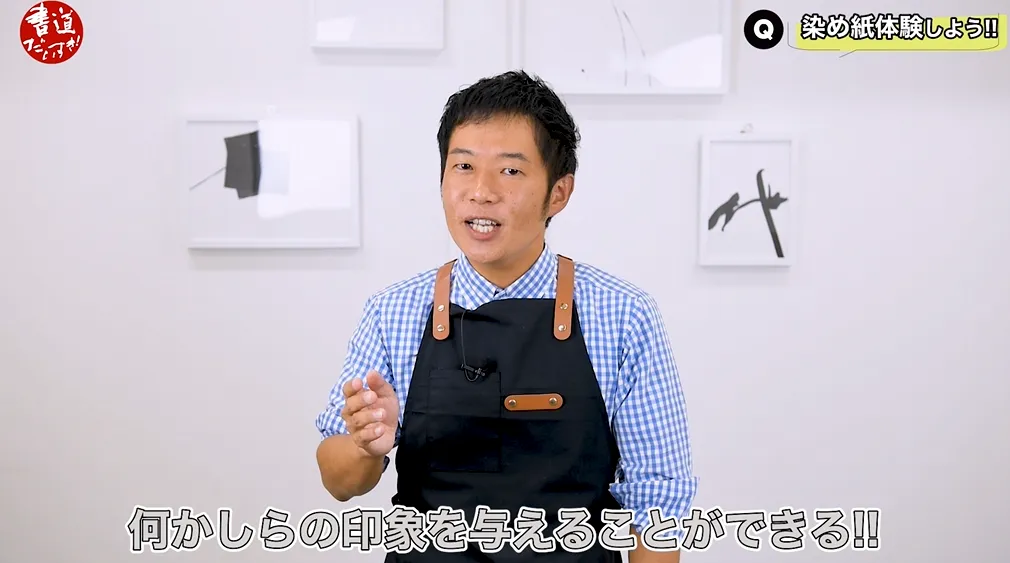
Just that alone means you were able to leave some kind of impression on the viewer. I think that counts as one more way to present your work and one more layer of expression.
Shimauchi 06:44
Creating pieces on paper dyed in your favorite colors will naturally make those works precious to you. And for those who see them, I believe they will also leave a stronger impression.
Shimauchi 07:01
This paper-dyeing method is very simple, so I really hope you’ll give it a try. This has been Shimauchi, and I love calligraphy. I’m sure there are many more clever approaches to paper dyeing than what I showed today,
Shimauchi 07:01
so if you have more knowledge or tips, please do share them with me. I’d really appreciate it. See you again next week. Goodbye!

![Dyed Paper [Genkuro/Jet Black] Hansetsu, 10 Sheets](http://en.shoyu-net.jp/cdn/shop/files/161445161_21e63f4e-7f36-4768-9dac-4f0f169d021a.jpg?v=1761641793&width=800)
![Dyed Paper [Sharegaki/Persimmon] Hansetsu, 10 Sheets](http://en.shoyu-net.jp/cdn/shop/files/161445163_0b39d5ea-7217-416a-998c-39e0026eda82.jpg?v=1761641796&width=800)
![Dyed Paper [Wakaba/Fresh Green] Hansetsu, 10 Sheets](http://en.shoyu-net.jp/cdn/shop/files/161445168_6f8616e7-8804-4d61-b96a-aa26369ecbde.jpg?v=1761641802&width=800)
![Dyed Paper [Genkuro/Jet Black] Hanshi, 20 Sheets](http://en.shoyu-net.jp/cdn/shop/files/161445169_19620456-92b2-4a36-aea2-92554d32ba15.jpg?v=1761641804&width=800)