Shodo Daisuki Episode 42
Shodo Daisuki – Episode 42
Bringing Your Work to Completion!! All About “Rakkan”!!
Shodo Daisuki – Episode 42
In this video, “Shodo Daisuki” host Shimauchi talks about rakkan (signature inscriptions)!
Shodo Daisuki – Episode 42: Video Overview
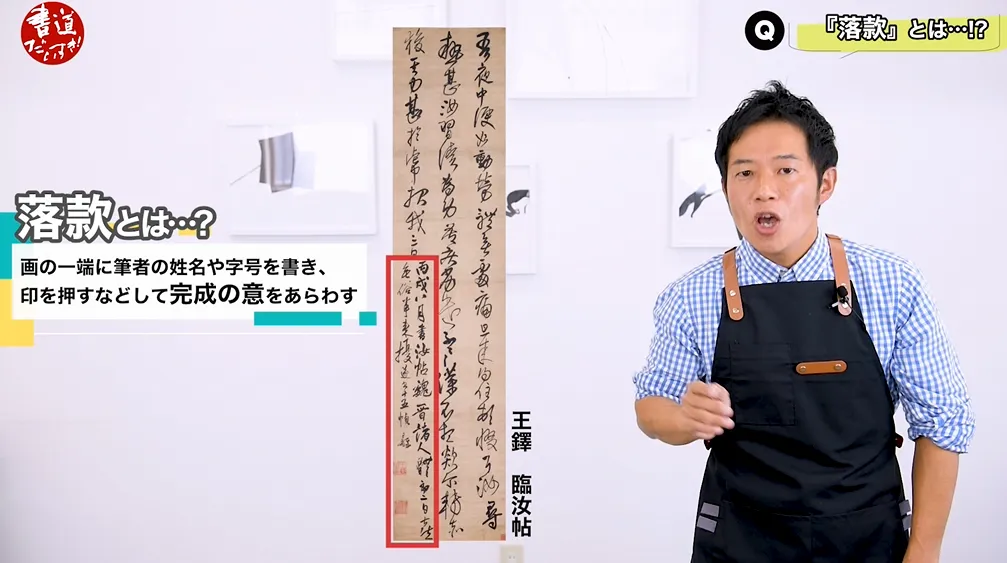
This is a lecture by Shimauchi about rakkan, the signature inscription that completes a calligraphy or painting. Rakkan refers to the inscription typically found along the left side of a work, containing the artist’s name, art name, date of production, and other information. The term originally comes from the abbreviation of 「落成款識」 (rakujo kanshiki), where rakujo means the completion of the work, and kanshiki refers to signing and stamping the piece.
The video explains in detail the basic ways to write rakkan and their various formats. It covers the grammatical structure used when writing your real name or art name (for example, 「〇〇書」 meaning “written by 〇〇”), as well as the differences in how rakkan are written when the work is a copy (rinsho) of a classical model.
The position and format of rakkan are also discussed. Using a standard half-sheet (hansetsu) piece as an example, Shimauchi explains how to decide where to place the rakkan and how to balance it with the main text. As a basic rule, the main text is written in the center of the paper, and the rakkan is written slightly above the center on the left side, but he also emphasizes the importance of adjusting it according to the work so that everything harmonizes visually.
Finally, he touches on the use of the traditional sexagenary cycle kan-shi (ten heavenly stems and twelve earthly branches) in indicating the year in rakkan. Because the cycle returns to the same combination every 60 years, the 61st year is called “kanreki” (a return to one’s original calendar sign).
He concludes by encouraging viewers to pay attention to the rakkan as well when viewing works at exhibitions, as this deepens one’s understanding of the piece. He also announces that in the next episode he will explain how to choose the appropriate size of rakkan to match each work.
Youtube Shodo Daisuki – Episode 42
Shimauchi 00:00
Hello, this is Shimauchi, and I love calligraphy. You may have heard the word rakkan before, but when you’re suddenly asked to explain what it is, you tend to hesitate and go “Well, um…” and run out of words, right? For many people, the impression of rakkan might actually be stronger for the “seal” itself rather than the writing. In this video, as an introductory part,
Shimauchi 00:22
I’d like to briefly explain what rakkan are. By knowing even a little bit, when you go to an exhibition and look at works, you’ll hopefully be able to think, “Ah, so this is the rakkan,” and notice things you might have overlooked before. If that happens, that will make me, Shimauchi, very happy.
Shimauchi 00:39
If you feel like, “I’d like to keep watching this channel,” please subscribe and hit the like button—just a quick click makes me really happy. Now, let’s start the main part. What are rakkan?
Shimauchi 00:57
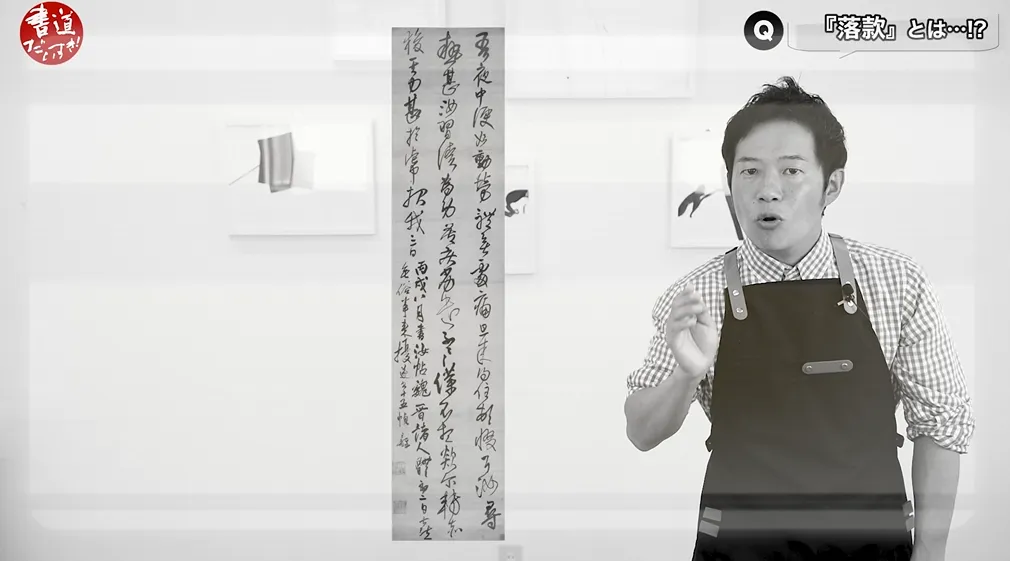
You often see them along the left side of calligraphy and paintings, don’t you? It’s the part where the artist writes their full name or art name (gō), adds a seal impression, and by doing so, expresses that the work is complete. Sometimes the date, place of production, the subject, or the reason for choosing the text are also written there. And here,
Shimauchi 01:19
everyone, this is the key point. You’ve probably seen it before: long, flowing lines of classical Chinese text written at the side, right? That’s the sort of thing they’re writing there. The word “rakkan” is originally an abbreviation of the phrase 「落成款識」. In modern usage, rakujo means the completion of the work,
Shimauchi 01:41
and kanshiki means signing and stamping the work. From here, I’d like to introduce some simple examples of rakkan.
Shimauchi 02:03
First, by writing only your name or art name, you can indicate who created the work. For example, when you write 「〇〇書」, it means “〇〇 wrote this.” If you place the verb-like character such as 「書」 after the noun that can serve as the subject (a person’s name), you get a simple rakkan structure that reads “〇〇 did such-and-such.” So, 「〇〇書」 literally means “〇〇 wrote (this).”
Shimauchi 02:23
For instance, 「島内書」 means “written by Shimauchi.” Up to now I’ve uploaded various videos on classical copying (rinsho), and for the rakkan used when doing rinsho, putting 「臨」 after your name means “〇〇 did a rinsho (copy).” So, above the character 「臨」 you would write the name of the person doing the copying.
Shimauchi 02:49
Conversely, if you place 「臨」 at the top, it means “copied from such-and-such,” so below 「臨」 you would write the name of the classical work or original calligrapher. On the other hand, for kana works, there is almost no explanation of the time, circumstances, or place; in many cases, only the seal is impressed.
Shimauchi 03:08
Sometimes, under your name or art name you may add a word such as 「書」 written in kana (hiragana) to describe that it was “written.” When citing a source, for example, you might write something like 「一作 牧水の歌」 (“a poem by Mokusu”) and combine that with your name or art name to form the rakkan. This is a common pattern.
Shimauchi 03:33
Next, let’s talk about the position and format of rakkan. The position and size of the rakkan will vary depending on the paper size and the composition of the work, but the most important point is whether the main text and the rakkan are well balanced with each other.
Shimauchi 03:55
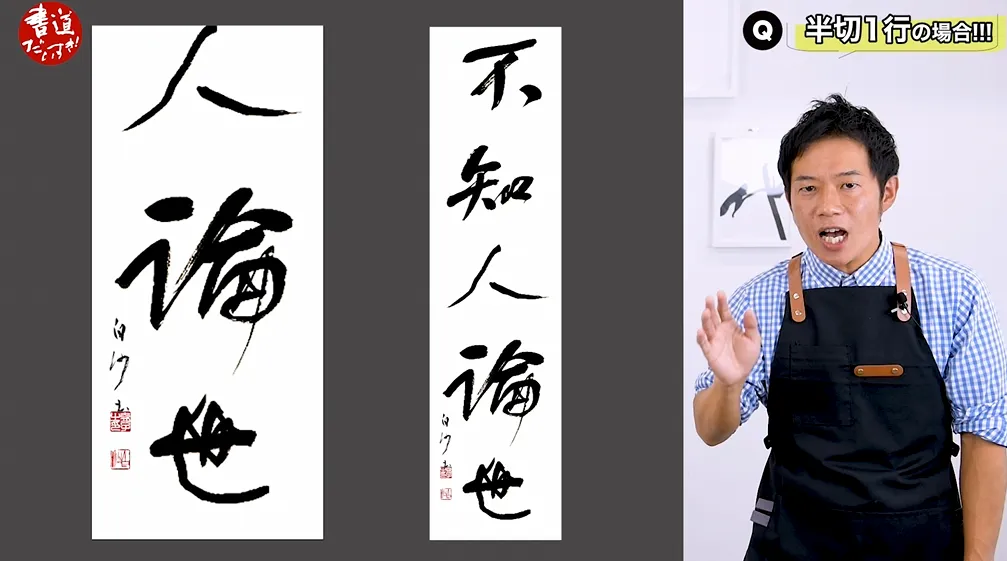
In this video, I’ll use a half-sheet (hansetsu) work as a familiar example. First, for a single-line hansetsu piece written in standard script, the general rule is that the main text is written in the center of the sheet, and the rakkan is written on the left side. The rakkan is often placed slightly above the center; if it is written too low, it can make the work look heavy or clumsy.
Shimauchi 04:20
If you consider the distance from the signature down to the rakkan seal as the “length” of the rakkan, then good balance is achieved when the center of that length aligns with the center of the sheet. However,
Shimauchi 04:38
whether that is always the best position or not is a subtle matter. The key is to place the rakkan in a way that suits the specific work. For some pieces, placing it higher works better; for others, putting it a bit lower may feel more stable. In other words, for a one-line rakkan, the center position is not an absolute rule.
Shimauchi 04:55
As you see in this illustration, it can also look very stylish to tuck the rakkan nicely along the left side like this. When it’s written that way, it looks really cool, doesn’t it? Next, let’s look at a two-line hansetsu piece.
Shimauchi 05:12
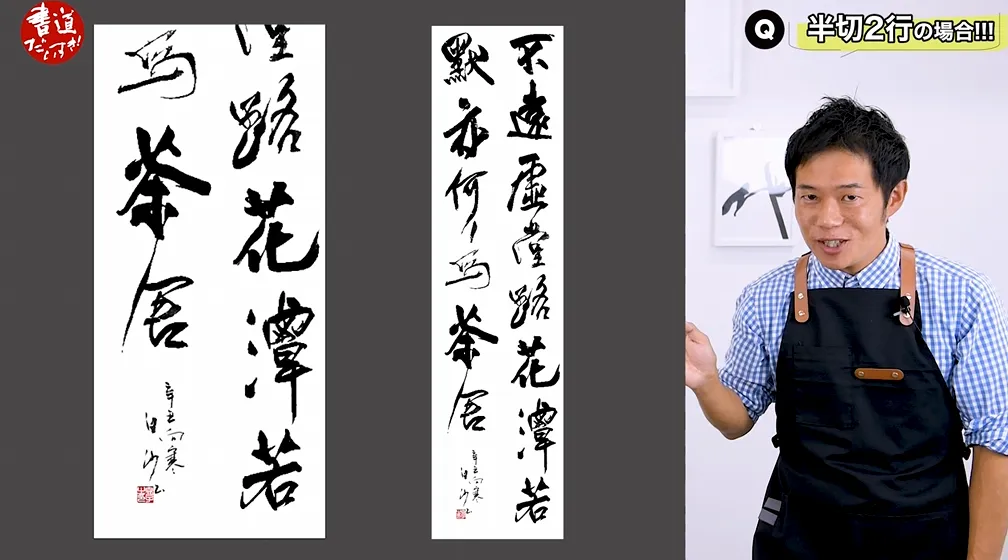
When the main text consists of two vertical lines, you need to write it from the beginning with the idea that a rakkan will go on the left. As shown in the diagram, writing the rakkan itself in two lines can look very refined and tight. One thing you must be careful about, however,
Shimauchi 05:30
is not to split proper nouns or set phrases between the first and second lines. Please be sure to avoid breaking words like that.
Shimauchi 05:49
There is much more that could be said about rakkan, but I’ll wrap things up here for today. Before we finish, though, I’d like to introduce one commonly seen example: using the sexagenary cycle to indicate the year in the rakkan.
Shimauchi 06:08
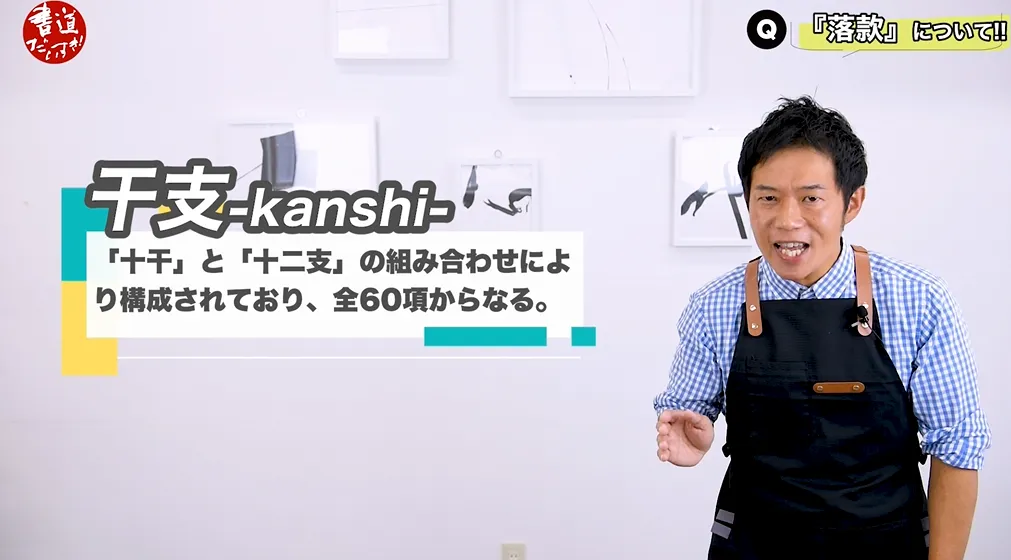
The sexagenary cycle is made up of the ten heavenly stems and twelve earthly branches. It’s a bit tricky to explain in words, so I’ll display a diagram for you here—please use that as a reference. Later on, twelve animals were assigned to the twelve branches, so in Japan we’re very familiar with this as the eto (zodiac signs).
Shimauchi 06:27
When you combine the ten stems with the twelve branches, the least common multiple of 10 and 12 is 60, so it takes 60 years to go through the full cycle once. That means that in the 61st year, the cycle comes back to the same combination it started with. This is where the word kanreki (sixtieth birthday, return to one’s original cyclical sign) comes from. In the old days, they used these kan-shi to express not only the year, but also the month, day, and even the time of day.
Shimauchi 06:53
Soon we’ll be entering the New Year’s card season. Many of you will probably be writing them, too. That’s one reason I decided to introduce kan-shi here at the end.
Shimauchi 07:10
How was it? When we look at Chinese works or the works of great calligraphers, we see long, flowing rakkan written beside the main text. It’s amazing, isn’t it? Very cool. When you go to an exhibition, are you perhaps overlooking these rakkan?
Shimauchi 07:28
As I mentioned earlier, rakkan contain all kinds of information. So I’d like to encourage you to look at them carefully and study them, instead of skipping over them. To be honest, I’m not very good at classical Chinese myself, so just looking at rakkan is about all I can manage—it’s not easy to understand them fully. But if we build up our knowledge of the conventions and memorize some of the standard phrases,
Shimauchi 07:46
we might eventually be able to create our own cool, original rakkan that truly match our works. Rakkan have this kind of depth to them, and I’d like to keep studying them little by little from now on.
Shimauchi 08:08
This has been Shimauchi, and I love calligraphy. In the next video, I’ll talk about choosing the right size of rakkan to suit your work. Please look forward to it. See you next time!