

Shodo Daisuki Episode 70
Shodo Daisuki Episode 70
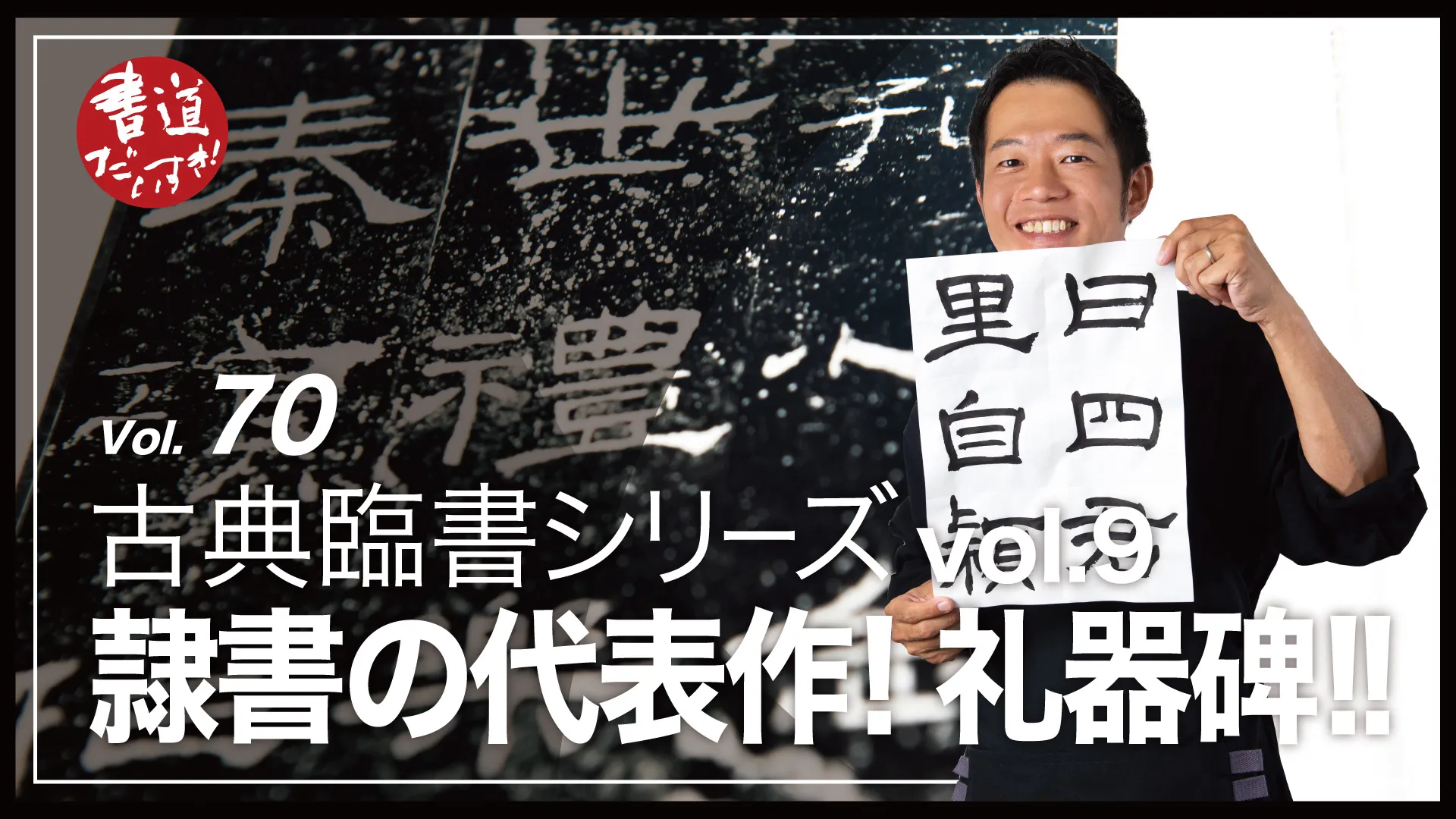
“A Masterpiece of Clerical Script!! The Liji Stele (Reikihi)!!” Classical Copying Series vol.9【Calligraphy】
Shodo Daisuki – Episode 70
In this video, Shodo Daisuki Shimauchi takes on the “Liji Stele (Reikihi)”!
Shodo Daisuki Episode 70: Video Overview
This episode records Shimauchi’s attempt at the “Liji Stele (Reikihi),” a representative masterpiece of Clerical Script (Reisho).
He explains the Later Han period beginning in AD 9, describing how a stele (stone inscription) culture emerged in this era and how calligraphy came to be recognized as an art of individual expression. He also shares an episode about the calligrapher “Zhang Zhi,” explaining that the term “Rinchi” (臨池) was born from the story of him writing nonstop on cloth throughout his house and even on the surface of a nearby pond.
He explains that the Liji Stele was completed in AD 156 (about 1,800 years ago) and was erected to praise the virtues of Han Chi (韓勅), a governor of the state of Lu. As for the author, there are theories that it was written by seven people or by a single person, and the conclusion remains unknown. Shimauchi evaluates this work as having a compelling power and charm that makes even modern viewers feel, “This is beautiful writing.”
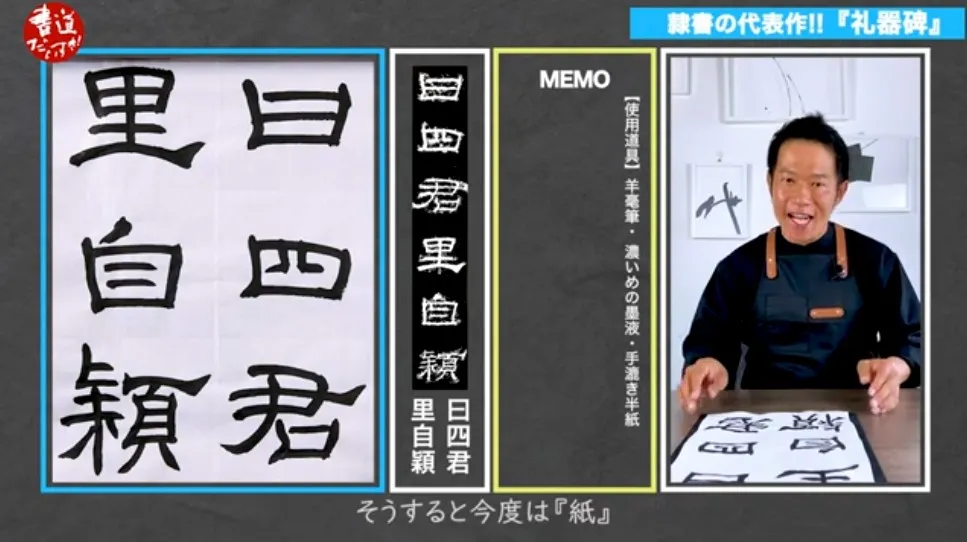
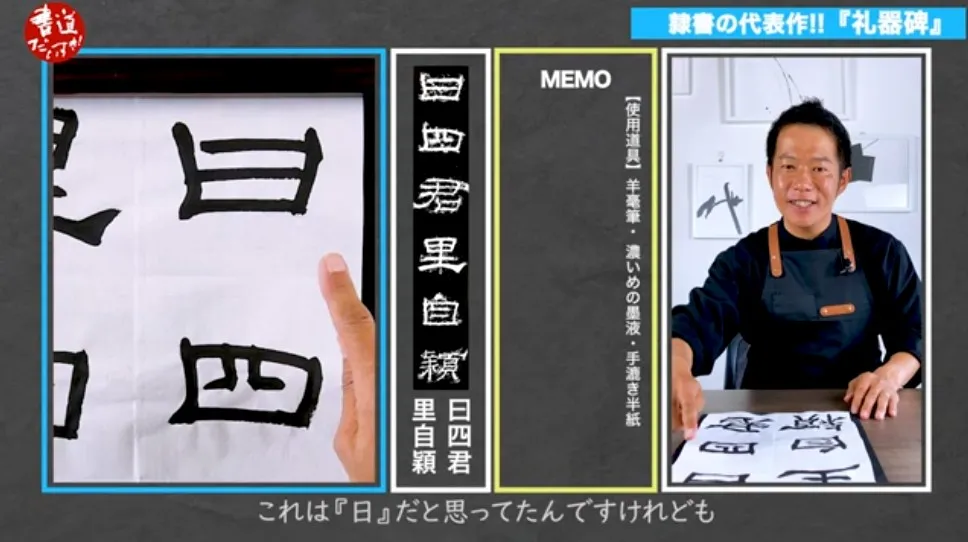
In the practical copying section, Shimauchi is shown writing six characters he selected. He also explains the tools in detail: he chose a relatively soft goat-hair brush, used a darker ink, and selected handmade paper that absorbs ink well. He also explains that a character he thought was “日” is actually the character “etsu” (えつ), depicting the act of lifting a vessel and peering inside, with meanings such as “to see” and “to say.”
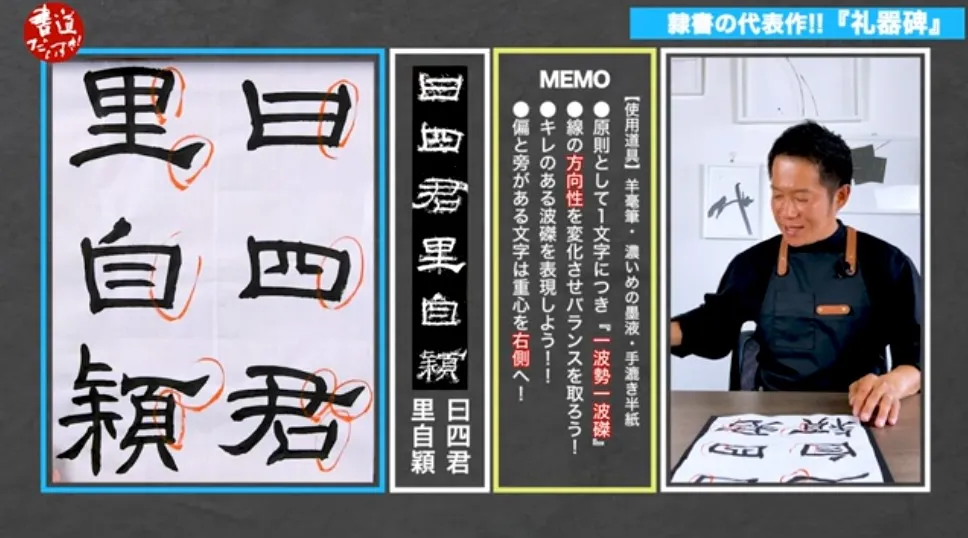
As characteristics of Clerical Script, he explains that horizontal strokes are long and vertical strokes are short, that there is a principle of “one hasei and one hataku (hata-ku) per character,” and that even the same character can vary in form. He especially emphasizes the importance of the clean, crisp “cut” at the end of the hataku stroke. Finally, Shimauchi says he wrote while being mindful of where the line quality changes, and stresses the importance of staying focused until the very end. He closes by announcing that next time he plans to take on another Clerical Script work, the “Caoquan Stele (Sōzenhi).”
YouTube Shodo Daisuki Episode 70
Shimauchi 00:00
Masterpieces continue to be created—so much so that people end up copying and copying again, even on the surface of the water. You could say it’s a kind of self-reflection. The parts where things change…
Hi, this is Shodo Daisuki Shimauchi. It’s time for the Classical Copying Series, where we experience Chinese calligraphy history in a real, hands-on way.
Shimauchi 00:18
This time, I’d like to take on a representative masterpiece of Clerical Script: the Liji Stele (Reikihi). Up to now, we’ve copied oracle bone script, bronze inscriptions, Small Seal Script, and early Clerical Script. But rather than feeling like we were facing a single “work,” it felt like confronting something huge and hard to grasp—more like “character forms” themselves. However…
Shimauchi 00:37
From this era onward, it’s a parade of masterpieces—so many to choose from. I, Shimauchi, have hardly copied any of them, so it feels like I’m standing at the entrance to a vast forest. But just as before, I want to face them sincerely and share the charm of these masterpieces with you in a simple, easy-to-understand way.
Shimauchi 00:57
On this channel, we introduce all kinds of things related to writing—not just calligraphy—so please subscribe and give the video a thumbs-up. Alright, let’s go with energy. From AD 9, the time when the Han changed the country name to Xin, the era is called the Later Han.
Shimauchi 01:18
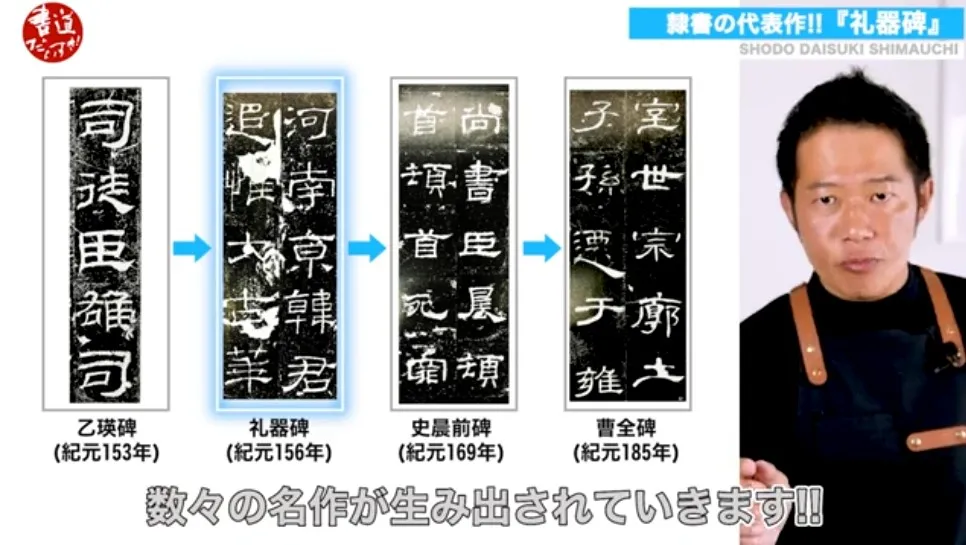
As time moves forward from the previous era, the refinement of Clerical Script does not stop. Moreover, from this period onward, a culture of erecting stone steles is born, and countless masterpieces are created all the way up to the present day. Around this time, it also became more common to sign the author’s name on these steles, and…
Shimauchi 01:37
that is said to mean calligraphy came to be recognized as an art of individual expression. Almost none of the works remain, but from this era, famous calligraphers begin to appear. Among them is the well-known calligrapher Zhang Zhi, and this calligrapher… well, he absolutely loved calligraphy.
Shimauchi 01:56
He loved it so much that he wrote nonstop on cloth all over his house. Still not satisfied, he even went to a nearby pond and practiced writing on the surface of the water—over and over—until, as the story goes, the pond turned black.
Shimauchi 02:12
It’s said that this became the origin of the term “Rinchi” (臨池), meaning “to write/practice.” And amid that, a masterpiece of Clerical Script was born—so let’s take a close look. The Liji Stele is said to have been completed in AD 156, more than about 1,800 years ago.
Shimauchi 02:32
The stele was erected to praise the virtues of Han Chi (韓勅), an important official in the state of Lu. It’s also said that on the back are written the names of the people who contributed funds to erect the stele—along with the amounts they gave. As for the author of the Liji Stele…
Shimauchi 02:49
Some scholars argue, “Because there are seven signatures on this inscription, it must have been written by seven people.” Others argue, “There are characters of many different sizes, but the consistency is strong—so it must have been written by one person.” In the end, it remains unknown.
Shimauchi 03:07
The fact that multiple theories exist really makes you feel how compelling this work is, doesn’t it? Someone once said, “To learn the beauty of Clerical Script, the Liji Stele and the Caoquan Stele are enough.” And to top it off…
Shimauchi 03:25
“This wasn’t written by hand or brush—its elegance is such that it can only be the work of divine power rather than human power.” Some people even reportedly got so excited they were out of breath. Certainly, the works we’ve copied so far have been beautiful, but…
Shimauchi 03:44
honestly, they sometimes felt “old.” But with the Liji Stele, it feels like not only I, Shimauchi, but even modern viewers who aren’t steeped in calligraphy can look at it and think, “That’s beautiful writing.” It seems to have a persuasive power and charm. Even compared with the early Clerical Script we did last time…
Shimauchi 04:02
there’s no trace of that tall, elongated Seal Script feel here; you could say the flattened proportions—and the hasei and hataku (wave-like movement and flaring finish)—are already fully formed. The Liji Stele, which feels almost divine—let’s copy it right away. Now then, let’s move into the practical copying.
Shimauchi 04:22
This time as well, I wrote six characters in advance—six that I personally wanted to write. Before I explain them, I’d like to talk a bit about the tools. First, the brush…
Shimauchi 04:40
When you research the Liji Stele, you’ll see some sources say it’s best to write it with a short-haired mixed brush (kengō-fude). But when I looked into it further, I found that ancient excavated brushes apparently contained deer hair, rabbit hair, and…
Shimauchi 05:02
goat hair mixed together. So I thought a slightly softer brush could also be fine, and this time again I challenged it with a goat-hair brush with slightly longer hairs. I know there will be different opinions on this, but I also realized ink capacity matters too…
Shimauchi 05:19
and that some amount of ink load is necessary for the Liji Stele. Taking that “ink-holding” aspect into account, I went with this setup. And as for the ink: it was written that it may have been done with darker ink, so for the first time I tried using ink darker than usual.
Shimauchi 05:37
Then the paper becomes important—paper really starts to matter here. For the paper, I chose handmade paper that absorbs ink relatively well. Those are the tools I used this time—please take them as reference.
Shimauchi 05:55
Next, among these characters, there are a few interesting ones—like this one here. I thought this character was “火,” but it actually wasn’t. It’s read “etsu” (えつ), and it depicts lifting up a vessel—one that had something inside—and peering into it…
Shimauchi 06:14
and then seeing what’s inside and saying it. So it carries meanings like “to see” and “to say.” So yes, it’s read “etsu,” and it definitely isn’t “卑,” either.
Shimauchi 06:32
This character “etsu” also apparently carries meanings like “a blade tip” or “brush tip,” and even “excellent,” so I thought, “What a great character,” and decided to remember it. Now, not limited to the Liji Stele, but…
Shimauchi 06:48
the biggest feature of Clerical Script is that the horizontal strokes are very long, while the vertical strokes are short. There’s also a principle of “one hasei and one hataku per character,” meaning: within a single character, the hasei is essentially one.
Shimauchi 07:10
So if you break this principle when writing, it won’t look like Clerical Script—so be careful. And as for the Liji Stele specifically, one characteristic is that when the same character appears, even that same character can have variations in its form.
Shimauchi 07:29
What I noticed this time is that there are many vertical strokes, and in these vertical strokes you can find different types—such as forward-leaning movement, backward-leaning movement, or perfectly vertical forms. There are all kinds of variations.
Shimauchi 07:46
I tended to overlook those, but they’re very characteristic. And of course, the hataku (the flaring finish)—the sharpness of that cut is incredibly crisp and wonderful. So I focused on how to bring out that hataku cleanly and sharply.
Shimauchi 08:04
As for the overall form: because the hataku is there, when a character has a hataku, it naturally ends up with its center of gravity on the right side. So when a character has a left and right component (hen and tsukuri)…
Shimauchi 08:20
there’s a tendency for the left component to be smaller and the right component to be larger. This doesn’t apply in every single case, of course, but it’s a common tendency—so that’s another characteristic.
Shimauchi 08:34
Above all, the thing I struggle with the most across all strokes is this: the starting stroke (kihitsu) is “zōhō” (hidden-tip start). So, the starting stroke is “zōhō”—whether you can bring this out cleanly is a key point, so with that in mind, I want to write them.
Shimauchi 09:39
Alright, I wrote them. It’s nerve-wracking every time, but I feel I’m gradually getting better at doing it in one go. When doing the final copy this time, the part I paid attention to—as I said earlier—was being mindful of where the line quality changes.
Shimauchi 09:55
In the previous video, I talked about how the directionality of lines can change the negative space, right? I hope this connects to that as well. And I tend to relax too much around the finishing section, but…
Shimauchi 10:14
with Clerical Script too, you must stay focused, stroke by stroke, all the way to the end. I still have a lot of weak points, but I want to keep that awareness continuously. That’s all. How was it? Among the many masterpieces of Clerical Script, we copied the Liji Stele today.
Shimauchi 10:33
This Clerical Script—adopted by most Japanese newspaper companies as a logo typeface—is familiar and beloved. It’s definitely something we want to master. Since we have the chance, next time I’d like to take on another Clerical Script work, the Caoquan Stele. So please look forward to it.
Shimauchi 10:53
With that, this was Shodo Daisuki Shimauchi. Let’s enjoy calligraphy without losing to the rainy season. See you again next week! Goodbye!
About Related Products
We introduce the products featured in this video.
Books / book & publications
Whether you are a beginner who wants to start calligraphy or an intermediate to advanced writer, the knowledge you can gain from books is essential.
You can learn not only from your teacher’s models, but also through books—making them ideal for practice at home and for self-study.
Building your calligraphy knowledge should also help broaden your perspective and deepen your understanding.