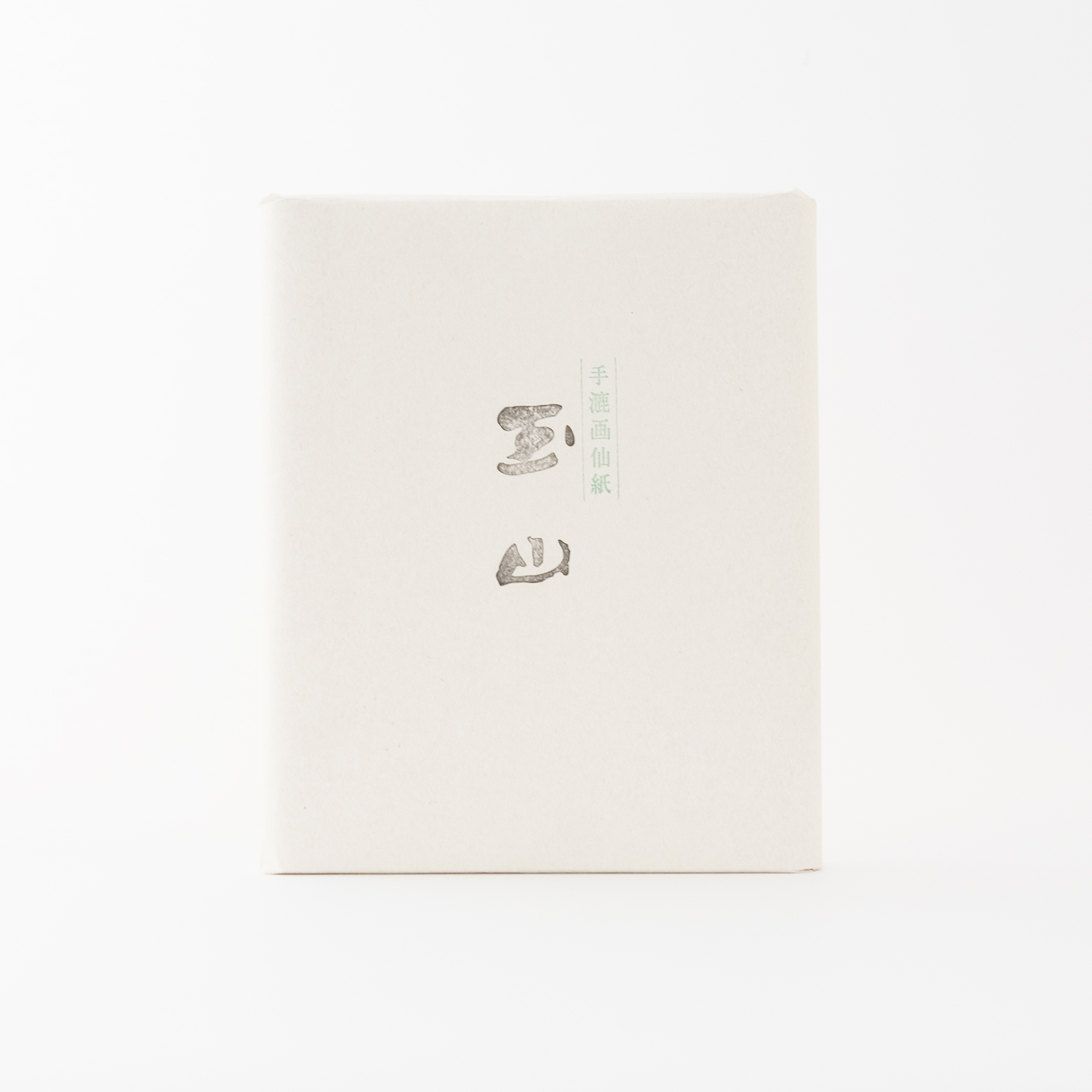
Shodo Daisuki Episode 23
Shodo Daisuki Episode 23
A Thorough Comparison of Standard Handmade Papers!【Calligraphy】
Shodo Daisuki – Episode 023
When you hear the term “handmade paper,” what kind of paper comes to mind?
Among the many types of handmade paper available, “Shimauchi” provides a thorough explanation of standard handmade papers in this episode!!
Shodo Daisuki Episode 23 — Video Overview
In this video, calligrapher Shimauchi explains in detail the different types and characteristics of handmade paper.
By actually using multiple kinds of handmade paper, he compares paper texture, ink absorption, and bleeding behavior, and explains what types of works each paper is best suited for.
In particular, he focuses on four types: “Xuan paper–style,” “Taiwanese paper,” “Taiwan-style paper,” and “handmade paper with sizing agents,” demonstrating each one in practice.
At the beginning, Shimauchi explains that the purpose of this video is to help viewers learn how to distinguish handmade papers and choose the appropriate paper when creating their own works.
He emphasizes that handmade paper is an extremely important element in calligraphy, and that the expressive range of a work can change greatly depending on the paper used.
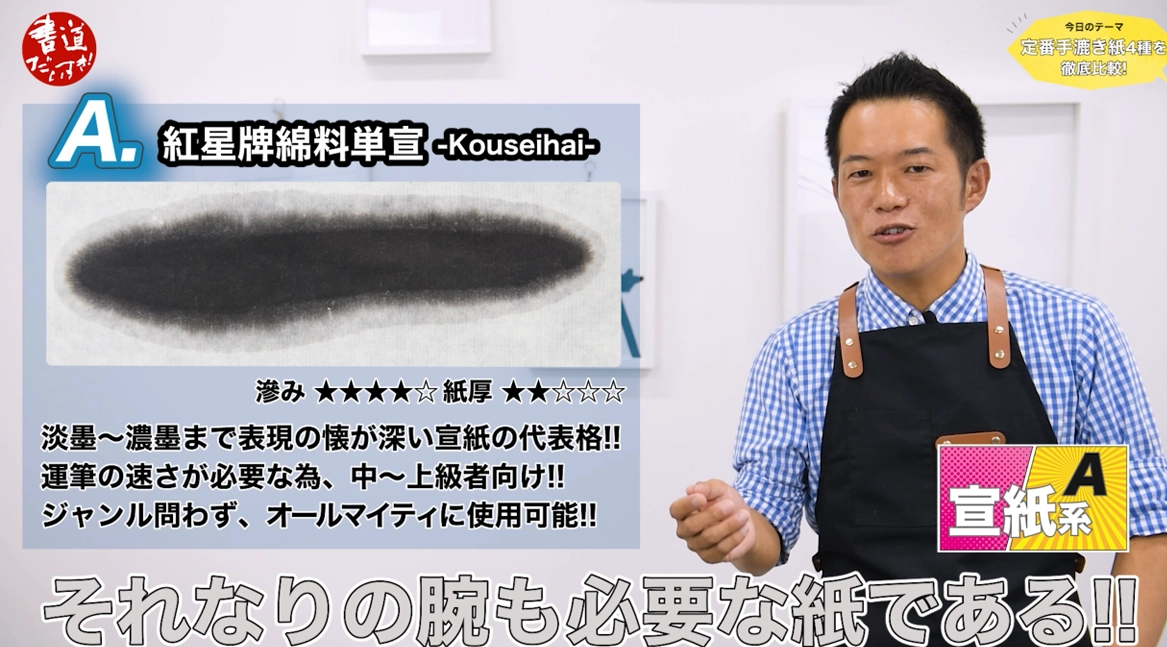
Regarding Xuan paper–style paper, he introduces an authentic paper made solely from rice straw and blue sandalwood bark, using the high-grade paper known as “Red Star Brand Cotton Xuan.”
This paper has a crisp texture and produces beautifully even ink bleeding.
It is versatile and suitable for both light and dark ink works, though it requires a certain level of brush speed.
He also notes that prices have risen sharply since around 2011, making it difficult to obtain today.
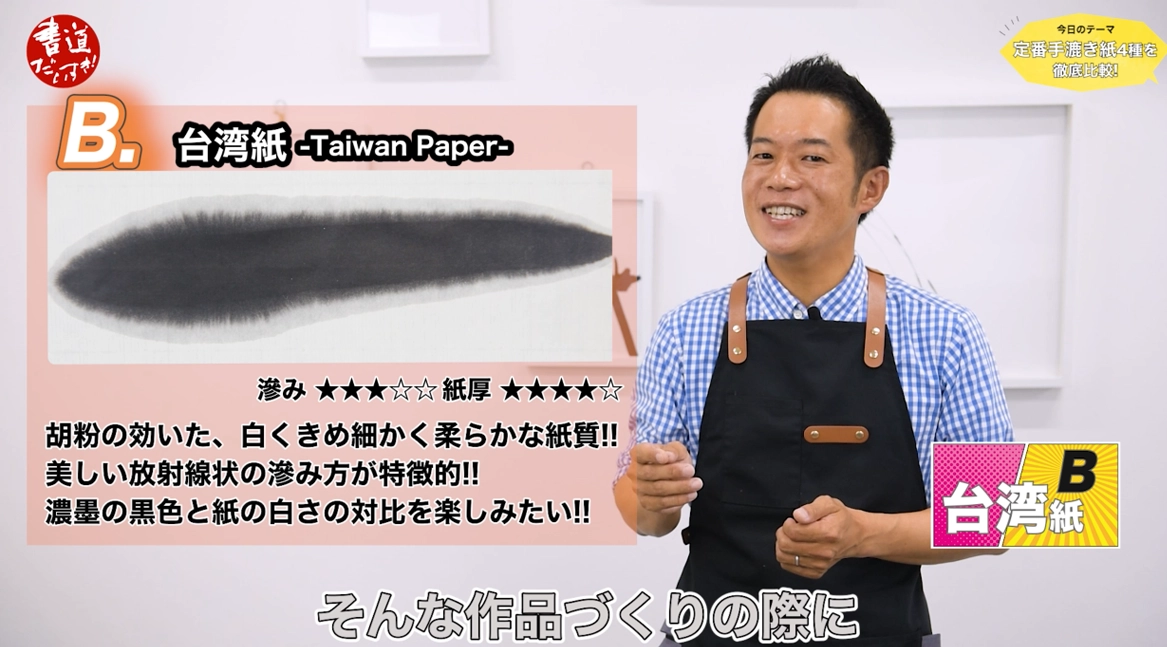
For Taiwanese paper, he explains that it is characterized by its fine texture and bright whiteness, and that it releases a powder called “gofun” when torn or rubbed.
It produces beautiful ink bleeding and is especially well suited for kanji–kana mixed works using dark ink, but is now difficult to obtain due to limited circulation.
Regarding Taiwan-style paper, he explains that it was once produced mainly in Xiamen, China, near Taiwan, but due to economic development and rising costs, it is now often produced inland in China.
There are both bleeding and non-bleeding types; the bleeding type works well with soft brushes and dark ink, while the non-bleeding type is better suited for mixed-hair brushes.
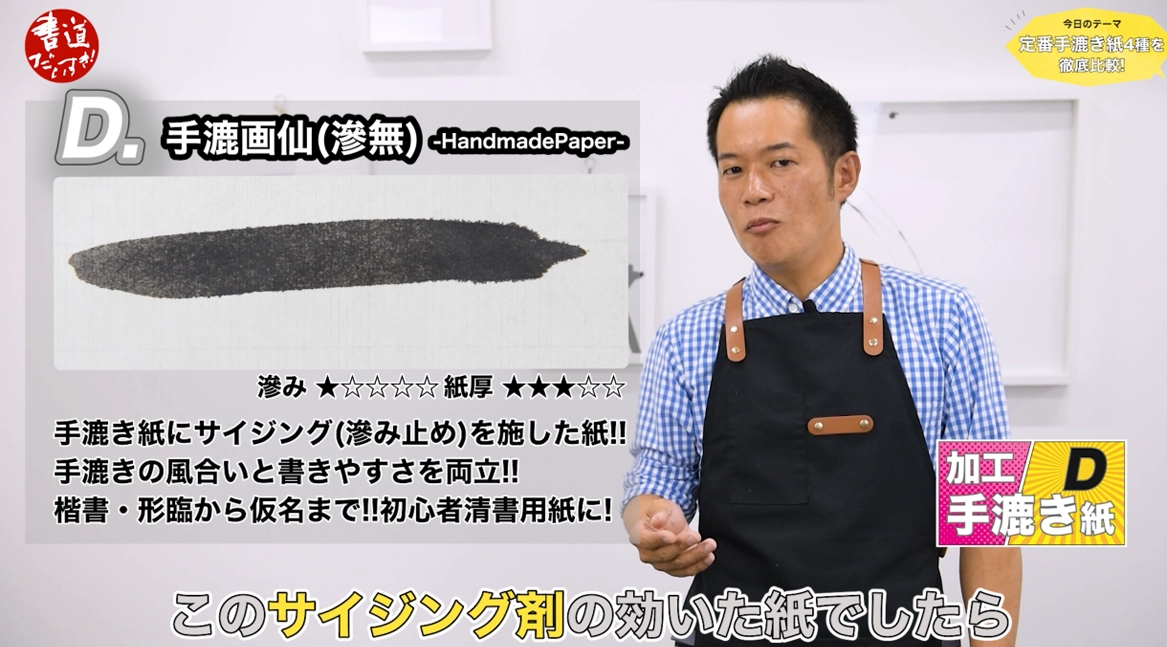
Finally, for handmade paper with sizing agents, he explains that it is not suitable for single-ink works, but works well for classical copying practice and kana-style works.
He explains that such paper can be identified by the way ink quickly pulls toward the center of the line when written.
Shimauchi concludes by emphasizing that paper selection is crucial in calligraphy, and that deepening one’s knowledge of paper expands expressive possibilities.
He encourages discussion in the comments section and closes with the phrase, “Those who master paper, master calligraphy.”
YouTube Shodo Daisuki Episode 23
Shimauchi 00:00
I’d like to introduce you to the fact that there are this many different types.
Gofun powder is flying everywhere like crazy, so I’m waiting for it to settle.
I’ll also show you the state after writing with gofun, so please use it as a reference. So, yes—
Shimauchi 00:17
Hello, this is Shodo Daisuki—Shimauchi. Excuse me.
Today, everyone, we’re doing “How to correctly distinguish paper: Handmade Paper Edition.”
At the very end of the previous video, I said I wanted to dive deeper into handmade paper, so this time I’ll explain the different types of handmade paper and their characteristics.
Shimauchi 00:41
This time, I’ve prepared several kinds of handmade paper—the unique features and the overall feel of each one.
While explaining those points, I’ll actually put ink on them and test them, so please don’t miss this video.
Shimauchi 00:58
After you finish watching, when you think, “For this piece, I want to express it like this,” and you have a certain image in mind—
at times like that, I hope you’ll be able to remember, “Ah, this is the kind of paper I should use.”
Shimauchi 01:13
If you can write while recalling that, it would make me really happy.
So I’m making this video with the hope that you’ll become able to distinguish handmade paper—please stay with me today.
Shimauchi 01:28
Alright, let’s begin.
Here we go! First, we’ll start with Xuan paper–style paper.
Strictly speaking, “Xuan paper” refers to paper made only in the Xuancheng area of Anhui Province using just two raw materials: rice straw and blue sandalwood bark.
Anything else is often categorized as “shoga-shi” (calligraphy/painting paper).
Shimauchi 01:50
I’m using the term “Xuan paper–style” here because there are many papers made to imitate Xuan paper, so I’m grouping them under that label.
The paper I used this time is known as the “King of Xuan”—
Shimauchi 02:11
Red Star Brand Cotton Xuan (Menryo Tansen).
It’s the texture—how should I put it—very fine-grained.
It’s a bit thin, but somehow it feels really crisp—like this.
Shimauchi 02:27
Can you tell? It clearly has that crisp feel.
As a comparison, with other papers you usually don’t get that crisp “structure-like” sound/feel.
This time, I used Red Star Brand Cotton Xuan.
Shimauchi 02:44
And “Red Star” has many variations depending on the blend ratio of its main raw materials—rice straw and blue sandalwood bark.
And depending on how it’s made,
Shimauchi 03:04
there are even more types. So for those who don’t realize how many types exist even within “Red Star,” I’ll share this as a reference—there really are this many kinds.
Shimauchi 03:20
My impression after writing: even with single ink, the base tone remained solid, and the bleed—how should I say it—ran beautifully and evenly.
Shimauchi 03:38
It was truly a beautiful bleed. So, as you’d expect from the so-called “King of Xuan,”
it may depend on skill, but Red Star feels incredibly versatile.
It works for single-piece works, and
Shimauchi 03:55
even with dark ink, I think you can create all kinds of expressions.
I also think dry-brush effects can come out beautifully.
So if you’re confident in your skill, I’d definitely recommend trying this Xuan paper—especially the high-grade kind.
Shimauchi 04:12
You might produce an excellent work. But Red Star has risen in price since around 2011—
it was really drastic. Now it’s become a paper that’s hard to afford,
but there are still “Red Star enthusiasts” who treasure it,
Shimauchi 04:29
carefully store it, and use it only at key moments—some even debate which year’s batch is best.
So why not try this classic, orthodox Xuan paper?
I was thinking about how I would use it myself.
Shimauchi 04:46
What I felt was that if you don’t have a certain level of brush speed, it can be tough.
If you do have that speed, then whether it’s a single-piece work or dark ink, I think it becomes truly versatile.
So,
Shimauchi 05:00
if your brushwork is on the slower side, the bleed might “take over your hand,” so to speak.
In the end, it really comes down to matching the paper to your skill level.
It can create versatile expression, but it also demands a certain level of technique.
Shimauchi 05:13
Next is Taiwanese paper—just as the name suggests, paper made in Taiwan.
But Taiwanese paper is now not widely distributed, is it?
So it’s probably one of the harder papers to obtain.
Looking at it, the grain is fine, the color is very white,
and it feels like a beautiful paper with plenty of gofun mixed in.
Related Products
Here are the products featured in this video.