Shodo Daisuki Episode 24
Shodo Daisuki Episode 24
How to Join Paper and How to Cut It!!
Shodo Daisuki – Episode 24
In this video, “Shimauchi” from Shodo Daisuki demonstrates and explains the technique of joining paper!
Shodo Daisuki Episode 24 — Video Summary
Shimauchi demonstrates and explains the technique of joining paper. He emphasizes the importance of paper joining as a practical way to expand a favorite paper into a larger size, especially in today’s world where large-scale works are often required for exhibitions. He explains the value of this traditional technique in modern practice.
In the lecture, he recommends using starch paste or laundry paste (powder paste) as essential tools for paper joining, and points out that stick glue and liquid glue containing chemical ingredients should be avoided. This is because problems may occur when water is applied later. He also introduces three ways to cut paper: using a cutter, a paper knife, and a method using water.
Finally, as a key point when using joined paper, he explains that to prevent the brush from catching on the pasted seam, you should use the paper so that the sheet without paste is on top. He also stresses the importance of leaving margins on both sides in consideration of paper distortion.
He concludes that this technique is not only practical, but also connected to the spirit of “learning from the past to create the new,” and emphasizes the value of knowing paper joining as an option when challenging large works.
YouTube Shodo Daisuki Episode 24
Shimauchi 00:00
Hi there—this is Shimauchi from Shodo Daisuki. It’s summer. Well, once the rainy season ends, it suddenly gets really hot all at once. And as you can probably tell just by looking at this Shimauchi cat face, I love summer. From here on, I’m basically welcoming a tan, but…
Shimauchi 00:18
Yeah, you know, you get past 40 and it really hits you. Little by little, you start worrying about sun damage and dark spots on your face, but regardless of that, I want to keep that summer heat glowing inside my heart, keep my energy up, and do my best—without getting too overbearing about it.
Shimauchi 00:33
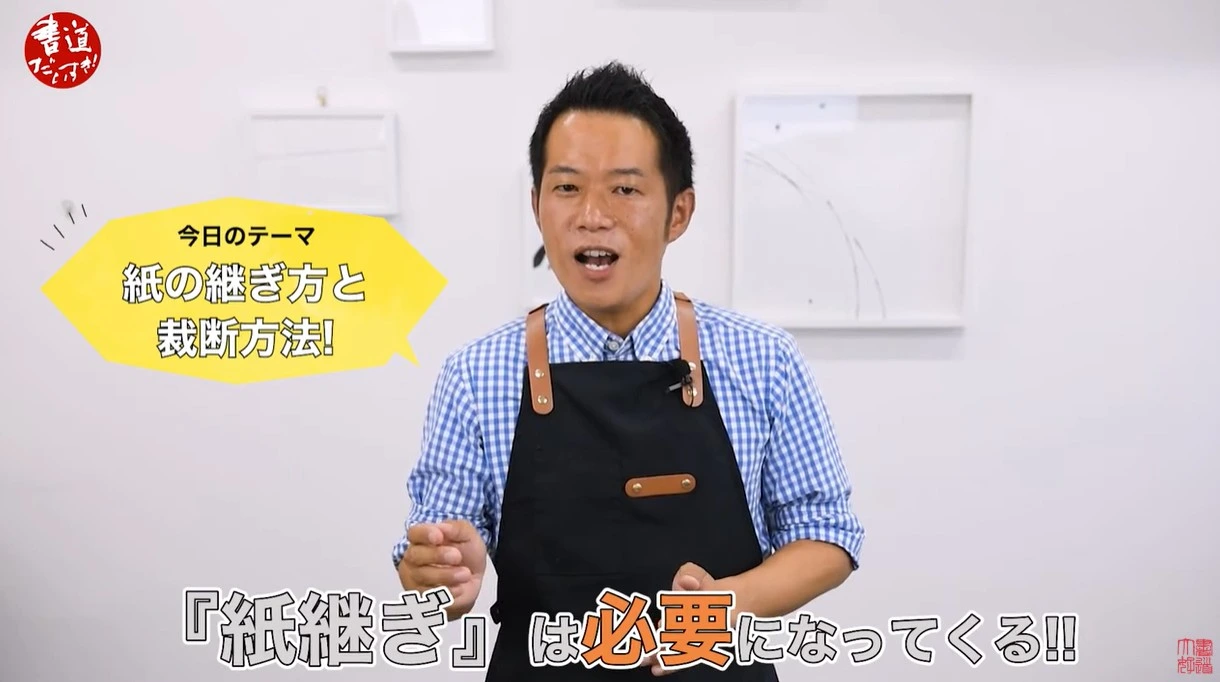
So everyone, thanks as always. Now then, today’s theme is “joining paper.” Do you need it or not? Generally speaking, you don’t, right? But—everyone—what about the paper you’re using now…
Shimauchi 00:53
If you find a paper you really like, can you get it again later? How about it? That’s actually pretty tough, right? When you realize, “This paper really fits my hand,” and you think, “I can make great work on this paper.”
Shimauchi 01:10
Then someone tells you, “Please write on a slightly bigger size,” or you end up needing to write on a bigger sheet. What do you do—just go buy it? Or instead, you take what you’re using now…
Shimauchi 01:23
If you join the paper you already love, you can make it bigger. Then you can write with the same familiar feel. That’s a pretty big advantage, isn’t it? So in times like that, paper joining becomes something you need.
Shimauchi 01:40
So think of it as maximizing the paper you have and love by joining it. And I’ll actually demonstrate it, so I hope you can put it to use.
Shimauchi 01:57
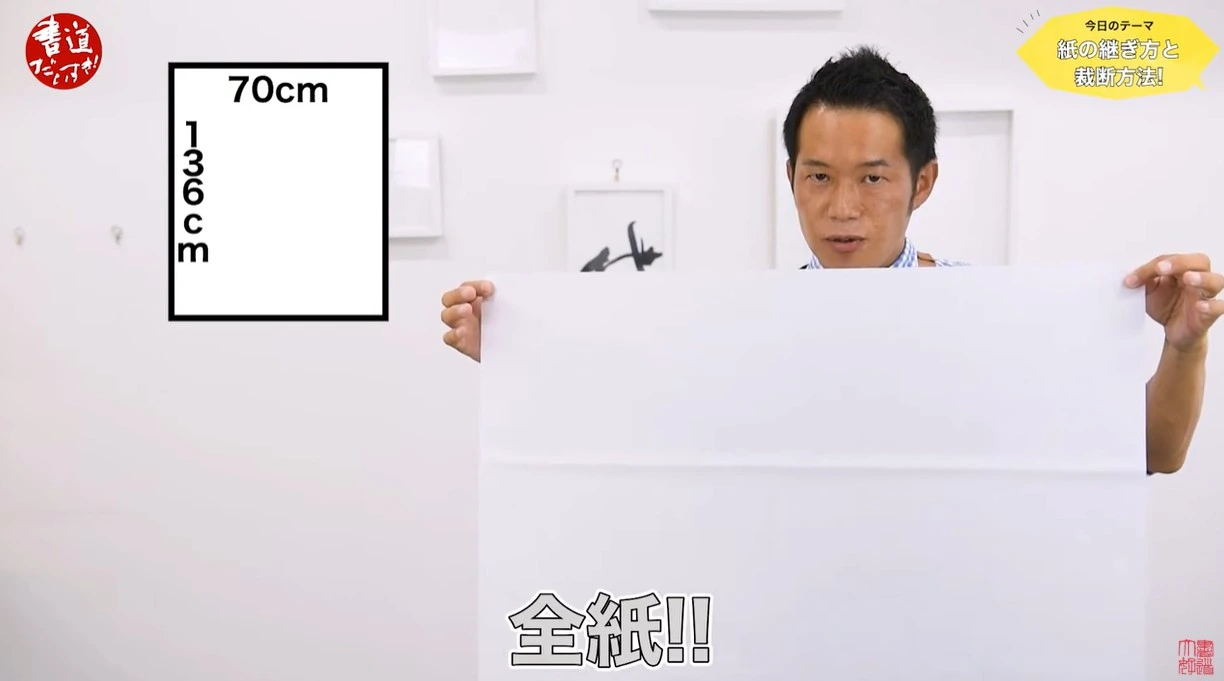
That’s how we’ll proceed. I’m going to do this paper joining passionately so it can be helpful to you. First, today we’re using this full-size paper—this paper is just so easy to write on. And the size I want to make it is…
Shimauchi 02:17
53×228—what’s called “108-hei.” To do that, first I need to remove the deckle edge from this sheet, so before joining, I’ll trim the edge. Like this—trim the edge, and then we’ll join from that trimmed area.
Shimauchi 02:45
Alright, now let’s get into the hands-on part. The tools you need for paper joining are very simple: the paper you want to join, and paste—just those. This “paste,” though…
Shimauchi 03:01
is extremely important. In other words, you need to limit the type of glue you use. People might say, “Oh, just use a stick glue,” or “Use liquid glue, right?” but…
Shimauchi 03:17
The chemical ingredients in stick glue or liquid glue might be fine just for joining paper, but when you actually mount it later and apply water, problems can occur. The water might not blend in nicely, or the paper won’t stretch properly because of the glue.
Shimauchi 03:35
So please don’t use those for paper joining. What should you use? Starch paste, or what’s called laundry paste.
Shimauchi 03:50
Basically, paste that stretches well with water. If you wonder what that is, think back to elementary school—those yellow tubes in your supply box…
Shimauchi 04:05
Maybe green? When you squeeze it out, it’s that milky-white paste—sticky, gooey—use that powder paste. Please make sure you don’t get this part wrong.
Shimauchi 04:23
Now, I put the starch paste we specified into this tray and kneaded it with a small amount of water. It becomes like this. Ideally, you’d use something cool like…
Shimauchi 04:37
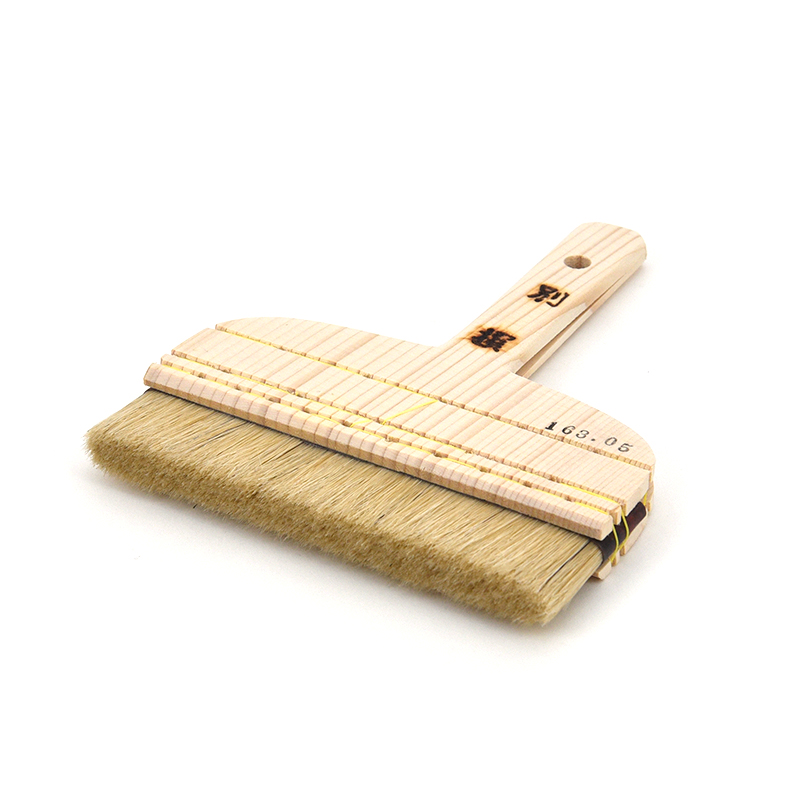
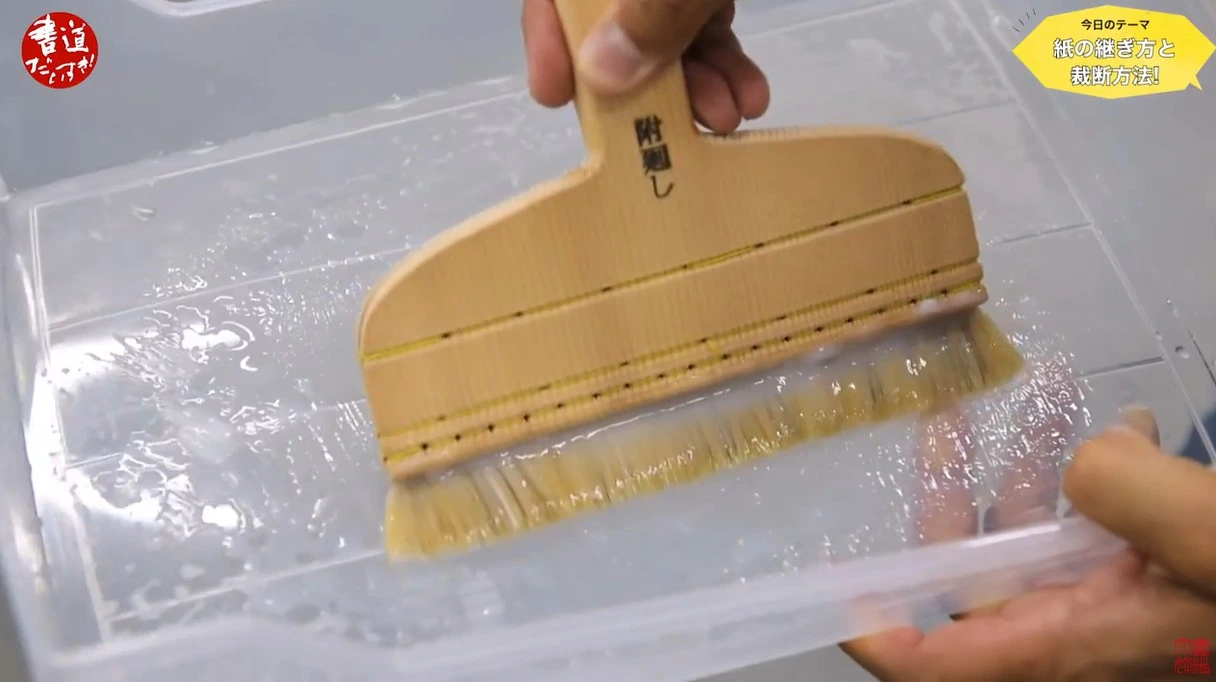
the kind of brush mounting artisans use—this is a “tsukemawashi” brush. I’d love to use it and apply paste in one quick motion, but…
Shimauchi 04:52
You don’t usually see these, right? And most people don’t own them—plus they’re expensive. So if using a special brush is difficult…
Shimauchi 05:04
you can use a brush—your regular writing brush—as a substitute. Dip it in paste and apply it like this. But some of you might think, “I don’t want to use my favorite brush for this…”
Shimauchi 05:19
So today, I won’t use a brush—I’ll use my finger. Alright, first…
Shimauchi 05:36
I wanted to paste five sheets at once, so I lined them up with 5 mm spacing. Ideally, the overlap should be as short as possible, but I made it 5 mm so it’s easier to see.
Shimauchi 05:57
And I placed paperweights so the sheets don’t move. At the top, because I want a consistent 5 mm paste area, I’d normally use a long ruler, but since I don’t have one…
Shimauchi 06:18
I used the trimmed edge we cut off earlier and placed it on top. Then I applied paste all at once. Now, if doing five sheets at once feels too hard…
Shimauchi 06:40
you can do one sheet at a time, of course. But applying paste one by one is time-consuming, so doing several at once like this is efficient—that’s why I showed it.
Shimauchi 06:58
Now, the most important part: front vs. back—where do you apply paste? Since we’re joining paper, you need to apply paste to the front side.
Shimauchi 07:16
If you’re not sure which is which, with handmade paper, the back often has brush marks. Confirm that carefully, and always apply paste to the front. Don’t get that wrong.
Shimauchi 07:32
Next, even though we pasted five at once, you join them one by one. Place one pasted sheet, then take the joining sheet (the one without paste)…
Shimauchi 07:54
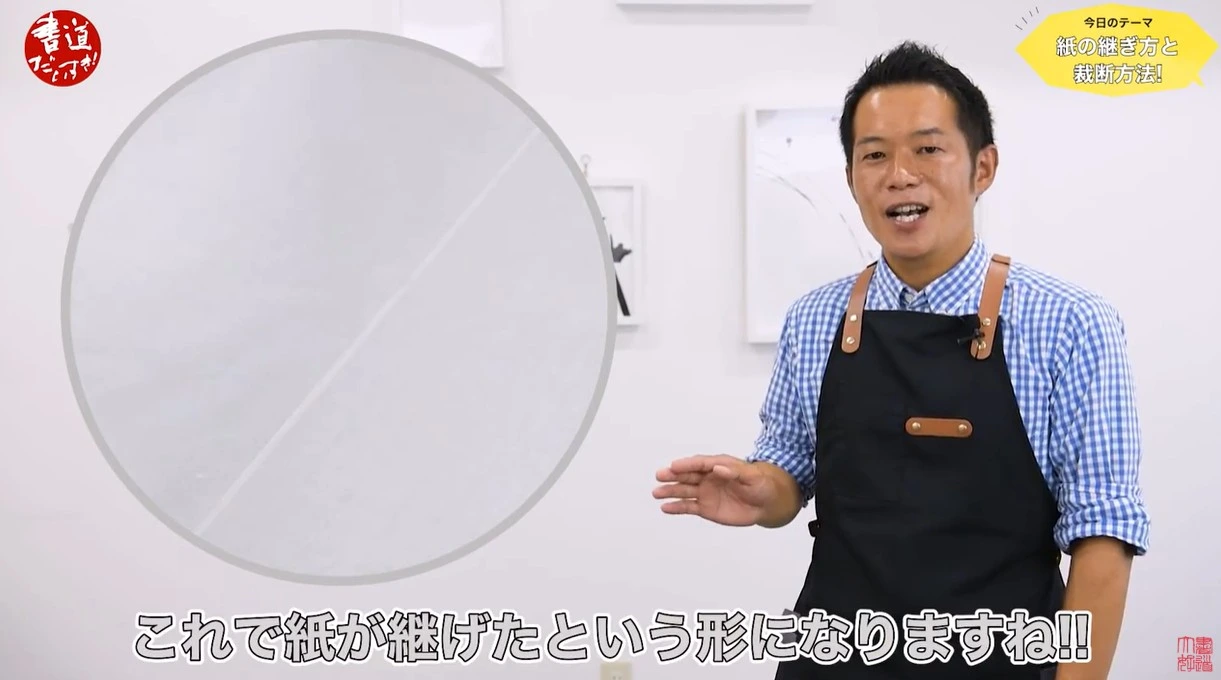
and place it on top of the pasted area. Then put the protective sheet on top and press firmly by hand. That’s all it takes.
Shimauchi 08:14
That’s how the paper gets joined. I tried to use as few tools as possible, but if you have a long ruler, place it on top of the protective paper…
Shimauchi 08:33
and rub over it. The ruler’s weight and flat surface help remove air and improve adhesion. Also, when lifting the joined paper…
Shimauchi 08:51
if you lift from the non-pasted side, the seam can peel. So when removing it from the board, always lift from the pasted side, please. Otherwise, your seam may come apart.
Shimauchi 09:11
Now in this state, it’s the length of two full sheets, so to make it 53×228, we need to cut it. So I’ll also introduce some cutting methods.
Shimauchi 09:29
First, the classic: use a cutter. You’ll need a long ruler. It seems simple—ruler and cutter—but it can actually be tricky.
Shimauchi 09:48
If the blade isn’t new, it won’t cut cleanly. Also, the angle matters. You might naturally hold it upright, but that can snag paper fibers and make it cut poorly.
Shimauchi 10:02
So keep the blade angle close to 0 degrees—almost parallel to the paper. That cuts the cleanest.
Shimauchi 10:16
Next, a handy tool: a paper knife. This is easy. Fold where you want to cut, insert the paper knife, and cut from the inside with a crisp motion.
Shimauchi 10:32
I used a stainless one, but there are wooden paper knives too—use what fits your hand.
Shimauchi 10:49
Finally, this may feel a bit advanced, but if you’re planning to send it to a mounting shop anyway, keep this in mind: use a brush with water…
Shimauchi 11:04
draw a water line across the paper, and use the moisture to tear it along the line. That’s another option.
Shimauchi 11:22
If you have a long ruler there too, it helps the tear line stay cleaner. So today I introduced three cutting methods.
Shimauchi 11:41
Now, the last and very important point: how to use the joined paper. The overlapped part—the area where the top sheet had no paste…
Shimauchi 11:57
make sure that sheet is on top when you write—toward the “head” of your writing direction. If it’s the other way around…
Shimauchi 12:15
the seam can catch on your brush as you write. So always use it so the sheet without paste is on top.
Shimauchi 12:33
One more detail: we tend to assume paper is a perfect rectangle, but surprisingly, it can be warped—especially handmade paper.
Shimauchi 12:47
And when you’ve joined paper, distortion can be even more likely. If you later square it up for mounting, and you’ve written too close to both edges…
Shimauchi 13:05
your characters might get cut off when the distortion is corrected. So with joined paper in particular, don’t write too close to the sides—leave proper margins.
Shimauchi 13:22
That’s all for today’s video. It probably looked easier than you expected. Sure, you can buy large paper, but making large paper by joining the one you love…
Shimauchi 13:38
can be one of your options too. Please remember this. In the old days, large sheets weren’t easy to buy in shops…
Shimauchi 13:55
so joining paper to make large sheets was normal. By learning that old wisdom and applying it today—that’s the spirit of “learning from the past.”
Shimauchi 14:08
So knowing how to join paper is a valuable skill. These days, exhibition works are getting bigger and bigger, so if someone tells you, “Submit a two-full-sheet piece next time,”…
Shimauchi 14:23
don’t think, “I can’t, I don’t have big paper.” If you have a paper you love and write well on, you can just join it.
Shimauchi 14:36
In that sense, knowing paper joining is really handy. Instead of thinking, “I don’t need it because I never write big,” think, “If I know this, I can challenge bigger work.”
Shimauchi 14:49
Keeping that in mind feels positive and makes things more fun—that’s what Shimauchi thinks.
Shimauchi 15:04
So joining paper was a bit of a niche topic, but I enjoyed it, and I’d be happy if it helped you. That’s it for Shodo Daisuki. Next time I might be even more tanned…
Shimauchi 15:20
but I’ll keep doing my best, so please keep supporting me. See you again—bye!
Related Products
Here are the products featured in this video.