

Shodo Daisuki Episode 45
Shodo Daisuki – Episode 45
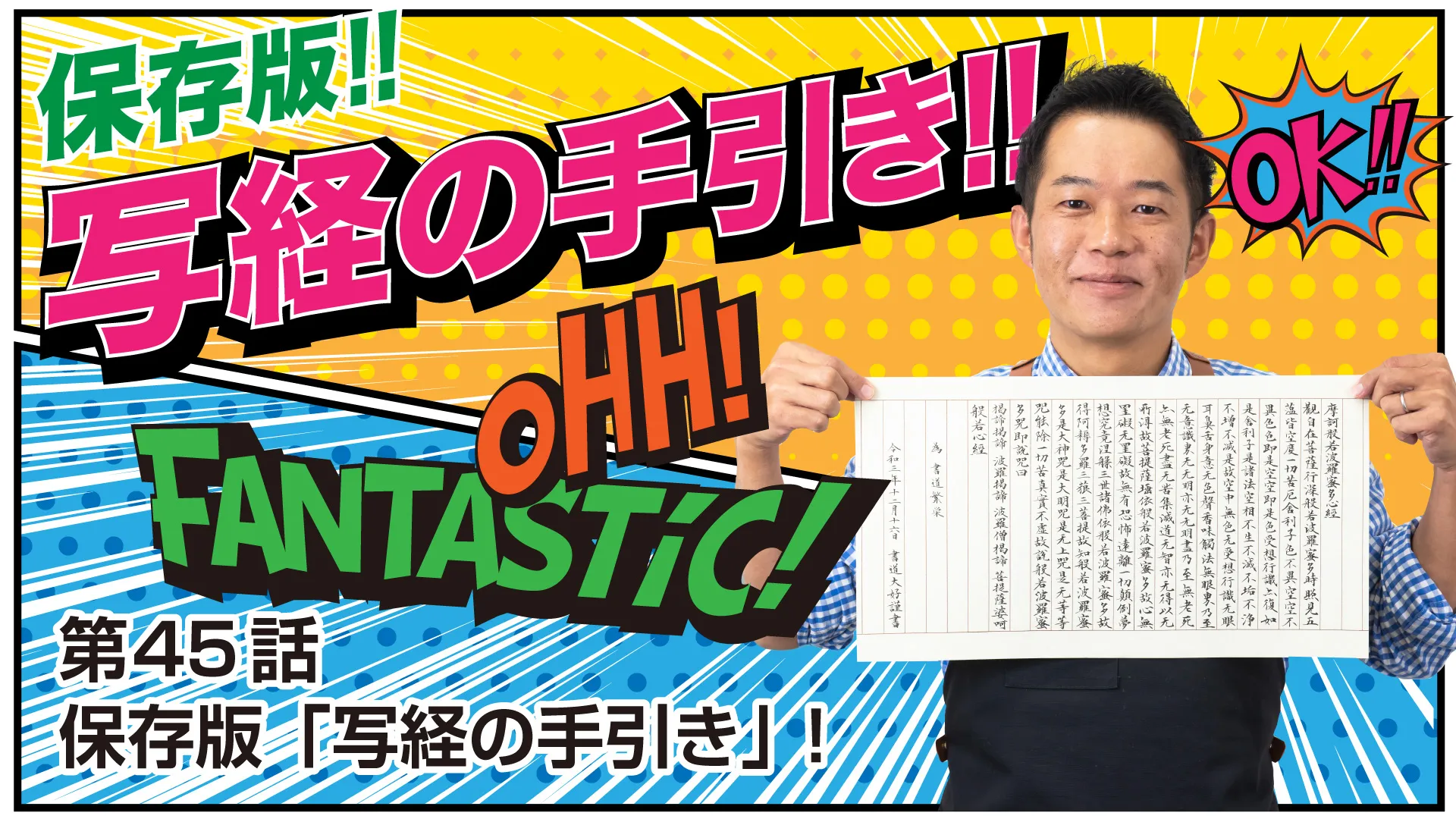
Complete Guide! The Definitive “Sutra Copying” Handbook!!【Calligraphy】
Shodo Daisuki – Episode 045
Sutra copying has become increasingly popular in recent years due to its many benefits!
But… do you really know the correct way to do it?
Stop guessing—watch this and start with confidence!
Shimauchi, who loves calligraphy, explains everything thoroughly!!
Shodo Daisuki – Episode 45: Video Overview
In this video, Shimauchi provides a detailed explanation under the theme “A Guide to Sutra Copying,” focusing on the correct way to approach sutra copying.
He resolves common concerns and questions people have when copying sutras—such as the orientation of the paper or what to do when you make a mistake—and offers knowledge that helps calm the mind before writing.
At the beginning of the video, Shimauchi introduces the three main benefits of sutra copying: stimulating the brain, boosting immunity, and improving handwriting. He strongly encourages even beginners to experience sutra copying, recommending the Heart Sutra (Hannya Shingyo), which has only 276 characters and can be completed relatively quickly.
He explains in detail how to choose sutra-copying tools. For paper, he recommends thick washi or hosho paper with minimal bleeding, and suggests using paper with guiding lines for beginners. For ink, he recommends high-quality solid ink—especially Japanese ink—that produces a deep black gloss. For brushes, he recommends the “sparrow-head brush” (jakutō-fude), which holds ink well.
Before beginning sutra copying, Shimauchi emphasizes preparing your environment: tidying the room, washing your hands, rinsing your mouth, adjusting your posture, grinding the ink, and calming your mind. He also explains how to write each section of the sutra: the title (naidai), main text, concluding title (okudai), the aspirational statement (ganmon), and how to date and sign your work.
Finally, he explains what to do when you make a mistake, as well as how to treat the finished sutra—reciting the dedication text, handling the finished work respectfully, and proper ways to dispose of practice sheets. He ends by encouraging viewers to try sutra copying for themselves.
YouTube Shodo Daisuki Episode 45
Shimauchi 00:00
Hello, this is Shimauchi, who loves calligraphy.
Today I’ll be talking under the theme “A Guide to Sutra Copying.”
In recent years, sutra copying has often been highlighted for its many benefits and is especially popular among women. Of course, I’ve tried it myself as well.
But everyone, are you really sure the way you’re doing it is correct?
Shimauchi 00:21
For example, how do you properly finish a session of sutra copying?
What should you do if you make a mistake while writing?
Or even something basic like: which side of the paper is the top?
Are you doing all this while secretly feeling uneasy?
To practice sutra copying, which is meant to calm the mind, while full of anxiety…
Shimauchi 00:39
…that would truly defeat the whole purpose, wouldn’t it?
By watching this video through to the end, I hope you’ll be able to approach sutra copying with a calm and settled heart.
On this channel, I introduce all kinds of topics related not only to shodo but to “writing” in general,
Shimauchi 00:55
so if you’d like to keep watching, please subscribe and give the video a like. I would really appreciate your support.
Now then, let’s get started. Please enjoy.
I’ll share three benefits that you can gain from sutra copying.
First: activating the brain. Second: boosting the body’s immune system. Third: improving your handwriting — this one is especially important, right?
Shimauchi 01:18
Some of you may be thinking, “That sounds too good to be true,”
but anyone who has actually tried sutra copying will probably understand what I mean.
All you do is quietly write character after character,
Shimauchi 01:36
yet somehow you start to feel as if your heart is being purified layer by layer.
If you’ve never experienced sutra copying before, I strongly encourage you to take this opportunity to give it a try.
As the word suggests, sutra copying means transcribing a Buddhist scripture by hand, or the text that has been copied by hand.
Shimauchi 01:58
The well-known Heart Sutra has 276 characters, which is relatively few, and can be completed in a short time, so it has become the mainstream choice, especially for beginners.
To summarize the Heart Sutra very simply: “Everything in this world has no fixed substance; by freeing oneself from attachment and desire, one can reach enlightenment. Therefore, chant this teaching.” — that is the gist of it.
Shimauchi 02:16
The Heart Sutra is filled with words meant to save people who suffer because they cling to various things; you could say the essential core of Buddhist teaching has been tightly condensed into it.
It would be very sad to copy the sutra without understanding the meaning at all.
So please at least remember that much as you practice.
Next, let’s talk about how to choose your tools for sutra copying, starting with the paper.
Shimauchi 02:56
For paper, you should choose something that hardly bleeds at all.
Because you’ll be writing slowly with a brush or brush pen,
the types of paper that work well are torinoko (a kind of washi) or gampi-based paper.
Torinoko is relatively thick and smooth, which makes the brush glide nicely.
Shimauchi 03:16
Gampi paper has the advantage of producing a darker, stronger black, and it’s thin and easy to layer over a model sheet.
For beginners, I recommend using sutra-copying paper with printed guide lines.
Most of these come with a model printed alongside, but if you look carefully at those models,
you’ll notice that each one is written in a slightly different style.
Shimauchi 03:34
You might find some that make you think, “Oh, I like this one,” and others that feel hard to follow.
So choosing based on the model text is one good approach.
And if this is truly your very first time using sutra-copying paper, it’s better to place a thin sheet over the model and trace it — essentially copying the model text directly.
Shimauchi 03:50
Doing that makes it much easier to maintain the shapes and proportions of the characters and write beautifully.
So I recommend choosing a thinner type of sutra-copying paper that you can overlay on top of the model sheet.
By the way, as I mentioned earlier, the narrower margin is the top of the sheet, and the wider margin is the bottom.
Please be sure not to forget this when you set up your paper.
Shimauchi 04:14
Next, let’s talk about the ink.
For ink, I recommend using a high-quality soot-based solid ink, especially Japanese stick ink.
For sutra copying, ink that is dark black with a beautiful sheen is ideal.
To get that effect, you need to grind the ink to a fairly dense consistency.
Shimauchi 04:33
How to grind ink properly is explained in another video, so please refer back to that.
If the ink becomes too sticky, it will actually be harder to write, so aim for ink that is dense yet still smooth and flowing.
If you feel that grinding ink every time is too time-consuming or difficult,
Shimauchi 04:50
there are also ready-made liquid inks formulated specifically for sutra copying.
These bottles are relatively small, easy to carry, and convenient for pouring out and putting away, so they’re quite handy.
However, since sutra copying is a special practice, I personally recommend grinding ink yourself — relaxing as you enjoy the fragrance, quietly grinding in silence to calm the mind.
Shimauchi 05:08
I think that kind of time is very important, so if possible, I’d be delighted if you would try to grind ink when you do sutra copying.
Next is the brush. For sutra copying, it is crucial that the tip of the brush responds well (has good “life” in the tip).
There are specialized sutra brushes and also sparrow-head brushes designed for this kind of writing. Personally, I especially recommend the sparrow-head brush.
Shimauchi 05:26
The reason is that a sparrow-head brush acts like a “tank” that stores a lot of ink.
If you use a brush that doesn’t hold much ink, you’ll have to keep dipping it again and again,
which makes continuous, calm writing difficult.
With a sparrow-head brush, the body of the brush holds plenty of ink,
Shimauchi 05:43
and the tip still remains responsive and sharp, so you get both good ink capacity and good line control.
Please keep “a brush that holds ink well and has a lively tip” in mind when choosing.
If you’re not used to brushes, you can use your favorite brush pen instead — that’s totally fine.
Recently, there are even brush pens made specifically for sutra copying.
Shimauchi 06:19
I’m quite interested in those myself, so using such a brush pen is definitely an option.
In any case, the most important thing is to use a tool that you find easy to write with.
Next is the inkstone. Since I’ve been encouraging you to grind solid ink, note that sutra copying doesn’t require a large amount of ink.
Shimauchi 06:37
A small inkstone around 3 to 4 inches is more than enough.
Some small inkstones even come with a fitted wooden box,
so it might be nice to own one compact, favorite inkstone especially for sutra copying.
Shimauchi 06:54
If you’re using liquid ink, you’ll also need a container to pour it into.
You can of course use a normal ink dish, but if you feel it’s a bit too large,
a small shallow dish or saucer you have at home works just fine as a substitute.
Shimauchi 07:09
Please feel free to use something like that instead.
Now, before we jump into how to actually write the sutra, there are still a few things you should do beforehand.
First, tidy the room, wash your hands, and rinse your mouth to purify yourself.
Then prepare your writing environment.
Shimauchi 07:28
Sit up straight, pour clean water onto the inkstone, and quietly grind the ink while calming your mind.
Finally, put your hands together and chant the sutra you’re about to copy, such as the Heart Sutra.
While I’d like sutra copying to feel approachable and easy to start,
it’s good to keep in mind that these kinds of preparations are traditionally recommended.
Shimauchi 07:47
All right, now let’s move on to how to actually write the sutra.
First, please refer to this diagram.
The “internal title” (naidai) is the name of the sutra written at the beginning of the text.
Some versions begin with “Bussetsu …” (“The Buddha said …”), others with “Maka Hannya …” and so on, so there are slight differences in how it’s written,
Shimauchi 08:07
but none of these forms are wrong, so there’s no problem.
What is important is that the internal title is written in the same size as the main text, and that the spacing between characters is slightly tighter than in the main text.
To be honest, I didn’t know this detail myself at first.
It’s quite difficult to do in practice, but that is how it is supposed to be written.
Shimauchi 08:26
Next is the main text.
Each line of the main text contains 17 characters.
The difficult part is that you must fit each character neatly between the top and bottom guide lines.
If you place the model text on the left and try to copy it exactly in both size and proportion, it will generally work out,
Shimauchi 08:51
but in reality that’s pretty challenging, isn’t it?
At first your characters tend to get too large and won’t fit in the allotted space.
That’s normal, but as with anything, you’ll improve gradually with practice.
There are 14 lines of 17 characters, and the 15th line has 6 characters.
After that comes a section in which the Sanskrit sounds are phonetically transcribed into Chinese characters.
Shimauchi 09:12
This part is called the “Gye.”
It’s grouped visually into sets of 4, 4, 5, and 5 characters with slightly wider spacing between the groups.
So although the line has 18 characters, you have to write them in a very flat, horizontally stretched shape to make them fit.
Writing these characters in a flatter form is a key point here.
Shimauchi 09:33
The concluding title (okudai), also called the “end title,” is where you write “Heart Sutra” after the main text.
You may leave one blank line between the main text and the concluding title, or you may not — either way is acceptable.
However, as I’ll explain in a moment, if you are going to write a personal aspiration (ganmon),
Shimauchi 09:56
you should leave one line blank after the concluding title and then write the ganmon.
After finishing the ganmon, leave another blank line and then write the date and your name.
You may also leave yet another line blank after that.
So, when deciding whether to leave a blank line between the main text and the concluding title,
Shimauchi 10:17
it’s best to look at the overall balance of the page and then decide whether or not to insert that blank line.
The ganmon, which I mentioned earlier, is the only place in the sutra where you can write your own feelings or wishes in your own words.
Up to this point, you have simply been copying the Heart Sutra itself word for word.
Shimauchi 10:35
But in the ganmon section, you can express your personal intention and prayers.
When we read the ganmon sections of old sutra copies, we can really sense the thoughts and feelings of people from that era — in other words, we can feel the “spirit of the times.”
That is quite fascinating.
Since each of you has your own reasons for doing sutra copying,
Shimauchi 10:55
I think it’s a wonderful idea to write a ganmon, even a simple one.
A very simple structure would be to begin with “For the sake of …” and then write wishes such as “family safety” or “recovery from illness,”
continuing on with your personal prayer.
Finally, at the bottom, you write the date and your name,
Shimauchi 11:18
and then add a word such as “keisho” (respectfully written), “haisho” (reverently written), or “kinsho” (humbly written).
If you traced the model text rather than writing freely, you can instead write “keisha,” “haisha,” or “kinsha” (indicating “respectfully copied,” etc.).
Your name should always be your real legal name.
You do not add an artist’s seal or signature stamp here.
Some people write using only their art name or press a seal as if it were a calligraphy work,
Shimauchi 11:42
but as a rule, sutra copies are not stamped with seals.
Taking all of this into account: if you write a ganmon after the concluding title, leave one blank line first.
Then, after the ganmon, leave another blank line before writing the date and your name.
You may leave one more line blank after that as well.
So when deciding where to place the concluding title relative to the main text,
Shimauchi 12:05
you should think about the overall layout and then decide whether to leave a blank line there or not.
The ganmon should be written in characters smaller than those of the main text,
and the first character of each line should be indented a few character spaces inward compared to the main text.
Shimauchi 12:25
Likewise, the date and your name should be written smaller than the main text,
and the final character of “sho” (as in keisho/haisho/kinsho) should line up vertically with the last character of the Heart Sutra text, so that everything ends on the same vertical line and the page looks well balanced.
It’s quite difficult in practice, but it’s useful knowledge to have, so please keep it in mind.
Shimauchi 12:43
It doesn’t happen very often, but if you do make a mistake while copying a character, how should you correct it?
The proper way is to place a dot to the right of the incorrect character,
then write the correct character in any open space above or below within that same line.
Shimauchi 13:03
If you accidentally skip a character — in other words, if you leave a character out — place a dot to the right between the characters where the omission occurred, then write the missing character at the very bottom of that line.
After adding the missing character, also place a dot beside that added character.
Shimauchi 13:25
Finally, what should you do after you have finished copying the sutra?
Strictly speaking, you should recite a “dedication verse” (ekōmon).
It’s quite difficult to memorize, so I couldn’t manage it all by heart myself,
so please allow me to read from a prompt here.
Shimauchi 13:41
“May the merits of this practice be extended to all, and may we and all living beings together attain the Buddha Way.”
— That is the dedication verse.
It’s a bit hard to understand at first, but this is what you are meant to recite.
Also, a finished sutra copy is considered just as sacred as a Buddhist statue,
Shimauchi 14:09
so it should be handled with great care.
You can dedicate it to a temple, or enshrine it respectfully on the family altar at home.
If you have sheets that are “spoiled” or written with mistakes, you should not simply crumple them and throw them into the trash; they are just as sacred as a Buddha image.
Shimauchi 14:29
You can keep them together and eventually dedicate them to a temple along with your completed sutras, or if you must dispose of them at home, do so by first bowing to the sutra sheets, then burning them, and finally bowing once again to the remaining ashes.
Please follow this kind of respectful procedure when disposing of them.
Shimauchi 14:51
How was this explanation for you?
To be honest, I myself learned quite a lot this time — there were many things I didn’t know before.
How does this compare with the way you usually approach sutra copying?
If you have your own method of practice, I’d be very happy if you could share it in the comments.
Shimauchi 15:12
When you quietly copy sutras in silence, with your thoughts directed toward someone dear or toward your own well-being,
I believe you will feel something far beyond the benefits I mentioned at the beginning of this video.
So I truly hope that all of you will give sutra copying a try.
Shimauchi 15:30
This has been Shimauchi, who loves calligraphy.
Thank you very much for staying with me through such a long video.
I look forward to seeing you again next week.
Thank you very much.
About Related Products
Here are the products that appear in this video.
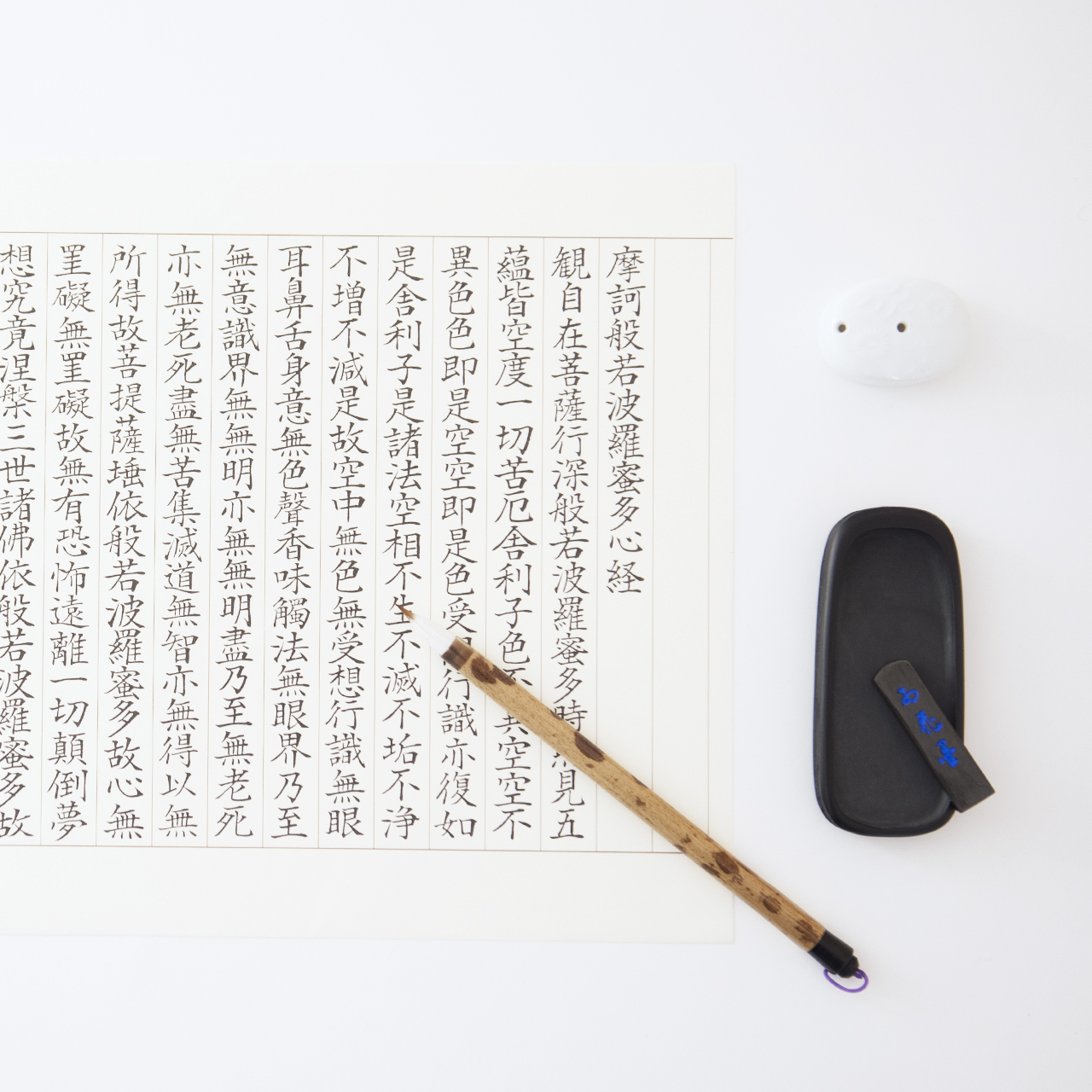
Sutra Copying Supplies / shakyo tohin
To start sutra copying, all you really need is “paper” and a “writing tool.”
However, many people are unsure which ones to choose.
For beginners, we recommend items such as “sutra-copying paper with model text,” “brushes for sutra copying,” “liquid ink for sutra copying,” and “inkstones for sutra copying.”


