

Shodo Daisuki Episode 49
Shodo Daisuki Episode 49
About "Sokkantaku" in Seal Engraving!!
Shodo Daisuki – Episode 49
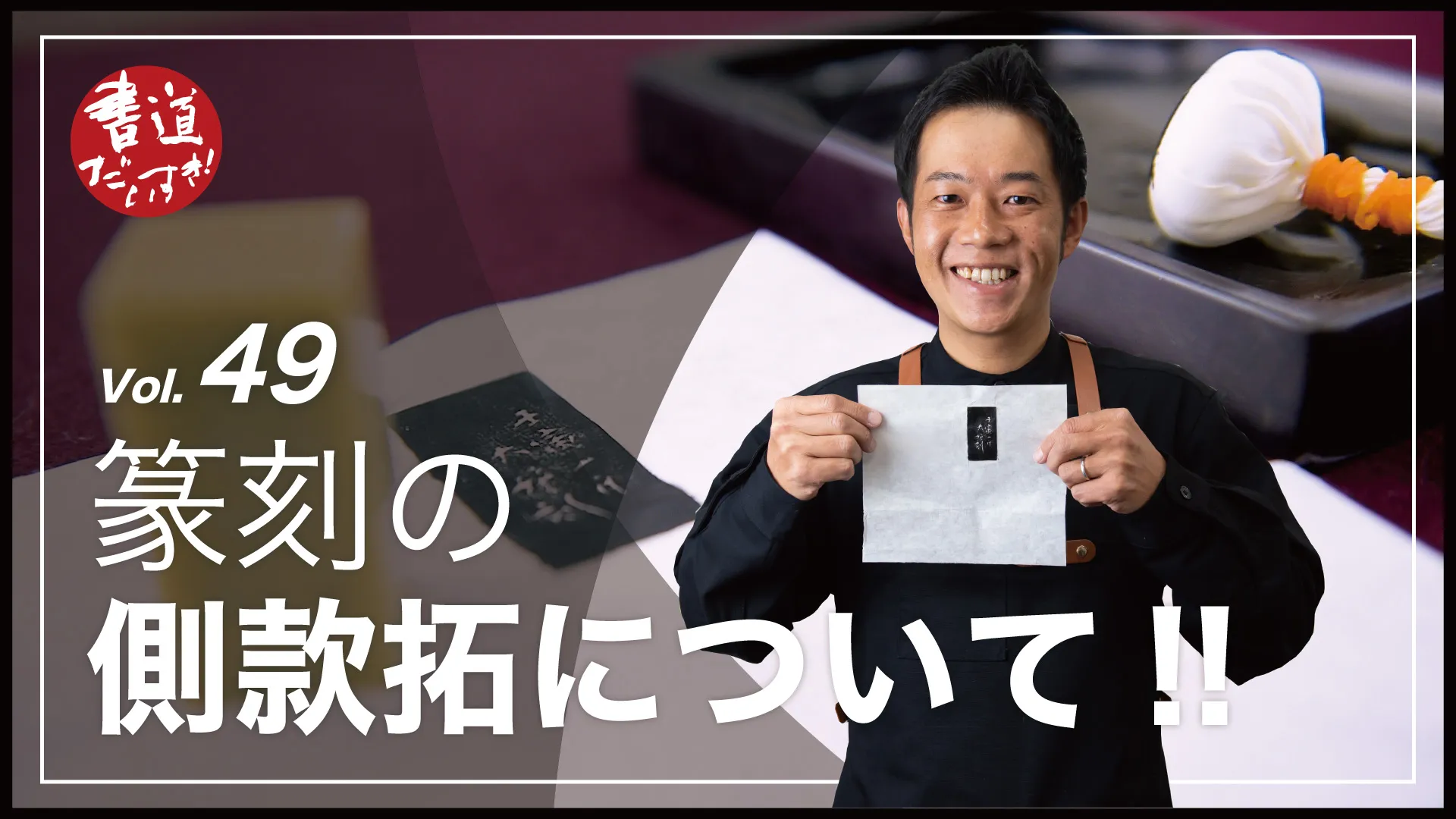
In this video, “Shimauchi,” the calligrapher of *Shodo Daisuki*, talks about **sokkantaku**, the method of taking a rubbing from the side inscription of a seal stone!
Shodo Daisuki Episode 49 — Video Overview
This video introduces how calligraphers take a *sokkantaku*—a rubbing taken from the carved side of a seal stone. The instructor carefully explains the process as he challenges the technique for the first time himself.
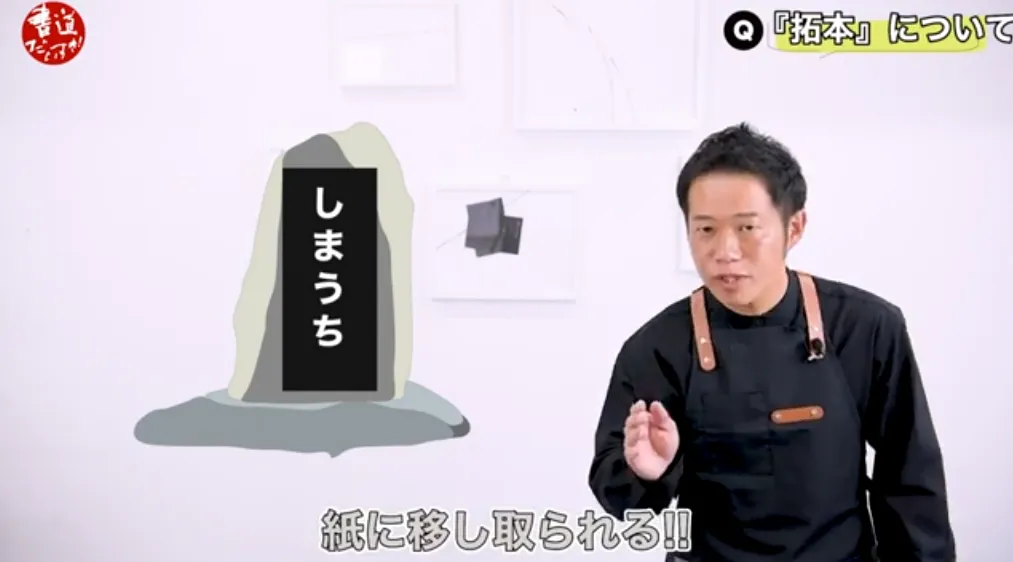
First, he explains the basic concept of rubbings (*takuhon*), a traditional technique for transferring carved characters from stone steles or seal stones onto paper. He describes how rubbings became widespread in ancient China as an efficient method of reproducing authentic works.
Next, he introduces the tools used for *sokkantaku*. While specialized tools are normally used, he demonstrates how to substitute easily accessible everyday items—such as a toothbrush, masks, ganpi paper, tracing paper, glue sticks, and ink.
In the practical section, he explains each step in detail: cleaning the seal stone, applying glue, attaching the paper, adjusting moisture, brushing to ensure adhesion, applying ink, drying, and removing the paper. He emphasizes that ensuring the paper adheres tightly to the carved surface and carefully adjusting the ink amount are crucial.
Finally, he discusses the cultural and artistic significance of rubbings, mentioning how the artistry emerges from the collaboration of the calligrapher (writer), engraver (carver), and the person taking the rubbing. He encourages viewers to enjoy taking rubbings even from familiar stone monuments and offers new perspectives on the craft.
YouTube Shodo Daisuki Episode 49
Shimauchi 00:00
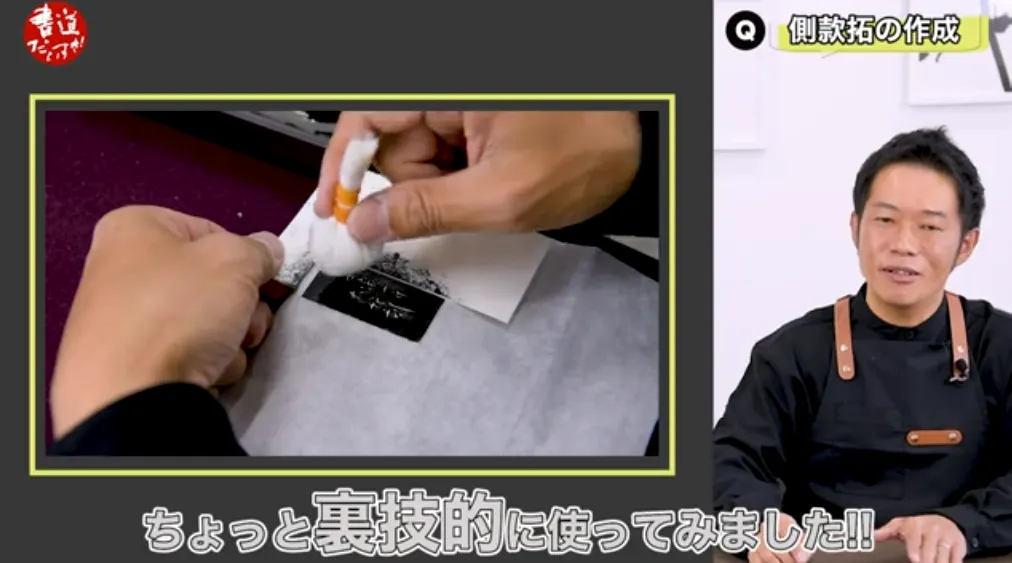
We press the paper tightly so it adheres perfectly. And this time, I’m actually using a toothbrush. I hadn’t been able to get the inking to work very well, so I tried using it as a little “secret trick.” I hope I’ve managed to show you something useful with that. Hello, I’m Shimauchi, the guy who loves calligraphy.
Shimauchi 00:20
So, everyone, what do you think? At a glance, do you notice anything different? That’s right — Benjamin got himself a brand-new outfit. How does it look? Does it suit him? Benjamin actually has pretty good fashion sense. Anyway, jokes aside…
Shimauchi 00:33
What is this video about today? As you know, I usually do classical copy work — especially regular script, which I really like. I copy a lot of classics. While doing that, I suddenly noticed, “Oh, there are a lot of rubbings with white characters on black backgrounds.”
Shimauchi 00:48
You know, where the background is black and the characters appear white. I started wondering if there was something like that close at hand, something rubbing-like. Thinking about it, one thing immediately came to mind. Because of my job, I often visit seal engravers, and sometimes they entrust me with seal stones that have side inscriptions.
Shimauchi 01:02
So I realized, “Wait, I actually have rubbings right within reach in the form of these side inscriptions.” That made me think, “Let’s try taking a *sokkantaku* from these and show everyone how the process works.”
Shimauchi 01:18
That’s why I decided to make this video. However, despite all that, I’ve actually never tried it myself before. But once I started researching it, I realized how deep and interesting it is. Through this hands-on experience, I’d like to show you how to take a *sokkantaku*.
So please watch until the end and stick with me. I’d really appreciate it.
Shimauchi 01:36
On this channel, I share all sorts of topics related to writing, not just calligraphy. So please subscribe and give the video a high rating if you can. I’d really appreciate your support.
Shimauchi 01:52
All right, let’s move on to the main part. Here we go! Before jumping into the actual *sokkantaku* process, I’d like to talk a bit about rubbings in general. When we say rubbings, we often think of large stone steles. Those stone monuments have characters carved into them, right?
Shimauchi 02:10
You press paper tightly over those carved characters, and then tap ink from above. Because there are raised and recessed parts in the carving, those become areas of black and white on the paper.
Shimauchi 02:26
I’m getting a little excited here, but that, in essence, is what a rubbing is — at least, that’s how I understand it. So when you see things like rubbings from famous steles at places like the University of Tokyo, the characters are white and the surrounding area is black. That’s a rubbing.
Shimauchi 02:39
Why did rubbings become so widespread back in the day? Well, you start with an original work. Lots of people want that original, but there’s only one. That means the only option is to make copies.
Shimauchi 02:55
You could try copying it by hand, of course, but that takes a lot of time. And even then, it’s not really exact. So people back then must have thought: first take a tracing of the original on paper, transfer it to stone, carve it, and then take a rubbing. That’s probably the fastest and most accurate way.
Shimauchi 03:13
In that sense, you could say rubbings are one of the ancient printing technologies of China. I imagine that’s how they spread so widely.
Shimauchi 03:27
Now, the side inscriptions carved into seal stones are like miniature versions of those large stone monuments. Taking a rubbing of that miniature stele — the side inscription — is what we call *sokkantaku*. So *sokkantaku* is really just another type of rubbing. With that understanding, let’s move on to the practical demonstration.
Shimauchi 03:50
First, let’s talk about the tools. As you’d expect, professional seal engravers probably use very fine, specialized tools. But for most of us, getting those tools together is difficult, and that raises the barrier to entry. So I used things that you can easily find around you. You might think, “Huh? You use that for this?” but please bear with me.
Shimauchi 04:06
The first and most important thing is the brush used for rubbings. Traditionally, they use a special brush made from palm fibers — called *shuro* in Japanese. It’s written with very difficult characters, and I have no idea how to get it. Maybe in Shanghai or somewhere in China. So, this time… I used a toothbrush.
Shimauchi 04:22
Next is the tampo, which is the pad used to apply ink. In this case, it’s made from silk cloth. Inside is absorbent cotton, and it’s held together with a rubber band.
This tampo is used to pick up ink and tap it onto the paper. It’s another very important tool.
Shimauchi 05:00
It seems that the silk — that very finely woven, smooth surface — is crucial. I actually tried using the surface of a disposable face mask, since we all have lots of those nowadays. You can see how ink has stained it here. But the weave was a bit too coarse, and the ink application ended up rough, so it didn’t work very well.
Shimauchi 05:20
When I tried taking a rubbing with that, I couldn’t get a good result. So I realized that a fine, smooth tampo is essential. Next is the paper used for the rubbing. Among several candidates, I chose ganpi paper. It’s thin but very strong.
Shimauchi 05:36
You could also use high-quality, medium-sized xuan paper with cotton content and a hard surface. That would work, too. But this time I decided to use ganpi paper. What really matters is the surface. Ideally, it should be smooth and not fuzzy.
Shimauchi 05:55
If the surface is fuzzy, it’s hard to get a clean rubbing. So “thin, smooth, and strong” are the key qualities. Next, I used tracing paper. In principle, there’s a special type of paper used for this, but I didn’t know how to obtain it, so I went with tracing paper instead.
Shimauchi 06:11
What is the tracing paper for? You place it over the ganpi paper and then rub over it with the toothbrush. It acts as a protective sheet — strong and durable enough to withstand the brushing.
Shimauchi 06:27
Next is the glue. Ideally, you’d dissolve traditional Japanese wheat paste (*yamato nori*) and use that. But since I’m me, I took a more modern approach: I used a glue stick, moistened slightly with water, as a substitute for paste.
Shimauchi 06:45
And finally, ink. You could use bottled liquid ink, but since we’ve spent so much time practicing proper ink grinding, I wanted to use a high-quality solid ink that has been carefully ground. So I used the same solid ink I’ve been using for sutra copying.
Shimauchi 07:01
And at last, the stone. This time I used a Qingtian stone. I even polished it beforehand — we covered polishing in another video — so I used this beautifully glossy seal stone to challenge the *sokkantaku*.
Shimauchi 07:22
The very first step is to clean the side of the stone where the inscription is carved. Naturally, if the grooves are clogged with debris, it will be difficult to take a proper rubbing. So cleaning thoroughly is essential.
Shimauchi 07:48
Once the surface is clean, I place the area where I want to take the rubbing facing up. I took a bit of a shortcut here and moistened the surface of the glue stick with water, then used my fingers to apply the glue to the side where I would take the rubbing.
Shimauchi 08:06
Next, I laid the ganpi paper used for the rubbing over the glued area. Then, using cotton soaked in water, I gently dabbed the surface of the ganpi paper over and over, evenly moistening it.
Shimauchi 08:27
After spreading water across it like that, I thought, “Hmm, there might be a bit too much moisture,” so I carefully blotted off the excess with tissue. This is said to be a very important step, so I made sure to do it thoroughly.
Shimauchi 08:41
The next step is to place the tracing paper on top. Then I use the toothbrush. At first I thought I might need to tap with the toothbrush, but instead, I used it at an angle and rubbed across the surface evenly.
Shimauchi 09:01
Now, I thought I might only need to do this brushing step once, but it isn’t that easy. You need to repeat it many times. I learned that repeatedly brushing like this is very important, so I took special care at this stage.
Shimauchi 09:21
I would lift the tracing paper several times, checking the condition of the ganpi paper underneath — how the moisture was doing — and then replace the tracing paper and brush again. I repeated this over and over.
Shimauchi 09:36
As I did that, the ganpi paper, which had been simply pressed against the stone at first, gradually began to feel crisp and tight. You can see it conforming exactly to the carved grooves. I think this is extremely important. If you fail here, you probably won’t get a good rubbing later, so I took extra care with this part.
Shimauchi 10:12
Next comes the ink. You load ink onto the tampo, but the amount of ink is surprisingly tricky. If you load the tampo with ink and immediately start tapping on the paper, the ink will gush out and flood everything, and the stone will get messy as well.
Shimauchi 10:33
If this were someone’s precious stone, that would be a disaster. So first, you need to adjust how much ink is in the tampo. I used a scrap piece of paper to blot off the excess ink so that only a very small amount remained — just a thin film that made me wonder if any ink was even there.
Shimauchi 11:08
Then, rather than starting directly over the carved characters, I began lightly tapping in the areas without characters, building up a thin film of ink there first. Forming this thin “ink membrane” is important, because it prevents the ink from soaking all the way through the paper even when you add more layers on top.
Shimauchi 11:26
That’s what I learned, though it was hard to grasp at first. As for actually tapping the ink, this stone is a perfect rectangle, so if you want to capture the corners cleanly, you need to be careful.
Shimauchi 11:46
If you just go at it without any support, the corner of the tampo can easily slip off and hit outside the area, leaving unwanted marks on the outer edges of the paper. That doesn’t look very good, and the rubbing won’t be clean.
Shimauchi 12:02
So I used a kind of backing sheet — an “ategami” — at the edges. That way, when the tampo goes past the edge, it only marks the backing sheet and not the main rubbing. That was a little hack I came up with.
Shimauchi 12:17
I had to build up many, many thin layers of ink, so it was a fairly patience-demanding task. But as the black gradually deepened and the carved characters slowly appeared, I found myself thinking, “This is fun; this is really interesting.”
Shimauchi 12:34
Next is the step of peeling off the ganpi paper. I wasn’t sure if I could just rip it off right away while it was still damp — especially since it was glued down. I wondered, “Is it really okay to just peel it off in one go?”
Shimauchi 12:49
It turns out that letting it dry first is important. Some books suggested gently blowing on it, and others recommended using a fan to help it dry. To be honest, I was a bit casual about it and did things like blowing on it and fanning it a little.
Shimauchi 13:05
Once it had dried enough, I peeled the paper off slowly and carefully.
Shimauchi 13:18
So, how does it look? This is the completed *sokkantaku*. For a first attempt, I think it turned out reasonably well.
Shimauchi 13:34
If someone like me, Shimauchi, can get a result like this, I think it’s definitely worth trying. Many of you probably haven’t thought about trying *sokkantaku* yourselves, but if watching this video helps you realize, “Oh, even Shimauchi can do it,” and makes you think, “Maybe I’ll give *sokkantaku* a try,” then I’d be really happy.
Shimauchi 13:48
So today I showed you how to take a *sokkantaku*, but I fully understand that, in reality, people who aren’t seal engravers rarely get the chance to do this.
Shimauchi 14:03
Nowadays we can scan handwritten characters into a computer, edit them digitally, print them onto stone, and maybe even have machines carve them. That might be the era we’re living in.
Shimauchi 14:20
But when I think about the past, the stone steles carved by engravers have a different nuance — a certain romance that modern methods don’t quite have. That’s how I, Shimauchi, feel.
Shimauchi 14:36
In fact, I’ve gone to take a rubbing from a stone stele once before. When my teacher’s teacher passed away and we decided to produce a memorial compilation of his works, we learned that one of his pieces had been carved into a stone stele. It was deep in the mountains, but we went to see it.
Shimauchi 14:55
Standing in front of it, I was overwhelmed. Of course, I was amazed by the brushwork of the great master who wrote the original, but what truly shocked me was the carving — the work of the engraver.
Shimauchi 15:13
The depth of the carving, the way every single brush-textured stroke had been faithfully reproduced in stone — it was astonishing. That stele was filled with the spirit of the author and the engraver. Then my own teacher approached it with tremendous seriousness and took the rubbing.
Shimauchi 15:34
That really surprised me. Because the way a rubbing looks can change significantly depending on who takes it and how it’s taken. When you think about it that way, it feels like a collaborative work between the author, the engraver, and the person taking the rubbing.
Shimauchi 15:56
I helped with some of the work of taking that rubbing, and it left a deep impression on me.
Shimauchi 16:13
If you think about it, there are probably a lot of stone steles around you as well. Many of them were likely written by distinguished calligraphers. We tend to focus only on the written characters when we go to see them,
Shimauchi 16:30
but if you take the time to look closely at how they were carved, your perspective changes a lot. With the proper permission, there are surely places where you’d be allowed to take rubbings as well.
Shimauchi 16:48
In this video I’ve talked about *sokkantaku*, but I hope I’ve also managed to convey something a bit more essential. If this can be of some help to you, I’ll be very happy.
Shimauchi 16:48–17:00頃
This has been Shimauchi, the guy who loves calligraphy. Next time will be Episode 50. Please look forward to it. See you then!
Related Products
Here are the products that appear in this video.
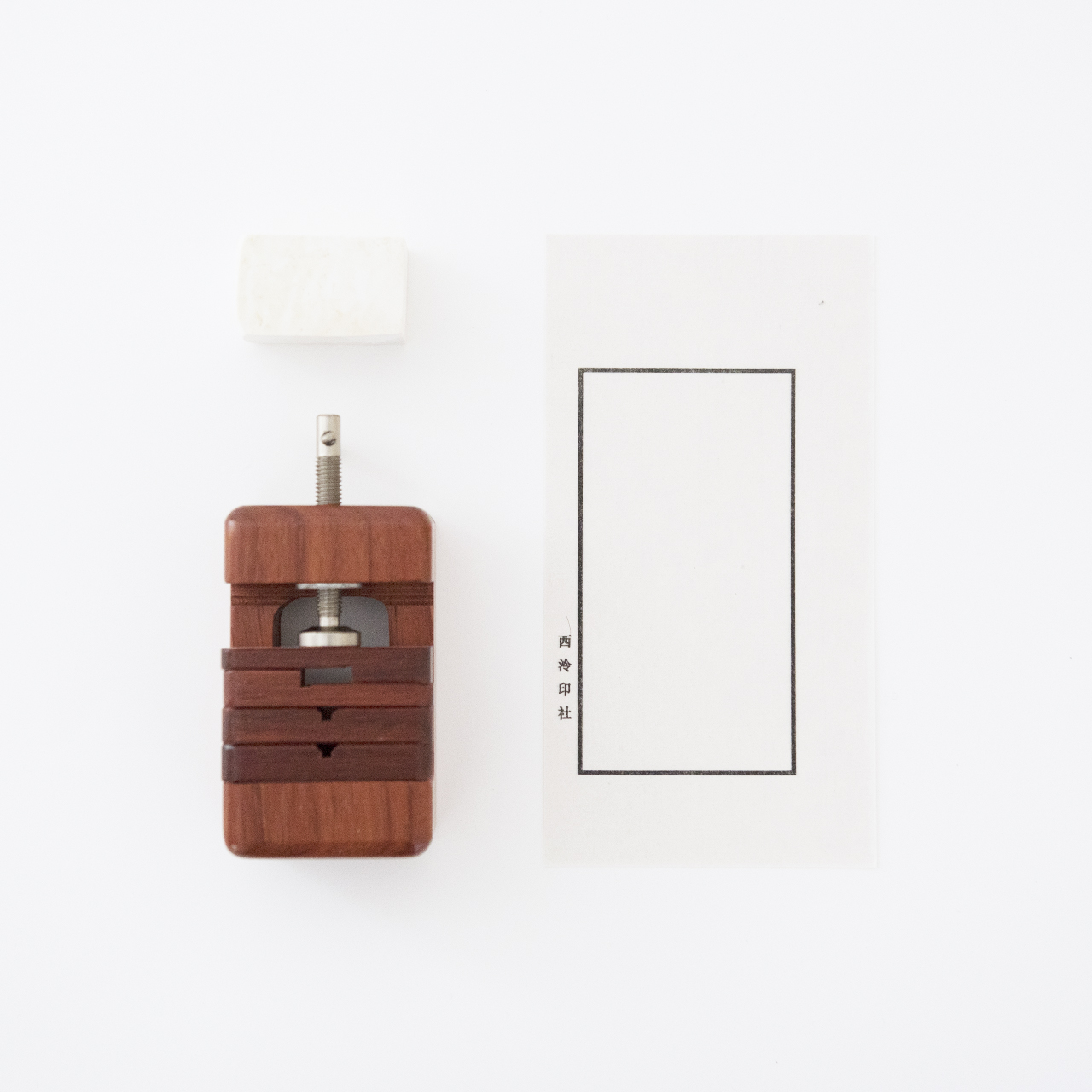
Seal Engraving Supplies / tenkokuitem
Rakkan seals become a part of your work itself. If you can carve them yourself, the joy of calligraphy expands even further.
Ordering a custom-made seal is nice, but if possible, why not enjoy crafting one with your own ideas and preferences?
At Shoyu Online, we offer a wide range of seal-engraving tools and materials to support your tenkoku (seal carving) journey.

