

Shodo Daisuki Episode 50
Shodo Daisuki Episode 50
When in Trouble, Watch This! Calligraphy Troubleshooting!!【Calligraphy】
Shodo Daisuki – Episode 050
Have you ever run into trouble while doing calligraphy?
Ink on your clothes, your work tearing…
Shimauchi gives an easy-to-understand explanation of the most common problems!!
Shodo Daisuki Episode 50 — Video Overview
Shimauchi presents a special 50th-episode video titled “Calligraphy Troubleshooting.”
After apologizing for a two-week gap in uploads, he explains in detail various problems that can occur while practicing calligraphy and how to solve them.
The aim of this video is to provide ways to deal with common issues that calligraphy lovers face, so that even while acknowledging the “irreversible beauty” of calligraphy, viewers can stay calm and respond appropriately when trouble occurs.
He introduces an effective way to remove ink stains from clothing using cooked rice, and compares this with using detergent alone.
He also explains that even if a work tears or gets a hole, it can be restored by asking a professional mounter (hyogu artisan) to back and repair it.
In addition, he covers what to do if ink gets on the blank margin of a work, if you accidentally stamp your name seal upside down, how to reduce paper bleeding by using darker ink or anti-bleed spray, and more.
Regarding hair shedding from new brushes, he explains that it is an unavoidable phenomenon due to how brushes are made, and that when a favorite brush starts shedding after long use, proper drying is more important than the way you wash it.
Shimauchi closes by inviting viewers to post any other calligraphy-related troubles or questions in the comments, and promises to keep sharing information to help everyone enjoy a more comfortable calligraphy life.
YouTube Shodo Daisuki Episode 50
Shimauchi 00:00
Ink has gotten on my clothes.
I thought I’d finally written something nice, and then the piece tore with a rip.
Don’t give up — there are ways to save things, and there are methods to definitely reduce bleeding.
Drying is the key.
Hello, I’m Shimauchi, the guy who loves calligraphy.
Shimauchi 00:19
This time I’ll be talking under the title “Calligraphy Troubleshooting.”
But first of all, I’m truly sorry for being away for two whole weeks.
Trouble happens in everyday life too, doesn’t it? I was all fired up to bring you this memorable 50th episode,
Shimauchi 00:32
but things didn’t go smoothly and it ended up taking a bit of time.
Still, I’m sure I’ll be able to share it with you all someday, so when that time comes, I hope you’ll look forward to it.
Shimauchi 00:45
As for today’s video, some of the topics overlap with what we’ve covered before, but I wanted to create a video that you can turn to whenever you’re in trouble — a sort of “watch this when things go wrong” guide.
I’ve picked out situations where people often think, “Oh no, what do I do?” or “I get nervous when this kind of trouble happens while I’m doing calligraphy,”
Shimauchi 01:04
and I’d like to offer ways to solve them.
Of course, I fully understand that calligraphy is about expressing beauty in that one moment, in that one stroke.
In other words, there is a beauty that comes from not being able to undo or redo your work.
Shimauchi 01:19
But if some problems can be fixed or redone, even to a degree, wouldn’t that help you relax a little more?
If you watch this video all the way to the end, I think you’ll be able to enjoy calligraphy with a slightly broader and more relaxed mindset.
Shimauchi 01:37
So please stay with me until the end. I’d really appreciate it.
On this channel, I share all kinds of topics related to writing, not just calligraphy, so please subscribe and give this video a like if you find it helpful.
Shimauchi 01:51
All right, let’s get into the main content.
Here we go! As always, I’ve added chapters — basically a table of contents — in the description below.
If you ever want to review a particular part, I hope you’ll make good use of them.
So, let’s get started.
Shimauchi 02:08
First topic: ink has gotten on my clothes.
In calligraphy, ink stains are something you can’t really separate yourself from. I, Shimauchi, have ruined countless shirts with ink.
You can’t remove ink stains perfectly, but I wanted to find out
Shimauchi 02:26
what method would remove them the most efficiently and cleanly, so I did a little test.
The method that worked best was using something dearly loved by Japanese people: plain cooked rice grains.
Let me introduce that method to you.
Shimauchi 02:47
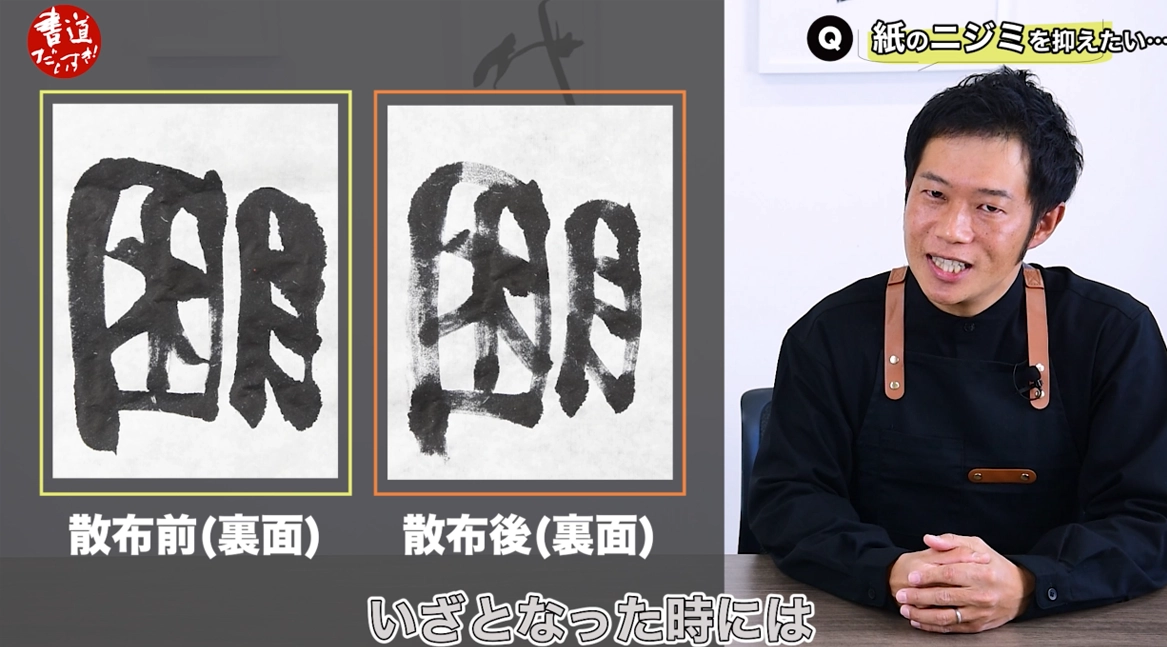
I tried two approaches: one using only detergent, and another where I rubbed in rice grains first and then used detergent.
I scrubbed both with the same type of brush for the same amount of time.
You’ll be able to see which method worked better.
Shimauchi 03:05
Thinking back, and I’m sure it’s still true now,
elementary school kids especially get ink on their clothes no matter how much you tell them not to.
Parents must be pulling their hair out over it.
So I hope you’ll try this out in real life and see how it works.
Shimauchi 03:20
This might be a bit of an aside, but I started wondering what ink-stick makers do about stains.
I heard that in the old days, they used nightingale droppings when the ink stains were really bad.
I was shocked!
Shimauchi 03:34
When I asked someone from that time, they said, yes, they really did use them.
Apparently, it left things very smooth and shiny.
So there’s a little piece of trivia for you.
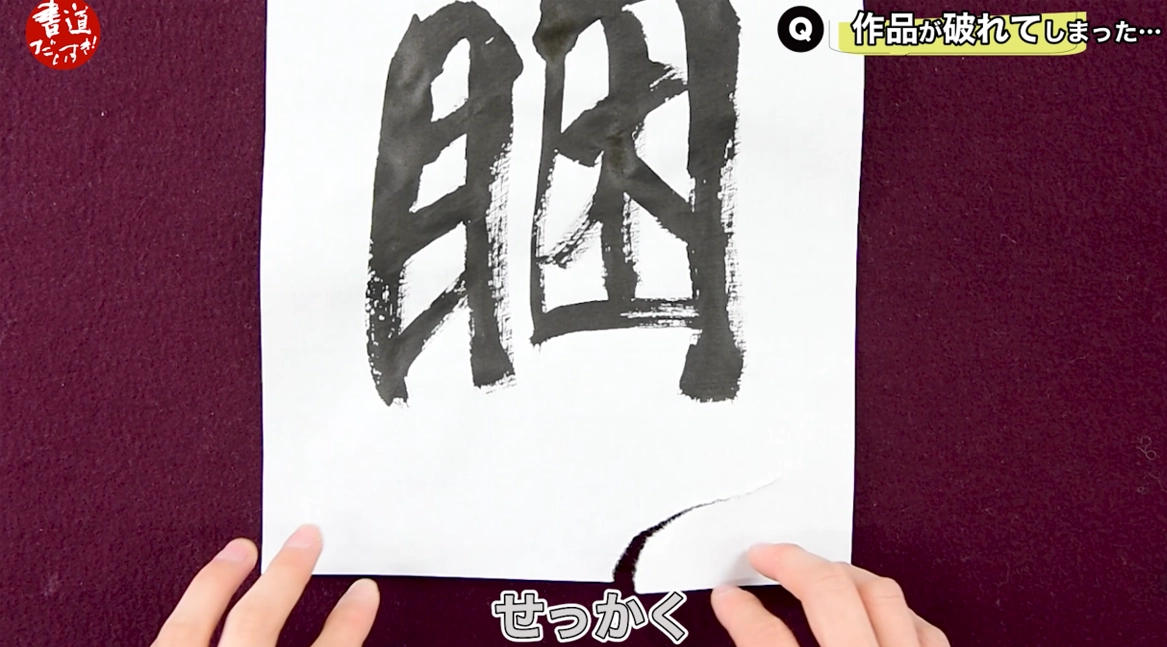
Next topic: when your work tears. This happens a lot too, doesn’t it?
Shimauchi 03:48
You finally write something that feels good, and then — rip — the paper tears.
Your first thought might be, “I have to start over from scratch.”
But don’t worry.
If you ask a professional mounter to do the backing work,
Shimauchi 04:01
they can repair it quite skillfully, so it will be okay.
Please keep that in mind.
Of course, since the paper has torn once, if you look closely, you might notice, “Ah, it must have ripped here.”
But unless someone is inspecting it from right up close,
Shimauchi 04:17
it’s hard to notice from a normal viewing distance.
Next, a similar case: when your work gets a hole.
This can happen in various ways. Maybe your stroke was too forceful and the brush caught, tearing an inked area of the paper,
Shimauchi 04:35
or maybe you snagged the paper and opened a hole in a blank white area.
There are many possibilities.
If an inked area tears, bring a section of paper where you’ve written with the same ink on the same kind of paper as when you did the work.
Shimauchi 04:52
And if a non-inked, white area is damaged, bring along a clean piece of the same paper you used for the work.
If you do that, a mounter will be able to repair it beautifully so the damage is hardly noticeable.
Shimauchi 05:08
Again, just like earlier, it might not be 100% invisible, and if you really scrutinize it you might see where it was fixed,
but from a normal distance it should be fine, so you can relax about that.
Also related to that…
Shimauchi 05:20
Next: ink has gotten on the work.
Here I mean ink that has gotten onto a clean, white margin of the piece.
Not ink you intentionally added, but ink that got there by accident.
Shimauchi 05:33
If that really bothers you and you want to remove it,
the same approach applies: bring the same type of paper you used for the work.
The mounter can neatly cut out the stained area
Shimauchi 05:47
and patch it for you, so please don’t worry too much about it.
Next topic: you stamped your name seal upside down.
This one is really heartbreaking.
You write a good piece, the seal carving turns out well, you stamp your seal and think, “Yes, I nailed it!” — then realize it’s upside down.
But again, don’t panic.
Shimauchi 06:05
Use the same seal to stamp the same impression on a separate piece of the same paper.
We’ll use that as the replacement patch.
Of course, the base paper must be exactly the same as the one used for the work.
And you also need to pay attention to
Shimauchi 06:24
the paper grain — the vertical and horizontal fiber direction.
You should match the grain direction of the patch to that of the original work.
So if you ever stamp your seal upside down, don’t give up, thinking it’s all over. There is hope.
Shimauchi 06:40
Let’s trust in the skills of mounters.
Okay, let’s keep moving.
Next, number six: you want to reduce bleeding on the paper.
There are many possible approaches here.
The first thing you can do in advance is to use thicker, darker ink.
Shimauchi 06:59
Naturally, the thicker the ink, the less it tends to bleed.
Another option is to use paper that doesn’t bleed much to begin with.
These are preparations you can make ahead of time.
But if you can’t prepare in advance and you have to use the paper you already have right now,
Shimauchi 07:16
then we need a more emergency-style solution.
One thing I came up with was to use mounting spray — specifically, anti-bleed spray — on the paper.
I was curious about this, so
Shimauchi 07:30
I experimented.
First I sprayed anti-bleed spray on the paper,
let it dry, and then wrote on it.
Interestingly, while the brush felt a bit scratchy, the bleeding was clearly reduced.
The only downside was
Shimauchi 07:49
that the ink color didn’t appear as rich as usual; it looked a little washed-out or whitish.
So yes, it’s a bit of a brute-force method,
but I can say for sure that the bleeding was definitely reduced.
Shimauchi 08:03
So it’s a method you can use as a last resort when you really need it.
All right, let’s keep going.
Number seven: hair is falling out of a new brush.
This is a tricky one for me to talk about, to be honest.
You buy a new brush, start using it, and hairs come out.
Shimauchi 08:20
You might understandably feel, “Why is hair falling out of a brand-new brush?”
But this is actually related to the brush-making process itself.
I’ve heard that during production, the hairs are handled while they are about 80% wet.
Then that damp brush
Shimauchi 08:36
is thoroughly dried,
the hairs are gathered and tied to form the tip — this tying process is called “oshime,”
and the finished tip is then inserted into the handle and glued in place.
Shimauchi 08:58
When gathering the hairs, artisans use a special “fude-kushi” comb to remove unwanted hairs, but it seems that those hairs cannot be removed perfectly 100% of the time.
Shimauchi 09:16
Let me give you an analogy.
Imagine you go to the barber and get a nice haircut.
Then they shampoo your hair, which gets it wet.
After drying, it looks clean and fresh, and you head home feeling great — but when you brush your hair at home,
Shimauchi 09:32
some loose hairs fall out, right?
It’s the same idea.
Since the hairs were worked while wet through about 80% of the process,
some hairs that were stuck together will naturally come free as everything dries.
When you start using and loosening the brush,
Shimauchi 09:46
those unnecessary hairs fall out.
That’s just how it is.
If you keep using the brush several times, the shedding will gradually stop,
so please don’t worry too much about that part.
Shimauchi 10:03
The key point is that when you first “break in” a new brush, some hair shedding is bound to occur.
So please don’t assume that “it’s new, so it won’t shed hair at all.”
That assumption is dangerous.
Please keep that in mind.
Shimauchi 10:17
Next, a related topic: a favorite brush that suddenly starts shedding hair.
You might think, “What’s going on?”
This brush that has always felt so good in your hand now begins to lose hair.
Shimauchi 10:35
You might suspect your washing method, and of course that can be a factor,
but more important than how you wash is how you dry the brush afterward.
Shimauchi 10:50
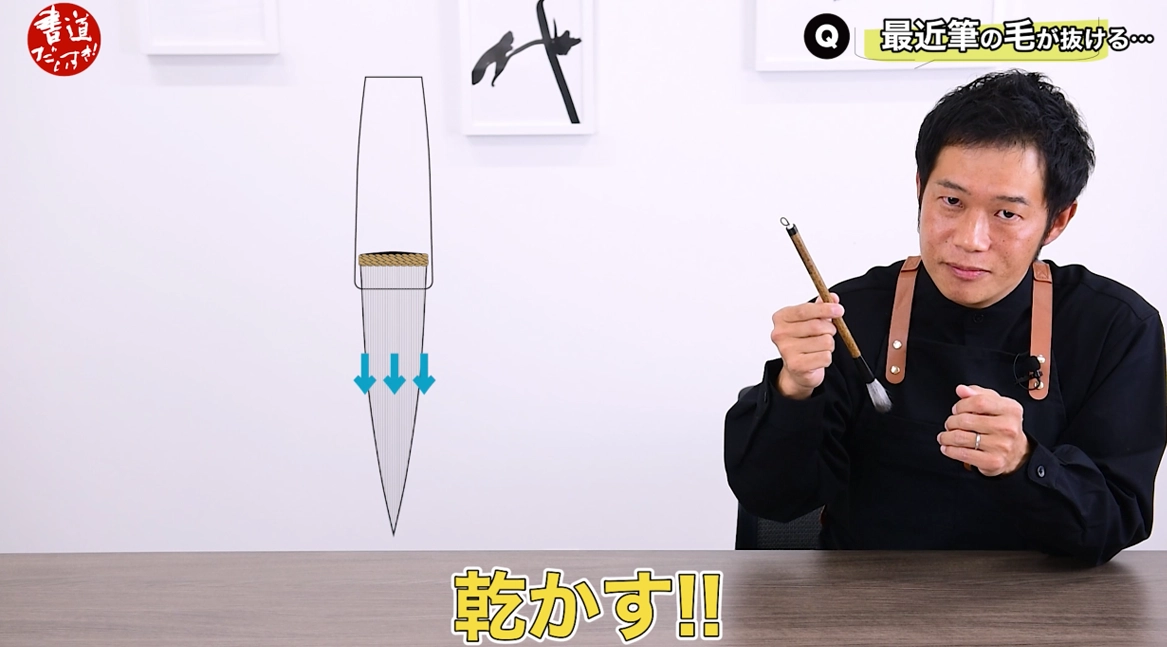
You need to dry it as soon as you’ve washed it.
If the base of the hairs at the ferrule never fully dries, it can start to rot.
When that happens, the hairs are damaged, break more easily, and start shedding.
Shimauchi 11:08
This is precisely why brushes have a cord attached to them:
so you can hang them up properly to dry.
By hanging the brush, the water runs down and the tip dries completely.
We tend to focus only on how we use or wash the brush,
Shimauchi 11:25
but drying is absolutely crucial.
Let me say that again: drying is important.
Please keep that in mind.
I’ve gone through these topics rather quickly — how was it?
If you practice calligraphy, I’m sure at least one or two of these issues sounded familiar.
Shimauchi 11:38
If there are any other problems where you’ve thought, “What should I do?” or “Is this a serious issue?”
please feel free to share them in the comments section.
Shimauchi 11:54
I hope all of you can enjoy a comfortable calligraphy life.
This has been Shimauchi, the guy who loves calligraphy. I’ll keep my spirits up and continue doing my best.
About Related Products
This section introduces the products that appear in this video.
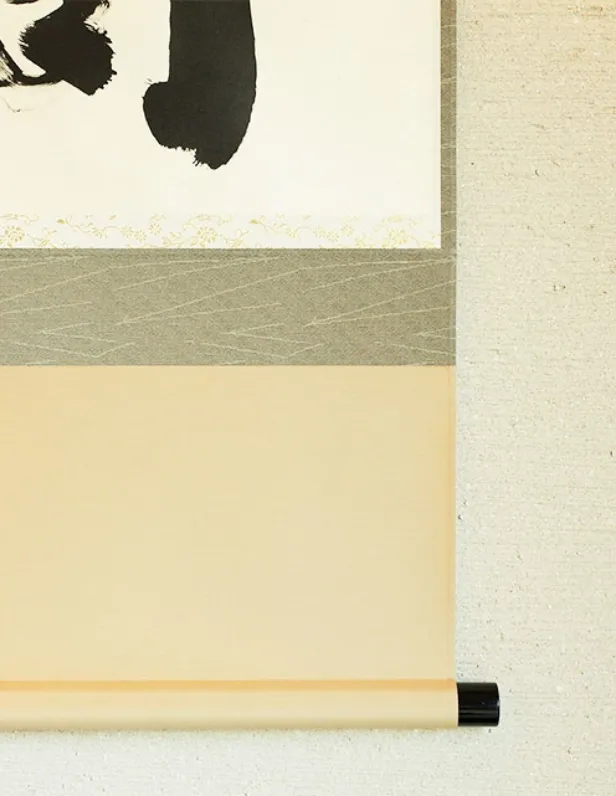
Hyosou Online Mounting Service / hyousou online
If you’re too busy to visit a store in person, feel uneasy about how the finished work will look, or want to avoid going out, this service lets you request mounting from home while checking the finished image in advance.


