

Shodo Daisuki Episode 51
Shodo Daisuki Episode 51
Everyone’s Dream! The World of Goat-Hair Brushes!!【Calligraphy】
Shodo Daisuki – Episode 051
If you practice calligraphy, you’ve probably admired goat-hair brushes at least once!
Many people avoid them because they feel soft and difficult to control…
But “goat-hair brush” is a broad category—there are countless types, each with very different writing characteristics!
In this episode, *Shimauchi* explains the魅力 and variety of goat-hair brushes!
Shodo Daisuki Episode 51 – Video Overview
Shimauchi presents a detailed explanation of goat-hair brushes.
Although they are often perceived as soft and difficult to use, in reality there are many kinds of goat-hair brushes whose characteristics vary depending on how the hairs at the tip are processed.
First, he explains that what we call “goat-hair brushes” do not use sheep wool but rather goat hair from goats raised in the lower Yangtze River region of China.
The quality differs depending on which part of the goat the hair comes from, with the neck area producing the highest-quality hair.
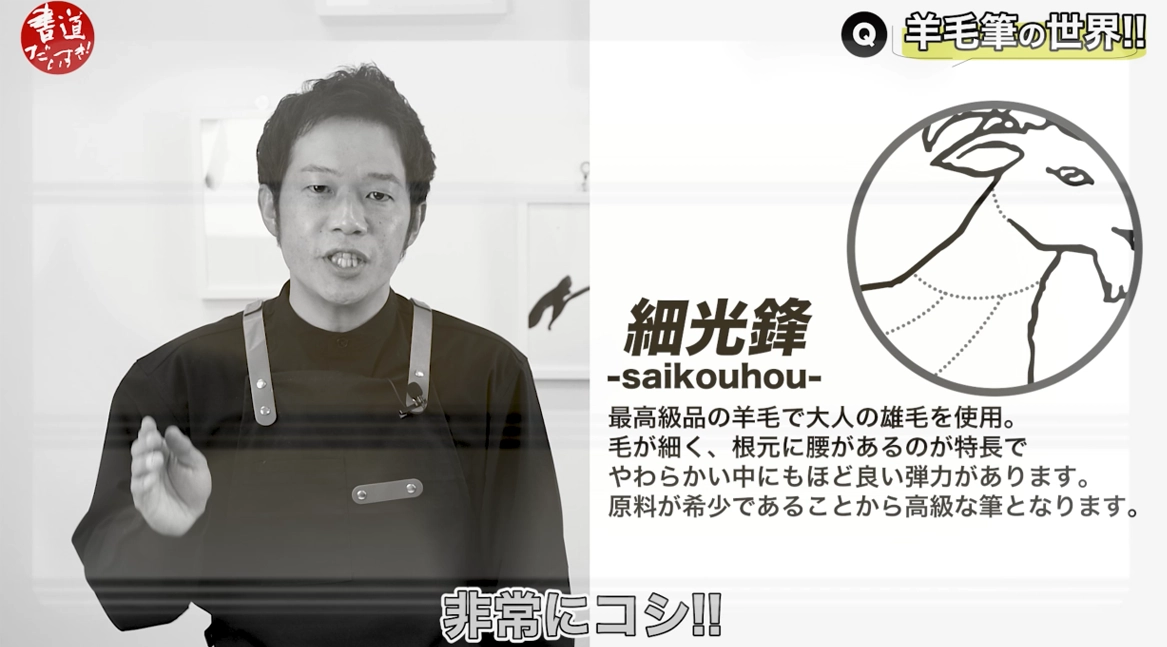
Brushes made from *saikōhō* (fine light-tipped hair) use the hair of adult male goats, characterized by extremely long, thin tips and strong roots. However, such high-quality raw materials are now extremely rare.
Goat-hair brushes can be broadly divided into two types: “aligned tips” and “trimmed tips.”
Aligned-tip brushes have consistent softness from root to tip, making it easy to spread the brush to create soft, expressive strokes.
Trimmed-tip brushes taper more sharply, allowing better control when you want the tip to respond cleanly.
Another key trait of goat-hair brushes is their excellent ink capacity—dramatically different from horse-hair brushes.
Goat-hair brushes also become easier to use as you repeatedly use, wash, and dry them; the hairs tighten naturally over time.
After long-term use, hairs may begin to shed, but the brush head can be remounted into a new handle, effectively “remaking” the brush.
Shimauchi encourages viewers to choose brushes that suit their writing style and to consider goat-hair brushes as a valuable option.


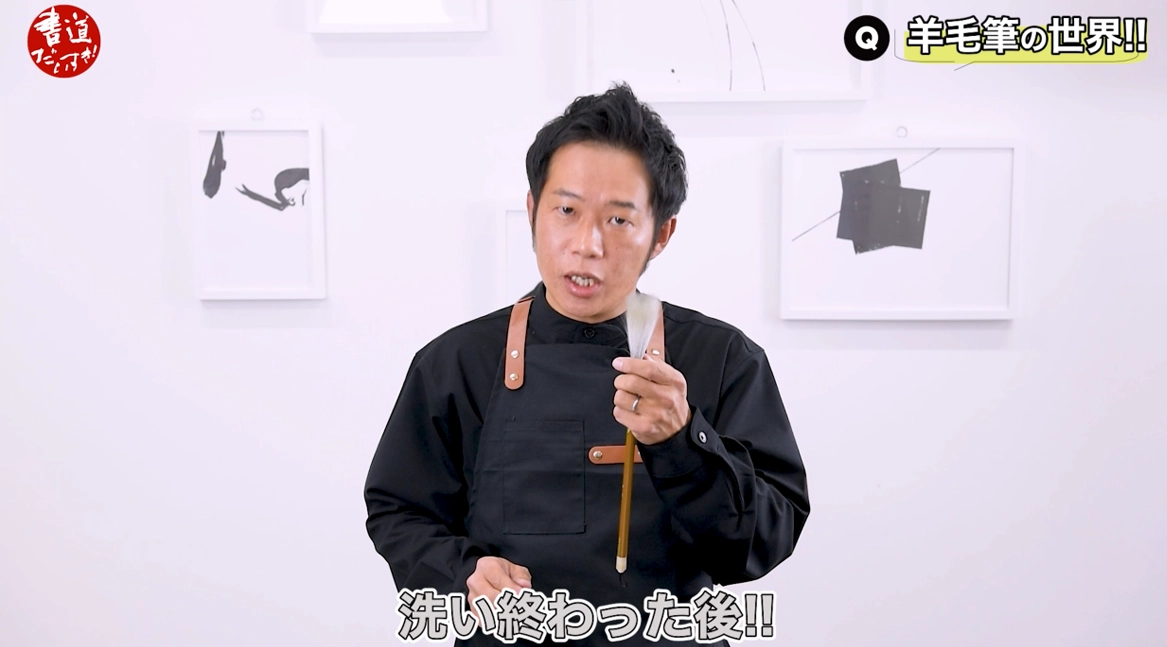
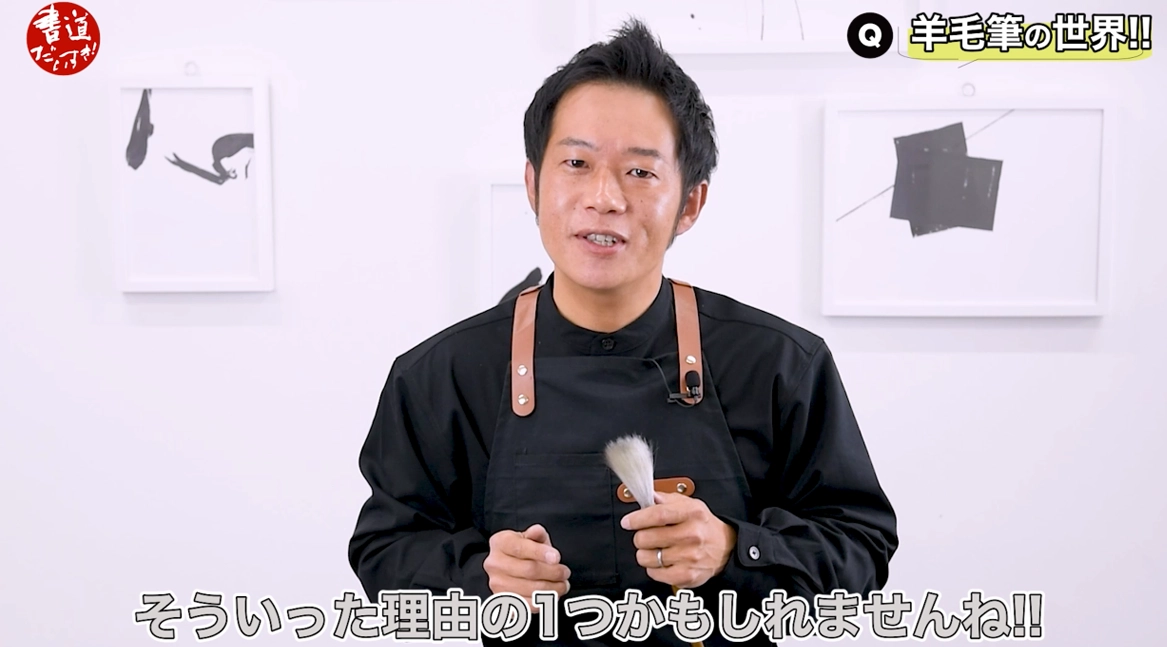
YouTube Shodo Daisuki Episode 51
Shimauchi 00:00
They have great resilience, and over many years the hair of these goats is carefully raised—this “power” in the hair creates very responsive tips, and the difference becomes all the more obvious.
So please don’t give up when choosing brushes.
Hi, this is Shimauchi, your calligraphy lover!
In this episode,
Shimauchi 00:21
I’d like to invite you into the world of goat-hair brushes that everyone admires.
You might have the impression that they’re somehow soft and therefore hard to write with.
To be honest, I’ve always been bad with goat-hair brushes myself—my own technique, my brush handling, shows up directly in the strokes.
Shimauchi 00:38
Because of that, I often feel as if the brush is saying, “You’re not really using me properly, are you?”
It’s like the brush is seeing right through me—it’s a bit unsettling.
But even with goat-hair brushes, there are many different types, and the way the hairs at the tip are processed also makes a big difference.
Shimauchi 00:55
Some people say, “Only a goat-hair brush can produce that kind of line,” or “I can’t resist the moment when that pure white hair loads up with ink.”
So I hope that, by watching this video, you’ll start to feel goat-hair brushes are more familiar and approachable, and that you’ll notice their unique魅力.
This channel introduces all kinds of topics related to writing, not just calligraphy itself, so
Shimauchi 01:11
please remember to like the video and subscribe to the channel for more!
Now then—welcome to the world of goat-hair brushes!
When you think of the features of goat-hair brushes, what comes to mind?
Perhaps: good resilience, tips that look like transparent amber, softness, excellent ink capacity, and strong durability.
Shimauchi 01:49
In fact, the hair does not come from sheep—it’s goat hair.
Did you already know that?
And not goats from Japan, but mainly goats raised in the lower Yangtze region of China.
The characteristics of the hair vary depending on which part of the goat it comes from.
Shimauchi 02:06
Let’s bring up a diagram here.
How does this look to you? There are quite a lot of specialized terms, aren’t there?
Honestly, many of these words only ever come up when you’re talking with a brush maker or seller.
Shimauchi 02:30
Even so, I’d like to briefly explain some of these terms.
It seems that the hair around the neck of the goat is particularly good.
This is just my imagination, but goats scratch themselves in all kinds of places, right?
Shimauchi 02:46
So the hair on the back or sides probably rubs against things and gets damaged more easily.
But the hair around the neck is harder to scratch—after all, the goat can’t really reach it.
That’s why you can get long, high-quality hair from that area.
Looking at the chart, you can see that “fine light-tipped hair” (*saikōhō*) from adult goats has very long, thin tips but a strong base.
Shimauchi 03:25
However, there simply aren’t many mature goats with that kind of hair anymore.
So this type of hair is now a very rare and precious material—that much is certain.
Brushes made entirely from such fine light-tipped hair are not something you encounter often.
Shimauchi 03:44
If they exist, they’re most likely made from old stocks of raw hair prepared long ago.
Next, “sainen kōhō” (fine soft light-tipped hair)—the name is quite tricky, isn’t it?
This type uses hair from young male goats taken from the same area of the body.
Because the goats are younger, the hair is a bit less resilient compared with *saikōhō*.
Shimauchi 04:03
“Saichokuhō” goat hair, on the other hand, mainly uses hair from female goats.
The hair is shorter, and typically you can make brushes up to around 5 cm in hair length from it.
If you can at least remember the terms I’ve just covered, people might say, “Wow, you really know a lot about goat-hair brushes!”
Shimauchi 04:42
So please keep those in mind as key points.
We’ve just talked about the very highest-grade parts, but as you’ve seen, there are many different hairs depending on the area of the goat.
That means there are also many different types of goat-hair brushes.
Shimauchi 04:57
That doesn’t mean coarse goat hair is useless.
Coarser goat-hair brushes can be great as a first step into the world of goat hair—they have good backbone and are easier to handle.
So they’re perfectly suitable for getting familiar with goat hair in general.
Shimauchi 05:13
The important thing is to pick brushes that match your current ability and purpose.
A good goat-hair brush is often said to have amber-colored tips.
Why is that?
Because the hair of goats that have been carefully raised over many years naturally thins out at the tips.
Shimauchi 05:32
The very ends of the hair become fine and translucent—that’s what gives the tips their amber appearance.
So if you find a goat-hair brush with such amber-colored tips in a brush that’s otherwise quite coarse, you’re probably looking at a rare and valuable material.
Shimauchi 05:48
Next, let’s talk about differences in the brush tip itself.
Have you heard the terms “aligned tips” (*saki-soroe*) and “trimmed tips” (*saki-suki*)?
First, aligned tips, which are also called *saki-yose*.
How can you recognize them?
Shimauchi 06:07
Even when there is no ink or water on the brush, if you gently touch it with your finger you’ll feel that it has the same density and softness from the base all the way to the tip.
In other words, the hairs are of similar length and evenly distributed.
When is this type useful?
Think of when master calligraphers write large characters—
Shimauchi 06:27
they often open the brush widely for a stroke and then sweep through in one motion, right?
With aligned tips, the brush opens fully and then moves smoothly across the paper.
This makes it easier to produce soft, expansive lines, and it also allows for unique, expressive strokes that can only come from this type of brush.
Shimauchi 06:43
So aligned-tip brushes are great when you want those particular qualities in your lines.
Next, let’s look at trimmed-tip brushes.
Again, with no water or ink, if you touch the hairs you’ll clearly feel that at some point along the length the amount of hair decreases sharply.
You can really sense, “Oh, this part has been thinned out.”
Shimauchi 07:21
When you load this type of brush with ink, the tip naturally becomes very fine and pointed.
So even though it’s goat-hair, you can still get a very controlled, sharp tip when you write.
Whenever you want to emphasize tip control and clarity in your lines, trimmed-tip brushes are a great option.
Shimauchi 07:37
The explanations so far might still feel a bit abstract, so I’ve also prepared a comparison with the tips wet.
I’ve dipped each of these two brushes in water so that you can see how the tips behave more clearly.
I think the difference in how they hold together will be much easier to understand visually.
Shimauchi 07:54
Now, let’s move on to ink capacity, another hallmark of goat-hair brushes.
To compare their ink-holding ability, I tested them against a horse-hair brush.
The horse-hair brush I used has a core of fine nylon inside, giving it a fairly large volume overall.
Shimauchi 08:13
In the test, I loaded each brush with ink and repeatedly wrote large “no” characters across the paper.
As you could see, the difference was striking.
It’s a bit of an extreme analogy, but imagine a scrubbing brush versus a sponge.
Shimauchi 08:32
If you soak both in water and then lift them out, the scrubbing brush sheds its water quickly, while the sponge holds much more for longer.
Goat-hair brushes behave more like the sponge in this comparison.
Another point is that goat-hair brushes tighten up as you use them—using, washing, and drying them repeatedly.
Shimauchi 09:05
If you look at a well-used brush after washing and drying, you’ll notice the hair near the base looks a bit darker.
That’s because, under magnification, the hairs have tiny scale-like “cuticles,” and ink settles into those areas.
Shimauchi 09:22
That ink in the cuticles helps the hairs bind together slightly, making the brush feel tighter and easier to control.
If you’ve carefully used and raised a goat-hair brush like this and then, over time, it starts shedding hairs, what should you do?
At first, if it’s just short hairs, it’s not a big problem.
Shimauchi 09:42
But if you start to see hairs coming out that are the same length as the visible bristle length, take a closer look at them.
You may notice that the base of those hairs is darkened—that means the hairs are breaking off at the very point where they enter the handle.
If that continues, eventually the entire brush head could come loose.
Shimauchi 10:01
But even then, don’t give up!
A goat-hair brush that you’ve used for years and finally learned to control just how you like is still very much worth saving.
That brush head can be cleaned up and then set into a new handle as a “reborn” brush.
Shimauchi 10:18
The damaged part is cut away, the remaining good hair is cleaned, and then set into a fresh handle.
Because the bristle bundle is inserted as deep as its own diameter, the visible hair length becomes shorter—but the part that you’re already comfortable using is now seated deeper and can perform even better.
Shimauchi 10:36
So a goat-hair brush that you’ve lovingly used can reveal new, unexpected qualities after being remade.
That’s one reason why so many people say, “For me, it has to be goat hair.”
Shimauchi 11:13
I hope you’ll remember that goat-hair brushes can be used for a very long time if you take good care of them.
Perhaps that’s one reason there are so many people who swear they can only write properly with goat-hair brushes.
So, how was it?
Don’t you feel a bit more eager to try goat-hair brushes now?
Shimauchi 11:32
Of course, I’m not here to stop or criticize anyone who wants to start calligraphy using only goat-hair brushes from day one.
But when you’re trying to write with a brush, if you can’t get the strokes you want and you’re constantly struggling, it’s hard to enjoy yourself—and it can become stressful.
Shimauchi 11:50
That’s why it’s so important to think carefully about what you want to write, and then choose which brush is best suited to express that.
Please don’t forget that point when you select your tools.
Still, wouldn’t it be cool to be able to draw sharp, powerful lines—even with a soft goat-hair brush?
Shimauchi 12:11
Wouldn’t it be great to draw rich, expressive strokes with a wide variety of line qualities?
If watching this video inspires you to add “goat-hair brush” to your list of possible choices, I’ll be very happy.
There’s a saying: “Even Kobo Daishi chose his brushes carefully.”
Shimauchi 12:29
I, too, want to keep choosing the best brushes for myself and continue practicing calligraphy with tools that really suit me.
Shimauchi 12:47
This has been Shimauchi, your calligraphy lover. I’ll see you again next week—goodbye!
About the Related Products
Here are the products that appear in this video.
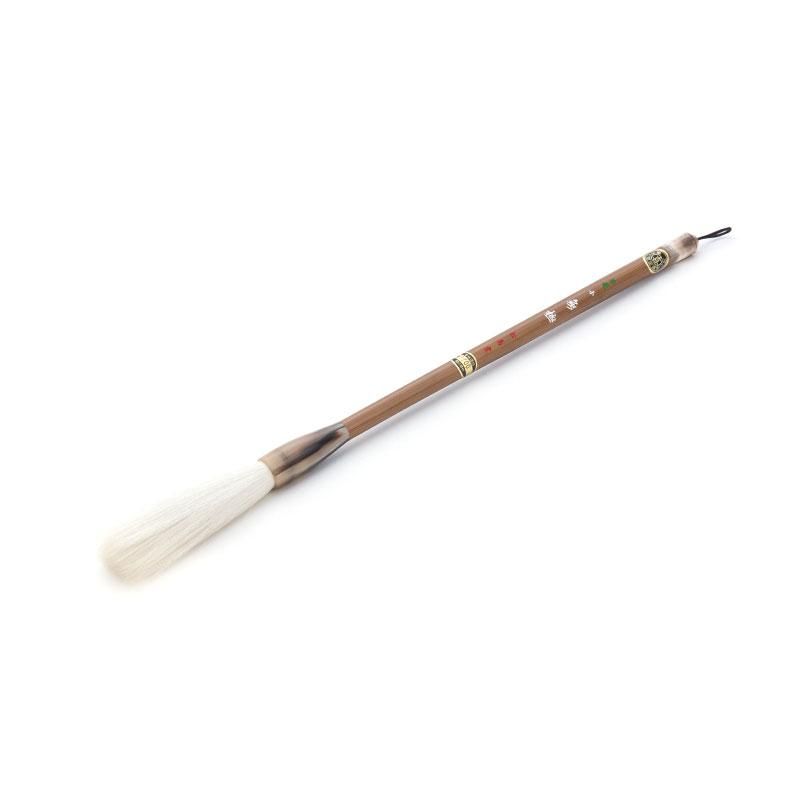
High-Grade Goat-Hair Brushes / kokyu yomofude
These are brushes recommended by Shoyu. “High-grade” does not necessarily mean “high-priced.”
At Shoyu, we offer goat-hair brushes that were once very expensive at more affordable prices while maintaining their quality.
Have you ever blamed your own skill when struggling with a brush that had no resilience?
Your technique matters, of course—but the tools you use are just as important.


