

Shodo Daisuki Episode 55
Shodo Daisuki Episode 55
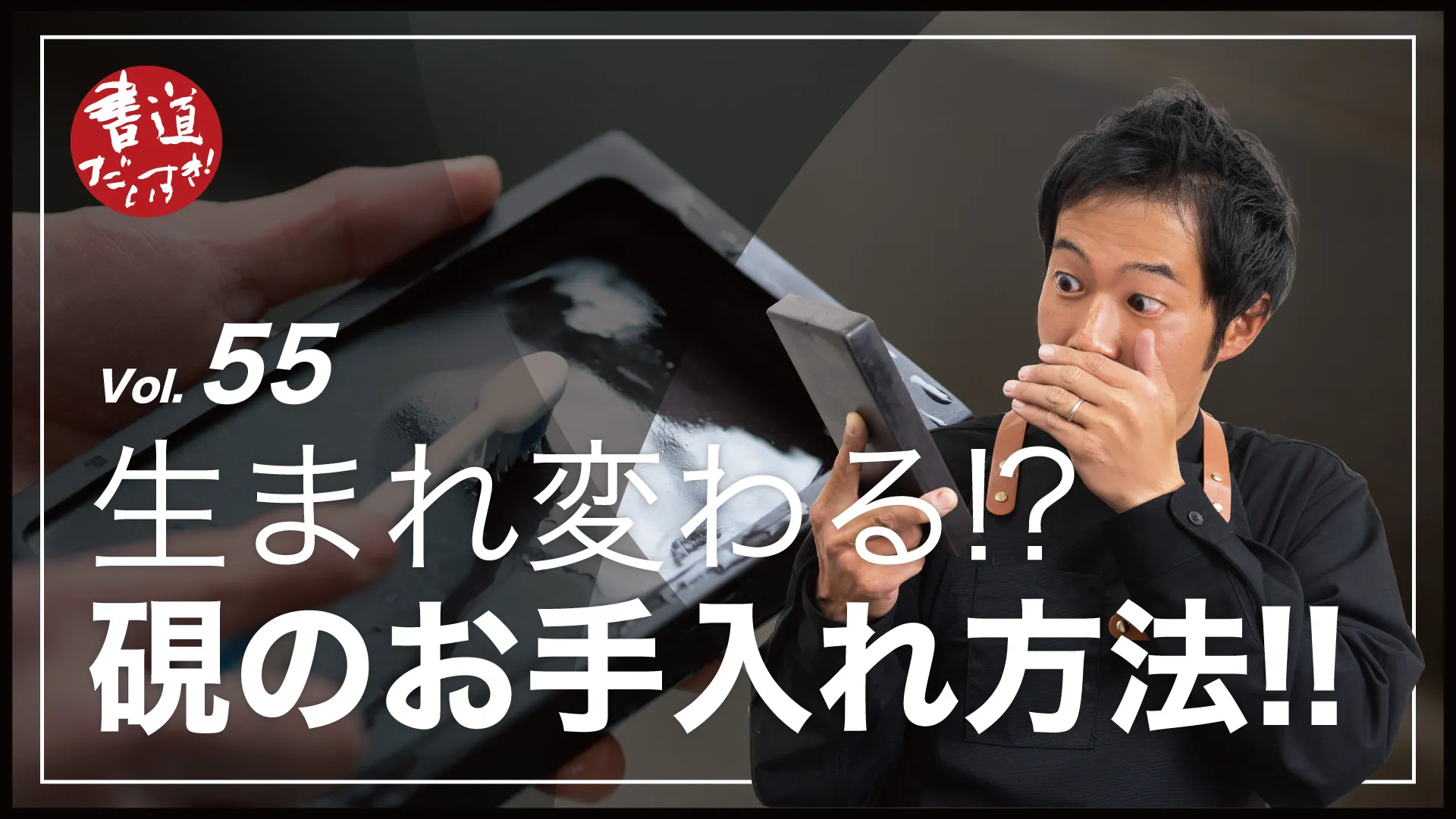
Must-See! Make Your Inkstone Like New — Care & Maintenance Tips【Calligraphy】
Shodo Daisuki – Episode 055
An indispensable tool in calligraphy: the inkstone (suzuri)!
Many people may not be fully aware of the proper washing and maintenance methods.
In this episode, we cover the basics of washing an inkstone and how to refresh the “hōmō” (the micro-tooth surface) using common kitchen cleaners—easy methods anyone can try!
It’s packed with tips!
Please try these with your own inkstone!
Shodo Daisuki Episode 55 – Video Overview
Mr. Shimauchi gives a detailed explanation of inkstone care and “medate” (re-sharpening the micro-tooth surface).
He points out that many people simply rinse with water or hot water after use and wipe dry, but this alone may not fully remove ink residue.
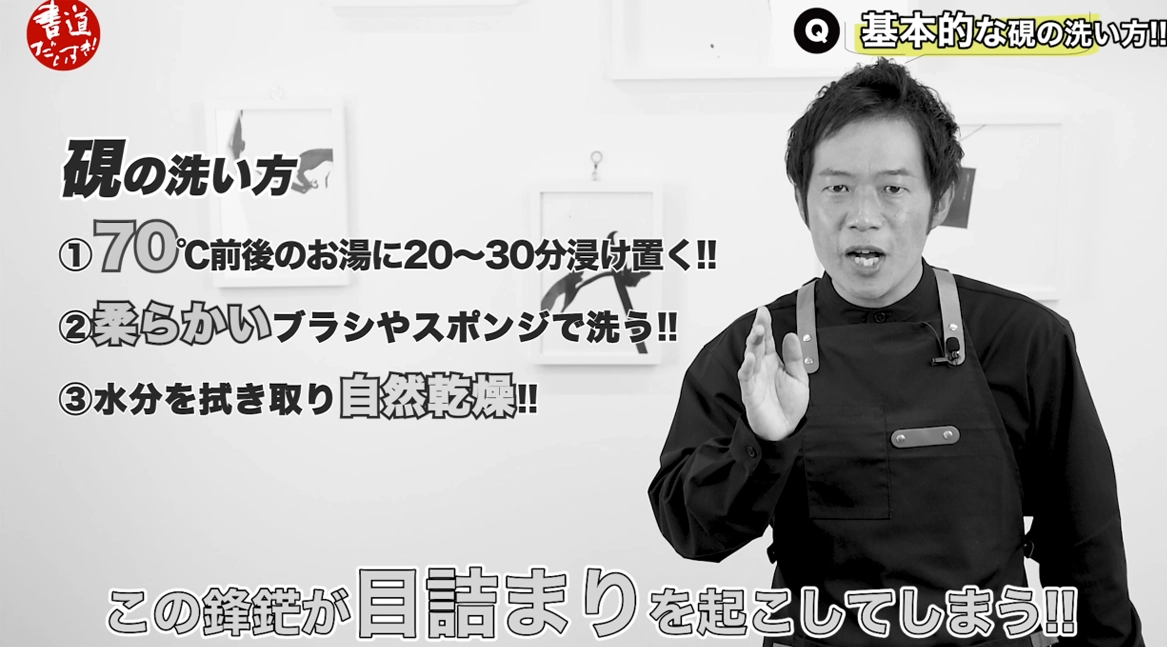
As a proper care method, he recommends first soaking the inkstone in hot water around 70°C for 20–30 minutes,
because nikawa (animal glue), a main component of ink, dissolves at this temperature.
Next, he explains that gently washing with a soft sponge or toothbrush and then letting it air-dry is important.
In particular, ink and glue can adhere to the inkstone’s “hōmō” (the fine uneven surface), causing clogging, so careful cleaning is necessary.
For new inkstones, many are coated with wax for appearance; since this wax also softens around 70°C, the same washing method helps reveal the inkstone’s true performance.
For medate, to re-sharpen a worn surface after long use, he suggests using a cream cleanser.
The cleanser’s abrasive (calcite) is less likely to damage the stone; used properly, it can revive the inkstone.
If the surface becomes too sharp after medate, he advises adjusting with waterproof sandpaper (grit 3000 or 4000).
However, for high-grade or quality inkstones, simple grinding with ink does not cause much wear, so medate is often unnecessary.
He concludes that medate should be the last resort because it carries risks of damage; first, review the correct washing method.
He also shares that he initially tried a mud whetstone method, but it scratched the inkstone, which led him to the method introduced here.
YouTube Shodo Daisuki – Episode 55
Shimauchi 00:00
This “hōmō” can get clogged.
If you feel something is off, this cleanser may be perfect for washing an inkstone.
It’s obvious at a glance—medate is the last resort.
Hello, I’m Shodo-Daisuki Shimauchi.
Shimauchi 00:19
Today’s topic is care that “rebirths” your inkstone—
a bold title indeed!
After using an inkstone, what do you usually do? Most people rinse with water or hot water and wipe dry, maybe rub the surface lightly with a finger…
Shimauchi 00:39
…and think, “Looks clean—perfect.”
But in fact, this doesn’t completely remove ink residue.
When buildup accumulates, your inkstone may not be showing its full potential.
Shimauchi 01:02
I’ll introduce my recommended inkstone care
to “revive” your inkstone like a phoenix.
Please join me. On this channel,
Shimauchi 01:21
we cover all things related to writing, not just calligraphy. Please subscribe, like, and leave warm comments!
Now, let’s dive in—
Here are the basics of washing an inkstone.
Shimauchi 01:42
Today I’m using my familiar Duan (Tanki) inkstone. Even when I think I wash it carefully, residue remains.
Let’s put this into practice.
First, soak the inkstone in hot water for 20–30 minutes.
Shimauchi 02:03
The key is the water temperature. At what temperature does nikawa—the main component of ink—dissolve?
It’s around 70°C.
So please aim for about 70°C water.
Shimauchi 02:24
If 20–30 minutes is too long, at least rinse thoroughly with hot water.
Step two: gently wash with a soft sponge or brush.
Today I used a soft toothbrush.
Shimauchi 02:45
Of course, clean carefully—but don’t scrub hard.
Be gentle at all times. Step three: after washing, you usually wipe with a cloth, right? After that—
Shimauchi 03:05
don’t blast it with a hair dryer!
Let it air-dry naturally.
That’s the basic washing method.
Even if you feel it’s clean, the inkstone has “hōmō”—
Shimauchi 03:24
fine unevenness where soot and nikawa can stick.
This clogs the micro-tooth surface, so
this washing method is essential.
Shimauchi 03:42
If you’ve never tried this before, please repeat it a few times. You’ll clean the inkstone effectively—give it a try!
A quick aside—
Shimauchi 04:01
A new inkstone is exciting!
You may want to start grinding ink right away. But be careful—many inkstones around ¥10,000 are
Shimauchi 04:18
finished with a cosmetic coating for appearance.
If water beads or runs off strangely when you drip it on—
Shimauchi 04:36
that’s a clear sign it’s been “made up.”
The coating is often wax.
And at what temperature does wax soften?
Shimauchi 04:56
Just like nikawa—around 70°C.
You see the point:
by doing the washing routine, the wax will soften and come off, and the inkstone’s original potential
Shimauchi 05:18
will come out.
So after buying a new inkstone, please wash it this way and “remove the makeup” early.
Now for the main point—
Shimauchi 05:37
If you still feel something’s off even after washing, medate may be needed.
Medate means re-sharpening the micro-tooth surface.
Long use leads to wear.
Shimauchi 06:00
By re-sharpening the hōmō, you can grind as before.
“But that sounds so specialized—do I need special tools?” you may ask—
Shimauchi 06:17
Don’t worry. We’ll use a kitchen staple:
a cream cleanser (e.g., Jif). It’s alkaline and combines surfactants (to lift dirt) with abrasives (to remove it).
Shimauchi 06:43
It’s perfect for washing inkstones.
The abrasive is natural calcite, which is softer than glass or stainless steel,
so it’s less likely to damage the inkstone—
Shimauchi 07:02
it “polishes” it instead.
Great, right? The method is simple: first soak at ~70°C for 20–30 minutes,
then take it out.
Shimauchi 07:18
Put cleanser on a soft toothbrush,
and gently, gently polish the whole surface evenly.
Gentleness is key—
don’t scrub hard or you’ll scratch it.
Shimauchi 07:39
Polish gently.
As you repeat, the abrasive particles will break down and “settle.”
So be patient—
keep polishing gently.
Then—
Shimauchi 07:54
rinse thoroughly with ~40°C lukewarm water,
wipe with a cloth,
and you’re done.
How is it? Side-by-side, the difference is obvious—much cleaner, right?
Shimauchi 08:13
However, polishing removes a tiny surface layer—
you may see the stone’s natural color.
But with cycles of grinding and washing,
Shimauchi 08:32
it will settle in.
It’s less “rebirth” and more “shedding a thin skin.”
A key caution:
the better the inkstone,
Shimauchi 08:51
the less the hōmō wears down from normal use.
So you can often say medate isn’t needed.
Medate removes surface material—
it may scratch or change color.
Shimauchi 09:08
You could damage your precious inkstone.
Please be careful.
If you wash properly on a daily basis,
Shimauchi 09:30
you won’t need medate at all.
Treat medate strictly as a last resort,
and proceed at your own risk.
After medate, the surface is very sharp—
Shimauchi 09:49
some may feel the grinding is “too sharp.”
In that case, use waterproof sandpaper.
It trims excess sharpness while keeping the hōmō standing.
Shimauchi 10:13
The higher the grit, the finer it is.
If you want a finer finish, use around 3000 or 4000 grit.
Today I use Duan (Tanki),
Shimauchi 10:31
and here’s a guide for other stones when polishing with waterproof paper.
Cut a small piece,
Shimauchi 10:48
fold it to fit your fingertip,
and polish gently and evenly as if grinding ink.
Again—don’t scrub hard. Note that waterproof paper clogs quickly even with gentle strokes—
Shimauchi 11:05
you’ll feel it.
When that happens, switch to a fresh piece
so you can keep polishing gently under the same conditions.
Shimauchi 11:22
How is it? It’s not “mirror-shine,” but my Duan inkstone feels revived after medate.
If you have an inkstone you haven’t used in a while, or you miss the old grinding feel—
Shimauchi 11:41
take it out and wash it like this—your inkstone will be happy!
How was it?
“Wait, you used that method?!”
Many of you may be surprised.
Shimauchi 11:56
At first, I tried a mud whetstone technique—
but there were impurities in the stone,
and my Duan got scratched.
I couldn’t release the video like that, so—
Shimauchi 12:16
I worried and thought hard—
and reached this method.
I’m not denying mud whetstones—please don’t misunderstand.
Shimauchi 12:36
I’m repeating myself, but medate can damage or alter the look of an inkstone, so this method minimizes risk.
First, review your washing routine;
Shimauchi 12:55
prioritize maintaining quality without medate whenever possible.
Thank you as always for your support—
see you next week!
Related Products
Here are the products featured in this video.
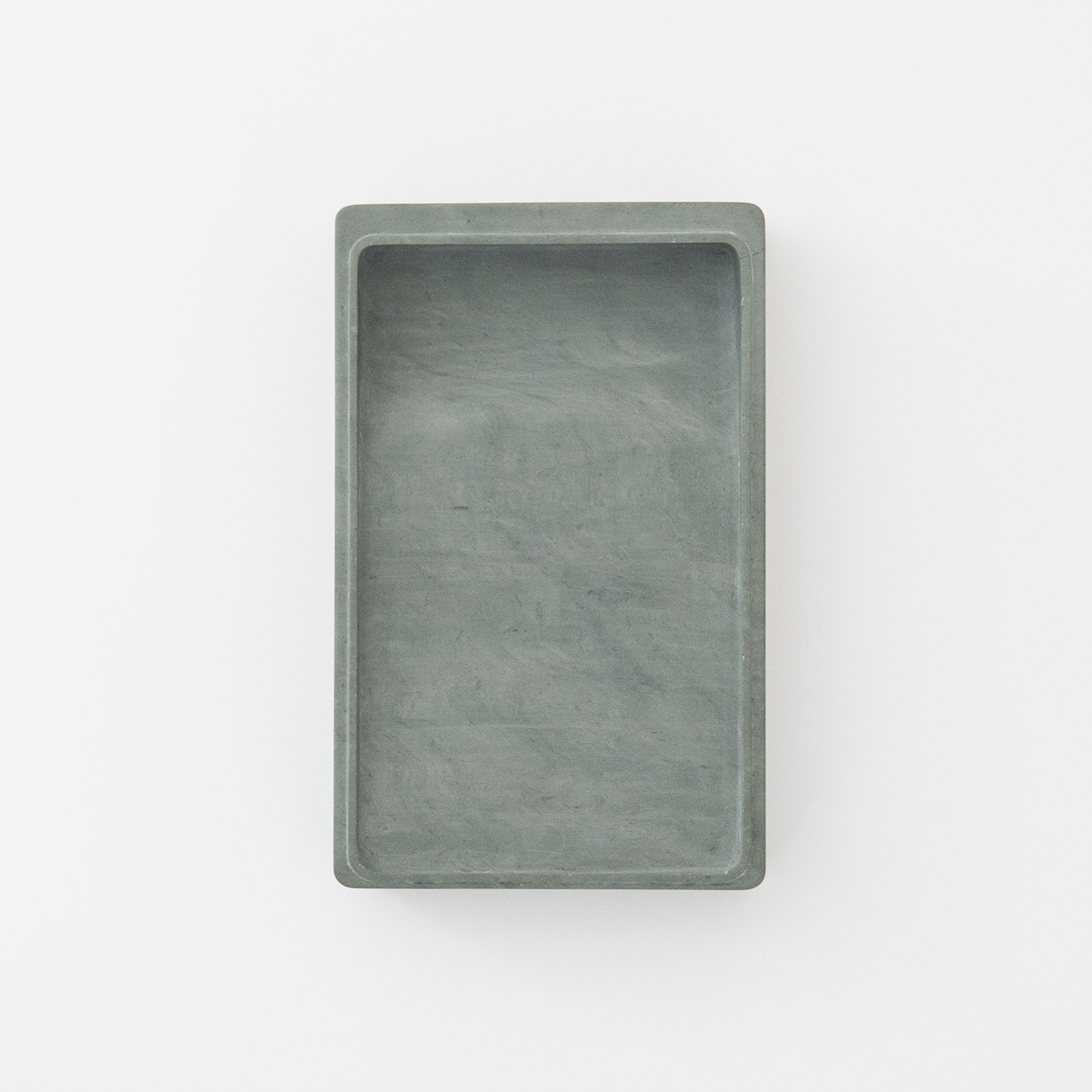
Inkstone / suzuri
The path begins with grinding ink.
Simply having an inkstone calms the mind… It’s not just a tool—it’s also an object of appreciation and art.
An inkstone plays a crucial role in achieving a rich ink color.
As the saying goes, “An inkstone lasts a lifetime.” Choose the best quality within your budget.
Good ink on a good inkstone—that’s the ultimate luxury.


