

Shodo Daisuki Episode 56
Shodo Daisuki Episode 56
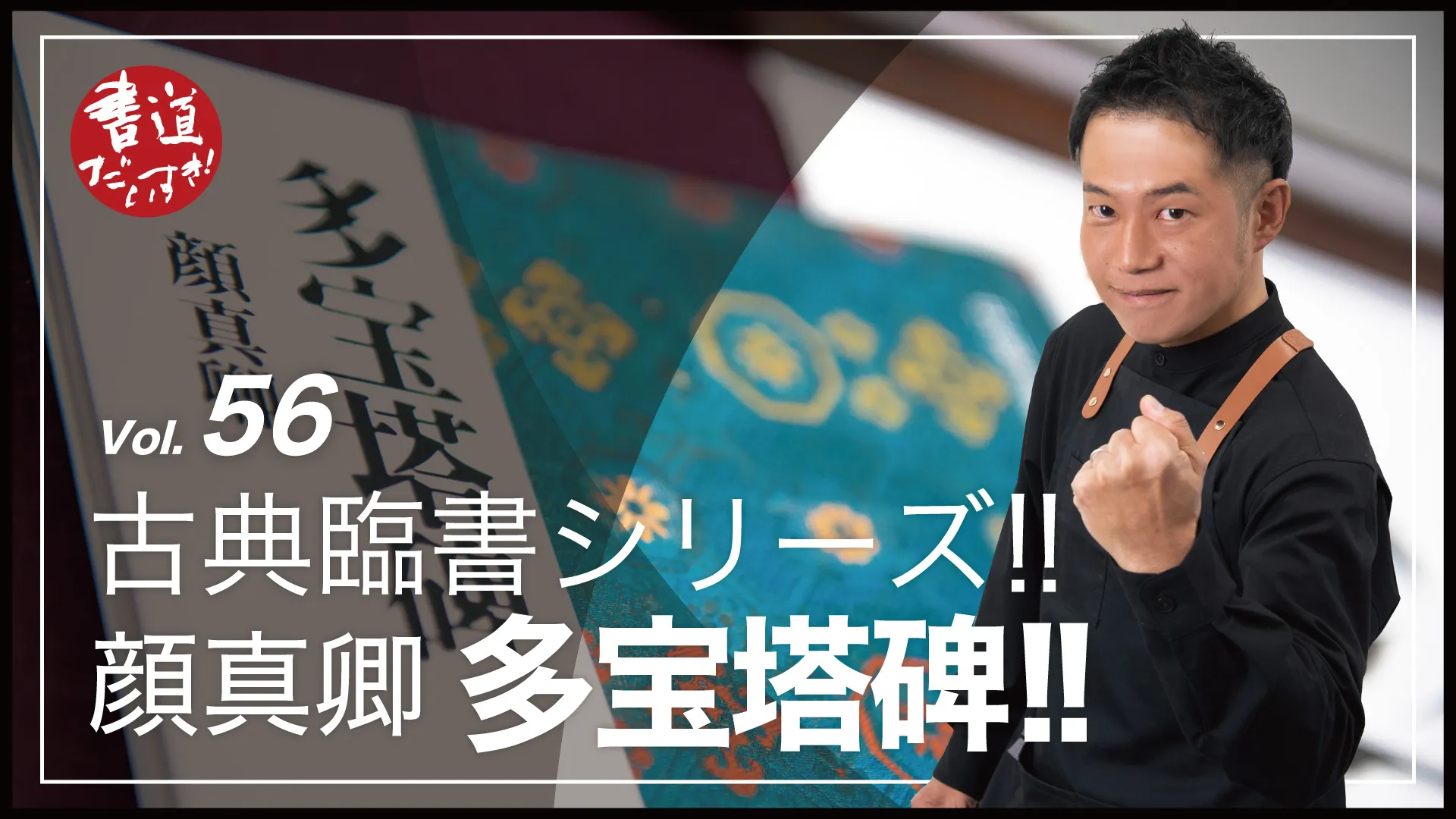
Classical Copy Series vol.3: “Yan Zhenqing – Dabao Pagoda Stele”【Calligraphy】
Shodo Daisuki – Episode 056
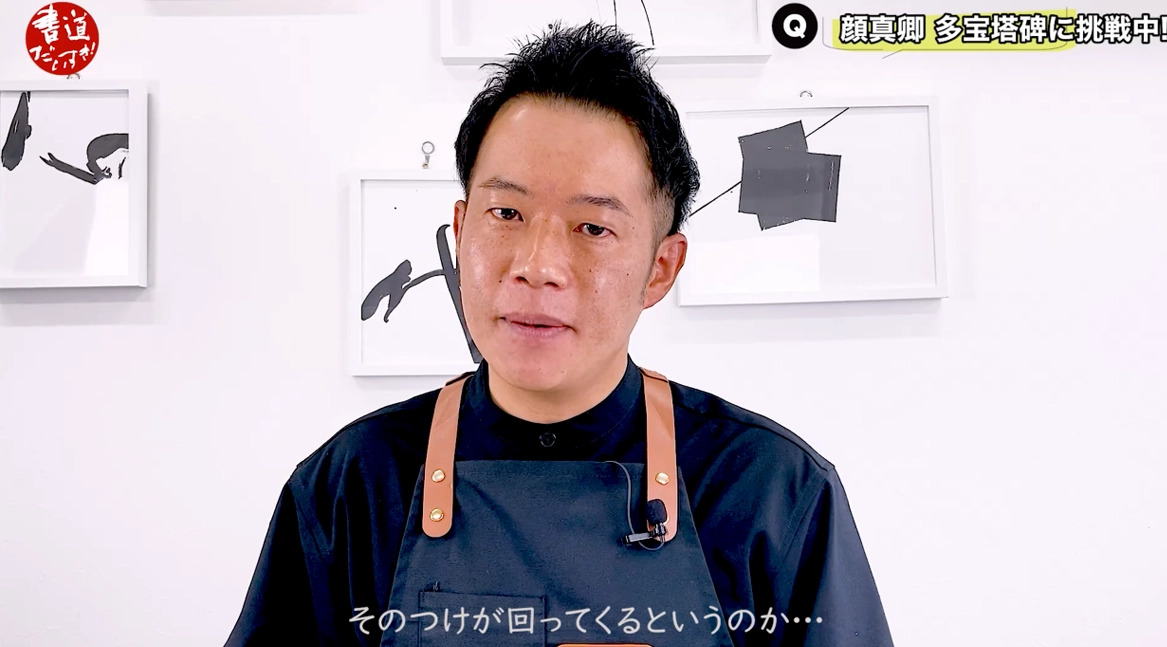
This is the third installment of the series where we introduce recommended classics and have “Shimauchi” actually do copy practice, explaining key points and cautions!
It’s designed to be clear and relatable.
Please watch and try it yourself!
Shodo Daisuki Episode 56 – Video Overview
As “Shodo Daisuki Shimauchi,” he introduces the Dabao Pagoda Stele by Yan Zhenqing as the third classic in the series.
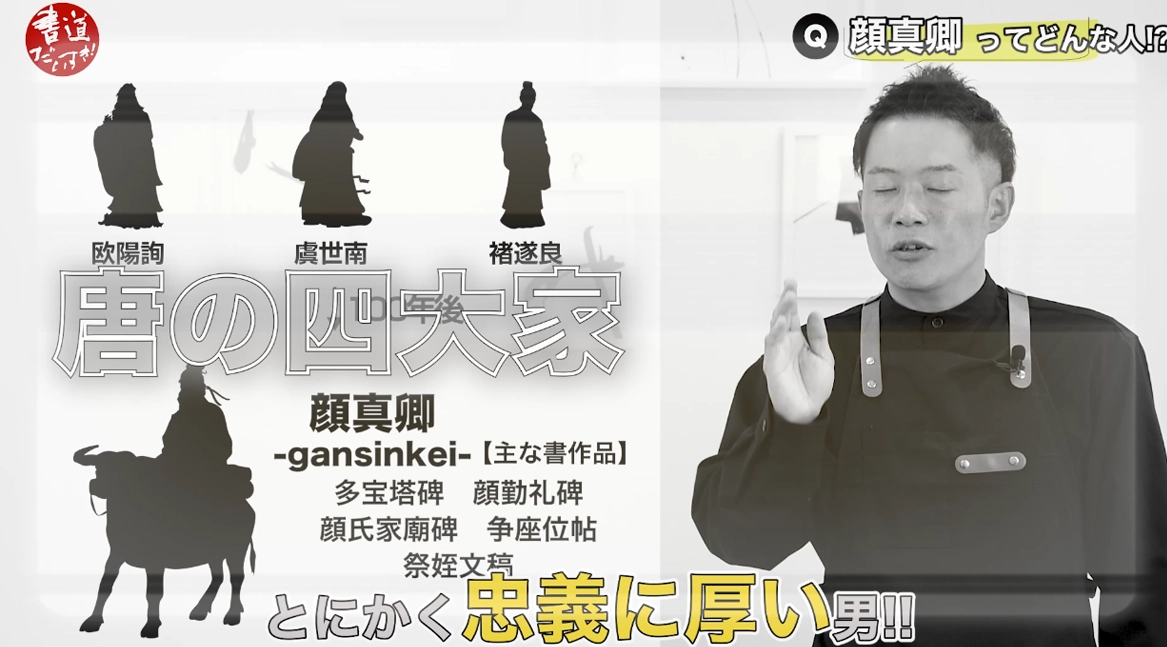
Yan Zhenqing is one of the Four Great Masters of the Tang and is known for his profound loyalty.
Although Shimauchi once had a strong aversion when he saw Yan’s Family Shrine Stele and avoided copying Yan for over 20 years, the strength he felt when he encountered the Dabao Pagoda Stele inspired him to take on the challenge this time.
He outlines Yan’s career and character: a man of deep loyalty who even raised volunteer troops during rebellions.
Because of his serious nature, he clashed with superiors and suffered repeated demotions, yet he stayed true to his loyalty until his passing at age 77.
Interestingly, Yan’s calligraphy was not highly valued during his lifetime; his reputation rose after his death.
Among later calligraphers, some—like Ouyang Xun or Huangfu Dan—praised him, while others—like Mi Fu—were harshly critical. Shimauchi sees this split as evidence of Yan’s human depth shining through his work.
The Dabao Pagoda Stele was written when Yan was 44 and is preserved today in the Jilin Museum in China.
The characters remain in beautiful condition, making it easy to study as a classic model.
Comparing it to the later Family Shrine Stele (written at age 72), we can see how much his style evolved over about 30 years.
Features of the Dabao Pagoda Stele include firm strokes, thin “corner” strokes with thick “heavy” strokes, and overall balanced structure.
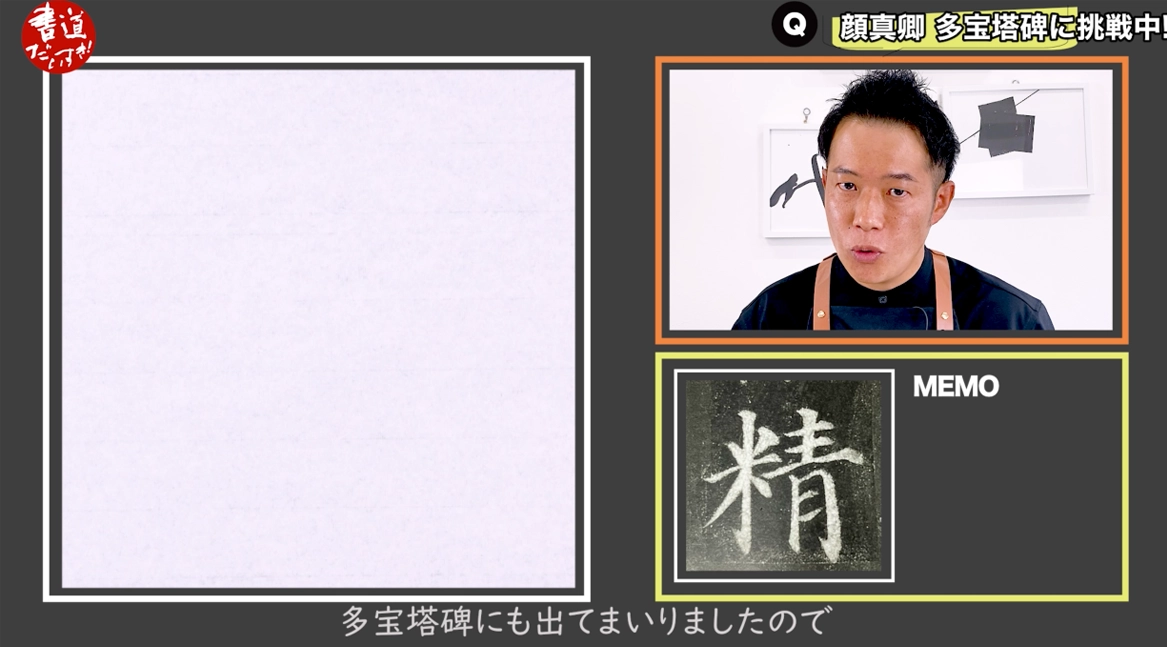
Shimauchi selects the characters “此,” “財,” and “性” to demonstrate copy practice while explaining Yan’s distinctive brush methods and features.
He concludes by sharing the joy of copying such a strongly individual work and reflecting on the importance of personal expression in writing—while humbly acknowledging he is still in the practice stage. He invites viewers to suggest classics they’d like to see.
YouTube Shodo Daisuki – Episode 56
Shimauchi 00:00
A man of deep loyalty—praised by some, derided by others.
Can you believe the same person wrote both? It’s not easy.
Hello, I’m Shodo-Daisuki Shimauchi. Today—
our Classical Copy Series, Part 3!
Shimauchi 00:25
We’ll explore Yan Zhenqing’s Dabao Pagoda Stele.
We’ve covered the early-Tang “Three Greats,” so I realized I’d forgotten someone—Yan Zhenqing of the “Four Great Masters of Tang.” Why had I “left him out”?
Shimauchi 00:46
Frankly—my personal bias.
Over 20 years ago, when I saw the Family Shrine Stele, I thought, “Huh?”
It was so far from the regular script I imagined that my “heart’s shutters” slammed shut.
Shimauchi 01:04
Since then I avoided copying Yan.
But when researching for this series, I saw the Dabao Pagoda Stele—
what a powerful, manly regular script!
Shimauchi 01:25
I simply had to try.
On this channel we cover all things writing, not just calligraphy—please subscribe and like!
Shimauchi 01:41
Let’s begin the series! First, who was Yan Zhenqing?
In early Tang under Taizong, we have Ouyang Xun, Yu Shinan, and Chu Suiliang—
Shimauchi 02:02
the “Three Greats of Early Tang.”
They left many masterpieces in regular script.
About a century later, in mid-Tang, came Yan Zhenqing.
He forged a unique style
Shimauchi 02:20
that profoundly influenced later generations.
Together, they’re the “Four Great Masters of Tang.”
As usual, he was elite—born to a famed family of scholarship and calligraphy.
Shimauchi 02:45
Ask contemporaries about Yan and they’d say in unison: a man of loyalty.
In an era of rebellions, he raised volunteer troops himself
Shimauchi 03:03
and fought back.
Yet such loyalty often pairs with a strict, upright nature—
so he clashed with superiors and—
Shimauchi 03:17
you know what happens—demotions.
Though repeatedly demoted, he remained loyal until he died at 77.
Surprisingly, however, his calligraphy wasn’t much valued then.
Shimauchi 03:57
That surprised me.
Later masters, though, praised “loyalty embodied in writing”—
acclaim that helped carry Yan’s work forward.
Shimauchi 04:15
His reputation grew after death—like Van Gogh.
Thus, in key texts of later masters—
Shimauchi 04:35
names like Su Shi and Huang Tingjian always appear.
They’d say, “Whenever you see it, it’s unmistakably Yan—truly great.”
Shimauchi 04:53
Meanwhile, another Song master—also in every textbook—
Mi Fu (米芾)—saw Yan’s regular script and said, “No, this won’t do,”
Shimauchi 05:11
criticizing it harshly.
Fascinating, isn’t it?
Praise from one side, censure from the other.
And yet—
Shimauchi 05:28
this very contradiction reveals Yan’s humanity.
His inner character emerges through his writing.
Perhaps Yan was the first to show this so clearly.
Shimauchi 05:46
Now, the Dabao Pagoda Stele: the text by Cen Xun records how a reliquary tower at Quanfu Temple was established; the calligraphy is by Yan at age 44.
It survives in China’s Jilin Museum.
Amazing.
Shimauchi 06:10
The original exists.
The condition of the characters is excellent,
so it’s very approachable as a classic model to study.
Some say it even feels “virtuous” or “moral” in flavor—
Shimauchi 06:27
which to me means the human quality shines through.
In my view, early-Tang regular script aims to be neatly agreeable to everyone—
“Now this is a beautiful character,” so to speak.
But with Dabao Pagoda—
Shimauchi 06:42
Yan’s very presence seems to rise from the characters.
On this foundation, later masters like Su Shi and Huang Tingjian
may have broadcast the charm of individuality.
Shimauchi 07:20
Here I’ve prepared a side-by-side of the Family Shrine Stele and Dabao Pagoda Stele. What do you think?
Were they written by the same person?
The Family Shrine Stele is a late work—age 72.
Shimauchi 07:38
It embodies the so-called “Yan method”: forward-swept force, and even seal-script-like concealed tips in the brush.
In contrast, Dabao is from age 44—
about 30 years apart.
Shimauchi 07:57
The transformation across those decades is remarkable.
Though the Family Shrine Stele once made me slam my shutters, Dabao shows—
Shimauchi 08:14
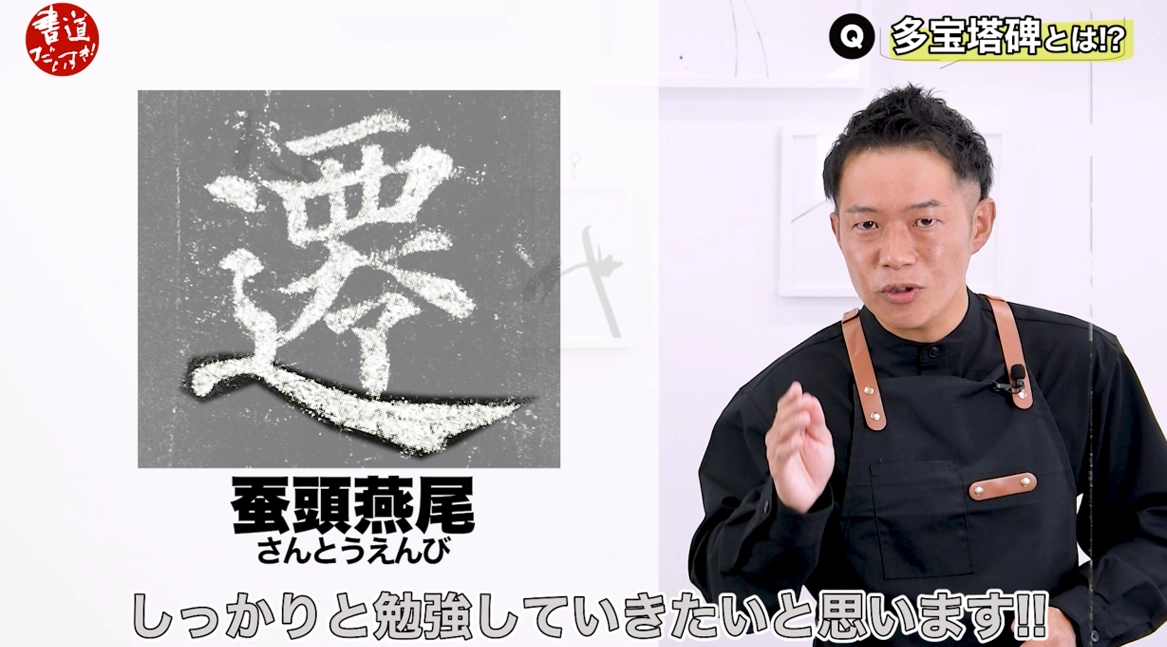
a “silkworm-head” swelling at the start of strokes, then the line thickens as it runs,
gains power, then suddenly relaxes,
and finally the tip flicks like a swallow’s tail or a mouse’s tail.
Shimauchi 08:36
This is called “silkworm-head and swallow-tail” (蚕頭燕尾).
You can already see elements that later blossom in the Family Shrine Stele.
Shimauchi 08:57
So—my hasty “shutter-slam” deserves reflection.
I’ll study properly this time.
Shimauchi 09:11
For Dabao, my personal key points:
(1) Each stroke stands firmly—
Shimauchi 09:30
the strength of Yan’s seriousness appears.
Horizontals tend thin; verticals thick.
(2) The overall structure is well balanced—very beautiful forms.
Shimauchi 09:51
I vaguely recall (pardon if mistaken) that children in China sometimes study characters within unique grid systems using Yan’s forms from a young age.
That speaks to their solidity and balance.
Bearing these in mind, let’s copy.
Shimauchi 10:12
Naturally, more traits will emerge as I write—
I’ll explain as I go.
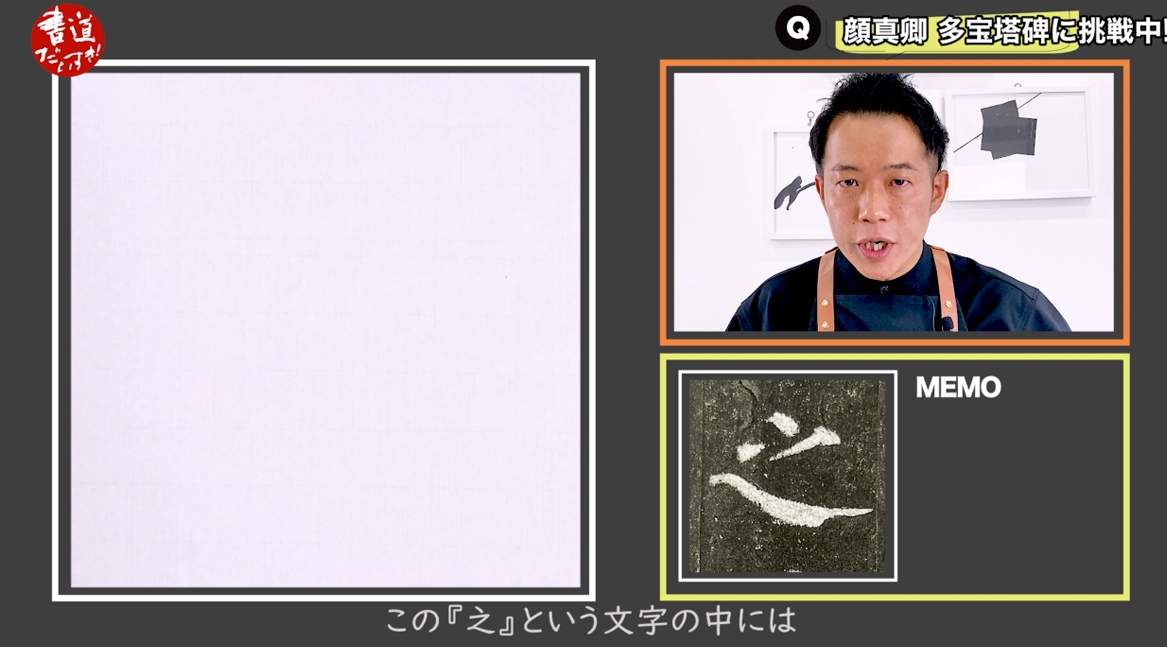
First character: “之.”
Here we go again.
Shimauchi 10:44
In “之” you can clearly see the basis of “silkworm-head and swallow-tail,” a hallmark of the Family Shrine Stele.
Its prototype is present in Dabao as well—
so I chose it.
Shimauchi 11:02
After two decades away from Yan, let me enjoy this.
Here we go—hard!
That silkworm-head & swallow-tail…
It surprised me.
Shimauchi 11:20
I wanted to enter with concealed tip, then finish with a crisp swallow-tail flick—
As for concealed-tip methods in Dabao, like those in seal/clerk scripts—
Shimauchi 11:42
options vary: wrap and pass the center of the line,
or go straight while keeping the tip oriented upward.
Shimauchi 12:04
I’m not used to it—tough.
If you over-wrap, the line can look bland and oily.
Shimauchi 12:22
So I tried to “click” in, stand the brush, then drive with strength—
but it’s hard.
Ideally: touch in, press, then glide out…
Shimauchi 12:42
I’ll write a sheet anyway—phew, difficult!
Does it read as silkworm-head & swallow-tail? Or is the concealed tip weak? The final tail should be fuller—
Shimauchi 13:09
but this will do for now.
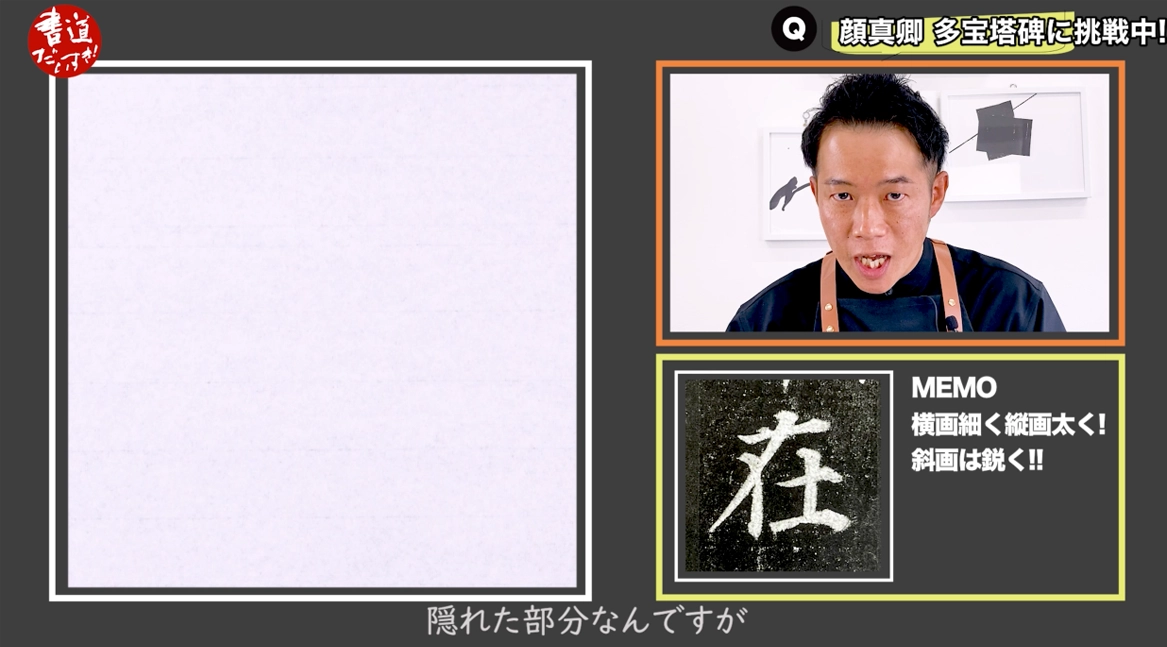
Next: “在.”
I chose it for its thin corner strokes and thick, strong mid-strokes.
Shimauchi 13:28
Also, the diagonal stroke down-left is surprisingly sharp.
There’s an interesting hidden brush move at the end—
I’ll explain as I write.
Shimauchi 13:46
First, the diagonal—ideally, sleeker and quicker.
For verticals, I tried to enter with concealed tip and press—was that correct?
Note the distinctive finish of the horizontals—
Shimauchi 14:26
you go, then lift slightly, then press to finish.
Curious habit—perhaps characteristic of Yan?
The diagonal too—press and release… tough! The brush isn’t the problem—
Shimauchi 15:10
it’s my skill.
Another try—faster this time.
I hooked the verticals with concealed tip.
Shimauchi 15:35
Not sure the finishing is right, but perhaps I’ve hinted at the fleshy strength.
Lastly: “精.”
We saw this in Jiuchenggong and the Confucius Temple—let’s compare.
Shimauchi 15:57
“精” also shows Yan’s traits—let’s try.
Here we go—
Shimauchi 16:20
Difficult.
In Dabao, the left-side components can be larger than expected.
Reviewing earlier points, there’s also a unique finishing style.
Shimauchi 16:37
And intriguingly, the verticals sometimes read as backswept, other times forward-swept.
Perhaps Yan, too, admired the early-Tang masters a bit.
Shimauchi 16:59
I wanted a crisper diagonal and verticals—
and per a comment request, I’ll show my real writing speed.
Shimauchi 17:17
I usually write slowly, so the videos are often sped up.
But just this once, let’s go real-time—
Shimauchi 17:34
Here we go.
…That’s all.
Brush methods are tough.
Shimauchi 19:19
Avoiding Yan for years has caught up with me.
Studying traits is one thing; embodying them with the brush is another—
it takes daily practice.
Shimauchi 19:36
This is my current level.
With more practice, maybe in a few years, copying Yan again will look better.
Shimauchi 19:53
So—study brush methods, choose classics, and practice—stacking the steps matters.
Shimauchi 20:08
Many feel shy about showing their copy practice—understandable—
but I’m honored just to have you watch.
Being seen motivates me to try harder.
Shimauchi 20:21
Please keep pushing me—“Shimauchi, you can improve!”—
I’ll keep copying more and more.
How was it?
Shimauchi 20:34
This time I copied the Dabao Pagoda Stele.
What I’m most glad about is copying a work with such strong individuality.
Shimauchi 20:50
We hear “individuality matters” all the time—
but when asked to write with individuality, I can’t yet declare, “This is my style.”
Shimauchi 21:08
Yet even I, seeing Dabao, could recognize: “So this is powerful individuality.”
It made me want to write that way—express myself.
Shimauchi 21:26
I’m grateful to have met such a classic.
As I’ve said, I’m not a teacher—
Shimauchi 22:01
just someone who loves calligraphy.
If you know a classic that could help express individuality, please tell me in the comments.
Shimauchi 22:13
This was Shodo-Daisuki Shimauchi.
Pollen’s getting strong—please take care. See you Friday—goodbye!
Related Products
Here are the products featured in this video.
Books / book & publication
Whether you’re a beginner or more advanced, knowledge from books is invaluable for calligraphy.
You can learn beyond your teacher’s exemplar, making them ideal for home practice and self-study.
Building knowledge broadens your perspective, too.


