

Shodo Daisuki Episode 58
Shodo Daisuki Episode 58
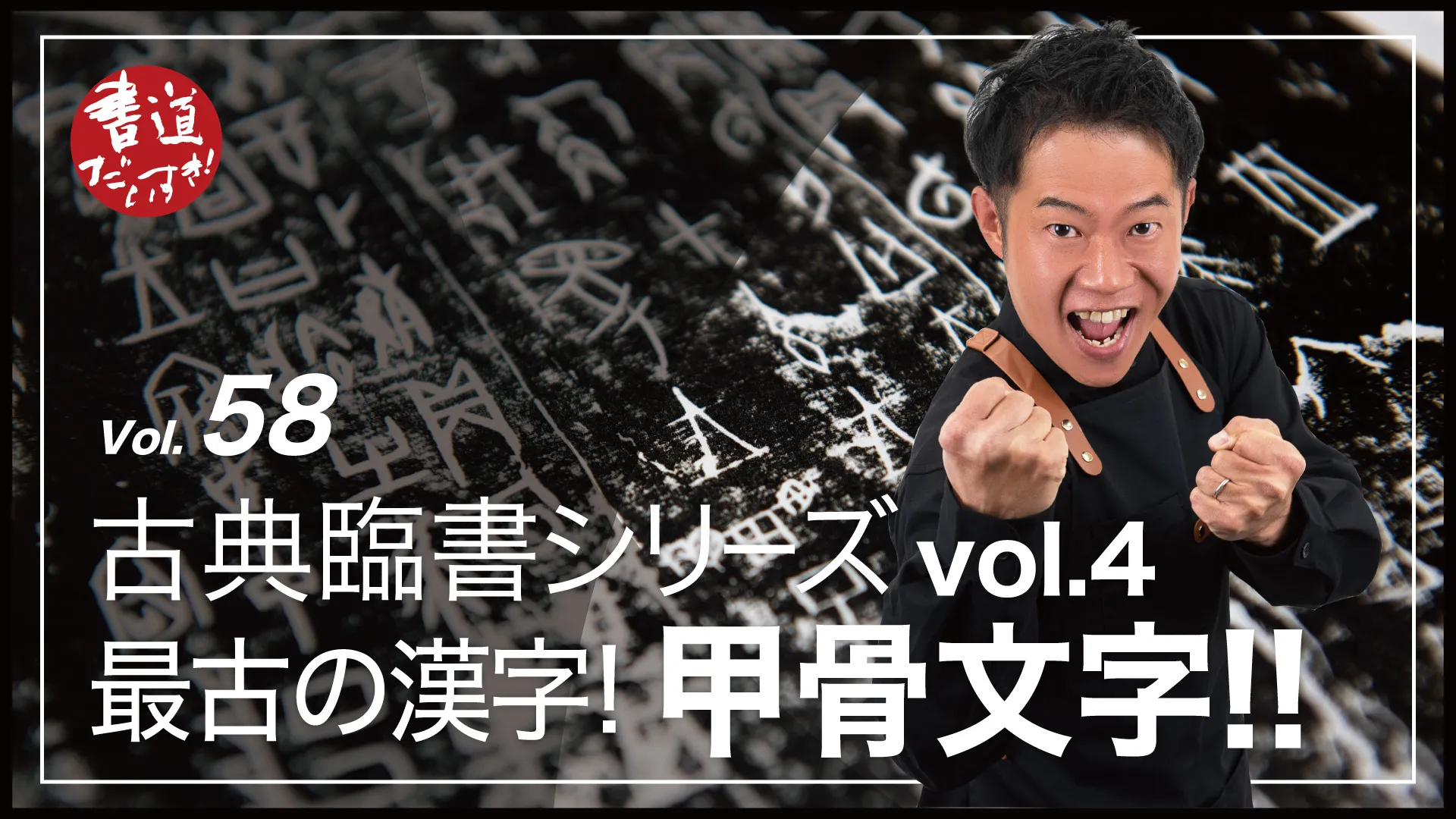
Classical Copying Series vol.4: Reliving Chinese Calligraphy History!! “The Oldest Chinese Characters!! Oracle Bone Script!!”【Calligraphy】
Shodo Daisuki – Episode 058
From this episode, we begin anew—copying the classics starting from the oldest Chinese characters, “Oracle Bone Script”!
It’s made to be very easy to understand and feel familiar to you!
Please watch and try it yourself!
Shodo Daisuki Episode 58 – Video Overview
This is the fourth installment in Shimauchi’s classical copying series.
Shimauchi states that, instead of continuing with famous models in regular, semi-cursive, and cursive script, he will now go back to the origins of Chinese characters—starting from Oracle Bone Script—and trace their development up to the present while doing classical copying.
Having turned 42 and studying classical copying on his own, he says his main goal is to understand and acquire a variety of brush techniques.
He judged that following the historical order of character development would be the most effective way to achieve this.
Regarding Oracle Bone Script, he explains in detail.
Oracle Bone Script was created in the late Shang (Yin) period to convey the results of divination to the gods.
It was carved with small knives into turtle plastrons and animal bones, and is also called “契文 (qìwén),” “占卜 (zhānbǔ),” or “卜辞 (bócí).”
It was discovered as “dragon bones” at the end of the 19th century, and its decipherment progressed thereafter.
He also explains the method of divination: grooves were made vertically and horizontally on the back of a turtle shell, it was heated with fire and then rapidly cooled; omens were read from the pattern of cracks thus produced.
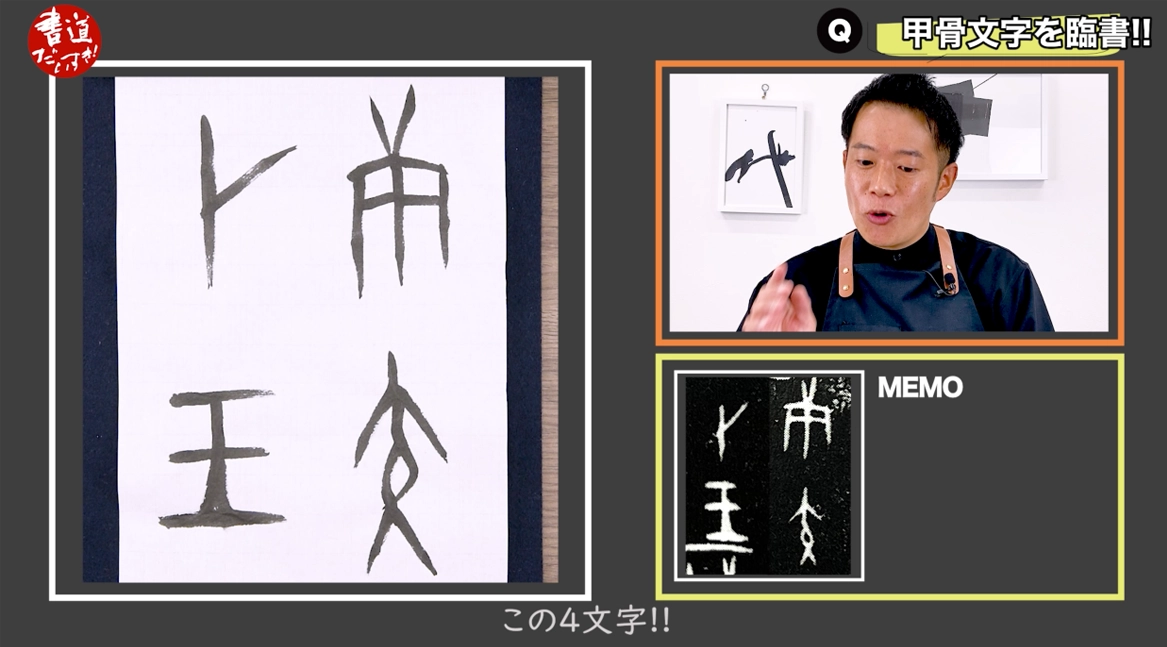
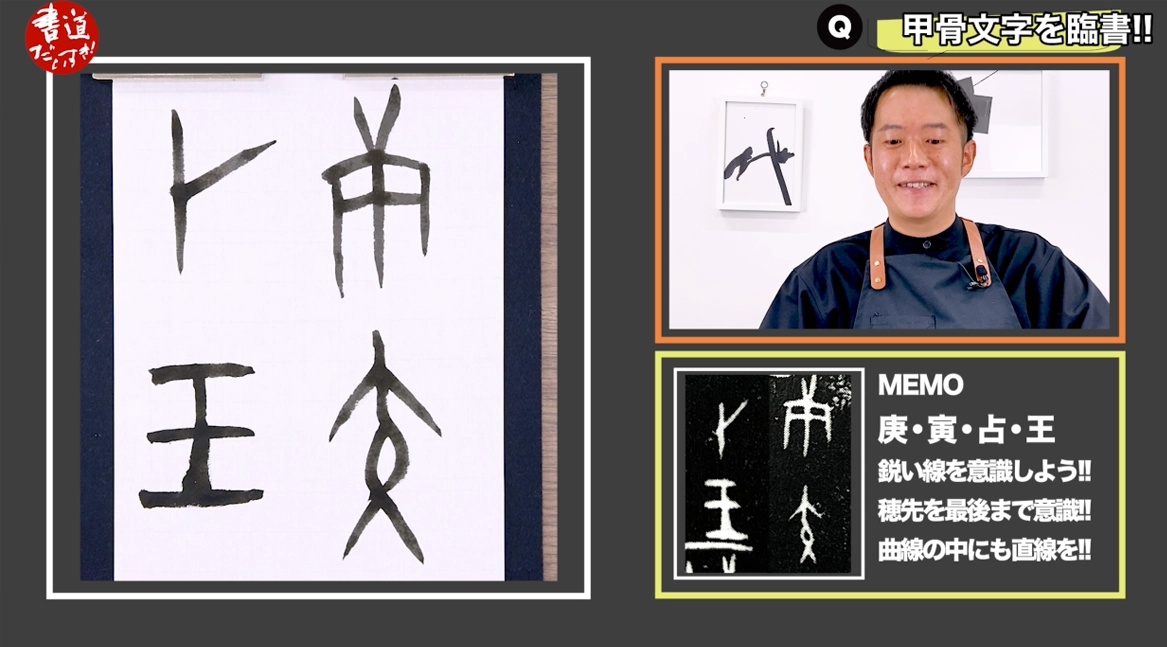
In the actual copying, he writes the four characters “庚寅卜王 (kōin boku ō).”
He notes with surprise that “寅,” one of the twelve earthly branches, was already in use during the Shang period.
He also explains the origins and meanings of each character.
As key points for copying, he emphasizes holding the brush upright to express knife-like sharp lines, and keeping attention alive through to the very end of each stroke.
After writing once, he lists points for improvement and tries again.
Finally, he says that copying Oracle Bone Script is excellent training for strengthening lines and a good opportunity to get to know the world of philology.
He ends by expressing the desire to convey, through this series, the appeal of learning the history of characters in an easy-to-understand way and expressing it as calligraphy.
YouTube Shodo Daisuki Episode 58
Shimauchi 00:00
Then we have to make it something understandable at a glance.
The root of character development lies in this Oracle Bone Script—and an awareness of keeping the brush tip alive until the very, very end.
And then, set those characters down as calligraphy.
Shimauchi 00:16
Hello, this is Shodo-Daisuki Shimauchi.
All right, here we go—the fourth classical copying series.
I’d like to proceed with good tempo, but I’m conflicted.
Yes, I’m wavering.
Shimauchi 00:32
Of course I thought about taking on famous classics—Wang Xizhi, Kūkai—but I asked myself: what do I really want to do? Which classics do I really want to engage?
Shimauchi 00:48
From childhood we hear it: Chinese history—4,000 years; or 6,000 years if we go back to the Neolithic.
Once you know that, well…
Shimauchi 01:02
I’ve decided. I will copy starting from the oldest Chinese characters—Oracle Bone Script—and work my way back up to the present.
When I was young, I copied what I was told, what I was given.
Shimauchi 01:20
Now at 42, facing classical copying on my own, I thought: if I’m going to do it, I’ll do it thoroughly.
Yes, that’s it.
Copying only famous regular/semi-cursive/cursive models might please viewers—even for a small channel—but…
Shimauchi 01:39
After three episodes on Tang regular script, featuring the Four Masters of the Tang, what I felt most was my own lack—and that brush methods evolved with the times.
Shimauchi 01:56
So my biggest goal in classical copying is to learn many brush methods and acquire them.
Doing it out of historical order would be a detour.
Shimauchi 02:13
Of course I’ll try my best to make videos that are worthwhile and educational for everyone—please continue to watch this series!
Shimauchi 02:47
Please subscribe, like, and support us—thank you!
Shimauchi 03:00
All right, first try at Oracle Bone Script! What is it?
It’s a script from the late Shang period.
People decided everything by divination,
Shimauchi 03:20
and reported those decisions to Heaven—to the gods.
Then, of course, you wonder—can the gods understand our words?
If not, what should we do?
Shimauchi 03:35
Right—make it something visible.
They recorded divinations with figures—diagrams—so the gods could “see.”
Shimauchi 04:02
They divined everything: tribal conflicts, harvests, climate, hunting… and dedicated those records to the gods.
Shimauchi 04:17
Because these were words addressed to the gods, later—say, by the Zhou—other tribes who couldn’t share a language tried using these “god-understandable” signs to communicate.
Shimauchi 04:34
Surprisingly, it worked—“Oh, I get it—this communicates!”
And thus, with time, writing developed.
Shimauchi 05:04
Oracle Bone inscriptions were carved into turtle shells and animal bones with sharp knives—hence the name “契文 (qìwén).”
Because of their divinatory content, they are also called “占卜” or “卜辞.”
Shimauchi 05:59
Their discovery is actually quite recent—late 19th century.
As “dragon bones,” people likely sought them as medicinal material,
Shimauchi 06:17
but someone noticed the carved signs and began to investigate.
More and more were found—not only in the ruins of the Shang capital but at various sites—
Shimauchi 06:36
and as collections grew, a coherent system became apparent, and decipherment progressed.
How did they divine?
Shimauchi 06:54
They heated the turtle shell and then rapidly cooled it, producing cracks.
But first—right—the “divination method”: on the reverse side they carved a vertical groove,
Shimauchi 07:13
and beside it a horizontal round pit—preparing it to crack in readable ways.
Then they applied heat,
Shimauchi 07:32
and rapidly cooled it so that the prepared spots cracked; they read good or ill from the crack pattern.
Please keep this in mind—it connects deeply with the characters themselves.
Shimauchi 08:08
All right—this is new territory for me, so I may have stumbled in my words,
but let’s move on to the actual writing.
Shimauchi 08:21
I’ll explain using a sheet I’ve written in advance.
The four characters are “庚寅卜王.”
Shimauchi 09:01
“寅” belongs to the twelve earthly branches—already used in late Shang.
That surprised me; I learned it this time.
Shimauchi 09:24
“卜” means “to divine.” “王” suggests a king who divines—probably that kind of content.
Now let’s look at each character.
Shimauchi 09:42
“甲”: imagined as a thin metal plate/armor—handled in both hands.
Shimauchi 09:58
“寅”: straightening an arrow with both hands.
“卜”: as we discussed—
Shimauchi 10:19
the vertical line and the round pit—exactly the setup used for divination.
Shimauchi 10:39
“王”: the blade edge of an axe, inverted, representing a royal symbol.
Among these, it is clearly close to the present form.
Shimauchi 11:00
As for copying points: because the originals were incised with small knives, I wanted to draw sharp, cut-like lines.
Ideally I’d use a stiff brush, but I used my usual mixed hair and focused on sharpness.
Shimauchi 11:37
There are still places I want to fix, where the line lost bite.
To emulate carving, settle the tip and draw decisively—keep attention through the very end of the stroke.
Shimauchi 12:26
I held the brush as upright as possible, sometimes entering with pure tip, sometimes reverse tip, prioritizing strong lines.
Shimauchi 12:40
Within curves, too, I aimed to produce straight, decisive movement.
Shimauchi 13:12
For “卜,” I considered starting points and aimed for a clean, crisp finish.
Shimauchi 13:31
And for “王,” I wanted to press with reverse tip and then snap out cleanly—keeping the tip “alive” to the end.
Shimauchi 13:48
In places my lines weakened as if I had “flicked” with a knife; I’ll keep the tip engaged until it exits.
Shimauchi 15:01
I was more careful the second time—
copying Oracle Bone Script turned out to be excellent training for producing sharp lines, regardless of exact shapes.
Shimauchi 15:38
If possible, also study the history of characters—philology.
It helps you feel the beginnings of the writing we use every day.
Shimauchi 16:12
Even if history isn’t your strong point, like with historical manga or dramas that make it easier to get into,
I hope this series lets you learn character history clearly and enjoy expressing it as calligraphy.
Shimauchi 16:31
This has been Shodo-Daisuki Shimauchi.
I’ll continue this classical copying series—see you next week! Goodbye!
About Related Products
We introduce the products that appear in this video.
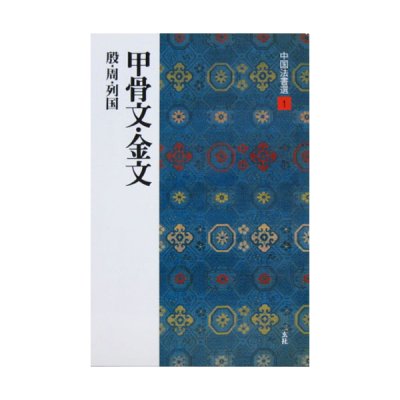
Books /book&publication
For beginners through intermediate and advanced learners alike, knowledge gained from books is important.
They allow you to learn beyond your teacher’s exemplar and are ideal for home practice or self-study.
Gaining knowledge of calligraphy should also help broaden your horizons.


