Shodo Daisuki Episode 59
Shodo Daisuki Episode 59
SPECIAL Feature!! On-Location Interview on Ink Making at Kobaien!!【Calligraphy】
Shodo Daisuki – Episode 59
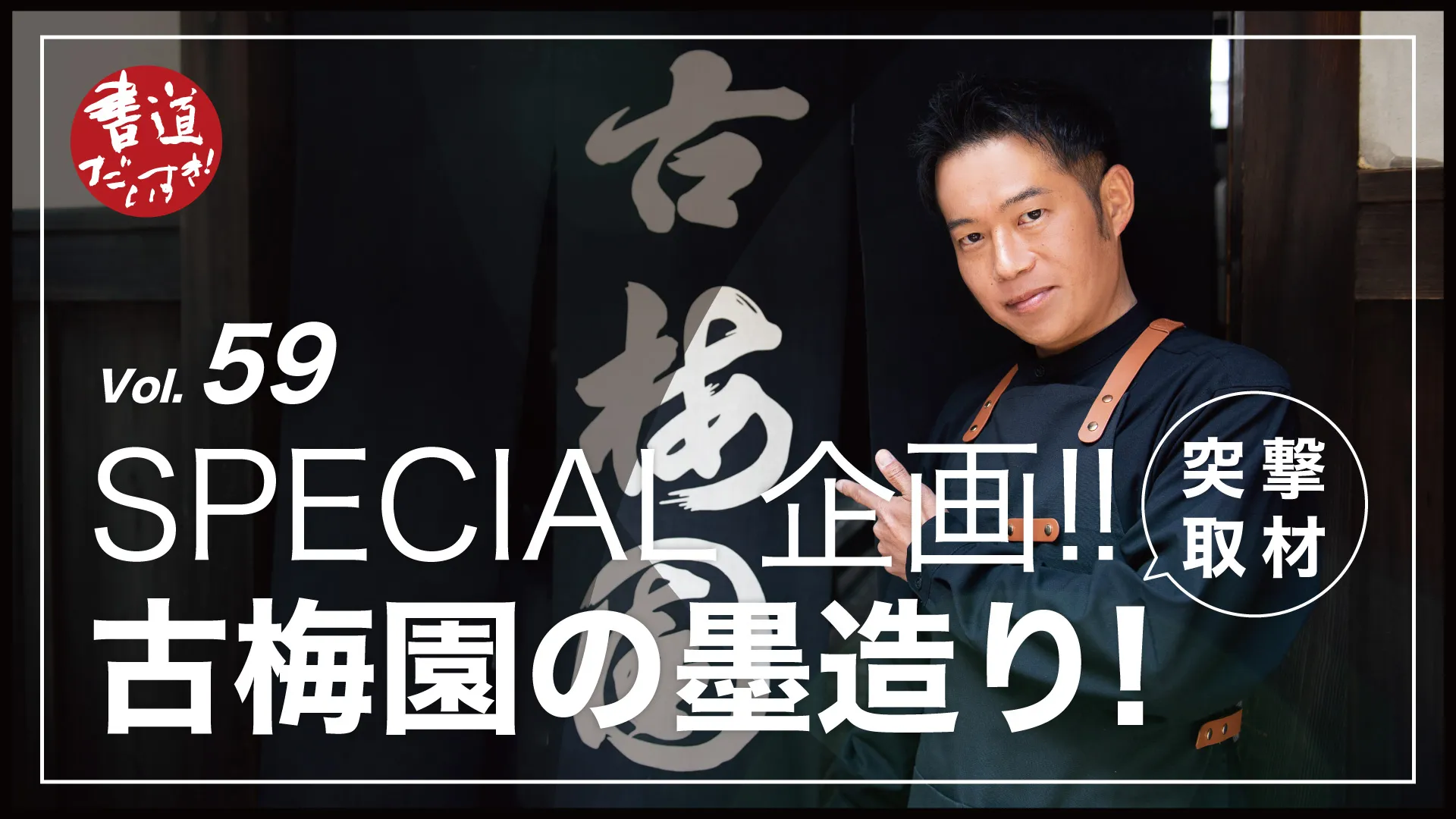
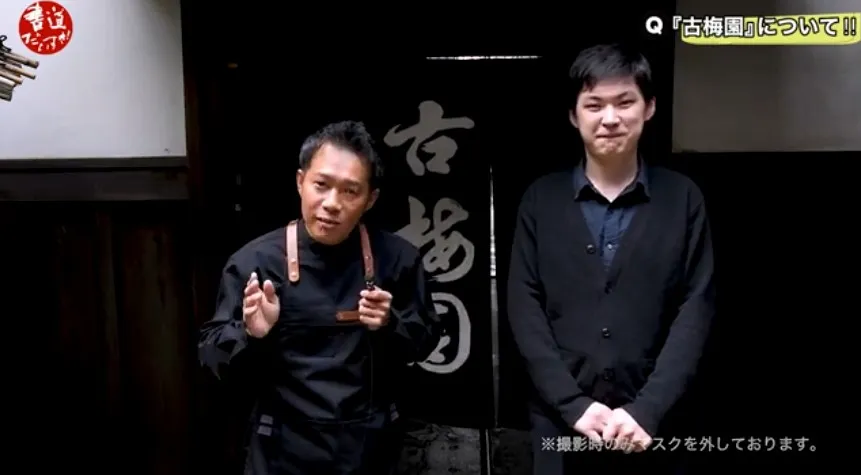
In this video, Shodo Daisuki Shimauchi visits “Kobaien”!
Shodo Daisuki Episode 59 – Video Overview
This episode documents a special shoot and interview of the ink-making process at Kobaien, a long-established ink manufacturer in Nara Prefecture.
Kobaien was founded in 1577 at the end of the Muromachi period and has now reached its 445th year in business. During the Edo period, they interacted with China under orders from the Tokugawa shogunate and, through research, created their flagship product “Benibana-zumi” (Safflower Ink). Even after more than 440 years since its founding, they continue making ink using traditional methods unchanged from the past.
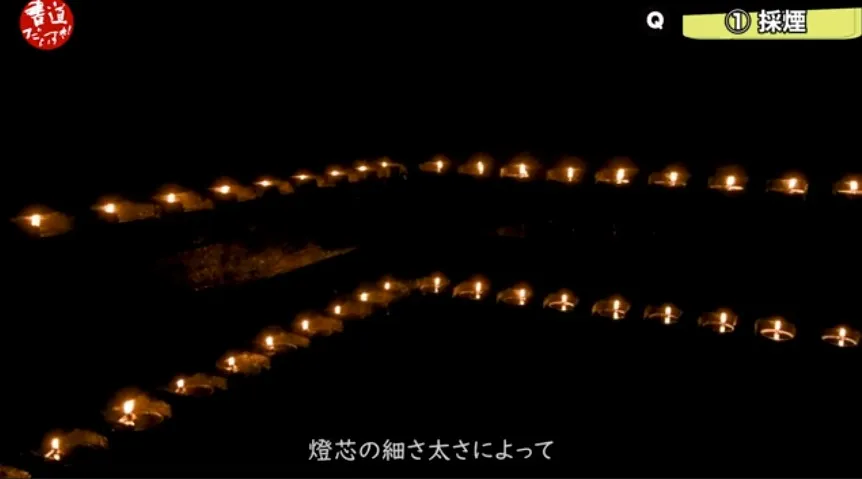
The ink-making process begins with collecting soot in the “soot-collecting chamber.” Vegetable oil is poured into earthenware; a wick is floated and lit, and soot adheres to earthenware placed above as a “lid.” The thickness of the wick affects soot particle size; burning a thin wick slowly yields finer soot particles.
Next, the adhesive nikawa (animal glue) is gently melted in a hot-water bath of about 70°C. Nikawa is made from the hides and bones of cattle, etc., and has an animal scent, but the smell dissipates once dry. The soot and nikawa are kneaded together to form ink “dough,” which is then pressed into wooden molds. The molds are made of pear wood, chosen because it resists deformation from humidity and is easy to work. Pressing the ink into the molds is a crucial step that determines the ink’s shape and quality.
After demolding, the ink is buried in ash to dry. Small ink sticks dry for about one week, larger ones for about one month, gradually drawing out moisture. Because ash alone does not remove all moisture, the sticks are then arranged on straw-woven racks to air-dry—this also takes at least one month.
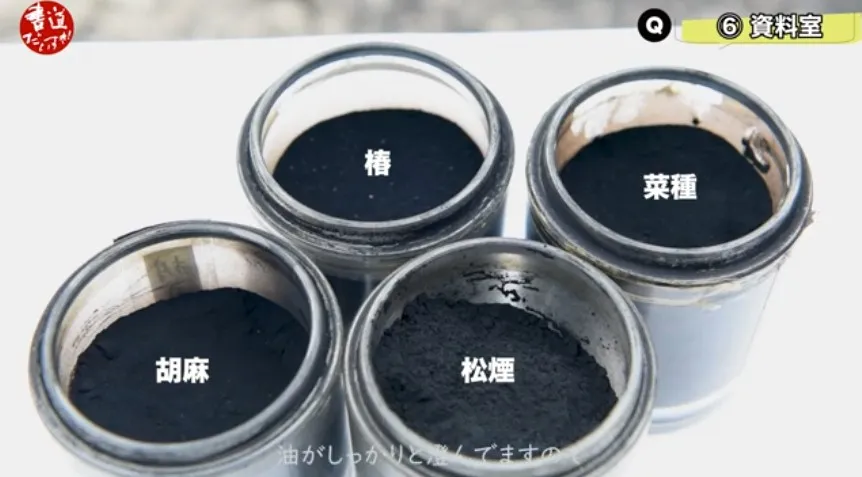
The materials used are also introduced in detail. Nikawa can be made from the hides/bones of cattle, deer, rabbits, etc., each with different properties. Oils for collecting soot include rapeseed, camellia, sesame, and others, producing inks with distinct characteristics. A small amount of fragrance is added to refine the smell. While animal-derived fragrances were used in the past, today they are primarily plant-based.
Finished ink is polished with clam shells (hamaguri) to bring out luster—this, too, requires skilled craftsmanship.
The episode concludes by reflecting on the “birth” of ink and the preciousness of grinding it, and with a pledge to continue enjoying calligraphy and sharing that joy with viewers.
YouTube Shodo Daisuki Episode 59
Shimauchi 00:00
We were granted special permission to film. It’s beautiful—almost otherworldly. Yes, truly… you might call it a divine craft. The craftsmen are remarkable, and there’s such a fine ink fragrance. It was a delightful day.
Hello, this is Shodo Daisuki Shima. Today, we’ve stepped out of the usual studio and arrived here—over 440 years of continuous ink making—the most venerable of venerable makers, Kobaien in Nara. I’m told the ink-making season runs from mid-October through late April. Today we’ve been granted very special permission to film the production site.
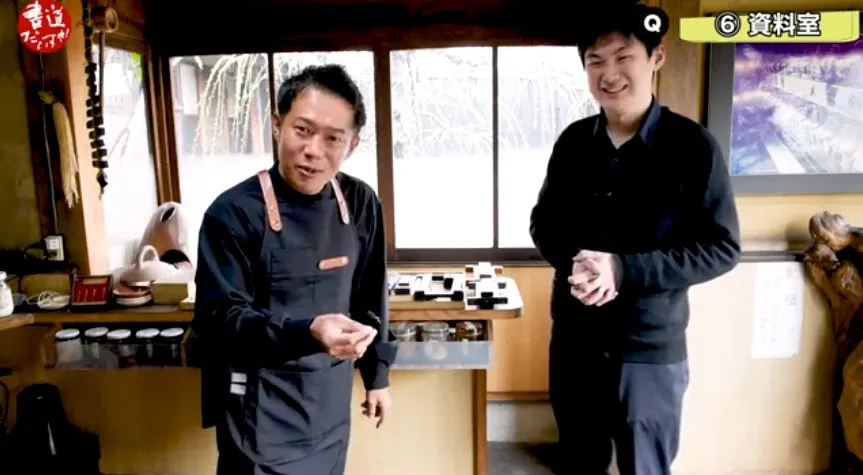
This is incredibly rare, everyone. We’ll show you every step in the birth of a solid ink stick, and I’ll also ask about the simple questions and curiosities I’ve always had. Let’s head in right away! Today’s guide is Mr. Azagami of Kobaien. Look at him—tall and handsome, right? Some viewers may not yet know Kobaien, so could you please give a brief introduction? Thank you very much. Our company, Kobaien…
Mr. Azagami 01:49
was founded in 1577, at the end of the Muromachi period. This year marks our 445th anniversary.
Later, in the Edo period, we interacted with China under orders from the shogunate, advancing our research and creating our flagship “Benibana-zumi.” Even now, more than 440 years on, we continue making ink by the same traditional methods.
Shimauchi 02:15
Thank you. Everyone, did you catch that? Very clear, wasn’t it?
Now, behind this noren curtain is the production floor. Let’s walk through the birth of ink, step by step. Please lead the way. Everyone, get excited—this is precious! Let’s go—
Mr. Azagami 03:00
This is the soot-collecting chamber, one of the cores of ink making. In earthenware we place vegetable oils and float a wick to burn; soot adheres to the earthenware lid above, and collecting this soot is called “sai-en.”
Shimauchi 03:21
Of course, this is my first time inside—and it feels… mystical. There’s a pleasant aroma. The camera may not capture it well, but it feels like the air is filled—almost “waiting”—with soot, even in the dim light.
And those wicks—beautiful, even dreamlike. The wicks’—?
Mr. Azagami 03:53
The thickness—thin vs. thick—changes the soot particle size. Burning thinner wicks slowly yields finer particles.
Shimauchi 04:07
I see—so the wick itself is extremely important. Indeed. Hearing is one thing—seeing is believing. I’ve learned a lot already.
Mr. Azagami 04:33
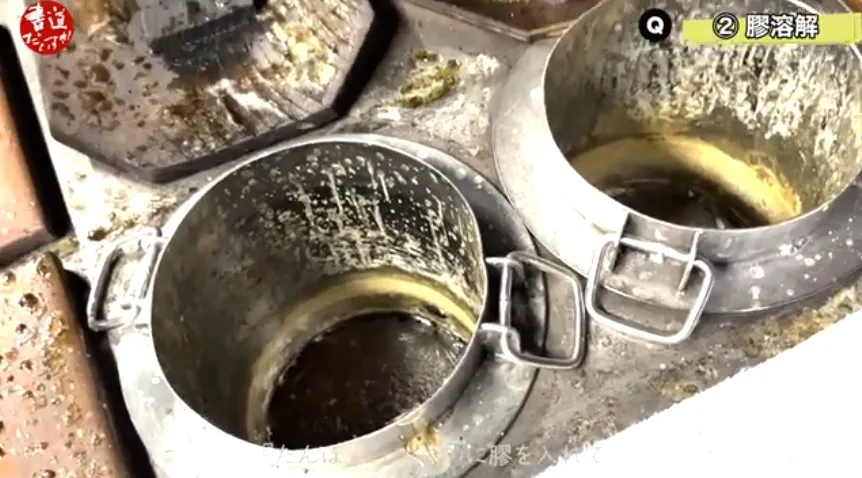
Here is where we melt the adhesive nikawa you saw earlier. We put nikawa into a ~30 cm vessel called “tanpo” and dissolve it gently in a hot-water bath.
Direct heat raises the temperature too much, altering the glue or causing it to stick to the pot, so we use a bain-marie at about 70°C to melt it slowly.
Shimauchi 05:03
Did you hear that, everyone? I previously mentioned 70°C as the melting temperature—it seems I was right! I’m a little pleased. Is this already—
Mr. Azagami 05:16
Yes, it’s melted, and as it contacts cooler air it begins to set.
Shimauchi 05:22
Oh, indeed—the surface… I see. May I smell it? Yes, please.
Mr. Azagami 05:31
Since it’s made from animal bones/hides, there will be a slight animal odor. How is it?
Shimauchi 05:39
Excuse me… hmm.
Surprisingly, nothing harsh—quite okay, actually. Not strong at all—calming, even. Fascinating!
Mr. Azagami 06:05
Yes, it can be a special smell—but…
Shimauchi 06:11
Not bad at all. May I open this? Yes.
Oh—look, just as you said: hot water is inside, and the vessel sits in it—this is the bain-marie. Very carefully set up—impressive craftsmanship. Amazing.
Mr. Azagami 06:55
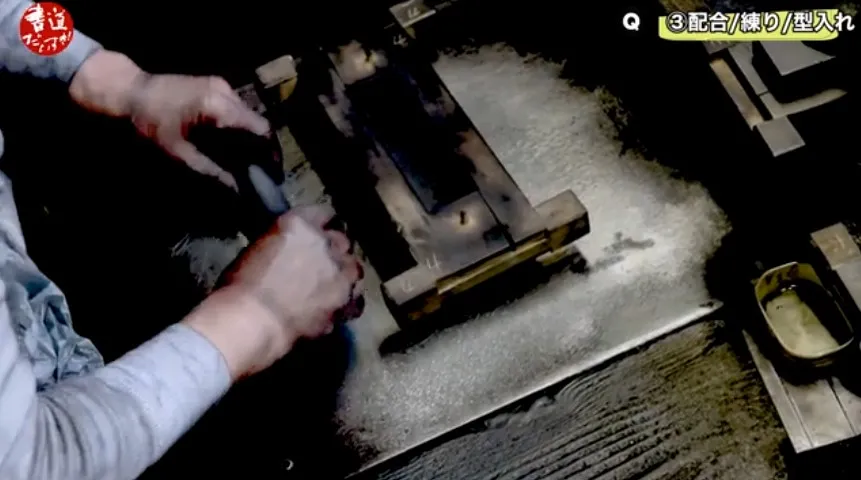
Next is the step where the kneaded soot and nikawa are pressed into wooden molds—this is where the familiar ink-stick shape is formed.
Shimauchi 07:09
Right. I’ve watched the craftsmen—every motion is purposeful, and very fast.
It’s almost divine—pure craftsmanship—so quick and intuitive. Impressive. This mold—
Mr. Azagami 07:44
We use pear wood for the molds. Pear resists humidity warping and is easy to carve and process.
Shimauchi 08:03
And the molds are disassembled for release—
Mr. Azagami 08:08
Yes. Rather than forcing the ink out, we take the mold apart to release it gently—each step done with care. The more carefully each piece is made,
Shimauchi 08:18
the better the—
Mr. Azagami 08:20
This step is crucial. The kneading and molding determine the surface and form of the ink.
Shimauchi 08:30
The “face” of the ink, right—exactly. Remarkable. And they use their whole body—not just hands, but feet—to knead.
Mr. Azagami 08:42
Yes, applying body weight firmly—
Shimauchi 08:46
Impressive. I have to ask: craftsmen’s hands and feet must get sooty. I’ve heard “uguisu powder” is used when washing—
Is that true?
Mr. Azagami 09:07
It is. It helps remove soot; afterwards, soap can be used as usual.
Shimauchi 09:16
You heard it—uguisu powder, indeed. A good trivia tidbit to share!
Mr. Azagami 09:44
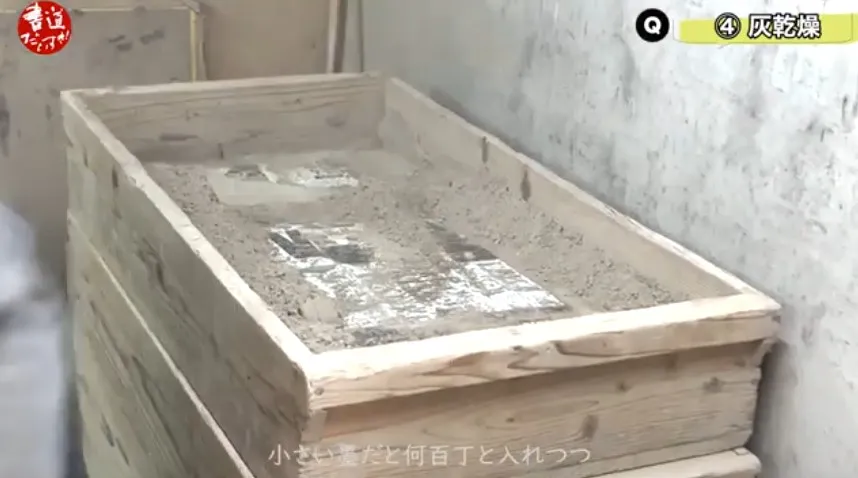
Here is where the molded ink is dried. To dry gently, we prepare ash with varying moisture-drawing capacity so water is extracted little by little.
Shimauchi 10:03
Even through a mask, the fragrance of ink is wonderful.
And there’s the finest dust in the air.
p>Mr. Azagami 10:20All molded pieces are dried. Small sticks number in the hundreds; if dried too quickly, surfaces crack. So moisture is reduced gradually: small sticks about a week from that side; larger sticks about a month. After ash-drying, remaining moisture is removed here by air-drying on straw racks, since ash alone can’t finish the job.
Shimauchi 11:32
As you said—meticulous and orderly. It’s stunning.
Honestly, just looking at them makes me feel content—they look so nicely cured. Various sizes, too.
Mr. Azagami 12:05
Even for small one-section sticks, we still air-dry at least one month to finish fully.
Shimauchi 12:16
At least a month, I see.
Mr. Azagami 12:20
And as they cure, they become smaller and harder—improving quality.
Shimauchi 12:27
So much careful work at every step.
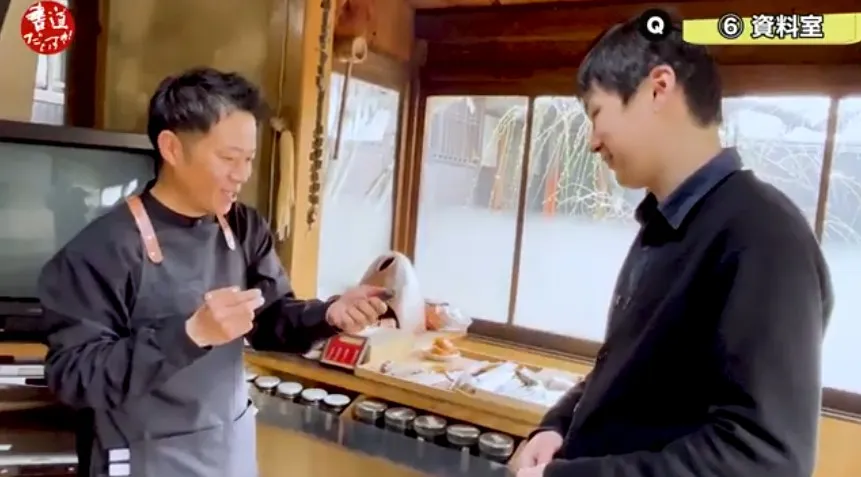
Now, after the tour, this area lets us touch actual materials like nikawa and soot while receiving explanations—please.
Mr. Azagami 13:08
First, about the melted nikawa: earlier you saw it already dissolved in the vessel; here are solid examples.
This one is bovine nikawa, made by dissolving and recasting cattle hides/bones.
Shimauchi 13:35
May I touch it? Oh—it’s pretty hard.
Mr. Azagami 13:46
And it doesn’t smell now; once dried, the odor dissipates.
Shimauchi 13:53
So drying removes the odor. I see.
Mr. Azagami 13:59
We also have other kinds—
Shimauchi 14:07
Ah—this I know. Right—
Mr. Azagami 14:45
And here—deer.
Shimauchi 14:48
Deer—fitting for Nara. Darker in color—interesting.
And another—perhaps goat?
Mr. Azagami 15:24
Transparency and hardness differ; soot particle behavior is affected by the glue choice.
Shimauchi 15:32
So selecting nikawa is extremely important. Thank you. Next—
Mr. Azagami 15:40
The soot used with nikawa. Oils for soot vary. Today we burned—
Shimauchi 15:54
Rapeseed oil—right.
Mr. Azagami 16:01
Also highly transparent camellia oil—
Shimauchi 16:14
Indeed—quite clear.
Mr. Azagami 16:25
And familiar sesame oil—though its scent while burning is stronger, like Chinese cooking.
Shimauchi 16:42
This one looks cloudier—quite different from the others.
Mr. Azagami 16:50
This is tung oil; it polymerizes on exposure to air, becoming viscous—tricky to handle.
Shimauchi 17:06
So it thickens with air contact—understood.
Mr. Azagami 17:17
Here are the vessels—
Shimauchi 17:19
The ones we saw earlier—right.
Mr. Azagami 17:23
We put the various oils in and use these wicks—
Shimauchi 17:27
As you explained, wick thickness changes the particle size—
Mr. Azagami 17:36
Slowly burning thin wicks yields finer soot.
Shimauchi 17:45
Are these hand-made by craftsmen? Yes—
Mr. Azagami 18:00
Then we burn them to collect soot like this—
Shimauchi 18:03
On large surfaces—bigger than they looked in the video—impressive.
Mr. Azagami 18:16
We brush off the adhered soot for collection—
Shimauchi 18:21
I see—quite large indeed.
Mr. Azagami 18:27
The flame is here; to avoid uneven deposition, we rotate about 45 degrees every ~20 minutes so soot coats evenly.
Shimauchi 18:43
So precise—guided by the craftsman’s sense and “inner clock.” Fascinating.
Mr. Azagami 18:55
One person may tend two rooms; we only showed one or two today.
Shimauchi 19:04
That craftsmanship—remarkable. Don’t miss this, everyone!
Mr. Azagami 19:20
Here are samples of the collected soot—
Shimauchi 19:25
I see—
Mr. Azagami 19:28
Particle size differs by oil; pine soot mixes large and small particles.
Shimauchi 19:39
The colors look quite different in person—surprising.
Once more—rapeseed, camellia—darker—
Mr. Azagami 20:03
Dense black from sesame—
Shimauchi 20:06
Very black indeed.
And pine soot—slightly larger particles, with a bluish cast—yes, I can see it now.
Mr. Azagami 20:35
Because nikawa has an animal odor when melted, we add a small amount of fragrance—
Shimauchi 20:51
Ah—so that refined ink aroma is from this.
Mr. Azagami 20:59
We mainly use plant-derived fragrances now—
Shimauchi 21:06
Excuse me—may I—
Yes—this is the one—
Mr. Azagami 21:31
In the past, animal-derived materials were used, but out of consideration for wildlife, plants are standard now.
Shimauchi 21:40
And this unusual one—
Mr. Azagami 21:46
Ambergris—formed in the intestines of sperm whales, like a bezoar.
Shimauchi 21:54
Hard to imagine—may I smell it? The color and shape are unique… Here goes—
Oh! How to describe this… yes, refined—like the fragrance at a grand temple.
Mr. Azagami 22:44
Modern inks sold today are mostly plant-scented, but older sticks—decades old—may include animal-derived fragrance.
Shimauchi 23:00
So the scent can hint at an ink’s background—interesting.
Mr. Azagami 23:14
Mixing nikawa, soot, and fragrance, then molding—
Shimauchi 23:19
There they are—
Mr. Azagami 23:23
This is a piece after ash-drying. Feel how light it is—nikawa’s balance makes it light yet strong.
Shimauchi 23:38
And this—are these clam shells?
Mr. Azagami 23:50
Yes, hamaguri. For example, this Benibana-zumi—when you see it in shops, it has a luster. After drying, we warm the surface slightly and polish with clam shells to create that shine.
Shimauchi 24:09
Warm, then polish with the shell’s surface—
Mr. Azagami 24:12
The slightly uneven inner part is used for polishing, bringing out a glossy finish.
Shimauchi 24:22
That also takes skill—indeed.
Mr. Azagami 24:33
There’s a knack—without it, the finish won’t be right.
Shimauchi 24:39
So this is how ink is made—astonishing.
Mr. Azagami 24:49
From soot collection to polishing—each step is done with care.
Shimauchi 24:54
I truly hope many can visit Kobaien and experience this firsthand.
Mr. Azagami 25:06
Seeing the process changes how you use and appreciate ink.
Shimauchi 25:12
Exactly—it deepens your affection for it. And to experience this at Kobaien—
How can people arrange it?
Mr. Azagami 25:35
The ink-making season runs roughly from October into the cold months until around April; please coordinate by phone or email in advance.
Shimauchi 25:57
With a proper reservation, you can try hand-forming and tour the plant—seeing is believing. What a luxurious experience—thank you!
Everyone, how was it? Learning about ink’s birth makes grinding it feel all the more precious. Not to treat solid ink as some untouchable rarity, but to feel—viscerally—the joy of using a material created through so much craft and history. I want to keep solid ink close, enjoy calligraphy to the fullest, and share that joy with you all. It was such a meaningful, delightful day.
This has been Shodo Daisuki Shima. Next time, together with the dashing Mr. Azagami, we’ll dive deeper with a Q&A about ink—please look forward to it! Wishing you a wonderful weekend—goodbye!
Text text text text
text text text text text text text text text text text text text text text text text text text text