Shodo Daisuki Episode 60
Shodo Daisuki Episode 60
13 Questions for the Professional!! Ink Mysteries Solved!!【Calligraphy】
Shodo Daisuki – Episode 60
In this video, Shodo-Daisuki Shimauchi visits “Kobaien”!
Shodo Daisuki Episode 60 – Video Overview
This time, Shimauchi asks Mr. Azakami of “Kobaien,” a long-established ink manufacturer in Nara, a wide range of questions about ink. The previous episode covered the on-site ink-making process; here the questions go deeper.
Mr. Azakami explains how ink prices are determined, noting they vary by stick size and soot particle fineness. He also contrasts ink for kanji versus kana: kanji ink is typically larger and reaches a deep black quickly for larger characters, while kana ink flows lightly and stretches smoothly for small characters.
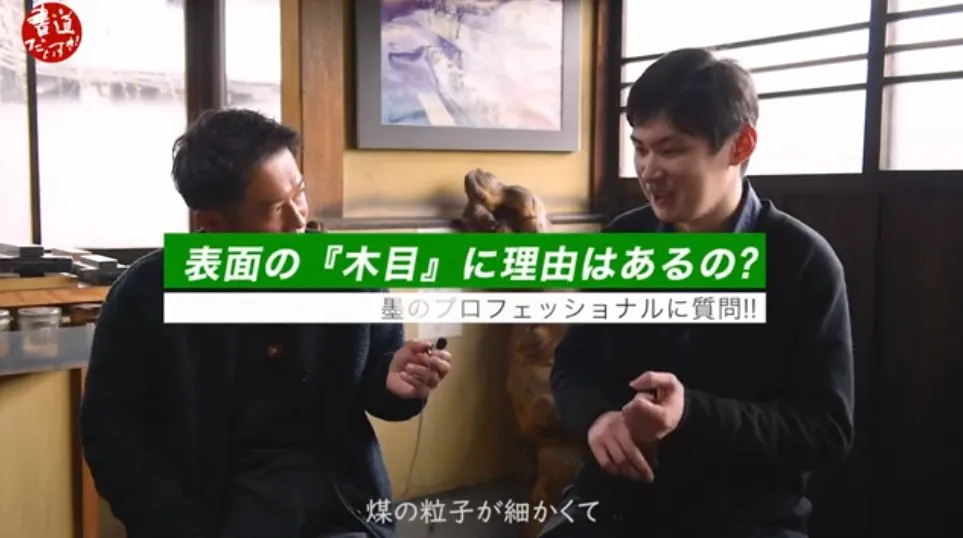
Regarding the woodgrain-like pattern that appears on an ink’s surface, he notes that finer soot particles and well-carved molds bring out the mold’s grain, which is a sign of quality. Visible grain indicates thorough kneading; it’s not artificially added—it appears naturally.
On grinding technique, he confirms the method shown in Shimauchi’s earlier video is correct: in principle you first make a dense ink, then dilute with water. About “aging” ink, he explains that resting sticks 4〜5 years in good storage makes them easier to use.
Concerning gold-wrapped sticks, beyond the luxurious look, the gold helps protect the ink from moisture and can suppress tackiness during grinding. Gold wrapping is often used for very fine-particle inks.
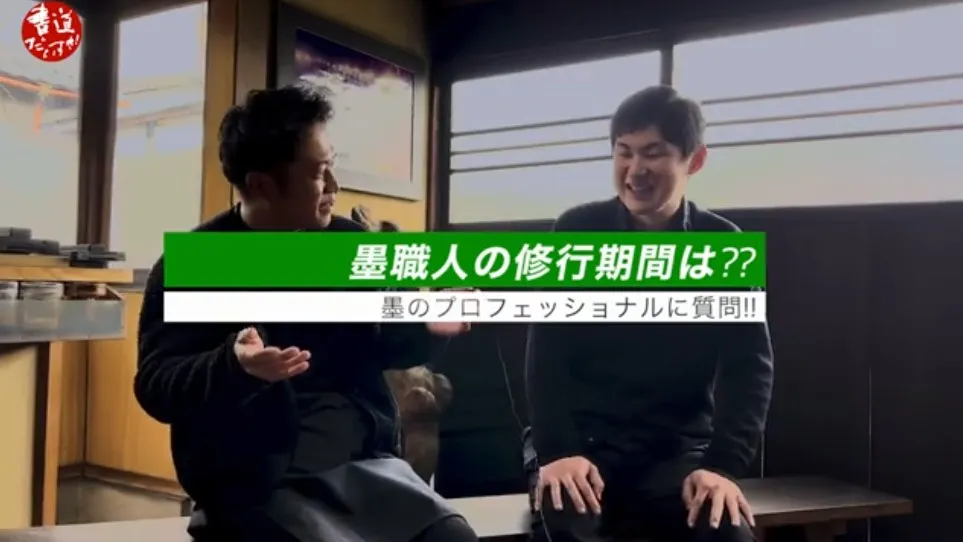
As for artisan training, after about 4〜5 years a trainee can work alongside a senior, but even veterans must put in steady effort—it's physically demanding work.
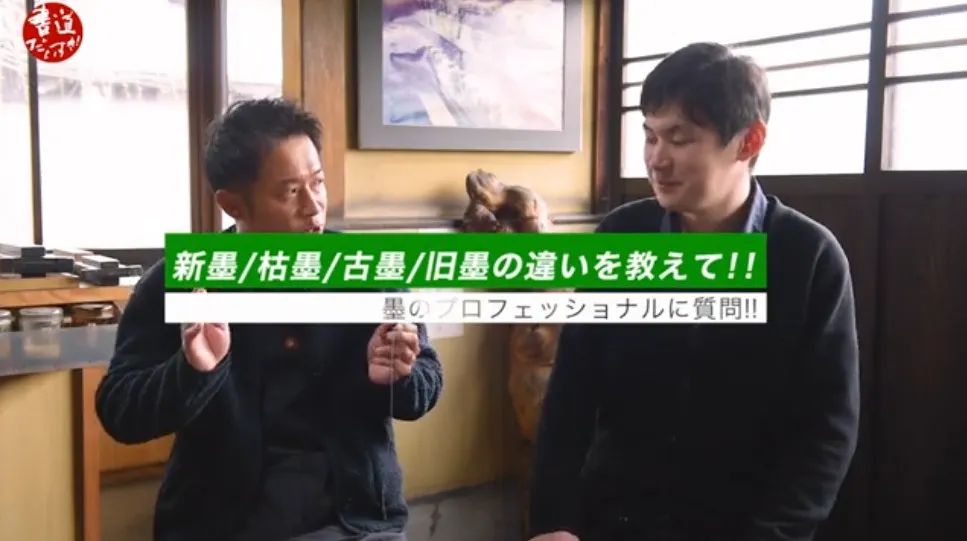
On the terms new/aged/antique ink, he defines: “new ink” as roughly within one year of production; “aged (kare) ink” as matured over years and easier to use; and “old/antique ink” as further aged with cultural/artistic value. Properly stored ink can last for centuries and still be usable.
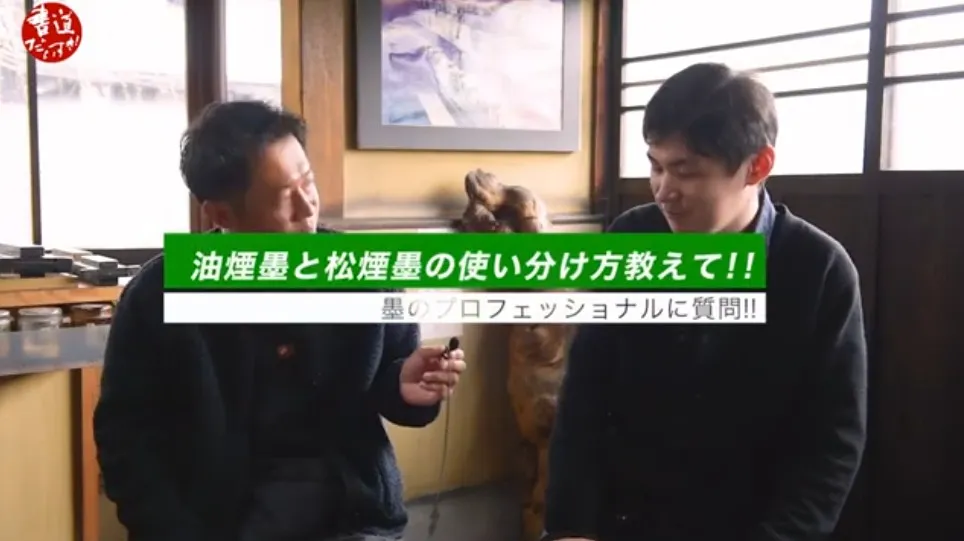
Finally, he distinguishes oil-soot ink from pine-soot ink: oil-soot yields fine particles and a deep, glossy black; pine-soot mixes particle sizes and often looks bluish. For the future, Kobaien aims to keep offering their traditional inks—made continuously for over 440 years—in ways that fit the times.
YouTube Shodo Daisuki Episode 60
Shimauchi 00:00
So, there’s “for kanji,” right. And also “for kana.” We often get asked for the production date; it might be a trade secret, but it’s very… Hi, this is Shodo-Daisuki Shimauchi. Continuing from the last episode, we’re visiting the long-established Kobaien in Nara. If you missed the previous video, please be sure to watch it first and then enjoy this one. In the last episode, we were shown the actual ink-making process.
Since we have this opportunity, this time we’ll keep asking about ink itself—from basic points to deeper, more technical topics. I’ll ask various questions and have them answered. So once again, we have Mr. Azakami joining us—thank you for being with us again today. Thank you. It’s a luxury to have one-on-one time like this, so I’ve compiled questions we often get in our shop and from viewers. From those, I’ll ask representative questions. Thank you in advance. Now, first of all—this might sound a bit clumsy—how are ink stick prices determined? Right, right.
Mr. Azakami 01:26
Ink prices range widely from inexpensive to expensive. Yes. One basic criterion is the size of the stick. Ah, smaller sticks are cheaper than larger ones when the material quality is the same, and vice versa. Another factor is particle fineness, which affects grindability, and differences in base oils, etc. Those factors influence the price.
Shimauchi 01:54
I see, I understand. So that’s how it works. Which makes me wonder:
Based on what you just said, about the labels “for kanji” and “for kana” shown on some sticks—does that reflect similar differences?
Mr. Azakami 02:12
We do separate them into kanji and kana. For kanji, many users write large characters, so larger sticks that reach black quickly are common. In contrast, for kana—many use them for small-brush copywork and continuous small characters—so although they still achieve a firm black, they tend to be smoother and spread lightly.
Shimauchi 02:38
I see, so that’s the difference. Right. So when choosing ink, it’s important to pick according to the use case.
Got it. I still have many things I want to ask, so I’ll keep going. Next—this is something I’ve really wondered about, and viewers may be curious too—on some ink surfaces you see vertical “woodgrain” lines. What’s the meaning of that difference?
Mr. Azakami 03:14
Generally, when the soot particles are very fine, the grain of the wooden mold appears clearly on the surface, and such sticks are regarded as higher quality.
Right now we also use pear wood for the molds, which naturally has unevenness; when that comes through clearly on the ink surface, it shows the kneading was done thoroughly.
Shimauchi 03:38
Oh, I see, that’s how it is. Yes. I had a naive idea—wondering if there was a difference between sticks with visible grain and those without.
Mr. Azakami 03:56
It doesn’t mean sticks without grain are bad, but if the woodgrain shows clearly, it indicates very thorough kneading.
Shimauchi 04:04
I see. A slightly tricky question: is it possible to “fake” woodgrain to make a stick look good?
Mr. Azakami 04:15
No, we don’t do that.
Shimauchi 04:18
Got it. So visible grain is a natural—and very good—sign.
Mr. Azakami 04:25
Yes, it appears naturally from the mold.
Shimauchi 04:30
Naturally—understood. Thank you. Next: on this YouTube channel we demonstrated how to grind ink back in Episode 7. Mr. Azakami, was that method correct?
Mr. Azakami 04:52
Yes, I watched the video. Thank you.
Yes, that method is correct. In principle, you first make a dense ink, then thin it with water to reach your tone. The same idea applies when making dark or light ink.
Shimauchi 05:13
Is that okay? I know I was a bit dramatic in that explanation…
Mr. Azakami 05:22
It’s fine—please grind adequately. A common mistake with light ink is adding a lot of water and grinding only a little. That results in too little pigment, so the quality isn’t there. You should bring the soot down thoroughly; there’s fragrance added as well, and when you grind properly that aroma also develops.
Shimauchi 05:50
I see. What struck me is the expert phrasing: “bring the soot down.” That’s a great way to say it—learned something today.
Let’s keep going—sorry, I have so many questions. Next: ink is often said to improve when “rested.” How long should you rest an ink stick?
Mr. Azakami 06:24
“Resting” basically reduces the moisture content under good storage conditions. There isn’t a strict definition, but for everyday use, around 4–5 years is often said to be a sweet spot.
Shimauchi 06:48
Right. As a salesperson and at the store too, your inks are very popular, and we’re often asked for the production date.
That’s why you print it, I see. Fans really pay attention to it, and the period you just mentioned is considered good.
Mr. Azakami 07:15
That’s right.
Shimauchi 07:17
Okay, moving on. About gold-wrapped sticks—I’ve always wondered: why wrap them in gold? It looks luxurious, but when you grind them, what happens to that gold? Could you explain?
Mr. Azakami 07:41
Gold wrapping indeed looks luxurious. Historically, the thin gold leaf also served to protect the stick from moisture.
Also, something learned more recently: since gold leaf is metal, when grinding, the stick can feel less tacky compared to sticks without gold. It suppresses that stickiness a bit.
Shimauchi 08:20
So the characteristic “tackiness” during grinding is reduced?
Mr. Azakami 08:26
Yes. You still get a solid black, but the resulting ink liquid feels smoother.
Shimauchi 08:32
Oh, I see—everyone, that’s interesting!
Mr. Azakami 08:36
We often wrap very fine-particle inks with gold, so it’s particularly recommended for kana practice.
Shimauchi 08:44
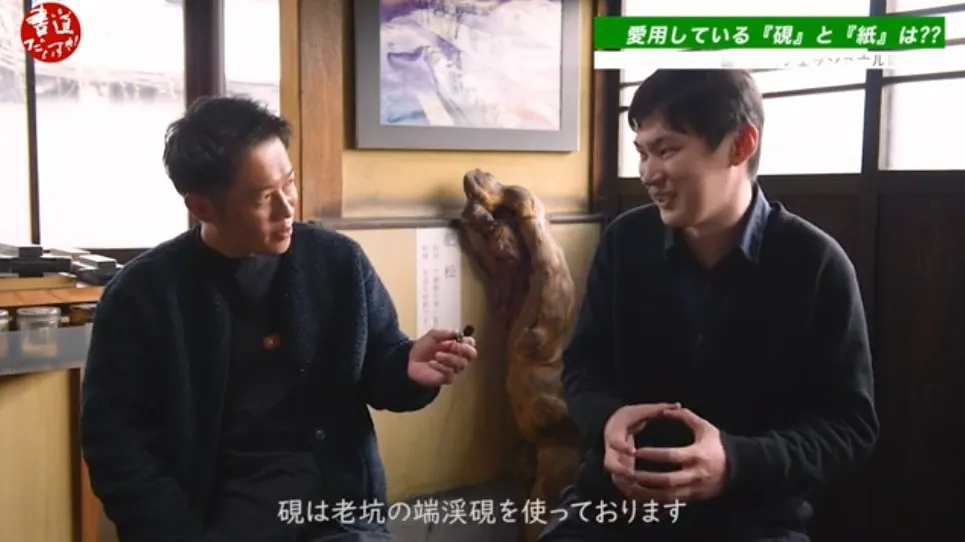
For kana too—unexpected, but noted. Kana writers, give gold-wrapped sticks a try. Next—this might be a bit different. I like doing experiments. Among various tests I’ve done with solid ink, I was curious about what kind of inkstone and paper you use when you run your own internal tests. I know some of it may be confidential, but could you share what you can?
Mr. Azakami 09:45
For soot color swatches and such, we try different things with inkstones and paper. Basically, the inkstone we use is Laokeng Duan. It’s known to be extremely fine, and paired with oil-soot, it yields a very high-quality ink liquid.
Shimauchi 10:09
Right, Laokeng is excellent.
Mr. Azakami 10:13
Ours is an old piece—used since before I joined the company.
Shimauchi 10:17
I see. Is it fairly large? —No, small. Ah, so you have various sizes. Understood.
Everyone, Kobaien uses Laokeng Duan like this.
Right. And the paper?
Mr. Azakami 10:33
Basically, Red Star brand.
Shimauchi 10:37
I see. As expected—
Mr. Azakami 10:38
It allows a firm black to bite in for dense ink; with lighter tones you can clearly see separation between edge and bleed.
Shimauchi 10:48
Understood. I also use Red Star “Mianliao Danxuan.” Good to know I wasn’t doing anything off base.
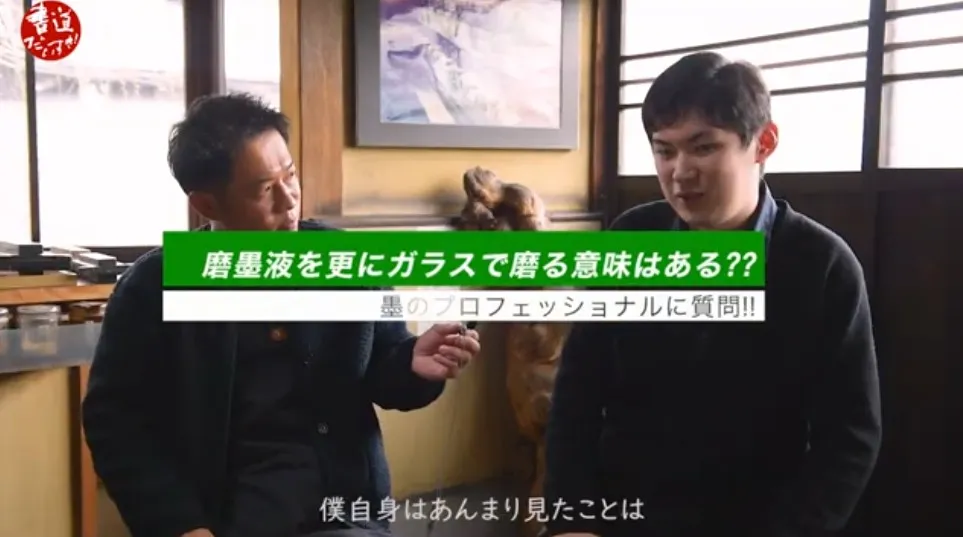
Thank you. May I keep going? Yes. Great. Earlier we talked about particle size. This may be a bit nerdy, but after grinding by hand, I’ve seen people who want it even finer place the ground ink on a glass plate and rub it with a fingertip. Is that actually a thing?
Mr. Azakami 11:37
I haven’t seen it much myself, but in principle, since glass is finer than most inkstone surfaces, kneading on glass with a fingertip can further break particles down—some teachers do that.
Shimauchi 11:56
I see—so it’s like the final coaxing of color: “Come on, give me your best black.”
Mr. Azakami 12:07
Exactly.
Especially nowadays, some people use automatic grinders. Those rotate mechanically, so to recover that hand-ground character, you can put the ink back on the inkstone—or on glass—and either re-grind or crush with a fingertip. It gets closer to the feel of hand-ground ink. For those making larger volumes, it’s extra work, but doing this once more brings out the color well—I recommend it.
Shimauchi 12:37
Understood. May I continue?
Earlier we watched the masterful techniques of your artisans—very moving. How long does it take to be recognized as a fully fledged craftsperson? What’s the training period?
Mr. Azakami 13:10
It varies by person and by task, but in general about 4–5 years to work alongside a senior and handle molding yourself. Even for veterans, it’s physically demanding daily work to complete a full quota within work hours.
Shimauchi 13:51
I see—so no matter how much you train, you keep studying daily. Even veterans keep striving to make excellent ink.
That’s wonderful—the mindset of a true craftsperson. Before we wrap up, is there anything you particularly want to emphasize?
Mr. Azakami 14:29
These days, fewer people grind solid ink; that’s the reality. But there’s a clear difference between bottled ink and solid sticks. As a first step, even if you mainly use bottled ink, try adding a little hand-ground solid ink.
Shimauchi 14:53
That anticipates what I was going to ask—thank you. I was about to ask about bottled ink vs. solid, but indeed, in reality both are used.
Another question: terms like “new,” “aged (kare),” and “old/antique” are used for sticks. What are the differences?
Mr. Azakami 15:30
There’s no single strict definition. “New” generally means within about 1–2 years of production, with some moisture still present. “Aged (kare)” means time has passed, the moisture has sufficiently dissipated, and it’s easier for everyday use with solid color. “Old/antique” refers to pieces aged even further, with cultural or artistic value. Some makers sell sticks that are 50 years old, for example.
Shimauchi 16:16
I see. Speaking of age: since Kobaien has a history of over 440 years, you must have many old treasures. How far back can a stick still be usable?
Mr. Azakami 16:53
For Japanese ink, with good storage, it’s said to last for hundreds of years. There are documents written with such ink that remain. Even when excavated historically, solid sticks can survive. Bottled liquid ink is different, but solid sticks have been made for over a thousand years; with proper storage, they last a very long time.
Shimauchi 17:35
So it won’t just crumble when you grind it. Right—“old/antique” might mean 50 years, 100 years, even 500. Understood.
Practically speaking, that all makes sense. Thank you. Finally, we often hear “oil-soot” and “pine-soot.” How should we use them differently?
Mr. Azakami 18:19
Oil-soot is essentially an aggregation of very fine particles; as mentioned earlier, it pairs well with fine inkstones like Duan, producing a deep black that bites into the paper with a glossy look. It’s great for kanji works and large pieces.
By contrast, pine-soot comes from burning pine; particle sizes range from large to fine, mixed together. Of course you can grind it on a fine inkstone too, but it shines for mid- to larger-format work. Ground on an inkstone, it yields very good quality.
Shimauchi 19:04
I see—results also vary by inkstone. I’ve also heard that with time, pine-soot can look bluish when ground—is that true?
Mr. Azakami 19:19
Yes. Especially with fresh pine-soot, compared to brownish tones, you often see a cooler, slightly bluish cast. Because of the particle mix, that appearance can emerge—and with aging it may become even more pronounced.
Shimauchi 19:41
I see. And compared to dense black, lighter tones tend to look more bluish-gray—
Mr. Azakami 19:49
Yes, diluted tones look more bluish-gray; dense tones in oil-soot give a glossy, deep black. Pine-soot tends to a non-glossy, absorbing black.
Shimauchi 19:58
Right—an absorbing black, so to speak.
Mr. Azakami 20:04
Yes, it absorbs light rather than reflecting it.
Shimauchi 20:09
That’s what people call “blue-black,” then. In our shop we’re often asked the difference between oil-soot and pine-soot. Everyone, feel free to rewatch that part and remember it.
I still have many more questions, but one last big one: what kind of ink does Kobaien aim for going forward?
Mr. Azakami 20:43
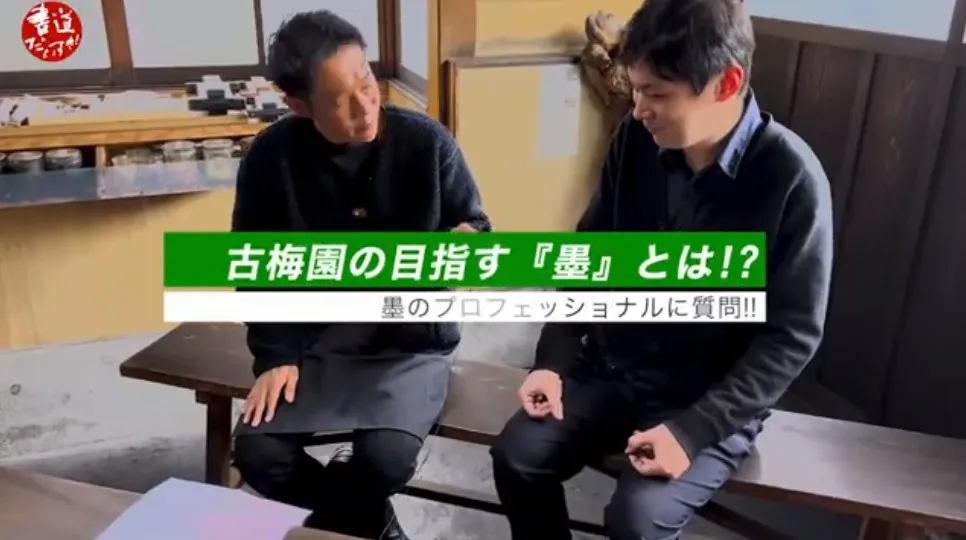
Times change. We’ve made solid ink for over 440 years; our challenge is to keep making ink in the same traditional way while offering it in ways that fit the era.
Shimauchi 21:08
I see—that’s your mission. I asked these questions very suddenly, but your smooth, expert answers impressed me—this is what true expertise looks like.
I realized I still have a lot to learn beyond calling myself “Shodo-Daisuki.” Thank you so much for your precious time and for answering everything. Thank you as well. I look forward to our continued relationship. Likewise. Everyone, how was it? After watching this video, you’re practically at a master-class level of ink knowledge, aren’t you?
If this video didn’t make you want to learn more about ink, perhaps you were glancing away—just joking. As for me, I can’t wait to go home and grind ink. If you want to learn more, please visit Kobaien sometime.
We’ll put various details in the description—thank you for checking it out. Solid ink is one of the core tools of calligraphy; while honoring your own spirit, let’s keep using solid ink energetically—ah, I misspoke. This has been Shodo-Daisuki Shimauchi. Kobaien is the best! See you next week! Goodbye!
Text text text text
text text text text text text text text text text text text text text text text text text text text