

Shodo Daisuki Episode 61
Shodo Daisuki Episode 61
Classics Copying Series vol.5 — “Mysterious Characters!! Bronze Inscriptions (Jinwen)!!”【Calligraphy】
Shodo Daisuki – Episode 061
About 300 years after the “Oracle Bone Script,”
we take on the “Bronze Inscriptions (Jinwen)” in our classics copying series!!
From turtle shells to bronze vessels!! A period of remarkable civilizational progress!!
Naturally, the script also transformed rapidly.
Please watch and try writing along with us!!
Shodo Daisuki Episode 61 — Video Overview
This video is the fifth installment of the “Classics Copying Series” by Shimauchi.
This time, he explains Jinwen (Bronze Inscriptions).
Jinwen refers to characters cast onto bronze vessels produced from the Yin (Shang) through Han periods, and emerged about 300 years after Oracle Bone Script.
The name “Jinwen” comes from the fact that bronze and copper were called “jin (metal)” at the time.
Rather than being carved directly into bronze, characters were first sketched, then lightly incised to create grooves into which clay was pressed to form the pattern; those forms were then cast. Thanks to this technique, the bronze surfaces could reproduce the draft characters faithfully.
Features of Jinwen include abundant curves and occasional “puffy dots,” giving a charming impression.
In early Yin, pottery was used for daily life, with bronze vessels reserved for special rituals and ceremonies.
Early bronze inscriptions recorded simple information such as the owner’s name or profession. By the Zhou period, the texts became longer and the number of characters increased.
This era produced so-called “award-and-commission vessels (shōshi sakumeiki),” on which royal authority was proclaimed.
For this episode, Shimauchi chose the inscription of the Da Yu Ding and attempted a copy.
It dates to roughly the early Zhou (around 1000 BCE) and commemorates the favors a man named Yu received from the king, recorded on a bronze vessel.
He copied the characters “Song,” “Zhou,” “Ling,” and “Yu,” striving to express the Jinwen-style curves and shifts in stroke thickness.
He closes by sharing the joy of experiencing history through tracing earlier scripts and builds excitement for the next installment of the series.
Introduction to the 5th Classics Copying installment 00:00:00
Shimauchi introduces his challenge of copying Jinwen for the fifth entry in the series.
He explains how Jinwen developed about 300 years after Oracle Bone Script, touches on the historical background, and notes that he will finish by actually writing.
He also asks viewers to subscribe and give the video a like, as the channel covers a wide range of calligraphy topics.
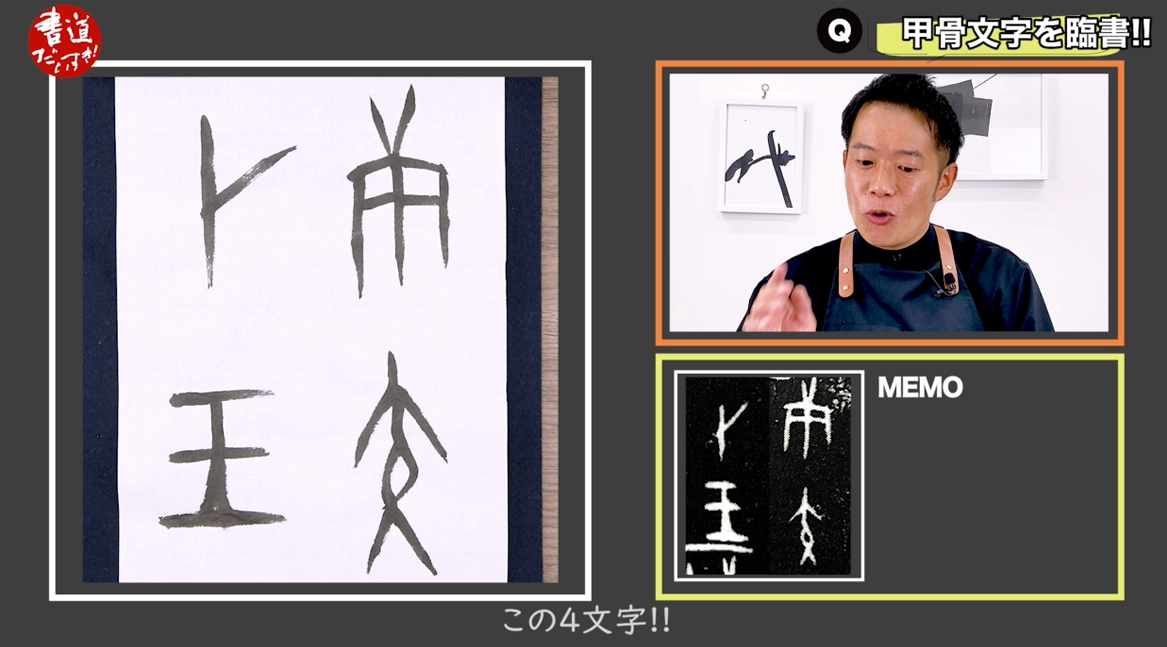
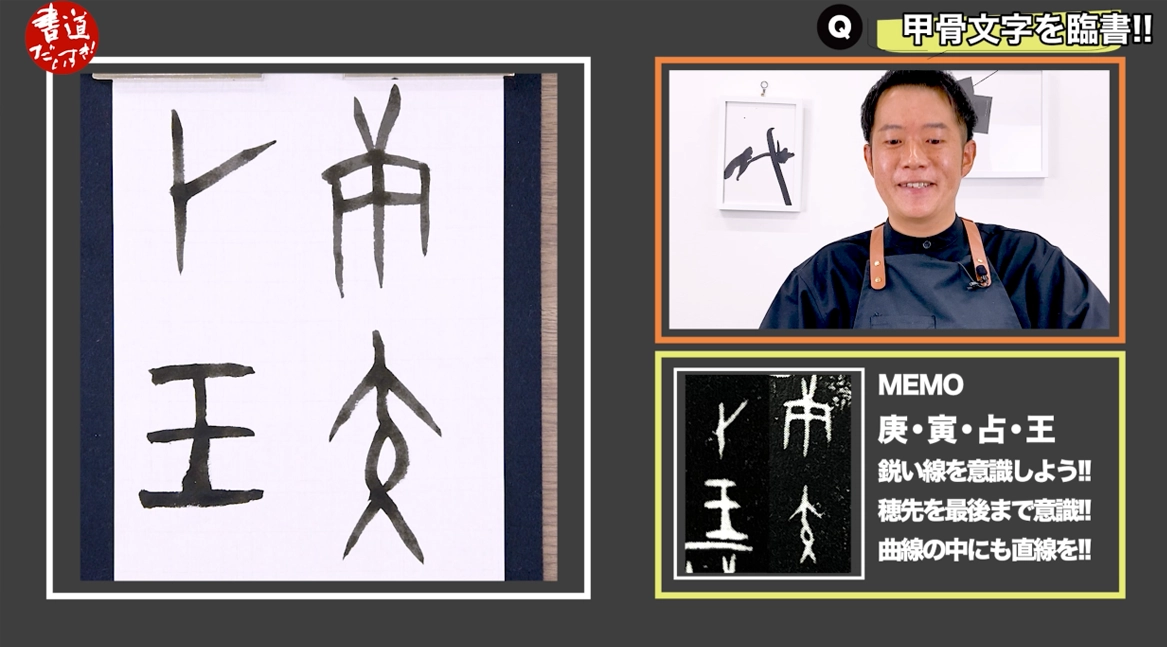
YouTube Shodo Daisuki — Episode 61
Shimauchi 00:00
So, they used bronze vessels—somehow that just clicks, doesn’t it?
I found it… cute, in a way. Here it’s actually even thicker in places.
Hi there, Shodo-Daisuki Shimauchi here!
We’re back with the fifth entry in the Classics Copying Series—let’s dive in without hesitation!
Shimauchi 00:19
About 300 years after the Oracle Bone Script comes… that’s right,
Jinwen (Bronze Inscriptions). Today I’m going to take on Jinwen.
We’ll look at how forms evolved from Oracle Bone Script to Jinwen, as well as the historical backdrop,
Shimauchi 00:38
and then finish by actually committing brush to paper.
Every time I approach this series, I study in advance and prepare for filming, but—how should I put it—preconceptions are slippery things.
Shimauchi 00:55
I’m reminded how vague our assumptions can be.
I think you’ll find plenty of “Oh, really?” moments that make you smile—
Shimauchi 01:09
so please stay with me to the end!
On this channel, we introduce all kinds of things related to writing, not just calligraphy—please subscribe and give us a like!
All right, let’s jump right into the Classics Copying Series!
Shimauchi 01:25
Jinwen was born some 300 years after the last script we covered.
Jinwen refers to characters cast onto bronze vessels made from the Yin (Shang) to the Han periods.
And these bronze vessels were made by pouring molten metal into molds,
Shimauchi 01:45
so you could say Jinwen are essentially “shaped” or “molded” characters.
Why is it called “Jinwen”?
Because bronze/copper were called “jin (metal)” at the time.
It kind of makes perfect sense, doesn’t it?
Shimauchi 02:02
From turtle shells to bronze vessels—
doesn’t that feel like a great leap forward in civilization?
Incidentally, the exact fabrication method of Jinwen still isn’t fully solved today.
Which means reproducing it in modern times is remarkably difficult.
Shimauchi 02:21
It’s even said to be “impossible to replicate,” indicating just how advanced the technology was.
A profoundly mysterious script—
that’s Jinwen. In its earliest days, the so-called Yin period,
for daily life they used pottery,
Shimauchi 02:42
and bronze vessels were used for special rituals and ceremonies.
Those bronzes initially carried simple information—owner’s name, occupation, and so on.
As time moved into the Zhou period,
Shimauchi 03:01
the inscriptions lengthened and the number of characters increased.
This is when “award-and-commission vessels” appeared, used to express the king’s authority on bronze.
Such changes took place then.
Shimauchi 03:17
Elaborate, set-text inscriptions are called meiwen (inscription texts).
These long inscriptions later became extremely important models for learning Seal Script in calligraphy.
Within the long sweep of Jinwen history, the piece I chose this time is…
Shimauchi 03:39
the Da Yu Ding.
Chronologically, it’s from the early Zhou—around 1000 BCE.
Compared to Oracle Bone Script, Jinwen uses many curves, and you often see those “puffy dots.”
Those features feel kind of…
Shimauchi 03:57
cute to me.
Embarrassing confession: I used to think, like Oracle Bone Script, Jinwen were carved directly into bronze.
But that was wrong.
Here’s how it really worked:
Shimauchi 04:14
You know the molds, right?
You sketch the characters, then lightly incise along the sketch.
That creates shallow grooves.
Then you press clay into those grooves to take the pattern.
Now look again at Jinwen on bronze—
Shimauchi 04:36
it starts to make sense, doesn’t it?
“Ahh, that’s why it looks like this,” you think.
Once this technique was discovered,
the characters you drafted could appear on bronze almost exactly as drawn.
Shimauchi 04:55
Which means—
this was also a moment when the joy of writing truly blossomed.
Don’t you think so? Because what you wrote as a draft
could appear just like that on bronze.
Shimauchi 05:12
You’d be like, “My very own writing ended up on bronze!”
In that sense, it might be fair to say
that changes in material had more influence than changes in people’s technique in that era.
Shimauchi 05:30
This time, I want to tackle those abundant curves and the charming, thickened strokes you see throughout—the so-called hibi (literally “plump strokes”).
I’ll try to recreate that feeling.
Okay—let’s begin the hands-on copying of Jinwen.
Shimauchi 05:51
We’re working with the Da Yu Ding, but first, briefly: what is it about?
In short, Mr. Yu wished to commemorate the favor he received from the king,
and had it preserved on a bronze vessel.
Shimauchi 06:08
As before, I picked out four characters in advance, and here is the piece I wrote.
I chose “Song” (the capital where the Zhou kings lived),
and then—
Shimauchi 06:28
“Ling” (to command),
and “Yu” (the person’s name).
There’s surrounding text of course, but the part I wrote reads roughly like “the king commanded Mr. Yu,”
Shimauchi 06:44
a fragment of that overall context.
As with the last episode, I wanted to retain the strength carried over from Oracle Bone Script,
and since Jinwen is a precursor to Seal Script,
Shimauchi 07:02
I aimed for concealed tips and centered brush (zhōngfēng) in my stroke execution.
That said, overall my lines came out a bit thin this time.
Shimauchi 07:17
Since I wanted to express those many curves and the hibi—those plump strokes—
when I compare closely with the original, for instance here, and here—
Shimauchi 07:37
the curves are actually quite thick in those spots.
Especially this time, I want to be careful about the thickened parts we call hibi.
Shimauchi 07:54
Because the characters were formed by molding, it might be that
they look a bit thicker than brush writing would, due to the casting process.
You can see that effect—
Shimauchi 08:08
it’s an “unnatural” thickness in one sense, yet it’s also quite charming.
I’ll keep that in mind for today’s writing.
Let me do a clean sheet now.
Shimauchi 08:21
I’ll write slowly.
We may speed up parts of the footage, but I’ll do my best.
Okay, I finished one sheet—hmm…
perhaps I misread the idea of hibi a little, and
Shimauchi 09:29
I put in a bit too much force.
It does feel more “plump” than the earlier attempt, but
if it reads as cute, that might be good enough.
Shimauchi 09:44
These distinctive Jinwen forms—
you know, I’ve been writing mostly clean, regularized scripts until now, so
Shimauchi 10:00
capturing this delicate sense of “intentional irregularity”—
that balance—is actually difficult.
So rather than a strict shape-copy (keirin),
Shimauchi 10:14
I feel it may be better—at least for me now—to tilt toward writing what I sense, closer to an “idea copy” (irin).
That’s how I felt this time, so I’ll stop here for today.
Did you enjoy it? I found many new discoveries again.
Tracing history backward through copying—
Shimauchi 10:34
it makes me feel like I’m quietly recreating each period myself.
Almost like being the lead in a historical drama.
With Jinwen, you start to see the writer’s expression show through more directly.
So what comes next—?
Shimauchi 10:52
What kind of drama awaits us?
I’ll keep studying for the next episode—please look forward to it!
This was Shodo-Daisuki Shimauchi.
See you again next week!
Shimauchi 11:07
Goodbye!
About Related Products
Here are products featured in this video.
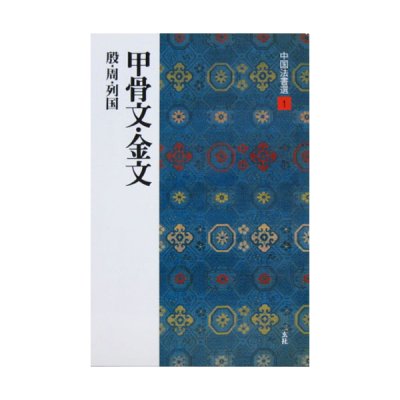
Books / Book & Publication
Whether you’re a beginner starting calligraphy or an intermediate/advanced learner, books are an essential source of knowledge.
They let you study beyond your teacher’s model and are ideal for home practice or self-study.
Gaining knowledge of calligraphy will surely broaden your horizons.


