

Shodo Daisuki Episode 65
Shodo Daisuki Episode 65
So, What’s the Deal? Why Write on the Back of Hanshi!?【Calligraphy】
Shodo Daisuki – Episode 65
In this video, Shimauchi from Shodo Daisuki explains why people write on the back side of hanshi!
Shodo Daisuki Episode 65: Video Overview
Shimauchi gave an explanation about calligraphy under the theme “Why write on the back of hanshi?” After receiving a question from a viewer—“A friend who does calligraphy advised me that writing on the back of hanshi will help me improve, but I feel resistant to writing on the back”—he explained this topic in detail.
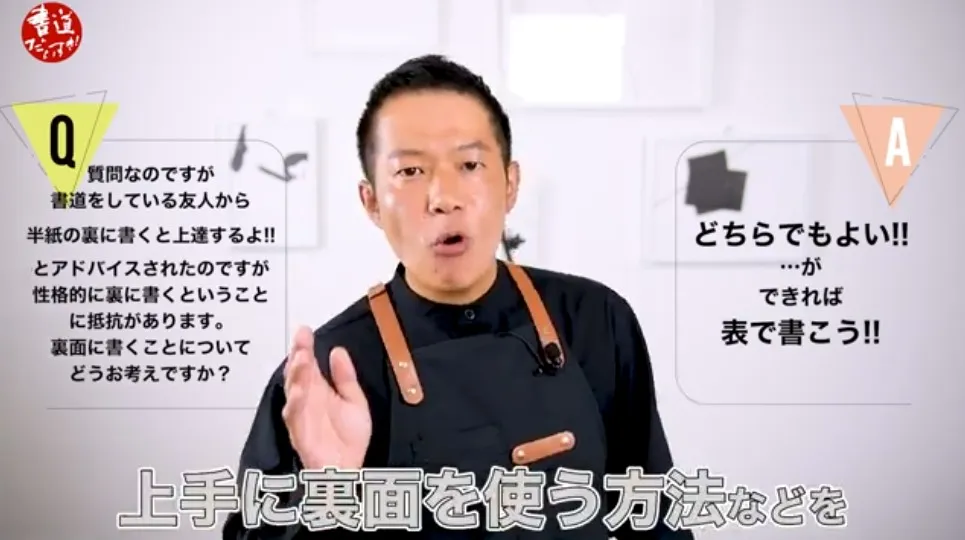
As a conclusion, he said, “Either is fine, but if possible, write on the front.” He notes that one reason the idea of writing on the back spread is related to the characteristics of inexpensive machine-made hanshi. Machine-made hanshi often has a treated surface, making it less prone to bleeding and easier to write on; however, it can also make the writer’s brush movement harder to see. In contrast, the back side is not treated, so it tends to bleed more and feel rougher—making the writer’s brushwork and skill more apparent.
However, after test-writing on various papers, he discovered that the properties of the back side differ depending on the paper. Some papers bleed more on the back, while others bleed less; he also reported that some papers are harder to write on from the back. Therefore, he emphasizes that it is important to understand the characteristics of the paper you use and compare writing on the front and back to decide.
Finally, he states that both the front and back of paper have advantages and disadvantages, and that the decision of which to use belongs to the writer. Rather than narrowing your options, he encourages enjoying calligraphy freely—while concluding with the reminder not to forget that “the essence of paper lies on its front surface.”
YouTube: Shodo Daisuki Episode 65
Shimauchi 00:00
What do you think? Don’t you feel more dynamism? The way the work looks changes—you won’t know until you try. Hi, I’m Shimauchi from Shodo Daisuki. This time, I’ll be talking about the theme of why we write on the back of hanshi.
Shimauchi 00:20
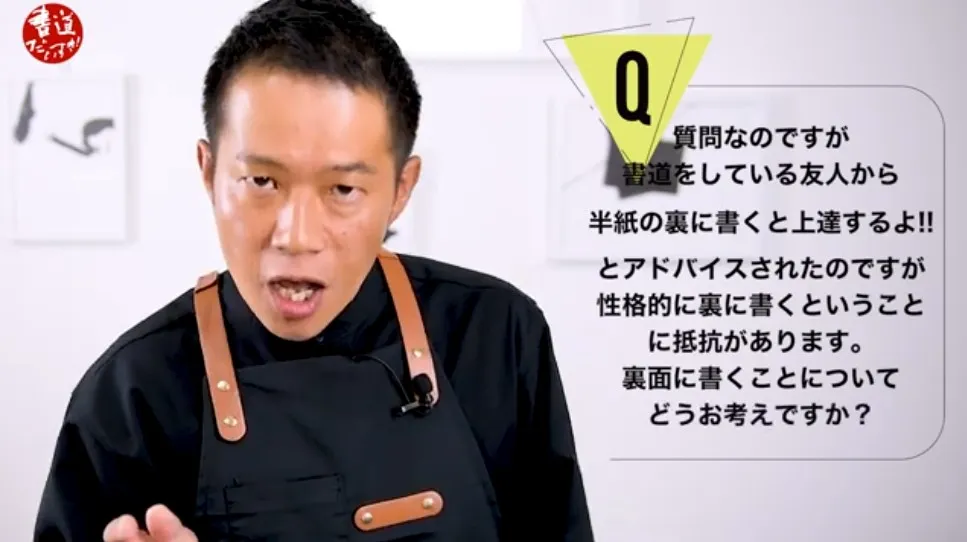
Right away, we received an email like this. It’s a question: A friend who does calligraphy advised me that writing on the back of hanshi will help me improve, but because of my personality I just can’t help feeling resistant to writing on the back. What do you think about writing on the back?
Shimauchi 00:38
That was the content. Thinking back, I feel like I’ve been asked this a few times. Like, “I ended up writing on the back today, but it’s okay, right?” or “Why does my teacher tell me to write on the back of the paper?” On the other hand, there are also cases like, “My teacher always tells me to write on the front.”
Shimauchi 01:00
To give the conclusion first: either is fine, but if possible, write on the front. But if that’s all, it won’t make a video—so in the main part, I’d like to introduce the various reasons people give and how to use the back side effectively. On this channel,
Shimauchi 01:19
not limited to calligraphy, we’ll keep introducing more and more things related to writing, so please subscribe and give it a like—thank you so much. Now then, let’s head into the main part. Here we go! Why do such different theories exist, like “the back is better” or “it must be the front”?
Shimauchi 01:40
This is strictly my personal view, but I’ll share it. I think it has to do with inexpensive machine-made hanshi. For those just starting out or beginners, you need to practice a lot, so in most cases you use inexpensive practice paper.
Shimauchi 02:00
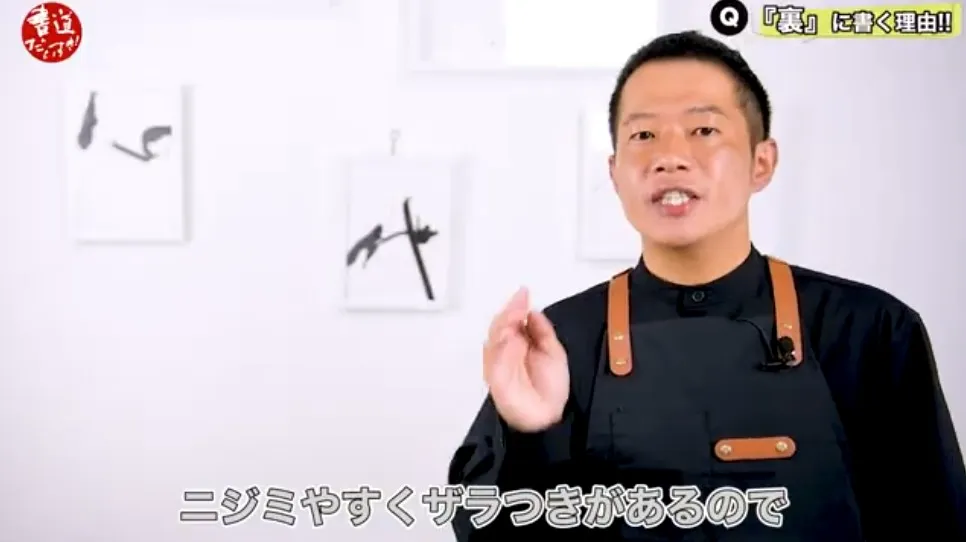
Paper makers are of course aware of this when producing it. So they treat the front surface to make it easier to write and less prone to bleeding. With this kind of machine-made paper, it certainly bleeds less and becomes easier to write on, but on the other hand, inevitably, that “kakusa” (subtle difference),
Shimauchi 02:17
such as how you wrote it or what speed you used—your brush movement—tends to become harder to see. So the writer’s skill becomes harder to judge, and teachers who value that aspect may say things like, “Write on the back of the paper,”
Shimauchi 02:37
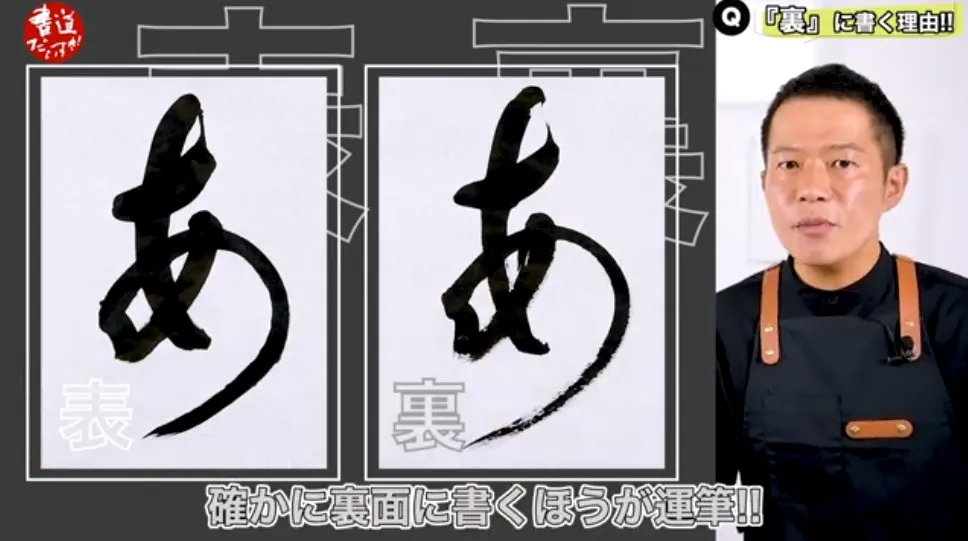
Because the back side is not treated, it bleeds more and has a roughness, which makes the writer’s brush movement easier to understand. Without fear of misunderstanding, you could say it brings the writing feel closer to that of typical handmade paper. Now, I actually tried writing, so please take a look here.
Shimauchi 02:53
When you write on the back, “kasure” appears, and don’t you feel more dynamism? In fact, when I (Shimauchi) wrote, definitely—writing on the back let me understand my own brush movement much better.
Shimauchi 03:08
And because “kasure” appears depending on how the brush tip travels, I thought, “Ah, I see.” Indeed, compared to writing on the front, it feels like writing on the back helps you recognize your own ability. The back has a roughness, so there’s resistance,
Shimauchi 03:24
with a pleasantly moderate “catch,” so personally I felt it was very easy to write on. For beginners, experiencing how the look of a work changes due to “kasure” could be good teaching material to learn firsthand.
Shimauchi 03:40
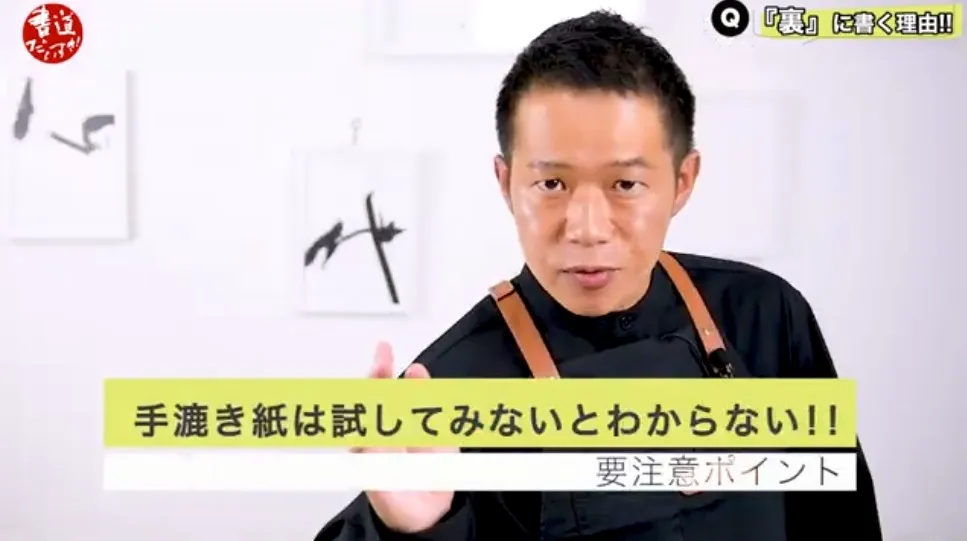
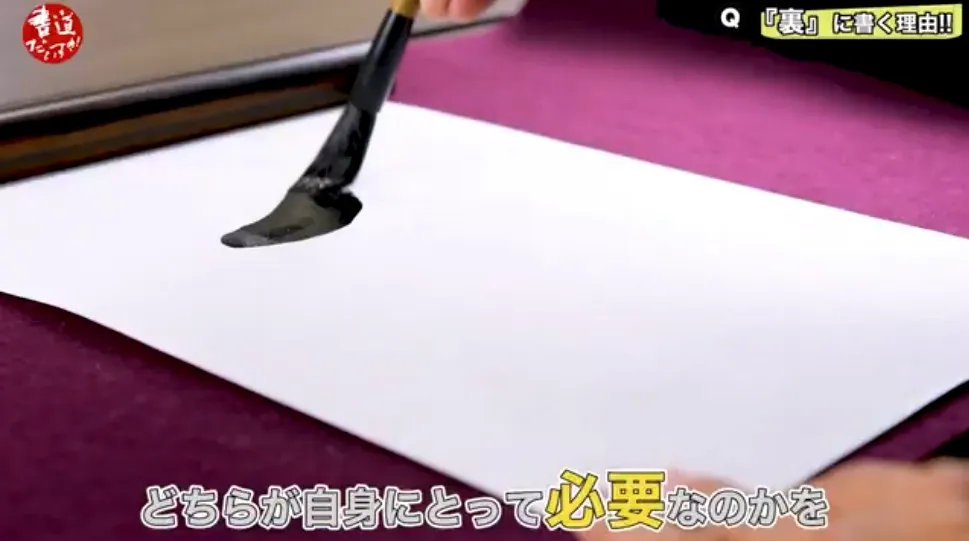
For those who thought, “Then I’ll try it too!”—please wait a moment. There’s more to this. As I prepared to make this video, I did test writing on the back side of many different papers, and I learned something.
Shimauchi 03:56
You won’t know until you try the paper. Honestly, there was no pattern at all: some papers bled more on the back, and others bled less on the back. And moreover,
Shimauchi 04:11
there were also papers where the back side wasn’t easier to write on—so it really varied. After understanding whether your paper is machine-made or handmade, compare the front and back and judge—this is essential.
Shimauchi 04:28
It’s dangerous to assume that all paper will gain dynamism by writing on the back, so please be careful. On the other hand, if you had a handmade paper you thought was great but felt you failed with it, this could be a good chance to try the reverse side.
Shimauchi 04:47
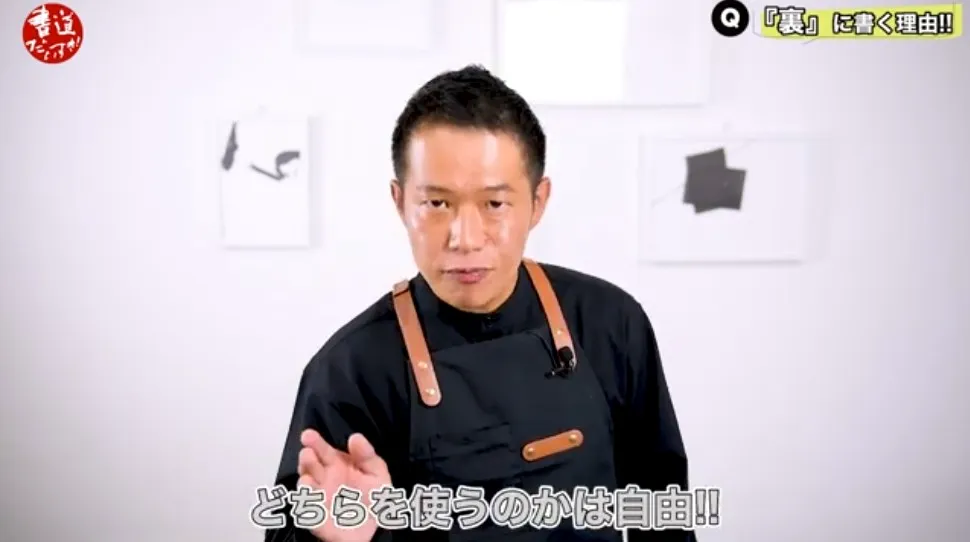
From all of the above, I think that by blindly following advice, discussions like “front vs. back” and such theories may be walking on their own. First, try the back side of the paper you have and decide which you need for yourself.
Shimauchi 05:06
If you can’t decide, I recommend using the front. I’m the type who feels resistant to writing on the back by nature, so I recommend using it only as part of learning.
Shimauchi 05:24
Some teachers may not allow writing on the back, so for work submissions and the like, you should write on the front side. By the way, for mounting such as backing (urauchi), it can be done regardless of front or back, so please don’t worry.
Shimauchi 05:41
How was it? I think there are various opinions, but I shared my honest feelings. Like the sun and the moon—both the front and back of paper have merits and demerits. Which one you use is,
Shimauchi 05:59
not so much “freedom,” but rather the writer has the right to decide. Please don’t narrow your choices—enjoy calligraphy freely. However, the essence of paper lies on the front surface—this is absolutely true, so please don’t forget that point.
About Related Products
We introduce the products featured in this video.
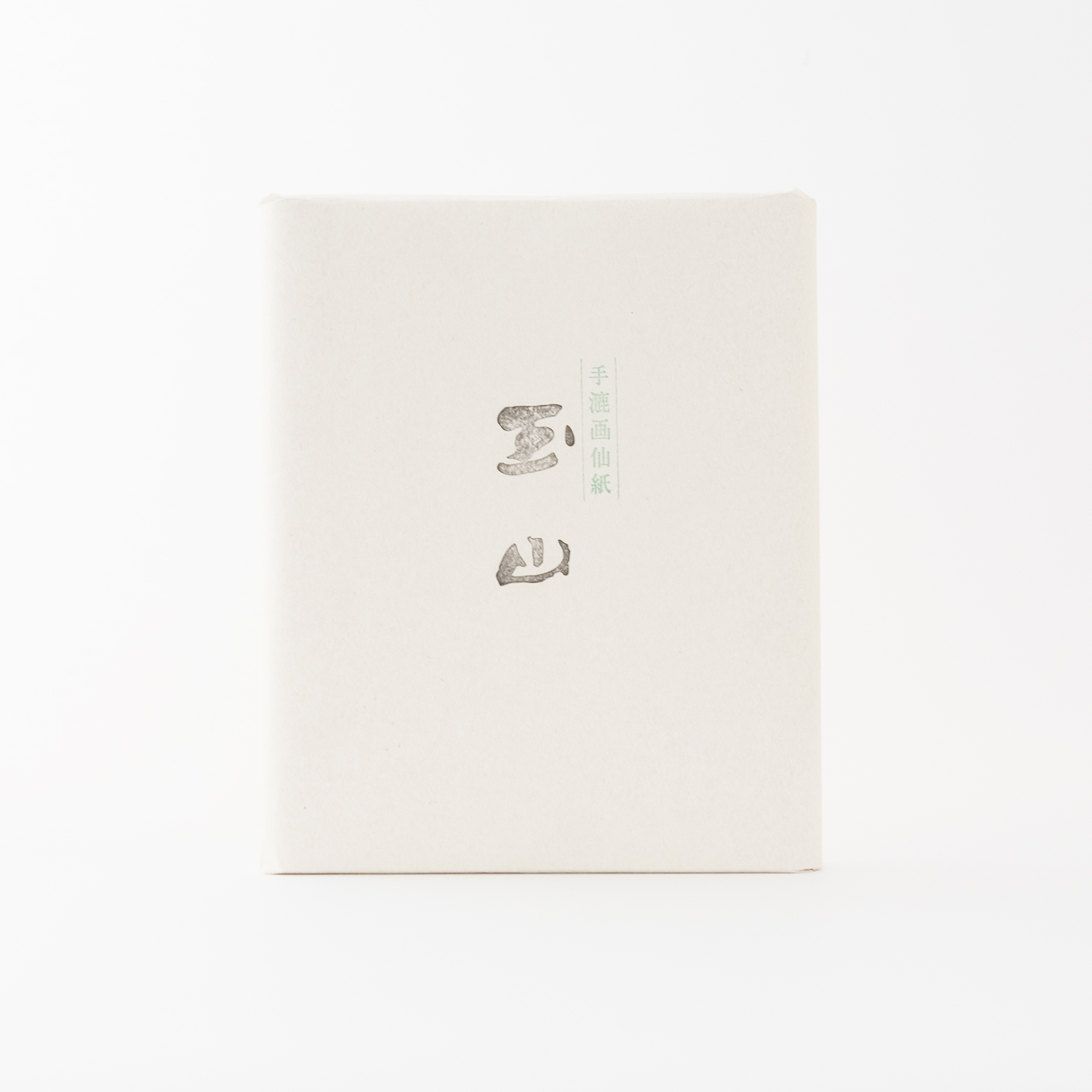
Calligraphy Paper /shodo-shi
Calligraphy paper comes in many sizes, including hanshi, Yatsugiri, Hansetsu, Zenshi, and special sizes.
Within these, there is also a wide range of types—paper for children’s school use, kakizome (New Year’s writing), sumi-e, sutra copying, exhibitions, and more.
Shoyu Online is used by a wide range of customers, from elementary school students to professional calligraphers.