

Shodo Daisuki Episode 64
Shodo Daisuki Episode 64
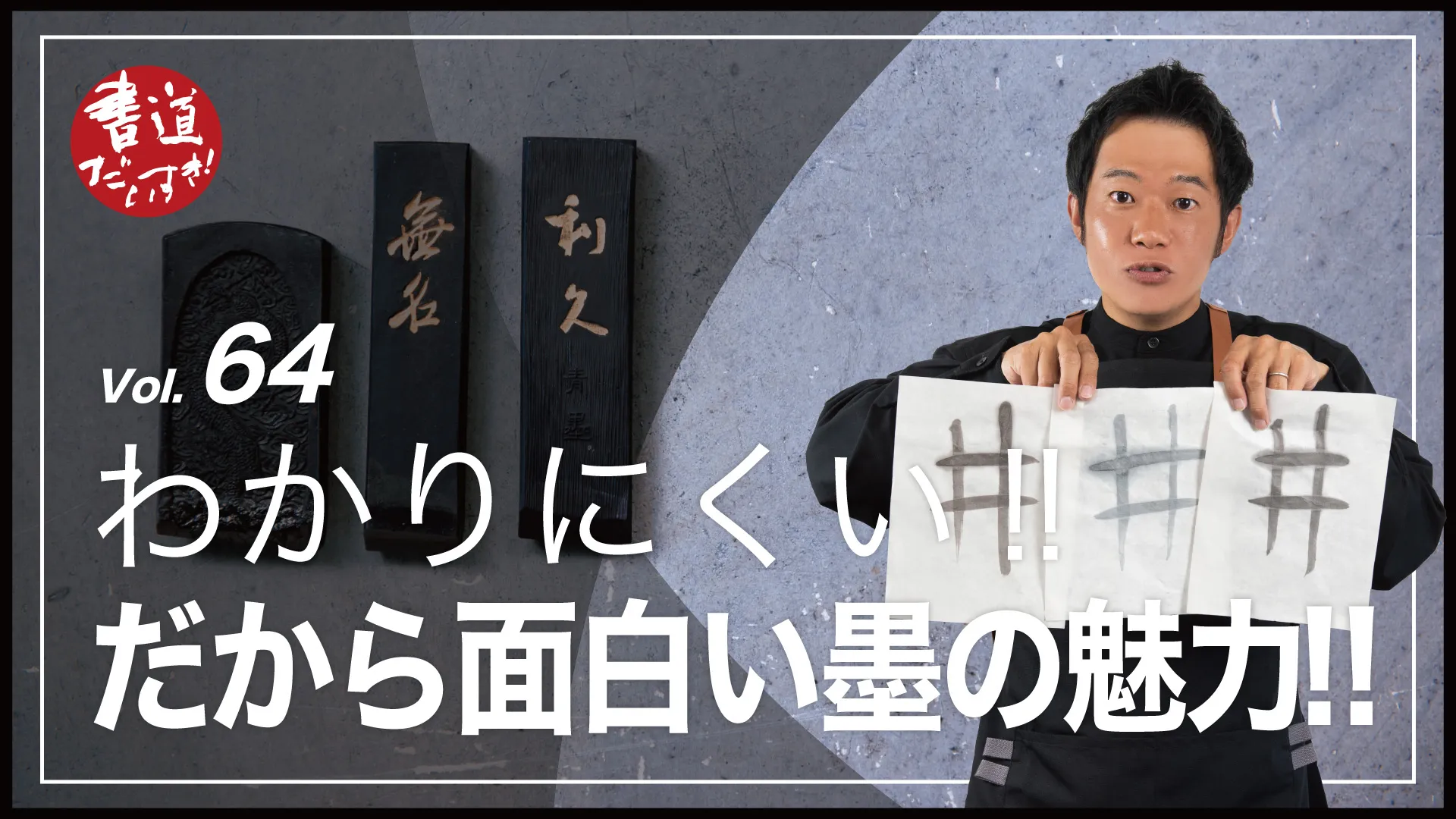
“Hard to Tell… and That’s the Fun Part! The Charm of Ink Tones!!”【Calligraphy】
Shodo Daisuki – Episode 064
Blue-cast, tea-cast, even purplish.
Though all are “black,” ink tones vary widely!!
Still, many people don’t quite “see” it when they try writing—right?
In this episode, Shimauchi explains these subtle, hard-to-grasp differences in a clear, practical way!!
Shodo Daisuki Episode 64 – Video Overview
This episode is a guided tour of the “Charm of Ink Tones.”
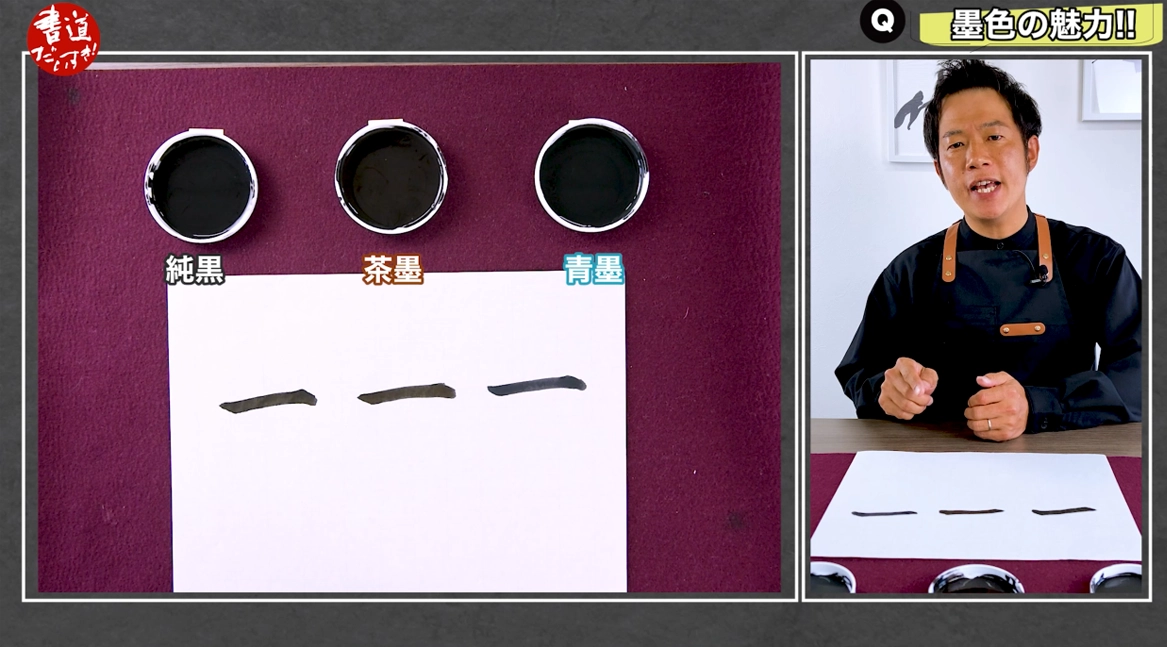
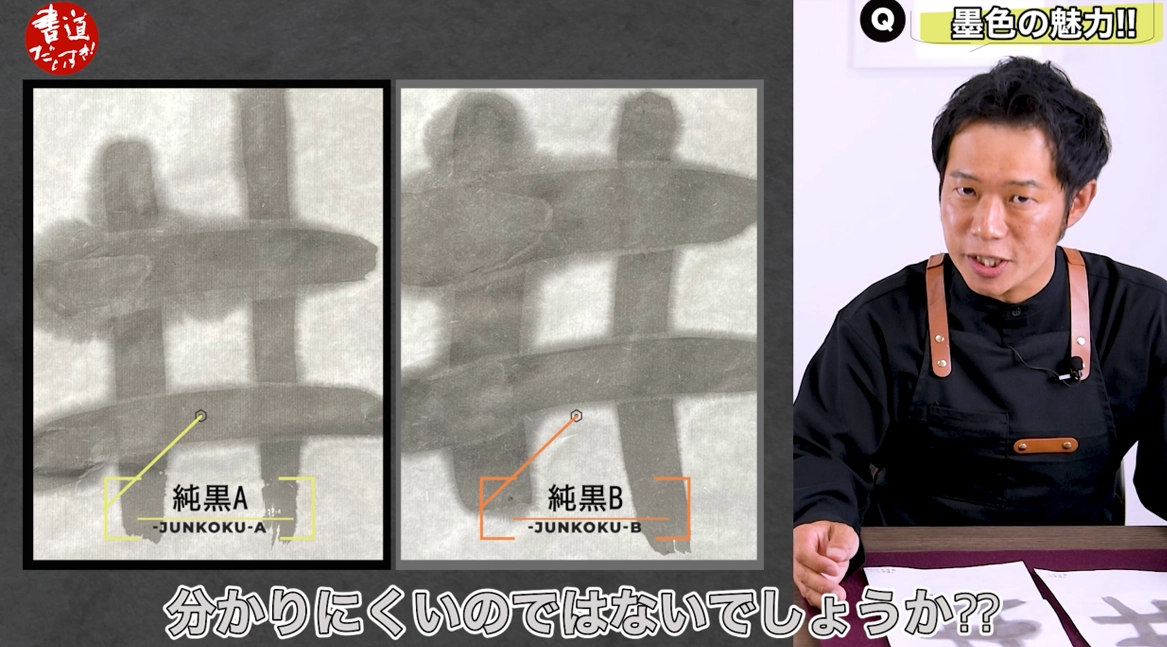
Shimauchi explains the nuanced differences among blue-cast ink, tea-cast ink, and neutral deep-black ink.
He opens by noting that while ink is often perceived as simply “black,” in practice there are delicate hue differences.
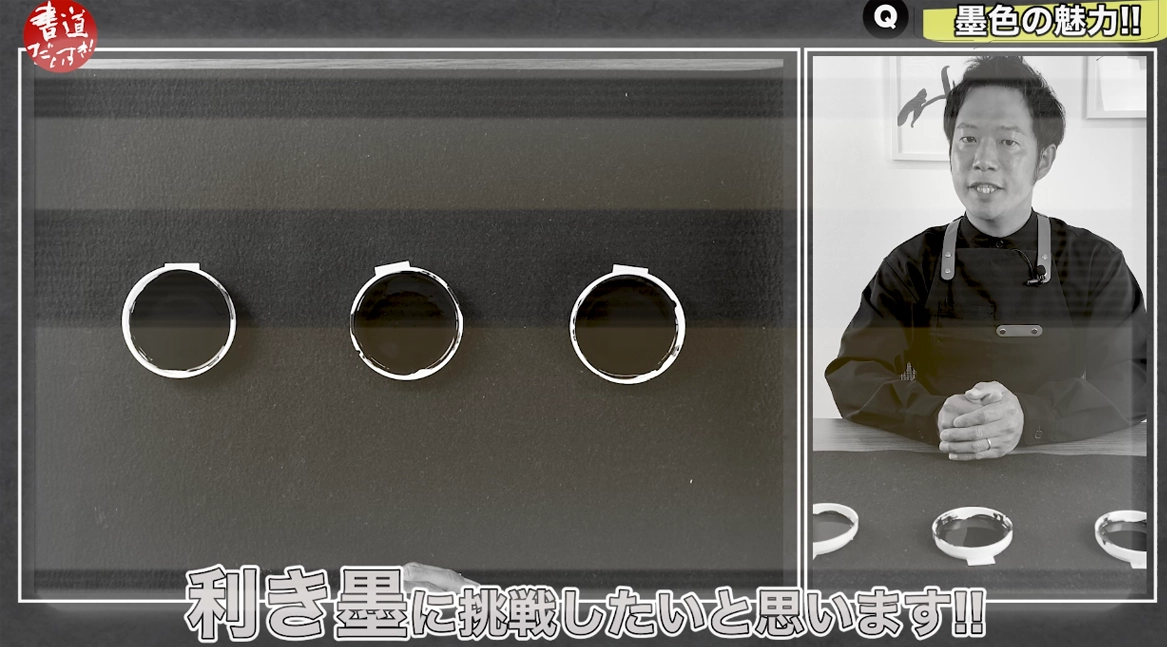
He prepares three different bottled inks and runs a blind identification test.
He points out that making light ink (淡墨) reveals differences most clearly.
Even then, they are not paint-like hues, but gentle tints—“a faint blue,” “a faint tea-brown,” etc.
Since in calligraphy the character is the protagonist, overly vivid color would distract; therefore good ink strikes a tight balance.
The larger the work, the more pronounced the ink-tone differences become.
Finally, he notes that beyond color, inks have individual “feel” in grinding, flow, and spread.
Start with reputable recommendations, then deepen your awareness of ink tone—doing so makes calligraphy even more enjoyable.
YouTube Shodo Daisuki Episode 64
Shimauchi 00:00
Then we have to make it something you can understand just by looking at it, right? The root of the development of characters lies in this Oracle Bone Script—and in the awareness of keeping the brush tip alive until the very, very, very end. That might be extremely important. And then, commit those characters to calligraphy.
Shimauchi 00:18
Hello—this is Shodo-Daisuki Shimauchi. All right, we’re here. I want to jump into the fourth installment of the Classical Copying Series, and I’d like to keep the pace up, but… Shimauchi is hesitating. Yes—I'm wavering.
Shimauchi 00:35
Well, I thought about taking on famous classics you all know—Wang Xizhi, or Kūkai—and working on that kind of classical copying. But then I asked myself: what is it that Shimauchi really wants to do? Which classics do I truly want to engage with?
Shimauchi 00:48
And I ended up thinking about it. Ever since we were little, we’ve heard it: China’s history—4,000 years. No, if we go back to the Neolithic era, there’s a 6,000-year history connected to writing. Once you learn that,
Shimauchi 01:06
—I made up my mind. I made up my mind. I declare that I will work backward, copying from the oldest kanji—Oracle Bone Script—all the way to the present day. When I was younger, I copied classics simply as I was told, taking what I was given.
Shimauchi 01:20
But now that I’m 42, and I’m facing classical copying on my own, I suddenly thought something. Shimauchi thought it—yes, I did. If I’m going to do it, I’m going all the way. That’s it. That’s the idea. Of course, copying famous classics in kaisho, gyosho, and sosho is,
Shimauchi 01:40
well—even if this is a small channel, I know full well that it would make a lot of people happy. But after doing three installments and covering the Four Great Masters of Tang kaisho and such, what I felt was my own immaturity.
Shimauchi 02:00
And also, that brush technique evolves over time. Sure, regardless of era, it might be fine to simply pick out classics that are easy to approach or especially famous and do them as they are, but
Shimauchi 02:14
as you saw earlier, my biggest purpose in classical copying is to learn a wide variety of brush techniques and acquire a wide variety of essential methods. That’s my greatest goal. So, to achieve that goal,
Shimauchi 02:33
I judged that doing it that way would probably be a detour. Of course, I won’t let you waste your time. I’ll work hard to create videos that you can learn from, so everyone—please, by all means—this series,
Shimauchi 02:50
if you’ll stay with me, it would truly, truly encourage me and make me very happy. On this channel, we’ll keep introducing more and more things related to writing—not just calligraphy—so please subscribe and give it a like. Thank you!
Shimauchi 03:00
All right—let’s take on Oracle Bone Script for the first time! So then, what exactly is Oracle Bone Script? Oracle Bone Script is writing that emerged in the late Shang period. Well, I’m not even sure whether we should call it “writing,” but anyway, in that era,
Shimauchi 03:21
they decided everything by divination. It’s hard to feel that in our modern age, but when it came to reporting what they’d decided by divination—who would they report to? Naturally, it would be to Heaven. To the gods. And then, at that moment,
Shimauchi 03:38
you’d go, “Wait—Gods, do you understand us?” right? Words you can’t understand won’t get through. So what should we do? Well, then you’d think: we have to make it something you can understand just by looking at it.
Shimauchi 03:48
So maybe you’d call them shapes—diagrams, charts—they recorded divination that way. Then the gods would understand, right? And you know, people back then—since everything was divination—they divined all kinds of things.
Shimauchi 04:02
“Will we win in conflicts between clans?” “Will the crops grow?” “And what about the weather?” “Will hunting go well?” They recorded everything. And then they offered those records to the gods, right?
Shimauchi 04:20
“Gods—this is what’s happening. This is what we’ll do.” Since these were characters that could be conveyed to the gods, as time passed and then the next era—say, the Zhou—there were other tribes and groups, right? But they didn’t understand each other’s spoken language. Still, if it’s something the gods can understand,
Shimauchi 04:35
they thought: maybe if we use this, we’ll be able to communicate. So they used these oracle bones. And then, more than expected—“Oh! I get it, I get it. This works. We can communicate!”—that’s probably what happened,
Shimauchi 04:53
and that’s how writing develops over time. The root of that development is this Oracle Bone Script. Isn’t that fascinating? There’s such romance to it. Sorry—personally,
Shimauchi 05:05
I’m getting a bit emotional. But I really do think it’s interesting. And to continue with “What is Oracle Bone Script?”—in reality, Oracle Bone Script was carved into turtle shells and animal bones.
Shimauchi 05:23
Since it was engraved with a sharp knife, it’s also called “keibun” (契文), apparently. It’s a difficult term, but it’s read “keibun.” And as I mentioned, the content is, well—divination—so it’s also called “senboku” (占卜),
Shimauchi 05:45
and also “bokushi” (卜辞), they say. Wow—that’s pretty hard. You could just say “Oracle Bone Script,” but it has two other names as well. As for the discovery of oracle bones—this actually jumps much closer to modern times—
Shimauchi 06:01
to the late 19th century. “Ryūkotsu” (“dragon bones”)—and this is totally my own guess—but I think people at the time probably looked for them to decoct and use as a folk medicine. Sorry—this is purely Shimauchi’s speculation, but,
Shimauchi 06:18
they must have noticed the characters carved into those “dragon bones” and thought, “What is this?” And when you look into it, more and more appear—not only from the ruins of the Shang capital, but from various archaeological sites. These “dragon bones,”
Shimauchi 06:37
and the characters carved on them—when people investigated, they realized, “Oh, this can be systematized properly,” and the decipherment advanced. As for how the divination was performed:
Shimauchi 06:57
they would heat a turtle shell over fire, and then rapidly cool it. By cooling it, cracks would form, and they would divine based on the way it cracked. But—wait a second—
Shimauchi 07:14
I thought, “Can you really crack something that sturdy just by heating it and then suddenly cooling it?” And then that word “senboku” starts to make sense. There’s a method: first, on the back side of the turtle shell,
Shimauchi 07:31
they carved vertical grooves—basically, they cut into it. And next to that, they also made round-ish depressions—again, carving. In other words, they prepared it in advance. Then they applied fire—heated that area.
Shimauchi 07:50
They made the back side easier to crack beforehand. Then they rapidly cooled it, it cracked, and based on how it cracked they determined good or bad fortune. This will come up later—it’s deeply connected to the characters—so please keep this in the back of your mind.
Shimauchi 08:11
Well… there’s a lot going on. This is all new to me, and I’m trying to explain things I’m still learning, so maybe I stumbled over my words a bit. But from here, I’d like to move into the actual writing,
Shimauchi 08:21
and enjoy it while imagining as much as possible. All right, now I’d like to finally move into the actual practice of copying. This time, I’ve already written one sheet first, so I’ll use what I wrote and explain as we go.
Shimauchi 08:41
First, these four characters—what did I write? If I put them in printed form: 庚、寅、占、王
Those are the four characters. And this “kō / 庚”—when you see it in print, doesn’t it look familiar? That’s right,
Shimauchi 08:41
we’ve done this before, haven’t we? It’s one of the Ten Heavenly Stems and Twelve Earthly Branches—one of them. In other words, it’s a word that expresses time. Isn’t that amazing? It was already being used in the late Shang period. I was surprised—this is the first time I learned this through this topic myself.
Shimauchi 09:25
“占” means “to divine,” right? And then “王”—the king. So the king probably performed the divination—something like that, I think. Now let’s look at the characters more closely. This “庚,”
Shimauchi 09:46
is a shape of pounding in a mortar, apparently. Like using both hands—doing all sorts of motions, you know. You can kind of see it, right? It’s interesting. It must be a form devised to communicate to the gods.
Shimauchi 10:00
And then “寅”—there’s something there too. It apparently means using both hands to straighten an arrow. I feel like I can sort of see it. And then this “卜,” meaning divination—this has been appearing again and again, but
Shimauchi 10:21
this vertical part is the crack, right? And this part here—this is the crack. They dig these vertical grooves and round holes beforehand, then heat it, then it cracks—and they divine good or bad fortune. That was the method, right?
Shimauchi 10:42
It’s exactly that shape. And lastly, “王”—apparently it’s represented by flipping the blade part of a sickle upside down. That is said to be the symbol of the king. Well, among these characters, this one is clearly
Shimauchi 11:00
closest to the modern “王,” right? And then, what points did I pay attention to when actually writing this time? Well, since it’s carved with a small knife—since it’s engraved—I wanted to bring out sharp lines. That’s important.
Shimauchi 11:22
Ideally, I wanted to use something like a stiff “gōmō” brush (hard hair), but I decided against that. So I used the dual-hair brush I’m used to, and worked as hard as I could on how to make the lines as sharp as possible.
Shimauchi 11:38
All right, I tried one sheet, but there’s still a lot I want to fix. Parts like this, and this, and this. The reason it ended up like this is because it’s carved with a small knife, so
Shimauchi 12:00
I wanted to express it like it was carved—tight, crisp, like “kyu!”—but I ended up going “pyu!” too quickly, you know? So I need to take it slower. And for sweeping strokes, everyone,
Shimauchi 12:13
that awareness of keeping the brush tip alive until the very, very, very end—I think that awareness is important—so I want to keep that in mind next time I write. Another thing I paid attention to was that it would be better to hold the brush straight up,
Shimauchi 12:27
and write with that intention. So there are places where I entered in a very “pure” upright way, and places where I entered differently. Anyway, I wrote while thinking, “I want the lines to come out strong.” So even while thinking “this might not be quite right,”
Shimauchi 12:41
I focused on how to write sharply and did my best. And also here—parts like this—I wanted sharper lines. Here too, and here too—also around here,
Shimauchi 13:00
the curved parts—well, even stroke order was pretty hard. This is also imagination: I wrote it thinking “maybe it’s like this,” so I don’t know if it’s correct, but even within the curved parts,
Shimauchi 13:12
I tried my best to bring out a slightly straight, angular movement. And then this—this “卜”—I first thought maybe it starts from this side, but then I went, “Wait,” and thought it probably starts here, so I went in strongly from this side in one go.
Shimauchi 13:33
So here too, I want to be careful to finish sharply at the end. And finally, this “王.” This part—this part—I wanted to press in firmly and then go “shu!” And then,
Shimauchi 13:58
this part here—since it’s carved with a small knife, I thought I was moving quickly, but the line ended up feeling a bit weak. So here too, I want to write so that my nerves reach all the way to the tip—so that they reach all the way to the end.
Shimauchi 15:00
Yes. I tried to be more careful than before, but I guess it’s in places like this, right? Everyone—when you hear “Oracle Bone Script,” I honestly imagined it as extremely difficult at first. I really did. But,
Shimauchi 15:20
once you actually try writing it… yes—there are many different brush techniques, and it became a study of how to produce sharp lines. So copying Oracle Bone Script—well, regardless of shape—may be very good for training your lines.
Shimauchi 15:39
If you get the chance to study, Oracle Bone Script can also be a great learning experience for stepping into the world of character studies—what you might call graphology/philology. That’s how it felt to me.
Shimauchi 15:51
How was it? I strongly feel that we were able to sense the beginning of the characters we use every day.
Shimauchi 16:03
Some of you might say, “I’m not good at history.” But there are history manga, and the Taiga drama that’s popular these days—
with things like that, a lot of people probably find themselves enjoying history, right?
Shimauchi 16:17
Learning the history of characters in an easy-to-understand way, and then committing those characters to calligraphy—this Classical Copying Series is something I sincerely hope will be loved by everyone for that kind of content. This was Shodo-Daisuki Shimauchi.
Related Products
Here are items featured in this video.
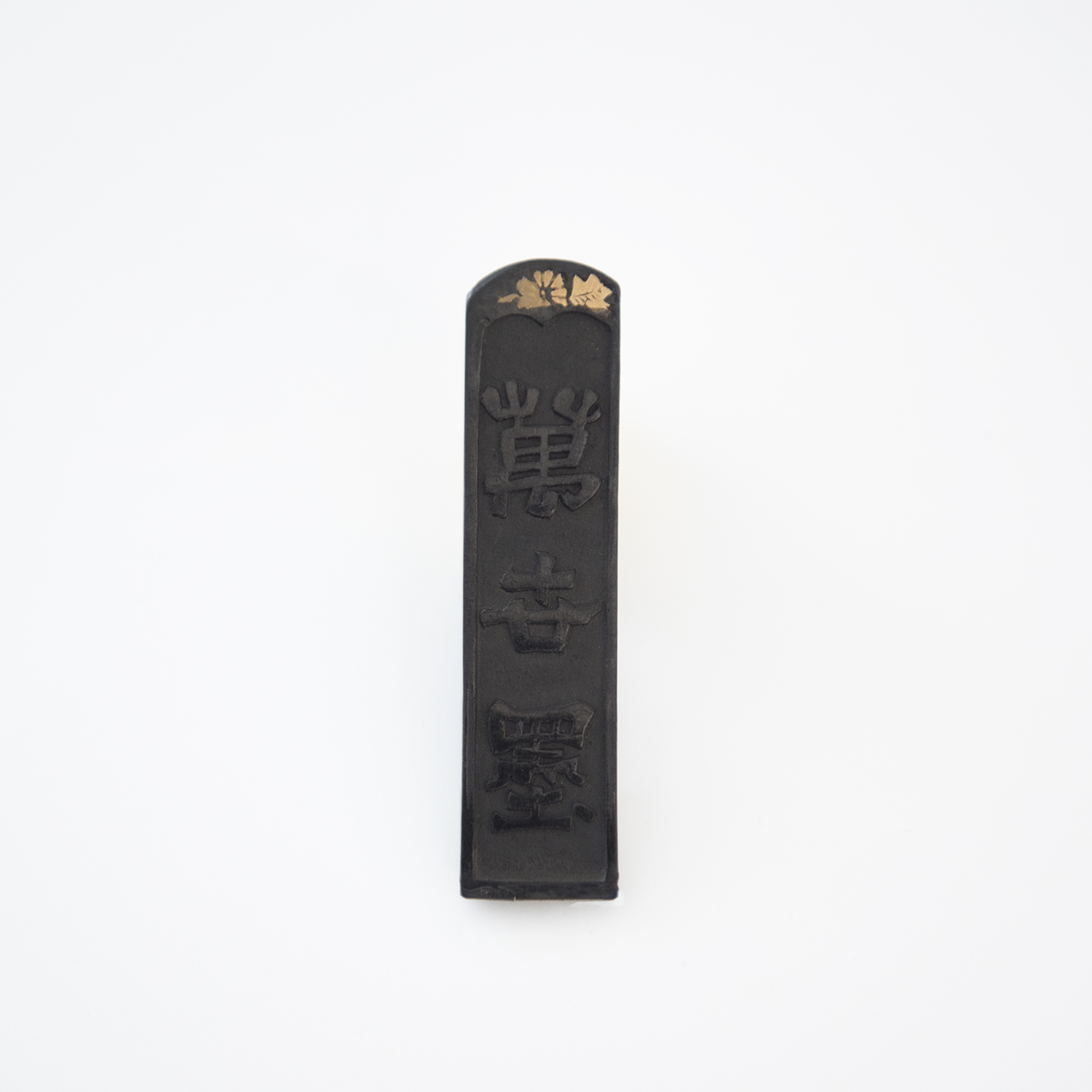
Ink / sumi
Ink is said to have begun in China’s Shang dynasty (before c. 1500 BCE).
Its main ingredients are soot, animal glue, and fragrance; these determine core characteristics.
Depending on composition, you can enjoy differences in depth, sheen, and bleed. Solid sticks offer a charm you won’t get from bottled ink.


