

Shodo Daisuki Episode 66
Shodo Daisuki Episode 66
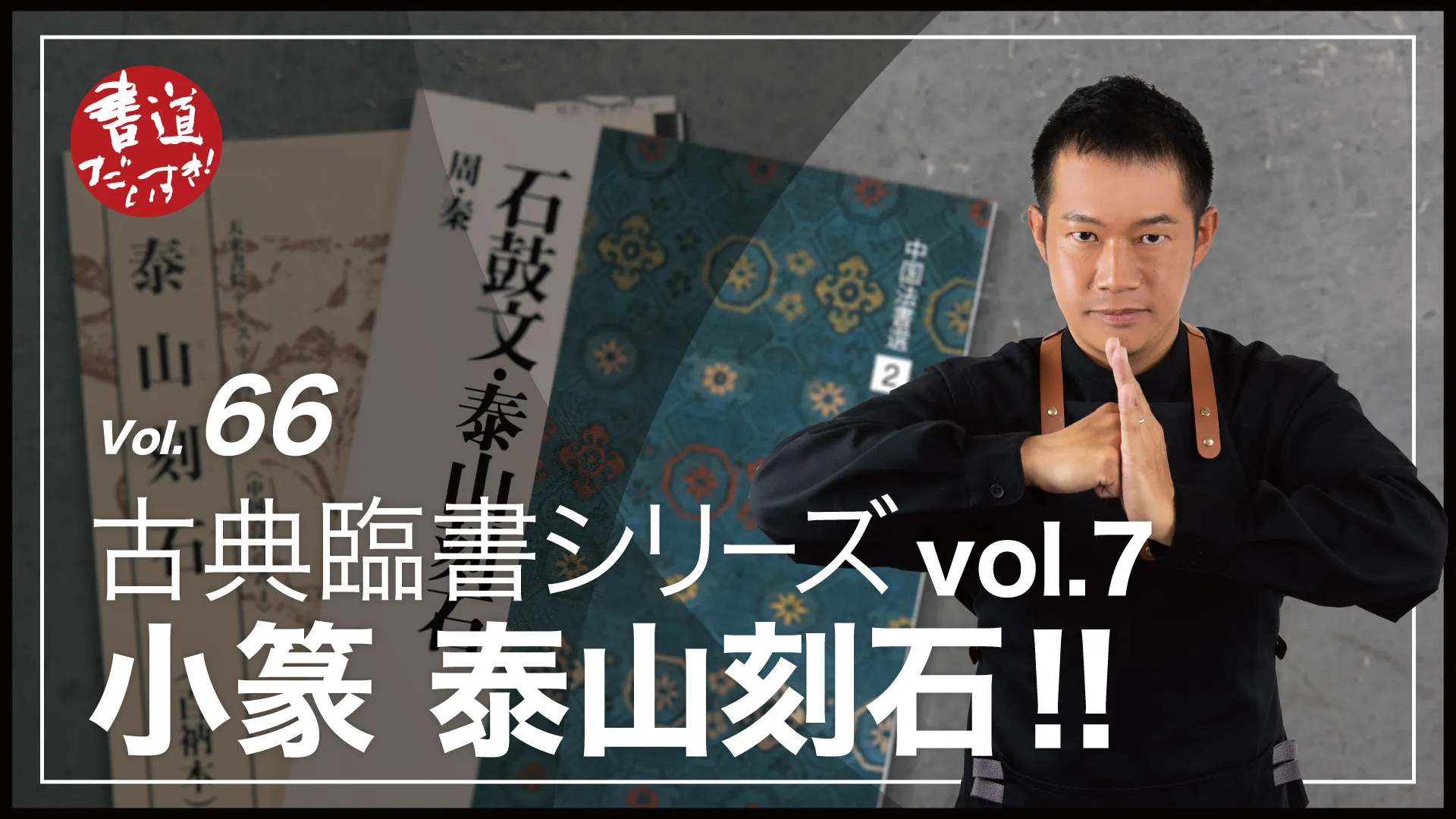
“Small Seal Script!! Mount Tai Inscription!! Classical Copying Series vol.7”【Calligraphy】
Shodo Daisuki – Episode 066
With the Qin dynasty unifying China, Small Seal Script (Xiaozhuan) became the standardized writing system!
In this episode, we will practice classical copying of one of its representative works, the “Mount Tai Inscription (Taishan Keshí)!!”
A masterpiece that expresses the First Emperor’s will in an orderly, dignified manner!!
Enjoy the Small Seal Script characters that have been handed down through the ages to the present day!!
Shodo Daisuki Episode 66: Video Overview
This video is part of the Chinese calligraphy history series by “Shodo Daisuki Shimauchi,” featuring an explanation of Small Seal Script (Xiaozhuan) along with practical copying practice.
It explains in detail the historical background and characteristics of Xiaozhuan, the script standardized by the First Emperor (Qin Shi Huang) during the Qin dynasty in China.
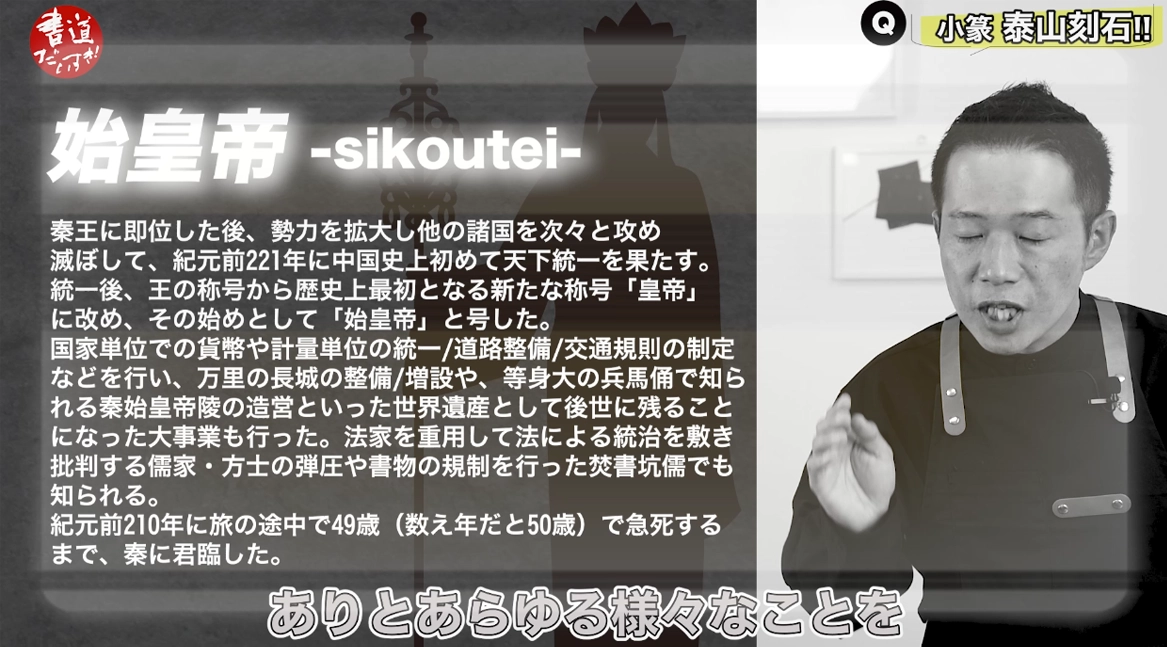
In 221 BCE, when Qin Shi Huang unified China, he unified many things—laws, currency, road widths, and more—and placed special importance on unifying the writing system as well.
He simplified the previously used “Large Seal Script” (Dazhuan) and established Xiaozhuan as the nationwide standard script.
During his imperial tours, Qin Shi Huang erected stone steles written in Xiaozhuan to display authority and to promote the spread of the script.
The instructor provides a detailed explanation of the Mount Tai Inscription (Taishan Keshí).
This stele was written by Li Si, the First Emperor’s right-hand man, and it is significant as the first work in Chinese calligraphy history for which the author is known.
It is explained that the original stele initially contained 223 characters, but it deteriorated over time, and ultimately only 10 characters remain today.
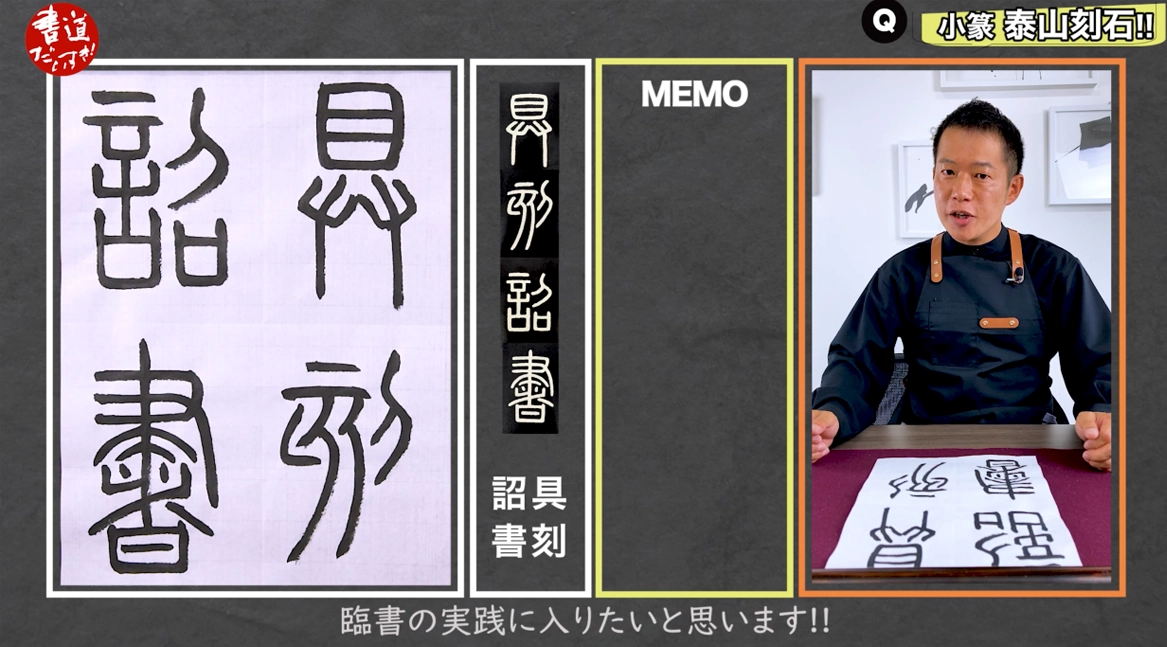
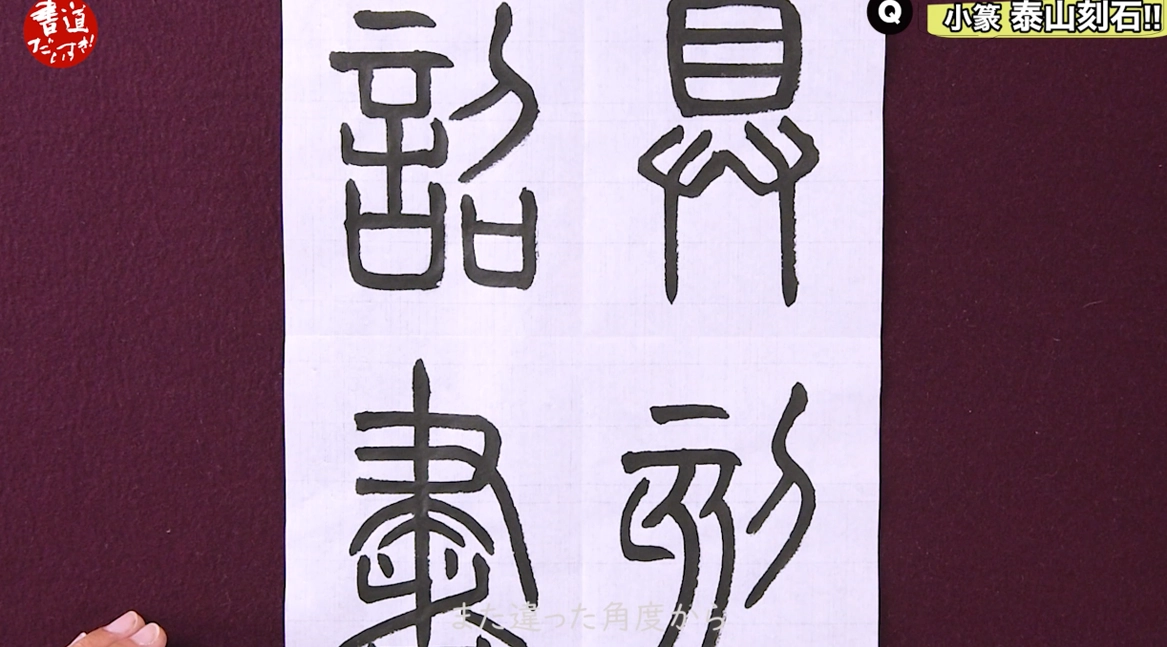
The instructor then performs practical copying of Xiaozhuan, writing and explaining four characters: “具,” “刻,” “招,” and “書.”
He also touches on the etymological meanings and origins of each character, explaining that together they form the meaning “to carve in detail the summoned/proclaimed writings.”
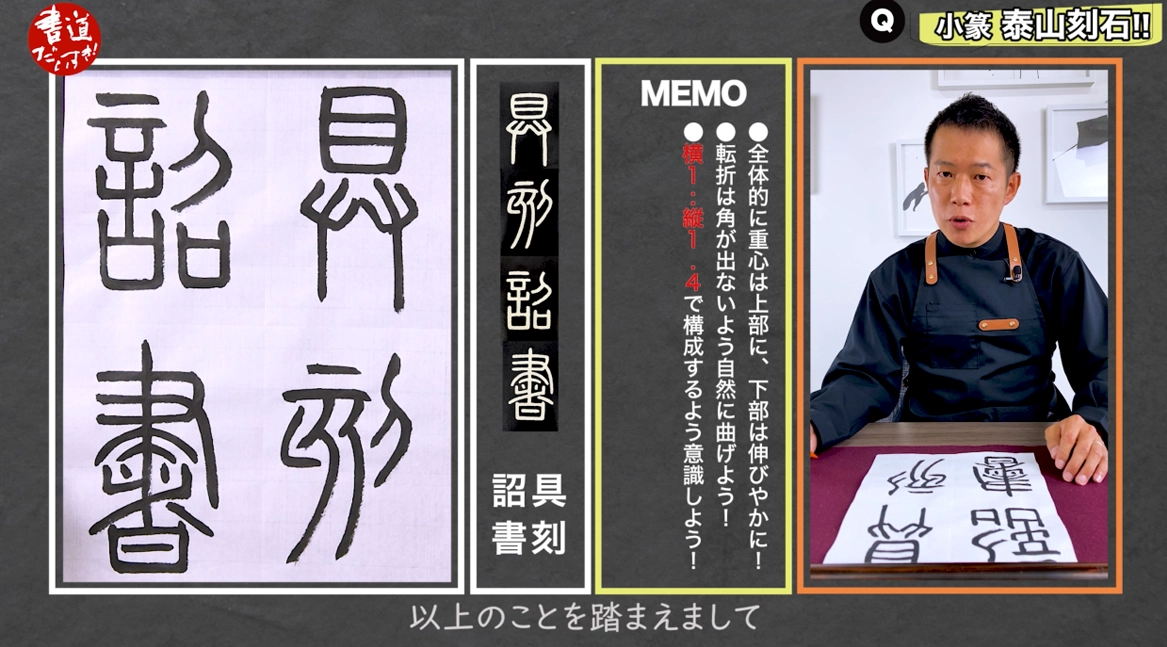
As characteristics of Xiaozhuan, he notes that the center of the character tends to be in the upper portion and the lower part extends vertically in an elegant, elongated form; that the lines have a natural shape like bent wire; and that the ratio of horizontal to vertical is a 1:1.4 “golden ratio,” among other points.
While practicing, the instructor feels firsthand the difficulty of achieving left-right symmetry and keeping line thickness consistent.
Finally, he introduces how Xiaozhuan is still used in modern Japan—such as for registered seals, contract seals, passports, and banknotes—and points out that Xiaozhuan exists in our everyday lives as well.
The video closes with a preview that next time will cover clerical script (Reisho), which further streamlined Xiaozhuan.
00:14:40
He explains the significance of studying Small Seal Script, noting how difficult it is to write uniform lines and how it is a script where you cannot “fake it.”
He also points out that even today in Japan, Xiaozhuan is used for registered seals and contract seals, and that while it has become less common in everyday life in China, it continues to be respected in Japan as a formal script.
He introduces that Xiaozhuan appears on passports and banknotes as well, meaning it exists in our daily lives.
The segment closes with a preview that next time will cover clerical script (Reisho), which further streamlined Xiaozhuan.
YouTube Shodo Daisuki Episode 66
Shimauchi 00:00
They unify all kinds of things, don’t they? Up to the point of establishing Small Seal Script—he’s a very “dark/deep” figure, and yet above all, it’s beautiful.
Hi, I’m Shimauchi from Shodo Daisuki.
Whether there’s demand or not, I’m honestly not sure—but it’s time for the Classical Copying series where we experience Chinese calligraphy history in chronological order, starting from the oldest.
Shimauchi 00:24
After Qin unified China, the very first thing they tackled was unifying the writing system.
This time, we bring you “Small Seal Script” and the “Mount Tai Inscription.”
As I mentioned last time, how were the different scripts of each state—each with its own style—unified?
And in the history of Chinese calligraphy,
Shimauchi 00:44
this is also the moment when, for the first time, a work with a clearly identified author was born.
Did you know that these Small Seal Script characters are actually quietly woven into our everyday lives as well?
Please stay with me until the end—thank you very much for your time.
Shimauchi 01:01
On this channel, not limited to calligraphy, we’ll keep introducing more and more things related to writing, so please subscribe and give it a like—thank you very much.
All right then—let’s go.
In 221 BCE, after bringing peace to an age of warfare that lasted some 550 years,
Shimauchi 01:24
the country that unified China was the state of Qin. At that time,
using the two characters “皇” and “帝,” titles associated with gods, they created the term “Emperor (皇帝),” and the first to call himself Emperor was Qin Shi Huang—the birth of the “First Emperor.”
This marks the beginning of imperial rule that continued for more than 2,000 years.
Shimauchi 01:46
By the way, in this era, Japan was still in the Jomon period.
The difference in civilization is truly astonishing.
Even after winning the war, unifying China did not happen automatically—so Qin Shi Huang used this opportunity to unify laws, currency, weights, roads, even the width of cart wheels, and more—
Shimauchi 02:08
all kinds of things, one after another.
Because these unification projects were carried out rapidly in a short period, it’s not hard to imagine that there were also extreme acts that can’t really be spoken of here.
Shimauchi 02:25
That may be part of the background for why Qin Shi Huang has come to be seen as frightening—scary, even.
This Qin Shi Huang placed especially great importance on unifying the writing system, simplifying the Large Seal Script style that Qin had been using—
Shimauchi 02:41
and established Small Seal Script (Xiaozhuan) as the nationwide standard script.
This “small” does not mean smaller in size; the previously used characters are called “Large Seal Script,” and “large/small” is used in the sense of old/new, so please keep that in mind.
Shimauchi 03:01
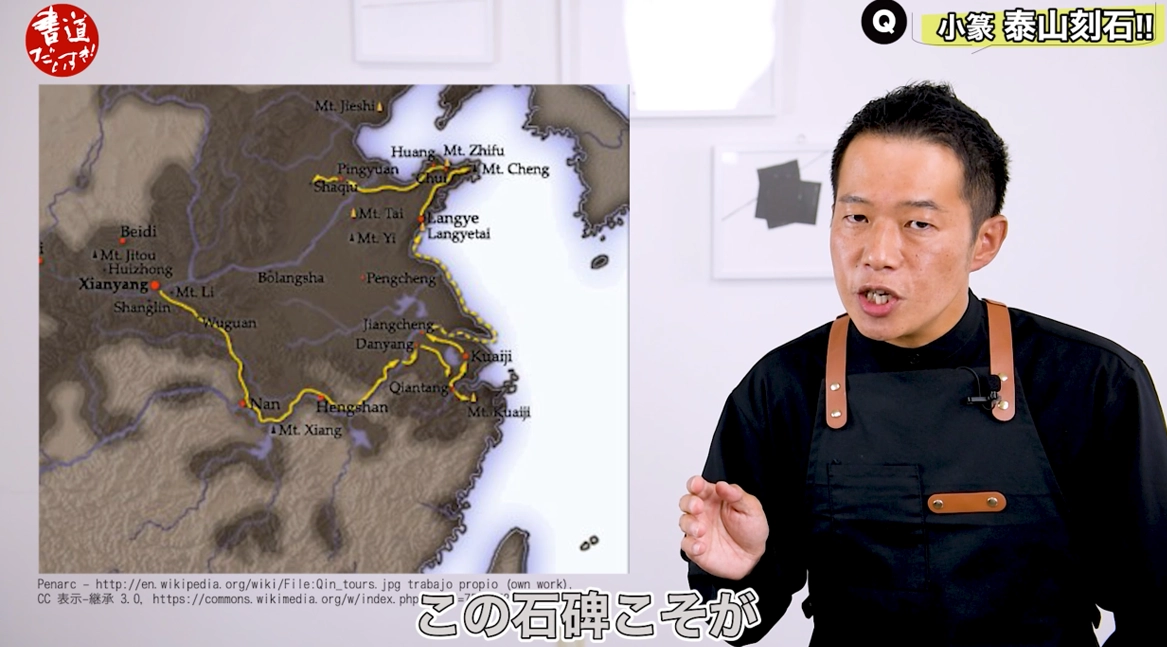
Now, with this “standard script” in hand, Qin Shi Huang began touring the country, and in the eastern regions—mountainous areas that were still unfamiliar—he erected stone steles written in this Small Seal Script to display authority and to spread the writing system, it is said.
Shimauchi 03:25
That stele is what connects to the Mount Tai Inscription we will copy today.
Mount Tai, located to the east of the capital Xianyang, was a famous mountain in that area.
The stele erected there is the Mount Tai Inscription.
The author is said to be Li Si—essentially the First Emperor’s right-hand man.
Shimauchi 03:50
He was so knowledgeable about law that he was called a “guardian of the law.”
But it’s amazing—this Mr. Li Si is the man who established Small Seal Script.
You could say that this title “Mount Tai Inscription” and the author name “Li Si” are the first matched pair in Chinese calligraphy history.
Shimauchi 04:13
That said, when you trace Li Si’s historical record, you find he was a very “dark/deep” figure.
This will be on the test—and I do know how his life ended—but I really can’t say it here,
Shimauchi 04:28
so I’ll cut it off completely.
If you’re really curious, please look it up yourself online or in books.
The original Mount Tai Inscription was written in 223 Xiaozhuan characters, but in the late Tang period,
Shimauchi 04:45
it collapsed.
When it was found in the Song period, it had 165 characters.
Then later, when it was excavated again in the Ming period, it was down to just 29 characters—and ultimately, only 10 characters remained on the rock.
Shimauchi 05:08
In a sense, it’s a perfect example of “there’s hardly anything left to see.”
That’s the fate the stele has fallen into.
If you look at a reconstruction diagram, it really does look like a half-finished jigsaw puzzle—its fragmented state is easy to understand.
Shimauchi 05:24
It is said that Li Si, the writer, sought to embody in this work the authority of the First Emperor, who wanted to claim divine power as his own.
Rather than “BAM!” with huge characters or “BAM!” with powerful strokes,
Shimauchi 05:41
he likely expressed that authority through the orderly, dignified beauty of these evenly drawn lines—this calm, structured script.
Now then, I will copy the Mount Tai Inscription: China’s first unified script, written by what can be called China’s first calligrapher.
Shimauchi 06:06
Alright, now I’d like to move on to the actual copying practice.
As usual, I tried writing four characters in advance.
So, which four did I write? First, the first character—this is “具” (tool/implement).
From an etymological standpoint, it relates to “鼎” (a bronze tripod vessel),
Shimauchi 06:23
the kind that appeared in the bronze age.
A three-legged vessel—an image of offering it up with both hands.
It’s quite interesting.
The second character is this one. This is “刻” (to carve/engrave).
Etymologically, it’s said to mean carving deeply.
Shimauchi 06:45
We’ve seen “鏨” (a chisel) before, too.
And if you look only at this part, it can be read as “亥,”
and since “亥” represents the shape of an animal, it can also carry the meaning of “carving an animal.”
Just thinking about it is kind of frightening, isn’t it?
Shimauchi 07:01
Next, the third character is “招.”
It’s written with the hand radical and “召” (as in “to summon/call”).
So it’s read as “招.”
This, apparently, means a divine oracle or proclamation.
It’s a rather mysterious character.
Shimauchi 07:20
The fourth character is “書” (to write).
The “sho” of Shodo Daisuki.
Structurally, it’s a very complex form.
There are layers of meanings combined in it, so it’s a bit difficult.
Shimauchi 07:34
To explain in detail, I mean. So speaking broadly, it of course means “to write” or “to record,” but then there’s more.
“Jukin!”—well, that’s a tough word.
It’s written as “a curse” and “to forbid,” and it’s said to mean sacred words offered up—holy characters.
Shimauchi 07:54
If it means repelling all kinds of harm, the power of characters is truly something.
And overall, it reads like “つぶさに招書を刻せば.”
As for the meaning: “招書” refers to writings issued by the emperor.
Shimauchi 08:13
“To carve” means to engrave into metal or stone, and “具” carries the meaning of “in detail / thoroughly,”
so it means “to carve in detail the writings issued by the emperor into stone.”
I think that perfectly expresses the meaning of the Mount Tai Inscription.
Now, continuing on—
Shimauchi 08:31
About the character forms: the center of the character is generally in the upper portion,
and the lower part extends vertically in an elegant, elongated way.
Also, this point—especially around the turning areas—how should I put it, it’s like bending wire.
In a natural way, it curves as it’s written.
Shimauchi 08:55
And finally, this may be the most important point:
A book said that if you compose the vertical as 1.4 against the horizontal, that becomes a “golden ratio.”
So this time, I prepared a frame with a 1.4 vertical ratio in advance, and
Shimauchi 09:17
I practiced so the characters would fit within it.
Now, did it actually work when I wrote it? I may still need more training,
but even just knowing it vs. not knowing it makes a big difference, so I hope it helps as a hint for everyone.
Shimauchi 09:31
Based on all that, I’d like to verify whether the characters I wrote capture those features.
First of all, on this first character—it’s obvious that the left-right symmetry here
wasn’t quite achieved.
Shimauchi 09:48
I struggled a lot.
I focused too much on symmetry and vertical length, so this part became a bit too elongated.
It might have needed to be a little flatter.
Next, with turning and changing direction without changing line thickness—
Shimauchi 10:09
turning the brush tip while keeping the thickness—those turns keep showing up, and it’s hard.
Here, the line completely changed, so that’s an issue.
And since the goal is to keep brush pressure consistent, you need to write with confident, direct strokes—
Shimauchi 10:27
especially on curves rather than straight lines.
On these curved parts, if you can’t maintain that direct stroke quality, it’s hard to keep the line consistent.
That’s another difficult point.
My biggest hurdle is: start with concealed tip (蔵鋒),
Shimauchi 10:46
and then write the line through the center with centered tip (中鋒).
Even now, looking at it, the concealed-tip start isn’t done well.
I want to be able to express those parts more cleanly, even just a little.
Shimauchi 11:02
And lastly, I also tried to keep the blank spaces equal,
but that connects directly to the overall form, so next time I want to write while being more conscious of it.
Like this—get the brush tip properly in,
Shimauchi 11:19
and write so it passes through the center.
If it’s a vertical stroke, like this—okay.
Write firmly—that’s probably the idea. I want to be mindful of it. Yes.
I focused and wrote one full sheet.
Personally, I feel I wrote it while reflecting on the points above, so—
Shimauchi 12:50
How should I say it…
That tension where you can’t relax even for a moment until the very end—
it’s very, well… “pleasant,” in a way.
I feel it becomes good study for myself.
So I just thought of something—
Shimauchi 13:05
I often hear teachers who do seal carving say: it’s not enough to only carve seals—
you have to properly study seal script, and you must practice writing it on hanshi.
Ah, I see—now I understand.
By actually writing seal script like this on hanshi,
Shimauchi 13:23
for the first time you can clearly see things like margins and the shape of the structure,
so studying Small Seal Script may connect to many other scripts—
that’s what I’m honestly feeling right now.
This Classical Copying series is finally reaching the end of the seal script section, but
Shimauchi 13:40
once again, what I felt after learning Small Seal Script is this:
Writing every single line uniformly—
when you glance at it, you immediately notice, “Ah, this line is a little weak,” or “Something’s off.”
Even if you’re only writing in kaisho, and a teacher tells you, “Improve your line quality,” or “Train your lines,” it might not fully click for some people, but—
Shimauchi 13:58
with Small Seal Script, you really can’t get away with faking it.
The moment you look, it’s obvious: “This line isn’t quite right,” or “There isn’t enough strength,”
it shows up very clearly.
So for those who previously found it unclear—“How do I train that quality?”—try learning Small Seal Script.
Shimauchi 14:12
You might be able to train your lines from a different angle.
And above all, this kind of structure—this kind of form—some people may think, “I like this, I want to write it,”
and realize, “Oh, there’s something like this.”
So yes, especially with seal script—Small Seal Script—there’s definitely value in copying it, but I experienced it too: it’s difficult.
But enjoying that difficulty may be part of what makes calligraphy so good.
That’s all. How was it?
Shimauchi 15:12
Small Seal Script, recognized as a formal script in this way—
with “tensho = Small Seal Script,” you probably see it often even in Japan today.
Most corporate registered seals and personal registered seals used in formal contracts are carved in Small Seal Script.
In China today, seals themselves aren’t used as much in everyday life, and yet—
Shimauchi 15:33
that Japan continues to respect and use Small Seal Script as a formal script—
isn’t that a fascinating point?
Even in passport characters, and even inside the banknotes we use every day, Small Seal Script is actually used.
Shimauchi 15:51
Why not use this as an opportunity to rediscover the appeal of Small Seal Script?
Now then—next, this “standard script” becomes even more streamlined and transforms into Clerical Script (Reisho).
Please look forward to the next episode of the Classical Copying series as well!
Shimauchi 16:07
That’s it for Shodo Daisuki Shimauchi—see you again next Friday! Goodbye!
About Related Products
We introduce the products featured in this video.
Books / book&publication
Whether you are a beginner who wants to start calligraphy or an intermediate/advanced learner, the knowledge you can gain from books is essential.
You can study beyond your teacher’s model examples, making them ideal for at-home practice and self-study.
Learning calligraphy knowledge should also help broaden your perspective and experience.