

Shodo Daisuki Episode 68
Shodo Daisuki Episode 68
“The Origin of Clerical Script!! Wooden Slips: Shogakusho!! Classical Copying Series vol.8”【Calligraphy】
Shodo Daisuki – Episode 068
No sooner had Qin unified China than the era shifted to the Han—right at the moment when the formerly unified script, “Small Seal Script,” was streamlined and transformed into Clerical Script!!
This is definitely a point you’ll want to check!!
We take a closer look at the appeal of wooden slips, which allow you to copy and experience the handwriting of that time!!
Shodo Daisuki Episode 68: Video Overview
This is a lecture from Shimauchi’s “Classical Copying Series” on the history of Chinese calligraphy.
This time, he focuses on the “wooden-slip Shogakusho” (early Han wooden slips), regarded as the origin of Clerical Script.
The lecture begins by emphasizing the importance of the early Han period, which is often considered the beginning of calligraphy as an art form.
After Qin collapsed in a short period of time and the era shifted to the Han dynasty, the development of script styles began in earnest.
Shimauchi stresses that this era marks “the beginning of calligraphy as an art,” and that the early Han period was the first step forward.
In 202 BCE, when Liu Bang overthrew Qin and the Han dynasty was established, before paper became widespread, silk and wood were mainly used as writing materials.
Because silk was expensive, wood and bamboo were more common. Wooden slips served a role similar to a modern memo pad, and a major advantage was that you could scrape them and rewrite.
He explains that the stationery set of the time consisted of four items: a brush, ink, an inkstone, and a small knife for scraping.
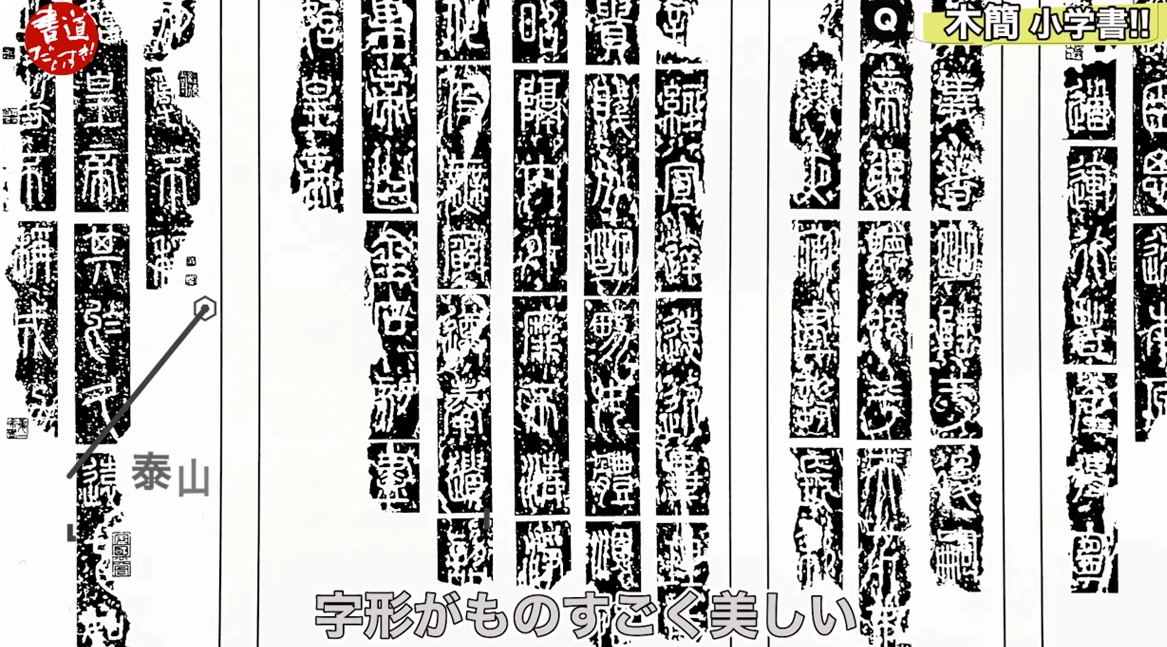
Because there are almost no surviving inscriptional sources from the Former Han—such as steles or bronze inscriptions—wooden slips and silk manuscripts excavated in the 1900s have become the only precious materials through which we can learn about that era.
Shimauchi says that copying wooden slips is a valuable experience that allows you to reproduce real “handwritten” brushwork.
Regarding the birth of Clerical Script, he explains that Qin’s unified Small Seal Script was beautiful but took too long to write and was inconvenient, so people shifted to simpler, more linear brush methods and simplified the writing by connecting strokes continuously.
Early Clerical Script is called “Korei” (ancient clerical), and from there it was refined into the more decorative “Happun-rei” (Eight-division clerical).
The wooden slips Shimauchi copies this time are “ancient clerical script,” positioned in between those stages.
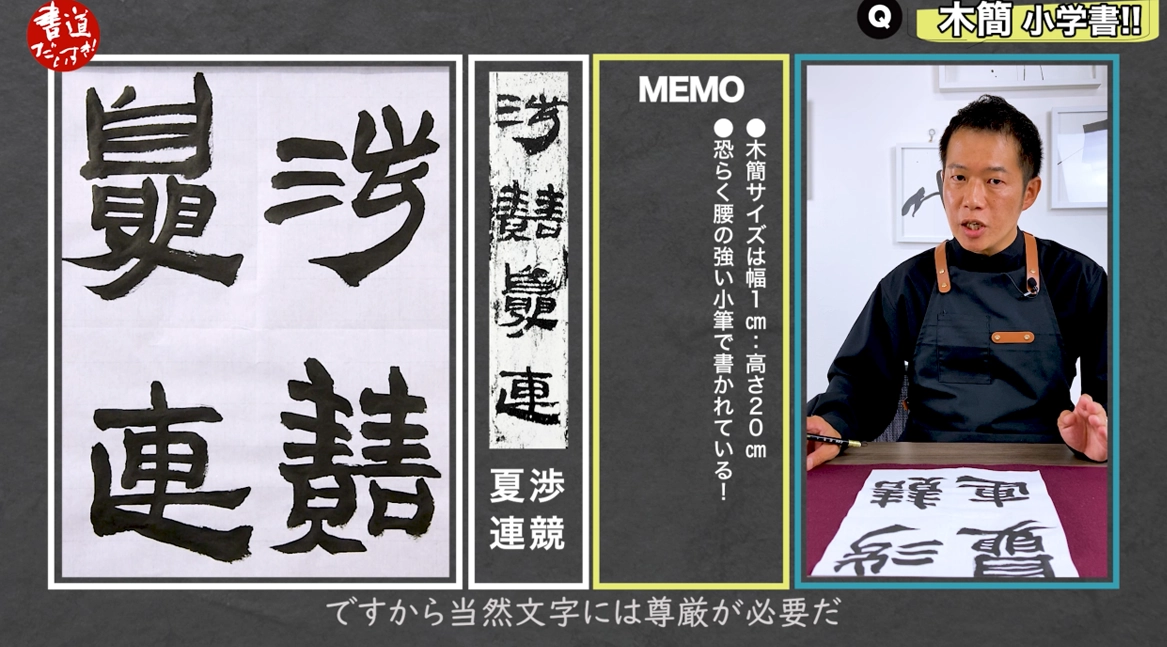
In the actual copying practice, he notes that small characters are written on thin wooden slips—about 1 cm wide, just over 20 cm long, and 0.2–0.3 mm thick—suggesting that brushes with strong resilience and sharp tips were used.
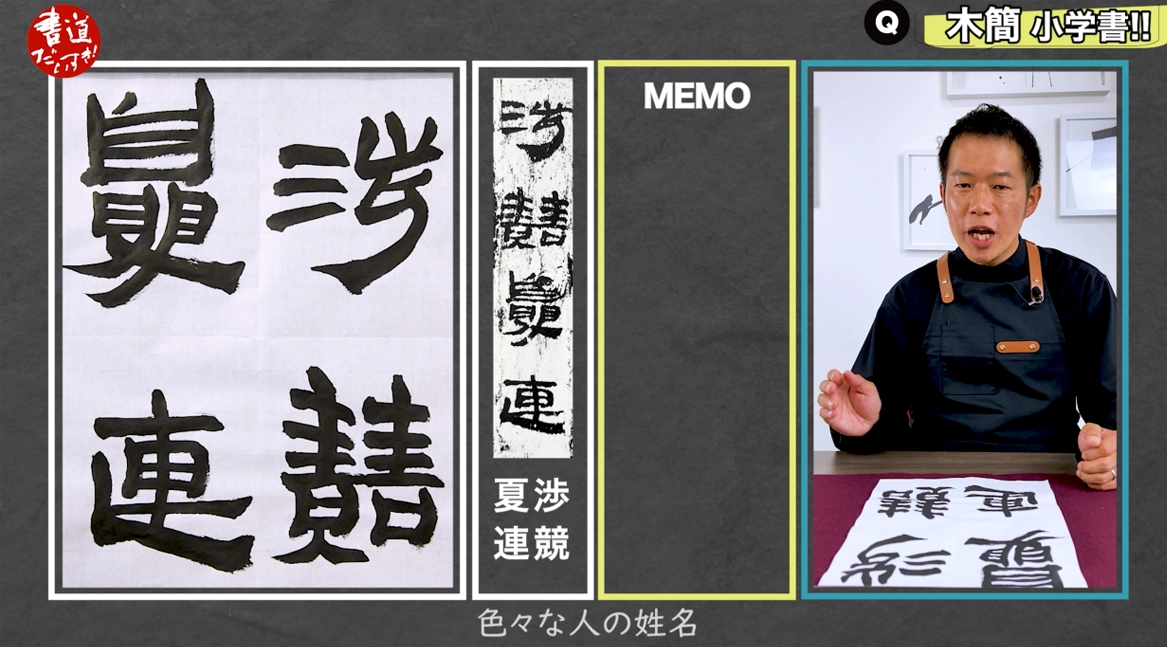
He copies four characters—“渉,” “競,” “夏,” and “連”—and points out that they retain an atmosphere of seal script while also showing features of clerical script.
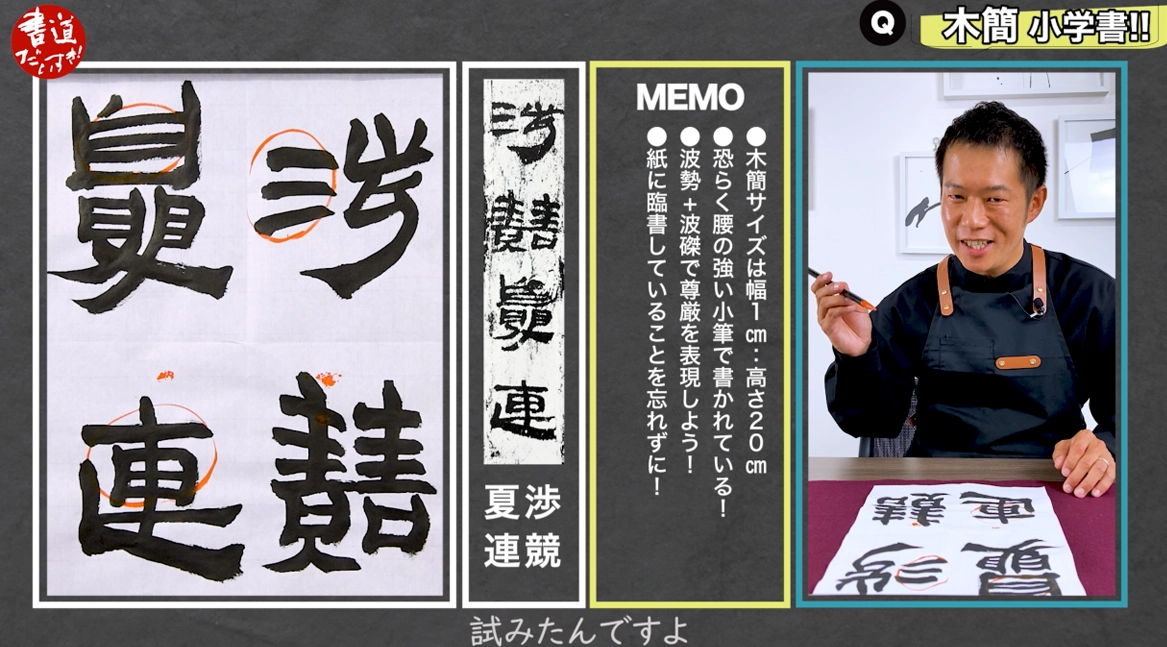
As distinctive clerical techniques, he explains “hasei” and “hataku.”
He demonstrates a technique in which, at a large turning corner, you roll in the brush tip, push it out, write in a wave-like motion, and finally send the brush out at the end.
He also touches on how difficult it is to express the natural wavering of lines that arises from brush resistance caused by the wooden-slip material.
Shimauchi emphasizes the value of copying through Chinese calligraphy history in chronological order, saying that knowing the background and techniques will influence future copying practice.
He closes by previewing that from next time the series will enter the era of Later Han “Happun-rei,” where famous steles appear, and he looks forward to seeing how people’s sense of beauty emerges as script forms.
YouTube Shodo Daisuki Episode 68
しまうち 00:00
The beginning of calligraphy as an art.
It really is a huge advantage, isn’t it?
As it becomes refined, it finishes with a wave-like motion—
Hi, this is Shodo Daisuki Shimauchi.
Welcome to the Classical Copying Series, where we experience Chinese calligraphy history in a real, hands-on way.
This time, we bring you “Wooden Slips: Shogakusho,” the origin of Clerical Script.
しまうち 00:25
The Qin dynasty that unified China unexpectedly fell after only 15 short years, and the era shifts to the Han dynasty.
And don’t underestimate wooden slips just because they seem like a minor topic—
After Qin’s standardization of writing, the Han era begins to develop techniques based on a stabilized script style.
しまうち 00:49
This timing is extremely important: the beginning of calligraphy as an art.
You could say that the early Han period was the first step forward.
This series isn’t popular with everyone—one look at the numbers makes that obvious.
I know. I get it.
しまうち 01:06
But I’m going to press on.
I’ll put links to the past videos in this Classical Copying Series in the description, so let’s study Chinese calligraphy history together.
As always, we’ll keep it simple and easy to understand, so—
しまうち 01:24
Please enjoy it all the way to the end.
On this channel, we introduce more and more things related to writing—not just calligraphy—so please subscribe and leave a like.
Now then, let’s get into the main part!
しまうち 01:42
First, about wooden slips: in 202 BCE, Xiang Yu and Liu Bang overthrew Qin and the Han dynasty was established.
In this era before paper became widespread, materials mainly used were silk and wood.
However, silk was extremely expensive, so—
しまうち 02:05
wood and bamboo are said to have been the main materials used.
It may have functioned like a modern memo pad.
The culture of writing on wood had existed since ancient times, and besides being easy to obtain, the fact that you could scrape it and rewrite was truly a huge advantage.
しまうち 02:20
So the stationery set of the time is said to have consisted of four items: a brush, ink, an inkstone, and a small knife for scraping.
So why wooden slips at this point in history?
しまうち 02:37
You might wonder that, but in the Former Han period, there are hardly any surviving written sources such as steles or bronze inscriptions.
Wooden slips and silk manuscripts excavated in the 1900s are the only materials through which we can learn about that era.
しまうち 02:57
In the world of calligraphy, when people say “wooden slips,” they often mean the wooden slips of this era—perhaps because of this background.
Many of the models used for classical copying today are characters carved into stone steles, right?
While some gap from true handwritten brushwork is unavoidable, copying wooden slips is, in my view, a precious experience that can reproduce that handwritten quality.
So then, how did Clerical Script come to be born?
The unified Small Seal Script established by Qin’s First Emperor—
しまうち 03:36
We clearly see it is extremely beautiful, but it took an incredibly long time to write, and honestly it was inconvenient.
I copied it in the previous episode, right?
It took a lot of time and a lot of concentration.
しまうち 03:54
And above all, it was really exhausting.
If you had to write a lot of characters like that, it’s honestly terrifying.
So people of the time changed the brush methods to something simpler and more linear than seal script, and they connected strokes continuously to simplify the form further.
しまうち 04:13
That is the moment a new script—Clerical Script—was born.
The character forms from the birth stage of Clerical Script are called “Korei” (ancient clerical).
From there it was refined, and what we’re familiar with—decorative, elegant “Happun-rei” with wave-like hataku—came to be called Clerical Script.
What I will copy this time is a wooden slip in an “ancient clerical” form that lies between those stages.
しまうち 04:36
This time, I want to fully experience that evolutionary process.
Alright, let’s move on to the actual copying practice.
The Shogakusho I’m copying this time is said to be a transcription of a handwriting practice text from the mid Former Han period, and it is said to contain various people’s two-character names.
しまうち 05:01
The silk manuscript found together with it—the Mawangdui silk text—is famous, but compared to that, this Shogakusho shows further progression toward clericalization, which is one of its features.
“Hasei” and “hataku” are also becoming more mature here, so it is said to indicate the early stage of Han clerical script.
What kind of wooden slip is it? It’s about 1 cm wide, and a little over 20 cm long, I’d say.
And the thickness is incredibly thin—about 0.2 to 0.3 mm.
しまうち 05:38
The fact that many small characters are written on it suggests—this is just my inference—that the brush used must have been very resilient and made with a sharply pointed tip.
And as usual, I tried writing four characters in advance on one sheet.
しまうち 05:59
The first character is “渉,” written with the water radical and “to walk.”
The second is “競,” as in “to compete.”
The third is “夏,” as in spring, summer, autumn, winter—summer.
And the fourth is “連,” as in “continuous/connected.”
When you look at them like this overall,
しまうち 06:22
you can definitely feel that an atmosphere of seal script remains in some way.
And at the same time, you can also feel that a clerical-script atmosphere is starting to appear.
The Han people, too, regarded characters as sacred and special, you know.
しまうち 06:39
So naturally, characters had to have dignity.
First you roll in the brush—yes, you roll it in—then push it out.
Then you write in a wave-like motion, and finally you send the brush out at the end.
Let’s do that again.
しまうち 07:00
At a large corner, roll in the tip, push it out, and then push it out at the end like a wave—that’s the idea.
This is what’s called “hasei,” but there were probably various ways to do it.
Roll in, then push out.
しまうち 07:22
And sometimes you sweep it like this, and other times you might send it out this way instead, right?
I used the term “hasei,” and this overall movement is also called hasei, but—
しまうち 07:38
this part here is called “hasei,” and the very last part here is called “hataku.”
Everyone, please remember this.
These are hasei and hataku.
Because this is written on wooden slips, the wood grain creates resistance, right?
So when you look at the original, the lines wobble in various places.
しまうち 07:55
For example, they wobble here, and they wobble here too—
and in places like this as well.
Trying to express that on paper was extremely difficult.
Even now, I don’t think I actually achieved it.
So when I do a final clean copy next time, since we’re writing on paper this time, I want to focus more on line quality.
しまうち 08:25
Next, I thought it would be good if the brush tip responded firmly, so I tried using a slightly shorter brush, or using a thin, long goat-hair brush—but then I ended up getting thicker lines than I expected.
For example, in parts like this, and this, and this.
If you try to express it with that kind of brush, what happens is—
しまうち 08:45
you end up having to lay the brush down like this and struggle with how to make it work—so I gave up on using short brushes.
Instead, for this time I decided on a “kengo” brush with a good amount of hair volume, and I’m going to strictly follow my usual brush method form, and try writing using only the up-and-down motion of the brush.
Just the up-and-down motion—only up and down—to produce thicker lines.
I’ll do my best to properly express hasei and hataku too, since they appear in places like this.
しまうち 09:39
Okay, I wrote it.
The atmosphere is completely different from the first sheet I wrote earlier, but what do you think?
When you look at the wooden slip at a glance, just as I said earlier, you really 고민 about those wavering lines—how should you change them, how should you handle them?
And since this is “paper,” I started to feel that maybe it’s okay to prioritize line quality.
So if anyone is struggling with wooden-slip copying, maybe it’s fine to take a bold approach—not exactly an “arrangement,” but more like: “Let the line do the talking.”
I’m interpreting it that way on my own.
It’s a truly interesting subject, and whether you know it and try it or not will likely affect your future copying practice in various ways—so everyone, everything is a challenge! Please take on the wooden-slip challenge too.
That’s all.
しまうち 11:46
How was it? Being able to experience how characters transform over time is one of the real pleasures of copying through Chinese calligraphy history in chronological order, isn’t it?
Even in the world of YouTube—are there any other calligraphy channels besides Shodo Daisuki that teach classical copying like this?
I understand the argument that knowing the background and techniques doesn’t automatically make your writing better.
But I believe that whether you’ve experienced copying seal script or early Han clerical script like this will have some influence when you copy later-stage clerical script.
Now then, from next time we finally enter the Later Han “Happun-rei” clerical script era, where many famous steles appear.
Aesthetic sense born from people using the same characters—how will that aesthetic sense take on individuality and appear as script forms?
Just thinking about it makes me excited already. Please look forward to what comes next!
This was Shodo Daisuki Shimauchi.
It’s getting hot, everyone. It’s fine to get fired up about calligraphy, but please be careful of heatstroke outdoors.
See you again next week. Goodbye! I’ll keep going strong too. Bye!
About Related Products
We introduce the products featured in this video.
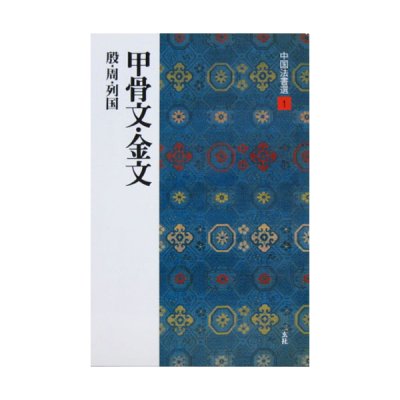
Books / book&publication
Whether you are a beginner who wants to start calligraphy or an intermediate/advanced learner, the knowledge you can gain from books is essential.
You can study beyond your teacher’s model examples, making them ideal for at-home practice and self-study.
Learning calligraphy knowledge should also help broaden your perspective and experience.